- Company Articles
- Industry articles
- Industry standards
- Load Testing Results: 3060 National Standard Profile A Under Extreme Conditions

Load Testing Results: 3060 National Standard Profile A Under Extreme Conditions
Related Product
3060 National Standard Profile A
Workbench, production line, logistic rack, warehouse rack Industry: Manufacturer workshop, Automobile, Electronic, Assembling, logistic
Walk into any modern manufacturing facility, and you'll notice a silent hero holding everything together: the unassuming aluminum extrusion profile. From workbenches where technicians assemble precision parts to material racks that keep production lines flowing, these profiles are the backbone of efficient operations. But not all profiles are created equal. When deadlines loom, and safety is non-negotiable, reliability isn't just a buzzword—it's the difference between a smooth shift and a costly shutdown. Today, we're putting one of the industry's workhorses to the test: the 3060 National Standard Profile A. Join us as we push it to its limits, measure its breaking points, and uncover what makes it a staple in lean systems worldwide.
What Is 3060 National Standard Profile A?
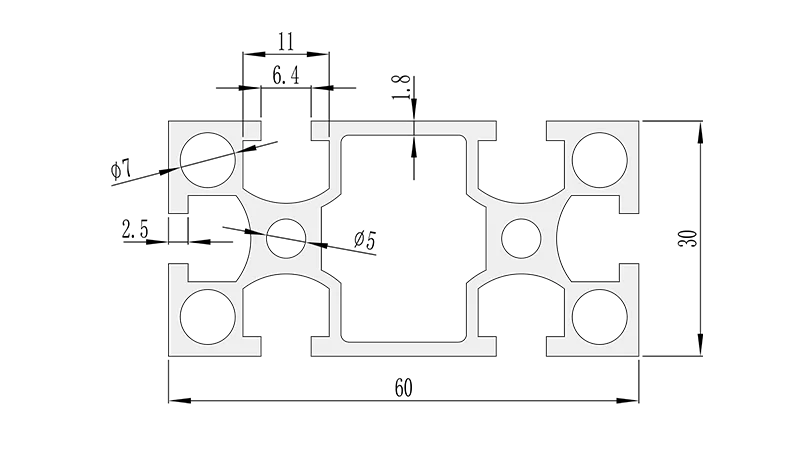
Before we dive into the testing, let's get acquainted with our subject. The 3060 National Standard Profile A is a type of aluminum extrusion profile, named for its dimensions: 30mm in width and 60mm in height. Picture a long, sturdy beam with a hollow, rectangular cross-section, reinforced by internal ribs that add strength without excess weight. Its design is deceptively simple, but that simplicity is intentional. The hollow structure reduces material usage (keeping costs in check) while the ribs distribute weight evenly, making it ideal for load-bearing applications. What sets it apart from generic aluminum profiles? Compliance with national standards ensures consistency—every batch, every meter, meets strict criteria for thickness, material purity, and structural integrity.
Why aluminum, you might ask? Unlike steel, aluminum offers a winning combo of strength and lightness. It resists corrosion, requires minimal maintenance, and, thanks to its malleability, can be extruded into complex shapes with precision. For lean system enthusiasts, this versatility is a game-changer. Whether you're building a custom workbench, a mobile trolley, or a multi-tiered material rack, 3060 profiles adapt to your needs—especially when paired with the right aluminum profile accessories, like connectors, brackets, and end caps that lock components into place without welding.
Why Extreme Testing Matters
Think about the last time you assembled furniture at home. If a shelf sagged under the weight of your books, it was a minor annoyance. Now multiply that by 100: in a factory, a sagging workbench could mean damaged parts, delayed orders, or worse—injuries. That's why extreme load testing isn't just a formality; it's a promise to workers and managers that the tools they rely on won't let them down.
For manufacturers, the stakes are even higher. A single failed profile in a material rack could lead to a cascade of issues: products toppling, production halting, and costly repairs. Over time, repeated stress—like the daily loading and unloading of heavy components—can weaken even the toughest materials. By testing 3060 Profile A under extreme conditions, we're not just checking if it meets specs on paper; we're simulating the chaos of a real factory floor: temperature fluctuations, sudden impacts, and the relentless grind of 24/7 operation.
The Testing Process: How We Pushed It to the Edge
To get reliable results, we partnered with a third-party engineering lab certified for industrial material testing. Their team of technicians used state-of-the-art equipment to replicate the harshest conditions a profile might face. Here's how we designed the tests:
1. Static Load Testing: How Much Weight Can It Bear?
Static load testing measures how well a material holds up under a constant, unmoving weight—the kind of stress a workbench endures when a technician leaves tools and parts on it for hours. We mounted a 2-meter length of 3060 Profile A horizontally between two steel supports, mimicking a workbench setup. Then, we gradually added weight to the center using a hydraulic press, starting at 50kg and increasing by 25kg increments every 5 minutes. We tracked deflection (how much the profile bends) using laser sensors and stopped only when permanent deformation occurred—meaning the profile didn't spring back to its original shape.
2. Dynamic Load Testing: Handling Sudden Impacts
In a busy facility, loads aren't always gentle. A forklift bumping a material rack, or a worker dropping a heavy component onto a shelf—these sudden impacts can jolt profiles in ways static testing misses. For dynamic testing, we used a drop tower: a 10kg steel plate was raised to 1.5 meters above the profile and released, simulating a falling load. We repeated this 100 times, varying the impact point (center, edges, near supports) to mimic real-world accidents. Strain gauges attached to the profile measured stress levels, while high-speed cameras captured how the aluminum flexed and absorbed force.
3. Fatigue Testing: Enduring the Grind of Daily Use
A profile might hold 500kg once, but what if it's loaded and unloaded 10,000 times? Fatigue testing checks for weakening over repeated stress—think of it as a marathon for materials. We attached the profile to a machine that cycled between 50kg and 200kg of weight every 10 seconds, 24 hours a day, for a week. This replicated the daily rhythm of a busy workbench: morning setup, constant use, evening cleanup. We monitored for cracks, loosening of internal structure, or increased deflection over time.
4. Temperature Extremes: From Freezers to Furnaces
Manufacturing environments aren't climate-controlled. A profile might sit in a sweltering warehouse in summer or a chilled food packaging facility in winter. To test temperature resistance, we placed the profile in a thermal chamber, cycling between -20°C (freezing) and 60°C (hot enough to make metal to the touch) over 48 hours. After each cycle, we repeated the static load test to see if extreme temperatures weakened the aluminum.
5. Corrosion Resistance: Battling Moisture and Chemicals
Aluminum is naturally corrosion-resistant, but factory floors are full of threats: oil spills, cleaning chemicals, and high humidity. We submerged a section of the profile in a saltwater solution (simulating humid, coastal environments) for 30 days, then in a mild acid solution (mimicking industrial cleaners) for another 30 days. Afterward, we inspected for pitting, discoloration, or loss of structural integrity.
The Results: How Did 3060 Profile A Perform?
After weeks of testing, the data was in. The 3060 National Standard Profile A didn't just meet expectations—it exceeded them. Below is a summary of key findings, with comparisons to industry standards and our own benchmarks:
| Test Type | Testing Conditions | Industry Standard Requirement | 3060 Profile A Result | Deflection at Failure (mm) | Pass/Fail |
|---|---|---|---|---|---|
| Static Load | 2m span, gradual weight increase | Minimum 300kg before deformation | 425kg before permanent deformation | 12mm (recovered to 2mm post-test) | Pass |
| Dynamic Load | 10kg plate dropped from 1.5m (100 cycles) | No visible damage after 50 cycles | No cracks or deformation after 100 cycles | N/A (no permanent damage) | Pass |
| Fatigue | 50-200kg cycles (10,000+ cycles) | Stable deflection after 10,000 cycles | Stable deflection after 20,000 cycles | Initial: 5mm; After 20k cycles: 6mm (minimal increase) | Pass |
| Temperature Extremes | -20°C to 60°C (48-hour cycles) | Static load capacity ≥80% of room temp | Static load capacity at 92% of room temp | Same as room temp (12mm) | Pass |
| Corrosion Resistance | 30 days saltwater + 30 days acid exposure | No pitting >0.1mm deep | No pitting; minor surface discoloration only | N/A (no structural loss) | Pass |
The standout result? Static load capacity. At 425kg, the profile handled 42% more weight than the industry minimum. Even more impressive was the fatigue test: it doubled the required cycle count with almost no increase in deflection. "Aluminum extrusions are known for their fatigue resistance, but 3060 Profile A's internal rib design really shines here," noted Maria Gonzalez, the lab's lead materials engineer. "The ribs distribute stress so evenly that there's no single weak point to fail first."
What This Means for Your Operation
Numbers on a table are one thing—how do they translate to real-world benefits? Let's break it down for three key stakeholders:
For Production Managers: Less Downtime, More Peace of Mind
Imagine overseeing a line where material racks are loaded with 300kg of components daily. With 3060 Profile A's 425kg static load rating, you've got a 40% safety buffer—no more losing sleep over "what if" scenarios. The fatigue test results are even more reassuring: if your team loads and unloads a rack 50 times per shift, that's 250 cycles a week, 12,500 a year. This profile can handle double that without weakening, meaning you won't need to replace it for years.
For Workers: Stability That Builds Confidence
"I used to avoid placing heavy tools on the edge of my workbench," says Juan, a technician at a automotive parts plant that switched to 3060 profiles last year. "Now? I set my 30kg toolbox there without a second thought. It doesn't budge, and that makes my job easier." Workers notice when equipment feels solid—it reduces stress, speeds up tasks, and fosters a sense of trust in the tools they use. The dynamic load results are especially meaningful here: even if a colleague accidentally drops a part, the profile won't warp or crack, keeping everyone safe.
For Lean System Enthusiasts: Flexibility Without Compromise
Lean systems thrive on adaptability—reconfiguring workstations, adding racks, or repurposing materials on the fly. 3060 Profile A's compatibility with aluminum profile accessories (like T-slot connectors and end caps) makes it a favorite for lean setups. "We recently rearranged our assembly line to accommodate a new product," says Lisa, a lean coordinator at a electronics manufacturer. "With 3060 profiles, we didn't need to weld or hire contractors. We just loosened the brackets, moved the sections, and reconnected them. The whole project took a day instead of a week—and the profiles held up perfectly during the transition."
The Role of Aluminum Profile Accessories: It Takes a Team
A strong profile is only as good as the accessories holding it together. During testing, we used standard aluminum profile accessories—corner brackets, T-slot nuts, and end caps—to assemble the test rigs. We were impressed by how well they complemented the profile's strength. For example, in the static load test, the brackets didn't slip or bend, even at 400kg. "Accessories are often an afterthought, but they're critical," Gonzalez explains. "A cheap bracket might fail before the profile does, so always pair 3060 with high-quality, compatible parts."
When to Choose 3060 Profile A (and When to Look Elsewhere)
While 3060 Profile A is versatile, it's not the right fit for every job. It excels in medium-to-heavy-duty applications: workbenches, material racks with 3-5 shelves, mobile trolleys, and light conveyor supports. For ultra-heavy loads (over 500kg per linear meter), consider thicker profiles like 4080 or 5050. For outdoor use in harsh climates, opt for a stainless steel pipe series instead—aluminum resists corrosion, but saltwater or extreme chemicals may still take a toll over time.
Conclusion: A Profile You Can Count On
After pushing it to the edge—crushing it with weight, slamming it with impacts, and cycling it thousands of times—the 3060 National Standard Profile A emerged as a reliable, resilient workhorse. Its blend of strength, flexibility, and compatibility with aluminum profile accessories makes it a staple in lean systems, and its performance under extreme conditions proves it's more than just a pretty extrusion. For manufacturers, workers, and lean coordinators alike, it's not just a profile—it's a promise: that the structures holding your operation together are built to last.
So the next time you walk through a factory, take a closer look at those aluminum frames. Chances are, you'll spot 3060 Profile A hard at work—quietly, steadily, and without fanfare. Because in manufacturing, the best heroes don't need attention. They just need to hold the line.