- Company Articles
- Industry articles
- Industry standards
- Long-Term Cost Comparison: 3060 National Standard Profile A vs. Disposable Framing Materials

Long-Term Cost Comparison: 3060 National Standard Profile A vs. Disposable Framing Materials
Related Product
3060 National Standard Profile A
Workbench, production line, logistic rack, warehouse rack Industry: Manufacturer workshop, Automobile, Electronic, Assembling, logistic
When small manufacturers, workshop owners, or even DIY enthusiasts set out to build a production line, workbench, or material rack, there's a common crossroads: the choice between "cheap now" and "smart later." It's easy to get drawn in by the allure of disposable framing materials—plywood sheets, flimsy plastic pipes, or low-grade steel that costs next to nothing upfront. But here's the thing no one talks about enough: those "savings" today often turn into hidden costs tomorrow. Repairs, replacements, wasted labor, and lost efficiency add up, quietly eating into your bottom line year after year.
On the other side of the spectrum sits something like the 3060 National Standard Profile A—an aluminum extrusion profile designed for durability, adaptability, and long-haul performance. It's not the cheapest option when you first open your wallet, but for businesses that plan to stick around, its value unfolds over time. In this article, we're diving deep into the long-term cost battle: Is skimping on framing materials really a good idea, or does investing in quality pay off in ways that go far beyond the initial price tag?
First, Let's Get to Know the Contenders
3060 National Standard Profile A: The "Built to Last" Contender
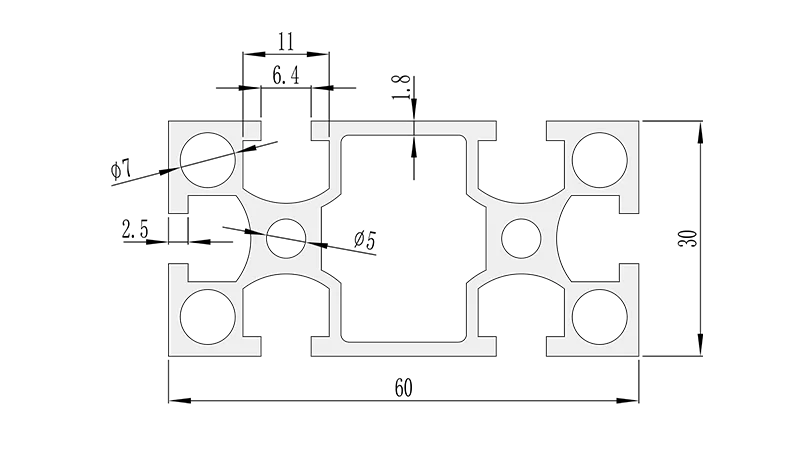
If you've ever walked through a well-organized factory or a modern workshop, you've probably seen aluminum extrusion profiles in action—sleek, silver structures holding up workbenches, guiding conveyor belts, or forming the backbone of material racks. The 3060 National Standard Profile A is one of these workhorses. Part of a standardized series of aluminum extrusions, it's named for its dimensions: roughly 30mm in width and 60mm in height, though exact specs follow national manufacturing standards to ensure consistency.
What makes it stand out? Aluminum, by nature, is lightweight but surprisingly strong—think of how airplanes are built with aluminum alloys. This profile takes that a step further: it's corrosion-resistant (no rust, even in humid workshops), easy to clean, and designed to be modular. That modularity is key. Unlike a solid wooden frame or a welded steel structure, the 3060 profile works with aluminum profile accessories —connectors, brackets, end caps, and even adjustable feet—to let you build, take apart, and rebuild structures as your needs change. Need a taller workbench? Swap out a few brackets. Want to add a shelf to your material rack? Just slide in a new crossbar. It's like building with high-tech Legos, but for grown-ups running businesses.
Common uses? You'll find it in everything from assembly line workbenches to automated conveyor systems, from storage racks to custom machine guards. It's the kind of material that doesn't just "do a job"—it grows with your business.
Disposable Framing Materials: The "Quick Fix" Option
Now, let's talk about the other side: disposable framing materials. These are the "here today, gone tomorrow" options. Think plywood sheets nailed together for a temporary workbench, cardboard tubes used as supports, low-grade steel pipes that start rusting after a rainstorm, or plastic pipes that crack under heavy loads. They're called "disposable" not because you throw them away immediately, but because they're designed (or at least treated) as short-term solutions. They're the go-to when budgets are extremely tight, or when a setup is only needed for a few months—like a pop-up workshop for a seasonal product or a one-time event.
Their appeal is obvious: upfront cost. A sheet of plywood might cost $20; a bundle of plastic pipes, $50. Compare that to a single 3060 profile section, which could run $30–$50 (depending on length) before even adding accessories. For a small business scraping by, that difference feels massive. But here's the catch: "disposable" often means "disposable sooner than you think." Plywood warps when it gets wet, cardboard collapses under weight, cheap steel rusts through, and plastic degrades under UV light or heavy use. They're not built to be taken apart and reused, either—if you need to reconfigure your setup, you're often tearing it down and starting over with new materials.
The Long-Term Cost Showdown: Beyond the First Invoice
Let's cut to the chase: which is cheaper over 5, 10, or even 20 years? To answer that, we need to look beyond the initial price tag. Let's break it down into real-world costs that business owners actually care about.
| Cost Factor | 3060 National Standard Profile A | Disposable Framing Materials |
|---|---|---|
| Upfront Cost | Higher: $500–$1,000 for a basic workbench (profile + accessories) | Lower: $100–$300 for a plywood/plastic pipe workbench |
| Replacement Frequency | Every 15–20 years (or longer with proper care) | Every 1–3 years (sooner in harsh environments) |
| Maintenance Costs | Minimal: Occasional tightening of accessories, cleaning ($50–$100/year) | High: Repairs, repainting, replacing warped/broken parts ($200–$500/year) |
| Labor for Repairs/Reconfiguring | Low: 1–2 hours to reconfigure with accessories | High: 4–8 hours to rebuild/repair (plus cost of new materials) |
| Total Cost Over 10 Years* | ~$1,500–$2,000 (initial + maintenance) | ~$3,000–$5,000 (initial + 3–5 replacements + repairs) |
*Estimates based on a small workshop with one workbench and one material rack. Costs vary by size and environment.
1. Upfront Cost: The Temptation of "Cheap Now"
Let's start with the obvious: disposable materials win the upfront cost battle. A plywood workbench might cost $200 to build, while a 3060 profile workbench with adjustable leveling feet (to keep it stable on uneven floors) and a solid top could run $600. For a cash-strapped startup, that $400 difference feels like a lot. It's easy to think, "Why spend more now when I can get by with this cheaper option?" But here's the problem: "getting by" often turns into "constantly fixing."
2. Replacement: The Hidden "Repeating Tax"
Disposable materials aren't built to last. Let's say you build a plywood workbench. The first year, it's fine. But by year two, the plywood starts warping from spilled coolant or humidity. The nails loosen, the surface gets chipped, and it starts wobbling. By year three, it's unsafe to use—you have to replace it. That's another $200. Now, multiply that over 10 years: if you replace it every 3 years, that's 3–4 replacements, totaling $600–$800. Suddenly, the "cheap" option isn't so cheap.
The 3060 profile? It's a different story. Aluminum doesn't warp, rust, or degrade. The only wear you might see is on moving parts like casters or roller tracks, and even those are replaceable with cheap accessories. A well-maintained 3060 structure can last 15–20 years. Some factories still use aluminum extrusion profiles installed in the 1990s. That's a one-time investment, not a repeating tax.
3. Maintenance: Time = Money (and Disposable Materials Waste Both)
Disposable materials need babysitting. A steel pipe rack starts rusting? You'll spend weekends sanding and repainting it. A plastic pipe support cracks? You're running to the hardware store to buy a new one. Every hour you spend fixing a wobbly workbench or replacing a broken shelf is an hour you're not spending on actually making products or growing your business. Labor isn't free—if your time (or your employee's time) is worth $25/hour, and you spend 10 hours a year fixing disposable setups, that's $250 in lost productivity annually.
The 3060 profile? Maintenance is a breeze. Wipe it down with a damp cloth to keep it clean. If a connector loosens, tighten it with a hex key in 30 seconds. Even better, features like adjustable leveling feet let you fix wobbles in minutes—no need to shim with pieces of wood or replace the entire structure. Maintenance time? Maybe 1–2 hours a year, tops. That's $25–$50 in labor costs, vs. $250+ for disposable materials.
4. Flexibility: When Your Business Changes (and It Will)
Here's a secret: no business stays the same. Maybe you start with a small assembly line, but a year later, you land a bigger client and need to expand. Or you switch from making small parts to larger products, and your workbench is suddenly too short. With disposable materials, changing your setup means starting over. You'll tear down the old plywood rack, buy new materials, and rebuild from scratch. That's more money (for materials) and more labor (for rebuilding).
The 3060 profile thrives on change. Remember those aluminum profile accessories? They let you adapt without starting over. Need a longer workbench? Unbolt the end caps, add a new section of profile, and reattach the accessories. Want to turn a static rack into a mobile cart? Swap out the leveling feet for casters. This flexibility is why it's a cornerstone of lean system principles—lean manufacturing is all about reducing waste, and nothing wastes more than rebuilding structures every time your needs shift. With the 3060 profile, you're not just building a workbench or a rack; you're building a system that grows with you.
5. The "Hidden Hidden Cost": Safety and Quality
This one's less about dollars and cents, but more about avoiding disaster. A rickety plywood shelf that collapses could damage expensive inventory. A wobbly workbench might lead to mistakes in assembly, costing you rework or customer returns. Disposable materials are often less stable and more prone to failure—they weren't engineered for heavy, daily use. The 3060 profile, on the other hand, is designed to meet load-bearing standards. Its modular connections are tested to hold weight without slipping, and its aluminum construction won't suddenly weaken or snap. In the long run, avoiding accidents and errors might be the biggest "cost saver" of all.
Real Talk: A Small Manufacturer's Experience
Let's ground this in a real story. I know a small electronics manufacturer—let's call them "TechCraft"—that started with disposable materials. When they opened their doors five years ago, they built their assembly workbenches out of plywood and 2x4s. The upfront cost was great: $200 per bench, and they built three for $600 total. But by year two, the benches were warping. The team was spending hours each month sanding down rough edges (to avoid damaging circuit boards) and tightening loose nails. By year three, two benches had to be replaced—another $400. Then, they landed a contract to make larger devices, and the old benches were too short. They had to build three new benches from scratch, costing $600 more. Total spent in 3 years: $600 (initial) + $400 (replacements) + $600 (new benches) = $1,600. Plus, countless hours of labor.
Finally, they switched to 3060 National Standard Profile A workbenches. The upfront cost was higher: $800 per bench, totaling $2,400 for three. But here's what happened next: No replacements needed in the two years since. No maintenance beyond wiping them down. When they needed longer benches, they bought three extra profile sections ($150 total) and extended the existing ones in an afternoon. Total spent in 2 years: $2,400 (initial) + $150 (extensions) = $2,550. But wait—over 5 years, the disposable setup cost $1,600 in 3 years, and would have needed more replacements. The 3060 setup, even with the higher upfront cost, will likely last another 15 years without replacement. TechCraft's owner told me, "I used to think we were saving money with plywood. Now I realize we were just borrowing trouble—and paying interest on it."
The Verdict: Short-Term Pain, Long-Term Gain
At the end of the day, the 3060 National Standard Profile A isn't just a framing material—it's an investment. Yes, it costs more upfront. But when you factor in replacement costs, maintenance labor, lost productivity, and the ability to adapt as your business grows, it's the cheaper option over time. Disposable materials might feel like a win when you're watching your first budget, but they're a slow leak in your finances—one that gets worse the longer you ignore it.
Think of it this way: Would you buy a car that breaks down every year, or one that runs reliably for a decade? The 3060 profile is the reliable car. It's not the flashiest choice, but it gets you where you need to go—without costing you a fortune in repairs or replacements along the way.
So, if you're setting up a workspace, building a production line, or investing in any structure that matters to your business, ask yourself: "Am I buying something that will cost me more later, or am I investing in something that will grow with me?" The answer might surprise you—and your bottom line will thank you for it.