- Company Articles
- Industry articles
- Industry standards
- Manufacturing Process of 2040 EU Standard Aluminum Profile: From Billet to Extrusion

Manufacturing Process of 2040 EU Standard Aluminum Profile: From Billet to Extrusion
Related Product
2040 EU Standard Aluminum Profile
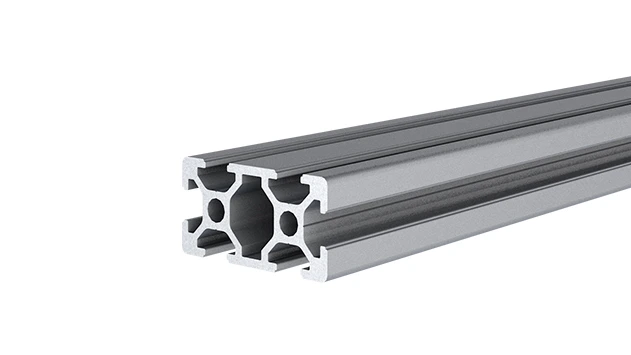
2040 is a 2.00 x 4.00CM fractional 20 series square extrusion T-slot profile with four open T-slots, two side with 2.00cm face, the other side with 4.00cm face. The profile has align-a-grooves to assist in aligning connecting profiles.
Walk into any modern factory, workshop, or even a tech startup's lab, and you'll likely spot sleek, silver structures holding up workbenches, framing machines, or organizing tools. Chances are, many of those structures are made from aluminum profiles—and if they're built to precise European standards, there's a good chance you're looking at a 2040 EU standard aluminum profile. But have you ever wondered how that simple-looking piece of metal goes from a chunk of raw material to a versatile building block of industrial design? Today, we're pulling back the curtain on the journey of the 2040 aluminum profile, from its humble beginnings as a billet to its final form as a key component in everything from assembly lines to office furniture. Along the way, we'll also touch on why EU standards matter, the craftsmanship involved in extrusion, and how tiny accessories like end caps and rubber strips turn a basic profile into a functional tool.
What Is a 2040 EU Standard Aluminum Profile, Anyway?
First things first: let's clarify what makes a 2040 aluminum profile "2040" and "EU standard." The numbers "2040" refer to its cross-sectional dimensions: 20mm in width and 40mm in height. Picture a rectangle, but with a twist—along its length, it has T-shaped grooves (called T-slots) that run the entire way. These slots are what make aluminum profiles so adaptable: you can slide in bolts, brackets, or accessories to attach shelves, panels, or other profiles without drilling holes. It's like building with a grown-up version of Tinkertoys, but sturdier and designed for industrial use.
As for "EU standard"? That's all about consistency and quality. European standards (EN standards, specifically) set strict guidelines for everything from the profile's dimensions and material composition to its mechanical properties (like strength and durability) and surface finish. For manufacturers, meeting these standards means their profiles can be used across Europe and beyond, trusted by engineers, builders, and designers to perform reliably in critical applications. It's not just about checking boxes, though—EU standards ensure safety (no sharp edges, for example), sustainability (many profiles use recycled aluminum), and compatibility (so a 2040 profile from Germany fits with accessories from Italy).
How Does 2040 Compare to Other EU Standard Profiles?
To get a better sense of where 2040 fits in, let's compare it to some common EU standard aluminum profiles. This table breaks down key details:
| Profile Type | Dimensions (Width x Height) | Common Uses | Key Accessories |
|---|---|---|---|
| 2020 EU standard aluminum profile | 20mm x 20mm | Light-duty frames, small shelving, 3D printer parts | Corner brackets, small end caps, plastic T-slot covers |
| 3030 EU standard aluminum profile | 30mm x 30mm | Workbench legs, medium shelving, machine guards | Heavy-duty brackets, cable management clips, rubber strips |
| 4040 EU standard aluminum profile | 40mm x 40mm | Industrial machine frames, conveyor supports, large shelving | Steel brackets, leveling feet, aluminum honeycomb panels |
| 2040 EU standard aluminum profile | 20mm x 40mm | Workbench frames, automation system rails, storage racks | Aluminum profile end cap, aluminum profile rubber strip, T-slot nuts |
Notice how 2040 sits in the middle? It's narrower than 4040 but taller than 2020, making it perfect for applications where you need a balance of strength and space efficiency—like the side rails of a workbench or the vertical supports of a material rack. And those accessories? They're not just add-ons. An aluminum profile end cap, for example, covers the sharp, open end of the profile to prevent cuts and keep out dust. An aluminum profile rubber strip, inserted into the T-slot, can seal gaps, reduce noise when parts slide, or even add a pop of color for visual organization. Small touches, but they turn a basic metal bar into a finished product.
Step 1: Starting with the Raw Material—Aluminum Billets
Every 2040 profile starts with aluminum, but not the shiny, polished kind you see in the end. We're talking about raw aluminum, typically sourced from bauxite ore (though recycled aluminum is increasingly common, thanks to sustainability efforts). Bauxite is mined, refined into alumina (aluminum oxide), and then smelted into pure aluminum. But pure aluminum is too soft for industrial use, so it's alloyed with small amounts of other metals—usually silicon and magnesium—to boost strength and durability. For EU standard profiles, the alloy is often 6063, a popular choice for extrusion because it's easy to shape and has good corrosion resistance.
Once the alloy is ready, it's cast into large cylindrical blocks called billets. Think of billets as the "dough" from which profiles are "baked." These billets can be several meters long and weigh hundreds of kilograms. But before they're ready for extrusion, they need a little prep work. First, they're cut to the right length for the extrusion press (usually 1-3 meters, depending on the press size). Then, their surfaces are cleaned to remove any dirt or oxide layers—even a tiny speck of dust can ruin the extrusion process later.

Step 2: Homogenization—Making the Metal "Uniform"
Imagine baking a cake with lumpy batter—chances are, some parts will be overcooked, others underdone. The same goes for aluminum billets: if the metal's internal structure isn't uniform, the extrusion process will result in weak spots or uneven shapes. That's where homogenization comes in. Homogenization is like "kneading" the billet at the molecular level. The billets are heated to around 570°C (that's hotter than your oven's broil setting!) and held at that temperature for several hours. This allows the alloying elements (silicon, magnesium) to distribute evenly throughout the aluminum, creating a consistent grain structure. When the billet cools, it's no longer a patchwork of soft and hard spots—it's a uniform, predictable material ready for shaping.
Why does this matter for EU standards? Because consistency is key. A homogenized billet extrudes into a profile with uniform strength and dimensions, ensuring that every 2040 profile off the line meets the same EN standards for tensile strength (how much force it can handle before breaking) and hardness. Without homogenization, you might end up with a profile that's strong on one end and weak on the other—not ideal for building something that needs to support heavy machinery or keep workers safe.
Step 3: Extrusion—The "Magic" of Shaping Metal
Now we get to the most exciting part: extrusion. If you've ever squeezed toothpaste out of a tube, you've got the basic idea—extrusion is just toothpaste for metal, but on a massive scale. Here's how it works:
Heating the Billet
First, the homogenized billet is heated again, but this time to a lower temperature—around 480-520°C. At this heat, aluminum becomes soft enough to shape but not molten (think of warm plasticine). Heating it evenly is crucial: if one part is hotter than another, it will flow faster during extrusion, leading to a distorted profile.
The Extrusion Press
Next, the billet is loaded into a hydraulic extrusion press—a machine that looks like a giant piston. One end of the press has a die: a custom-made steel tool with a hole shaped exactly like the cross-section of the desired profile (in this case, a 20mm x 40mm rectangle with T-slots). The other end has a ram (a huge metal plunger) that pushes the billet into the die with tons of force—we're talking thousands of tons of pressure here.
Through the Die: Shaping the Profile
As the ram pushes, the soft aluminum is forced through the die's opening. It's a slow process—extrusion speeds are usually just a few meters per minute—but that slowness ensures precision. As the metal flows through the die, it takes on the die's shape, emerging on the other side as a long, continuous 2040 profile with T-slots running its entire length. It's mesmerizing to watch: one moment, you've got a solid billet; the next, a sleek, uniform profile is gliding out of the press, like something out of a sci-fi movie.
The Die Maker's Art
We can't talk about extrusion without mentioning the die itself. Making a die for a 2040 profile is a craft. Die makers use computer-aided design (CAD) to create the exact shape, then machine it from high-strength steel (often H13 tool steel) to withstand the extreme pressure and heat. Even the smallest imperfection in the die—a nick in the T-slot, for example—will show up in every profile extruded with it. That's why die makers spend hours polishing and testing dies before they're used. For EU standard profiles, the die must be precise to within hundredths of a millimeter to meet dimensional tolerances—no room for error here.
Step 4: Cooling and Stretching—Straightening Things Out
When the 2040 profile first exits the die, it's still hot (around 500°C) and soft. If left to cool on its own, it might warp or bend as it contracts. To prevent this, the profile is immediately run through a cooling table. Most factories use water spray cooling: rows of nozzles spray water onto the profile as it moves along a conveyor, rapidly cooling it to around 50°C. This "quenching" locks in the profile's shape and starts the process of hardening the alloy.
But even with cooling, profiles can still have slight bends or twists. That's where stretching comes in. The cooled profile is clamped at both ends by a stretcher—a machine that pulls it with just enough force to straighten it out. Stretching also helps align the metal's grain structure, improving strength. For EU standards, the stretch must be precise: too little, and the profile is warped; too much, and it might crack. Skilled operators monitor the process, using lasers to check straightness as the profile is stretched.
Step 5: Aging—Building Strength
Remember how we alloyed the aluminum with silicon and magnesium earlier? Now it's time to put those elements to work. After stretching, the 2040 profiles are loaded into an aging oven, where they're heated to around 180°C and held there for 4-6 hours. This process, called artificial aging, causes tiny particles of an aluminum-silicon-magnesium compound to form within the metal. These particles act like microscopic anchors, blocking the movement of the aluminum's grain boundaries and making the metal stronger and harder. By the end of aging, the profile has reached its full mechanical strength—typically around 180 MPa (megapascals) of tensile strength, which is more than enough to support heavy loads in industrial settings.
Step 6: Surface Treatment—More Than Just Shiny
At this point, the 2040 profile is strong, straight, and shaped correctly—but it's still got a dull, matte finish from extrusion. Surface treatment is where it gets its final look and added functionality. There are several common treatments for EU standard profiles:
Anodizing
Anodizing is the most popular treatment. It involves submerging the profile in an electrolytic solution and passing an electric current through it. This creates a thick, hard oxide layer on the aluminum's surface, which is resistant to corrosion, scratches, and fading. Anodized profiles have a smooth, satin finish and can be dyed (though natural silver is most common for industrial use).
Powder Coating
For a more colorful or textured finish, powder coating is an option. Dry powder (usually polyester) is electrostatically sprayed onto the profile, then baked to melt and cure into a tough, even layer. It's great for profiles that need to match a company's brand colors or blend into an office environment.
Electrophoresis
Electrophoresis (or e-coating) is a process where the profile is dipped in a paint bath and an electric current is applied, causing the paint to adhere evenly to the surface. It's often used for profiles that need a thin, uniform coating for corrosion resistance.
EU standards set strict limits on surface defects: no cracks, no blisters, and only minor scratches allowed. For anodized profiles, the oxide layer must be at least 10 micrometers thick to meet EN standards—another example of how these standards ensure long-lasting quality.
Step 7: Cutting and Finishing—Precision in Every Inch
After surface treatment, the continuous 2040 profile is still several meters long. It's time to cut it into usable lengths. Factories use circular saws or band saws with diamond-tipped blades to ensure clean, straight cuts. For EU standards, the cut length must be precise—usually within ±0.5mm per meter. Why? Because when you're building a workbench or a machine frame, even a small difference in length can throw off the entire assembly.
Once cut, the ends of the profile are deburred—smoothed to remove any sharp edges left by the saw. This isn't just about safety (though no one wants to get a cut from a sharp metal edge); it also ensures that accessories like aluminum profile end caps fit snugly. Speaking of accessories…
Aluminum Profile Accessories: The Little Things That Matter
A 2040 profile on its own is just a metal bar. It's the accessories that turn it into something useful. Let's take a closer look at two common ones that are critical for EU standard applications:
Aluminum Profile End Cap
Imagine building a shelf with 2040 profiles. The open ends of the profiles would be sharp, collect dust, and look unfinished. Enter the aluminum profile end cap: a small plastic or metal cap that snaps or screws into the end of the profile. It protects workers from cuts, keeps debris out of the T-slots, and gives the finished structure a polished look. EU standards often require end caps in public or workplace settings for safety, and they come in colors to match the profile's finish.
T-slots are great for attaching things, but they can also let in moisture, dirt, or noise. Aluminum profile rubber strips solve that. These flexible strips press into the T-slots, sealing them against dust and water. They also reduce vibration and noise when parts are slid into the slots—handy for workbenches where tools are constantly being moved. Some rubber strips even have conductive properties for ESD (electrostatic discharge) applications, protecting sensitive electronics from static damage.
Other common accessories include T-slot nuts (to secure bolts in the slots), brackets (to connect profiles at angles), and leveling feet (to stabilize structures on uneven floors). Together, these accessories make the 2040 profile a modular building system—you can take it apart, reconfigure it, and add new components as your needs change. It's no wonder engineers love it: it's strong, lightweight, and adaptable, all while meeting the strictest EU standards.
Quality Control: Ensuring EU Standards Are Met
We've mentioned EU standards a lot, but what does "meeting standards" actually look like in practice? At every step of the manufacturing process, quality control (QC) technicians are checking, testing, and measuring to ensure the 2040 profile meets EN specifications. Here are just a few of the checks they perform:
- Dimensional checks: Using calipers and gauges to verify the profile's width (20mm), height (40mm), and T-slot dimensions. Even a 0.1mm (deviation) can fail EU standards.
- Tensile testing: Cutting a sample from the profile and pulling it until it breaks to measure its tensile strength and elongation (how much it stretches before breaking).
- Hardness testing: Using a durometer to check the profile's hardness, ensuring the aging process worked correctly.
- Surface inspection: Examining the profile under lights for scratches, dents, or discoloration. Anodized finishes are checked for uniformity and thickness.
- Straightness testing: Rolling the profile on a flat surface or using lasers to check for bends or twists.
If a batch fails any of these tests, it's rejected—no exceptions. For manufacturers, this rigor is worth it: EU standard compliance opens doors to global markets and builds trust with customers who know they're getting a reliable product.
From Factory to Workshop: The Many Lives of a 2040 Profile
So, where do these 2040 profiles end up after they leave the factory? Everywhere. Here are just a few examples:
- Workbenches: 2040 profiles form the frames of industrial workbenches, with accessories like shelves, tool hooks, and lighting attached via T-slots.
- Automation systems: In factories, they're used as rails for robotic arms or conveyor systems, guiding machines along precise paths.
- Storage racks: Lightweight but strong, they're perfect for building adjustable shelving in warehouses or labs.
- Machine guards: Safety barriers around moving machinery, often fitted with transparent panels in the T-slots.
- Office furniture: Modern desks, partitions, and monitor stands often use 2040 profiles for a sleek, industrial look.
In each of these roles, the profile's EU standard certification is a mark of quality. A workshop owner in France can order 2040 profiles from a supplier in Spain, confident that they'll fit with accessories from Germany and perform as expected. It's a testament to the power of standardization—and the craftsmanship that goes into making something as "simple" as an aluminum profile.
Conclusion: The Journey of Craftsmanship
The next time you see a 2040 EU standard aluminum profile, take a moment to appreciate its journey. From the bauxite mine to the extrusion press, from the aging oven to the QC lab, every step involves skill, precision, and a commitment to quality. It's not just metal—it's the result of engineers, die makers, and technicians working together to create a product that's strong, versatile, and built to last. And when you add in accessories like aluminum profile end caps and rubber strips, you're looking at a system that empowers people to build, create, and innovate.
So whether it's holding up a workbench in a garage or framing a robotic assembly line in a factory, the 2040 aluminum profile is more than just a part. It's a symbol of how manufacturing can be both precise and adaptable, standardized and creative. And in a world that demands more from its tools, that's something worth celebrating.