- Company Articles
- Industry articles
- Industry standards
- Modular Design Benefits of 3060 National Standard Profile A Systems

Modular Design Benefits of 3060 National Standard Profile A Systems
Related Product
3060 National Standard Profile A
Workbench, production line, logistic rack, warehouse rack Industry: Manufacturer workshop, Automobile, Electronic, Assembling, logistic
In today's fast-paced manufacturing landscape, where production lines shift overnight, product cycles shrink, and customer demands evolve by the quarter, rigidity is the enemy of progress. Traditional factory setups—welded steel frames, fixed wooden workbenches, or one-size-fits-all plastic racks—lock businesses into inflexible workflows, making it nearly impossible to adapt without costly overhauls. This is where modular design steps in, and at the heart of this revolution lies a quiet workhorse: the 3060 National Standard Profile A. More than just a length of aluminum, this extrusion has become the backbone of agile manufacturing, offering a level of adaptability, durability, and cost-efficiency that traditional systems can only dream of. In this article, we'll dive into why the modular design of 3060 National Standard Profile A systems is reshaping how factories, workshops, and production facilities operate—from small-scale startups to global industrial giants.
What is 3060 National Standard Profile A?
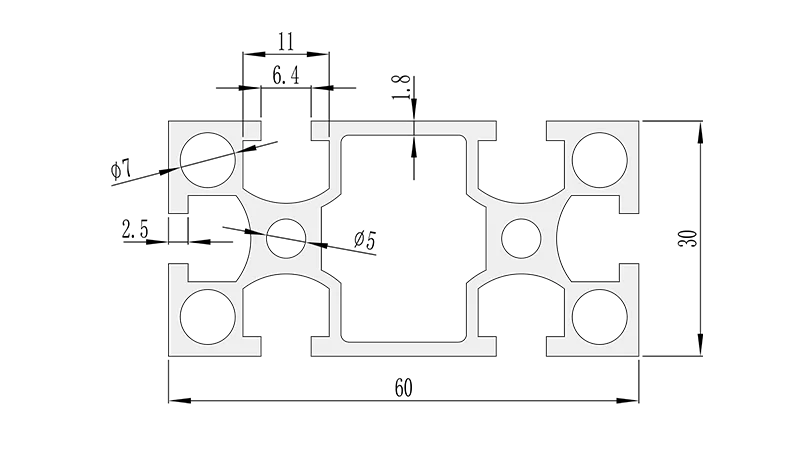
Before we explore its benefits, let's get to know the star of the show: the 3060 National Standard Profile A. As the name suggests, this is an aluminum extrusion with a cross-sectional dimension of 30mm (width) by 60mm (height), manufactured to strict national standards that ensure consistency in size, material quality, and performance. Made from 6063-T5 aluminum alloy—a popular choice for industrial applications—it strikes an impressive balance between strength and lightweight performance. The "T5" designation means it's artificially aged to enhance hardness, making it resistant to bending under heavy loads while remaining easy to handle during assembly.
What truly sets the 3060 Profile A apart, though, is its T-slot design. Running along its length are precision-machined slots that act as universal connection points for a vast array of aluminum profile accessories—think brackets, connectors, end caps, and even specialized components like roller track guides. These slots eliminate the need for welding, drilling, or adhesives; instead, assembly is as simple as sliding a T-slot nut into the groove, aligning a bracket, and tightening a bolt. This design is the foundation of its modularity, turning a single length of aluminum into a building block for endless configurations.
Commonly found in industrial workbenches, material handling racks, machine guards, and lean system setups, the 3060 Profile A is versatile enough to handle everything from light-duty assembly tasks to heavyweight storage solutions. Its dimensions make it particularly well-suited for applications where vertical space is a priority—like shelving or multi-tiered workstations—without sacrificing stability. Now, let's unpack why this seemingly simple profile has become a game-changer for modular design.
Core Benefits of Modular Design with 3060 National Standard Profile A
1. Unmatched Flexibility: Adapt on the Fly, No Welding Required
In manufacturing, the only constant is change. A product line might need to expand to accommodate a new SKU, a workbench might need to be repositioned to reduce operator fatigue, or a material rack might need to shrink to free up floor space for a new machine. Traditional systems crumble under these demands—welded steel frames require cutting and rewelding, wooden structures warp or break when disassembled, and plastic racks crack under the stress of reconfiguration. The 3060 Profile A, by contrast, thrives on change.
Take a typical workbench, for example. A standard fixed workbench is built to a single height, with a static surface and maybe a few shelves bolted in place. If an operator needs a taller surface to stand during assembly, or a shorter one for seated tasks, the entire bench might need to be replaced. With 3060 Profile A, though, adjusting height is as simple as swapping out the leg brackets for longer ones or adding extension pieces. Need to mount a tool rail above the surface? Slide a bracket into the T-slot, tighten a bolt, and you're done. Want to add a bin for small parts? Attach a side bracket using aluminum profile accessories like a 90° connector, and the bin is secured—no drilling, no mess, no downtime.
This flexibility extends beyond workbenches. Imagine a lean system where material flows from storage to assembly via roller track. If production volume increases and the track needs to be extended by 2 meters, there's no need to order a custom-length replacement. Instead, you can cut a new section of 3060 Profile A to size, connect it to the existing track using a roller track placon mount, and have the system up and running in under an hour. Even better, if the layout needs to shift later—say, to accommodate a new conveyor—you can disassemble the track, reconfigure the profiles, and reuse every component. In a world where downtime costs manufacturers an average of $22,000 per minute, according to IndustryWeek, this ability to adapt without halting production is invaluable.
2. Cost-Efficiency: Save Money Today, and Tomorrow
At first glance, modular systems like those built with 3060 Profile A might seem more expensive than traditional alternatives. After all, a length of aluminum alloy costs more upfront than a wooden plank or a piece of welded steel. But look closer, and the math shifts dramatically. Modular design with 3060 Profile A delivers cost savings across the entire lifecycle of a system—from initial setup to long-term maintenance and eventual expansion.
Start with installation costs. Traditional steel welding requires skilled labor, specialized equipment, and often on-site fabrication, which drives up labor expenses. Wooden or plastic systems might be cheaper to buy, but they require custom cutting, painting, and sealing to meet industrial standards. With 3060 Profile A, assembly is a do-it-yourself job. No special skills are needed—just a basic set of wrenches and a tape measure. A small team can build a full workbench or material rack in a fraction of the time it would take to weld a steel frame, slashing labor costs by 30-50% in many cases.
Then there's the cost of change. When a traditional system becomes obsolete—say, a fixed rack that can't accommodate larger parts—you're forced to scrap it and buy new. With 3060 Profile A, components are reusable. That rack can be disassembled, and the profiles repurposed into a workbench, a machine guard, or a new storage solution. Over time, this reusability adds up. A 2022 study by the Modular Construction Institute found that modular industrial systems reduce long-term costs by an average of 25% compared to fixed alternatives, thanks to their ability to adapt rather than be replaced.
Maintenance costs are another area where 3060 Profile A shines. Aluminum is naturally resistant to corrosion, so unlike steel, it won't rust when exposed to moisture or chemicals—a common issue in manufacturing environments. The anodized finish on most 3060 profiles adds an extra layer of protection, preventing scratches, stains, and wear from daily use. Wooden systems, by contrast, warp with humidity and attract pests, while plastic can crack or fade under UV light. Over 10 years, the maintenance costs for a modular aluminum system are often less than half those of traditional materials, according to data from the Aluminum Extruders Council.
3. Scalability: Grow at Your Own Pace
For small manufacturers or startups, investing in a full production setup upfront is risky. Demand is unpredictable, and overbuilding can tie up capital needed for other priorities. Modular systems built with 3060 Profile A eliminate this risk by allowing businesses to start small and scale gradually. Whether you're launching a new product line or expanding an existing one, you can add components as needed, without overcommitting to a fixed layout.
Consider a hypothetical scenario: A startup electronics manufacturer begins with a single workbench built from 3060 Profile A, used for assembling circuit boards. As orders pick up, they need more workspace, so they add two more workbenches, connecting them with a roller track to move components between stations. Six months later, demand spikes again, and they expand into a full lean system by adding a material rack (using 3060 profiles and aluminum profile accessories like shelf brackets) and extending the roller track to feed parts directly to the assembly line. Two years down the line, when they introduce a larger product, they don't need to replace the entire setup—they simply adjust the workbench heights, add deeper shelves to the rack, and swap out the roller track for a wider model. Every step of the way, they've invested only in what they needed, when they needed it, avoiding the waste of overcapacity.
This scalability isn't just for startups, either. Large manufacturers with fluctuating demand—like those in the automotive or consumer goods industries—use 3060 Profile A to create temporary production cells during peak seasons. For example, a car parts supplier might add a modular assembly line in Q4 to meet holiday demand, then disassemble it in Q1 and reuse the profiles for storage racks. This "pay-as-you-grow" model ensures that capital is always allocated efficiently, whether you're a team of five or five hundred.
4. Durability: Built to Last, Even in Tough Environments
Industrial environments are unforgiving. Systems must withstand heavy loads, constant vibration, exposure to oils and chemicals, and the wear and tear of daily use. 3060 National Standard Profile A doesn't just meet these demands—it exceeds them, thanks to the inherent properties of aluminum alloy and its precision engineering.
Aluminum's strength-to-weight ratio is a standout feature. Pound for pound, it's stronger than steel, meaning 3060 Profile A can support heavy loads—up to 500kg per linear meter in some configurations—without adding unnecessary bulk. This makes it ideal for applications like material racks, where supporting stacked pallets or large components is critical. Unlike plastic, which deforms under heat or pressure, or wood, which weakens over time, aluminum maintains its structural integrity for decades. Many manufacturers report using 3060 Profile A systems for 15+ years with minimal signs of wear.
The anodized surface treatment adds another layer of durability. Anodization creates a hard, porous oxide layer on the aluminum's surface that resists scratches, dents, and chemical corrosion. In testing, anodized aluminum has been shown to withstand exposure to common industrial chemicals like motor oil, cleaning solvents, and coolants without degrading—a stark contrast to painted steel, which chips and rusts when the coating is compromised. This durability reduces the need for replacements, further lowering long-term costs.
Even the T-slot design contributes to longevity. Unlike drilled holes, which weaken metal over time, the slots distribute stress evenly along the profile's length, preventing cracks or fatigue. T-slot nuts and bolts, made from high-strength steel, lock securely into place without stripping, ensuring that connections remain tight even after repeated disassembly and reassembly. For manufacturers operating 24/7 production lines, this reliability is non-negotiable.
5. Compatibility with Aluminum Profile Accessories: Endless Customization, Minimal Effort
A modular system is only as good as the accessories that bring it to life, and 3060 National Standard Profile A excels here. The market offers a vast ecosystem of aluminum profile accessories designed specifically to work with its T-slot design, turning basic profiles into highly specialized tools. From simple brackets to complex motion components, these accessories eliminate the need for custom fabrication, allowing users to build exactly what they need, when they need it.
Take connectors, for example. Whether you need a 90° angle for a workbench corner, a 45° joint for a sloped shelf, or a straight connector to extend a rack, there's an accessory for every angle. Many of these connectors are adjustable, too—like internal rotary aluminum joints, which allow profiles to pivot for dynamic setups, such as foldable workbenches or tilting material racks. Even specialized components like roller track placon mounts—used to attach roller track to profiles—snap into the T-slots with precision, ensuring smooth material flow without alignment issues.
End caps and edge protectors are another example of how accessories enhance functionality. These simple plastic or aluminum pieces snap into the ends of profiles, covering sharp edges to improve safety and giving systems a clean, professional look. For workbenches, tool rails and bin holders—mounted via T-slot brackets—keep tools and parts within arm's reach, reducing operator movement and boosting productivity. Even lighting can be integrated using accessory brackets, turning a basic workbench into an illuminated assembly station.
The best part? Most aluminum profile accessories are interchangeable across different profile sizes. A 90° connector that works with 3060 Profile A can also be used with 2040 or 4080 profiles, making it easy to mix and match components for hybrid systems. This compatibility reduces inventory costs, as manufacturers don't need to stock specialized parts for every profile size—just a few universal accessories.
Real-World Applications: How 3060 Profile A Transforms Workflows
To truly appreciate the benefits of 3060 National Standard Profile A, let's look at how it's being used in real manufacturing environments. These case studies highlight its versatility and the tangible impact it has on productivity, efficiency, and adaptability.
Workbenches Redefined: A mid-sized electronics manufacturer was struggling with ergonomic issues—their fixed-height workbenches forced operators to hunch or stretch during assembly, leading to fatigue and increased error rates. Switching to 3060 Profile A workbenches allowed them to adjust heights in 50mm increments using adjustable leg brackets, reducing worker complaints by 65% in the first month. They also added tool rails with hanging bins (mounted via T-slot brackets) and integrated LED lighting, cutting part retrieval time by 20%. When a new product line required a wider work surface, they simply added extension profiles and a new top—no new bench needed.
Lean System Optimization: A automotive parts supplier wanted to implement a lean system to reduce waste in their assembly line. Using 3060 Profile A as the backbone, they built a modular production cell with roller track for material flow, kanban racks for inventory storage, and adjustable workbenches. The roller track, mounted via placon mounts, allowed parts to glide smoothly from storage to assembly, eliminating the need for manual cart transport. When demand for a new part spiked, they extended the track by 3 meters and added two more workbenches in a single day, increasing throughput by 30% without disrupting existing production.
Material Handling Made Agile: A pharmaceutical manufacturer needed storage racks that could adapt to changing batch sizes—from small vials to large equipment cases. Traditional fixed racks couldn't keep up, leading to wasted space and disorganized inventory. Using 3060 Profile A and shelf brackets, they built configurable racks with adjustable heights and widths. When a new product required taller shelves, they simply moved the brackets to higher T-slots; when batch sizes shrank, they added dividers using aluminum guide rails. The result? A 40% reduction in storage space usage and a 50% improvement in inventory accuracy.
Traditional vs. Modular: A Head-to-Head Comparison
| Feature | Traditional Fixed Systems (Steel/Wood/Plastic) | 3060 Modular Systems |
|---|---|---|
| Flexibility | Limited—requires cutting/welding to reconfigure; often permanent | High—disassemble, reconfigure, and reuse components in minutes |
| Upfront Cost | Lower initial cost for basic setups | Higher upfront cost, but offset by long-term savings |
| Lifecycle Cost | High—frequent replacements and maintenance | Low—reusable components, minimal maintenance, 15+ year lifespan |
| Installation Time | Long—requires skilled labor (e.g., welders, carpenters) | Short—assembled by in-house teams with basic tools |
| Scalability | Limited—must rebuild or replace to expand | Unlimited—add components incrementally as needed |
| Durability | Variable—steel rusts, wood warps, plastic cracks | Excellent—anodized aluminum resists corrosion, scratches, and wear |
| Customization | Limited—requires custom fabrication for special features | Unlimited—mix and match aluminum profile accessories for any function |
Conclusion: The Future of Manufacturing is Modular
In a world where agility is the key to survival, 3060 National Standard Profile A systems are more than just a trend—they're a necessity. By combining flexibility, cost-efficiency, scalability, and durability, they empower manufacturers to adapt to changing demands, reduce waste, and stay competitive in an increasingly fast-paced market. Whether you're building a single workbench or a full lean system, the modular design of 3060 Profile A transforms aluminum profiles and accessories into tools for innovation.
The numbers speak for themselves: businesses using modular systems report 25-40% reductions in downtime, 30% lower long-term costs, and 50% faster response times to market changes. For manufacturers looking to future-proof their operations, the choice is clear: modular design with 3060 National Standard Profile A isn't just an investment in equipment—it's an investment in adaptability, efficiency, and growth.
So, the next time you walk through a factory, workshop, or production facility, take a closer look at the structures around you. Chances are, the ones that look sleek, adaptable, and built to last are made with 3060 Profile A. And as manufacturing continues to evolve, those structures will be the ones leading the charge into a more agile, efficient future.