- Company Articles
- Industry articles
- Industry standards
- Multi-Industry Adaptability of 3060 National Standard Profile A: A Comprehensive Analysis

Multi-Industry Adaptability of 3060 National Standard Profile A: A Comprehensive Analysis
Related Product
3060 National Standard Profile A
Workbench, production line, logistic rack, warehouse rack Industry: Manufacturer workshop, Automobile, Electronic, Assembling, logistic
In the fast-paced world of modern manufacturing, logistics, and beyond, the search for flexible, durable, and cost-effective solutions is never-ending. Industries today demand tools that can keep up with evolving workflows, adapt to new processes, and stand the test of time—all while keeping operational costs in check. Enter the 3060 National Standard Profile A, a humble yet powerful aluminum extrusion that has quietly become a backbone for countless businesses across sectors. More than just a piece of metal, this profile embodies the spirit of adaptability, offering a modular foundation that transforms how teams build, organize, and innovate. Let's dive into why this unassuming aluminum extrusion has become a go-to choice, exploring its features, real-world applications, and the unique ways it elevates efficiency across industries.
Understanding 3060 National Standard Profile A: More Than Just Aluminum
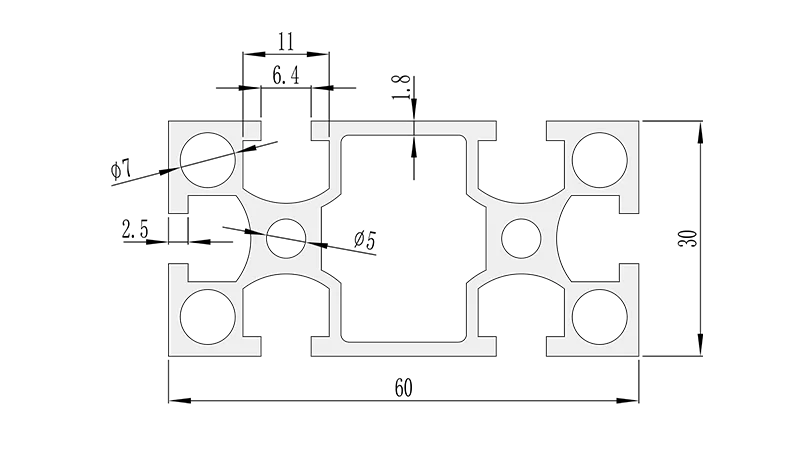
At first glance, the 3060 National Standard Profile A might look like any other aluminum bar—but that's where its simplicity ends. Defined by its precise 30mm x 60mm cross-section, this profile is a product of advanced aluminum extrusion, a process where molten aluminum alloy is pushed through a die to form its consistent, reliable shape. What sets it apart is its adherence to national standards, ensuring uniformity in dimensions, material quality, and performance across every piece. This standardization isn't just about compliance; it's about trust. Engineers, factory managers, and designers know exactly what they're getting, making planning and execution smoother, whether they're building a single workbench or an entire production line.
Let's break down its core features. First, material matters: crafted from high-grade aluminum alloy, it strikes the perfect balance between strength and weight. Unlike heavy steel or flimsy plastic, it's light enough to be moved and reconfigured by a small team but robust enough to support heavy loads—think toolboxes, machinery parts, or even small equipment. Then there's the surface treatment: most 3060 profiles undergo anodization, a process that creates a protective oxide layer. This not only gives it a sleek, professional finish but also makes it resistant to corrosion, scratches, and daily wear—critical for environments where moisture, chemicals, or frequent use are part of the norm.
But the real genius lies in its design: T-slots. Running along its length, these grooves are like built-in connection points, allowing for easy attachment of aluminum profile accessories without welding or drilling. Need to add a shelf? Slide in a bracket. Want to mount a lamp or a tool holder? Screw in a T-nut. This modularity turns the profile from a static piece into a dynamic building block, adaptable to almost any need. And with a load capacity that often exceeds 200kg per linear meter (depending on support spacing), it's not just flexible—it's reliable.
Where It Shines: 3060 Profile A's Cross-Industry Impact
The true measure of a great industrial solution is its ability to thrive in diverse settings. The 3060 National Standard Profile A doesn't just thrive—it transforms industries by solving unique challenges. Let's explore how it makes its mark across key sectors.
1. Manufacturing: Building the Backbone of Production Lines
Walk into any modern manufacturing plant, and you'll likely spot 3060 profiles hard at work. From automotive assembly floors to electronics production hubs, this profile is the unsung hero of lean system implementation. Take workbenches, for example: manufacturers need surfaces that are sturdy, customizable, and easy to reconfigure as production lines shift. With 3060 profiles as the frame, teams can build workbenches of any height or length, add tool hooks, bins, or even ESD (Electrostatic Discharge) mats for sensitive electronics assembly. The T-slots mean that if a new tool is introduced, workers don't need to drill holes or weld—they simply slide in a new bracket and secure it with a screw. This agility reduces downtime and keeps production lines running smoothly.
Beyond workbenches, 3060 profiles shine in material handling. Flow racks, which keep parts moving to assembly stations, rely on the profile's strength to support multiple levels of bins or trays. Even conveyor systems benefit: the lightweight nature of aluminum makes it easier to install overhead or mobile conveyors, while the corrosion resistance ensures longevity in environments where oils or coolants are present. In one automotive plant in Guangzhou, the switch to 3060-based assembly stations cut setup time for new car models by 30%—a game-changer in an industry where speed to market is everything.
2. Logistics & Warehousing: Streamlining the Flow of Goods
Logistics and warehousing thrive on efficiency, and 3060 National Standard Profile A is a master at optimizing space and movement. Warehouses need racking systems that can grow with inventory, and traditional steel racks are often fixed and bulky. 3060 profiles, paired with aluminum profile accessories like corner codes and connectors, let teams build modular material racks that adjust in height, width, or depth as storage needs change. A small e-commerce warehouse might start with a few racks for seasonal items, then expand to double the capacity during peak shopping seasons—all without replacing the entire system.
Roller tracks, essential for sliding boxes or totes along picking stations, also benefit from the profile's design. By mounting roller track guides to 3060 frames, warehouses create smooth, low-friction paths that reduce manual labor and speed up order fulfillment. And let's not forget turnover trolleys: these mobile carts, built with 3060 profiles and casters, are lightweight enough for workers to push across the warehouse but strong enough to carry heavy loads of inventory. In a busy distribution center in Shanghai, using 3060-based turnover trolleys reduced worker fatigue by 25%—a small change that led to fewer injuries and higher productivity.
3. Electronics & Precision Engineering: Protecting Sensitive Work
The electronics industry demands precision, cleanliness, and protection—three areas where 3060 National Standard Profile A excels. ESD workstations, critical for assembling circuit boards or handling microchips, require surfaces that dissipate static electricity to avoid damaging sensitive components. 3060 profiles, when combined with ESD-safe panels and grounding accessories, form the perfect base for these workstations. The anodized surface is non-conductive, and the modular design allows for integrating antistatic mats, ionizers, or tool holders—all without compromising the ESD protection.
Precision engineering labs also rely on the profile's stability. Testing equipment or calibration stations need rigid frames to prevent vibrations from skewing results. 3060 profiles, with their high rigidity-to-weight ratio, provide that stability without adding unnecessary bulk. Researchers can mount sensors, monitors, or sample holders directly to the T-slots, knowing the frame won't flex or shift during experiments. In a Shenzhen-based electronics factory, 3060 profiles were used to build custom test benches for 5G components, ensuring measurements stayed accurate even during long production runs.
4. Healthcare: Clean, Durable, and Adaptable
Healthcare facilities have unique demands: cleanliness, sterility, and adaptability to changing patient needs. 3060 National Standard Profile A meets all three. In hospitals, mobile medical carts—used to transport medications, tools, or patient records—are often built with the profile. Aluminum's smooth, non-porous surface is easy to sanitize, critical for preventing the spread of germs, while the lightweight design makes carts easy for nurses to maneuver through tight hallways. The T-slots allow for adding accessories like cup holders, document trays, or IV pole attachments, turning a basic cart into a specialized tool for each department.
Laboratories, too, benefit from 3060-based setups. Cleanrooms require equipment racks that don't shed particles, and the anodized finish of the profile ensures minimal dust accumulation. Whether it's a rack for lab glassware or a frame for a fume hood, the modularity means labs can reconfigure setups when new equipment arrives, avoiding the cost of custom-built steel frames. In a Beijing research hospital, 3060 profiles were used to build adjustable shelving in a COVID-19 testing lab, allowing technicians to quickly reorganize as testing volumes spiked—proving that adaptability can even save lives.
The Power of Accessories: Turning Profiles into Solutions
A profile is only as versatile as the accessories that bring it to life, and 3060 National Standard Profile A pairs seamlessly with a wide range of aluminum profile accessories. These small but mighty components turn basic aluminum bars into fully functional systems, and understanding them is key to unlocking the profile's full potential.
Let's start with the basics: corner codes and connectors. These small, often L-shaped pieces join profiles at 90-degree angles, forming the corners of workbenches, racks, or frames. What makes them special is their compatibility with T-slots—no welding required. Simply slide a T-nut into the slot, align the corner code, and tighten the bolt. For added strength, 3060 aluminum angle yards (specifically designed for 30x60mm profiles) provide extra reinforcement at joints, making structures sturdier for heavy loads.
End caps might seem like an afterthought, but they're essential for safety and aesthetics. These plastic or aluminum caps snap onto the ends of profiles, covering sharp edges that could cause cuts and giving finished products a polished look. In healthcare settings, they also prevent dust or debris from collecting inside the profile—a small detail that makes cleaning easier.
Hinges and casters add mobility and flexibility. Hinged brackets let sections of a frame fold down, ideal for foldable workbenches or temporary barriers. Casters, when mounted to the base of a 3060 frame, turn static racks into mobile trolleys. Locking casters ensure stability when needed, while swivel casters allow for easy maneuvering around tight corners—perfect for warehouses or hospital corridors.
For more specialized needs, there are accessories like tool holders, bin rails, and even lighting brackets. A factory workbench might use bin rails (mounted via T-slots) to hold small parts bins, keeping tools within arm's reach. A lab setup could add a lighting bracket to mount LED strips under a shelf, illuminating work surfaces without cluttering the area. The beauty of it all is that these accessories are interchangeable—today's workbench can become tomorrow's storage rack with a few swapped components.
Why 3060 National Standard Profile A? Comparing the Competition
With so many aluminum profiles on the market, why does the 3060 National Standard Profile A stand out? Let's compare it to other common options to see its unique advantages.
| Feature | 3060 National Standard Profile A | 2020 Profile (Smaller) | 4080 Profile (Larger) | Steel Profiles |
|---|---|---|---|---|
| Dimensions | 30mm x 60mm | 20mm x 20mm | 40mm x 80mm | Varies (often bulkier) |
| Weight | Light (≈1.2kg/m) | Very light (≈0.5kg/m) | Heavier (≈2.5kg/m) | Heavy (≈5-10kg/m) |
| Load Capacity | High (200-300kg/m) | Low (50-100kg/m) | Very High (400-500kg/m) | Very High (500+kg/m) |
| Modularity | Excellent (T-slots, standard accessories) | Good (limited accessory size) | Excellent (more T-slots) | Poor (requires welding/drilling) |
| Cost | Moderate (balance of price and performance) | Low (but limited use cases) | High (overkill for small projects) | High (material + labor for customization) |
| Best For | Workbenches, racks, medium-load systems | Light-duty shelving, small frames | Heavy machinery, large conveyor systems | Fixed, high-load structures (rarely modular) |
As the table shows, 3060 National Standard Profile A hits the sweet spot: it's not too small to be limited, not too large to be cumbersome, and far more affordable and flexible than steel. For most industries, it offers the perfect balance of strength, weight, and cost—making it the go-to choice for projects where adaptability and efficiency are priorities.
The Future of Adaptability: Why 3060 Profile A Will Keep Evolving
In a world where industries are constantly evolving—new technologies, shifting consumer demands, and the need for sustainability—3060 National Standard Profile A isn't just a solution for today; it's a foundation for tomorrow. Its modular design aligns with the trend toward "lean" and flexible manufacturing, where waste is minimized and resources are maximized. As businesses strive to reduce their carbon footprint, aluminum's recyclability adds another layer of appeal: old profiles can be melted down and repurposed, reducing reliance on raw materials.
Looking ahead, we'll likely see even more specialized accessories and finishes, expanding the profile's use in emerging fields like renewable energy (solar panel mounting frames) or robotics (lightweight robot workstations). The national standard ensures consistency, but manufacturers are also innovating within those standards—adding new T-slot configurations or stronger aluminum alloys to meet growing demands.
At the end of the day, the 3060 National Standard Profile A is more than just a piece of aluminum. It's a symbol of how simplicity, standardization, and adaptability can transform industries. Whether you're building a small workbench in a garage or a sprawling production line in a factory, this profile doesn't just meet expectations—it empowers teams to imagine, create, and adapt. And in a world that never stops changing, that's the most valuable tool of all.