- Company Articles
- Industry articles
- Industry standards
- 2020 National Standard Profile Fatigue Resistance: Testing for High-Cycle Applications

2020 National Standard Profile Fatigue Resistance: Testing for High-Cycle Applications
Related Product
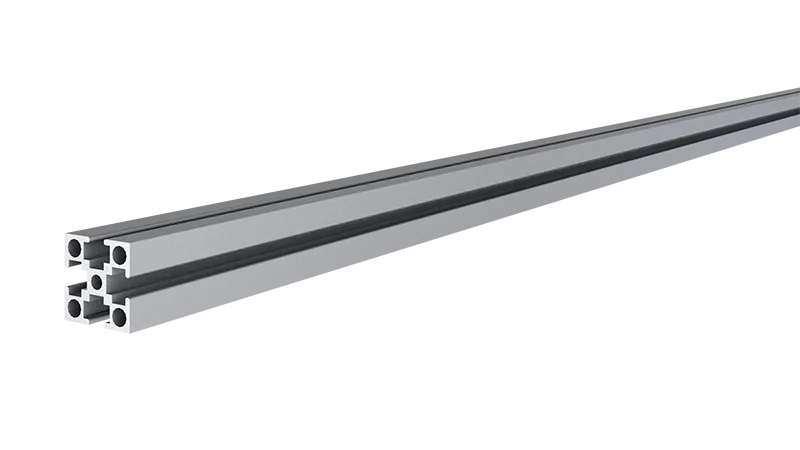
2020 National Standard Profile
45° external bending joint, used for 45° external connection of two aluminum pipes.
Walk into any modern manufacturing facility, and you'll likely spot them: sleek, silver structures holding tools, transporting parts, or serving as the backbone of workstations. These are aluminum profiles, the unsung heroes of lean production systems. Among them, the 2020 National Standard Profile stands out—a compact, versatile workhorse that's become a staple in factories worldwide. But what makes this unassuming 20x20mm profile so crucial? It's not just its size or strength; it's its ability to keep up with the relentless pace of high-cycle applications. In environments where a workbench is used 8 hours a day, a material rack is loaded and unloaded dozens of times hourly, or a conveyor system runs nonstop, fatigue resistance isn't just a nice-to-have—it's a make-or-break factor. Let's dive into why the 2020 National Standard Profile's fatigue resistance matters, how it's tested, and how it holds up in the real world.
What Is the 2020 National Standard Profile, Anyway?
First, let's get familiar with our star player. The 2020 National Standard Profile is a type of aluminum extrusion, typically measuring 20mm by 20mm in cross-section. Made from aluminum alloys like 6063-T5—known for its excellent balance of strength, ductility, and corrosion resistance—it's designed to be modular. That means with the right aluminum profile accessories —think corner codes, brackets, or T-slot nuts—you can build just about anything: workbenches, material racks, machine guards, or even lightweight conveyor frames. Its small size makes it ideal for applications where space is tight but strength can't be compromised, like in electronics assembly lines or small-part manufacturing.
But here's the thing: in high-cycle settings, "good enough" doesn't cut it. Imagine a workbench in an automotive parts plant. Every shift, operators place heavy tools on it, lean against it, and slide components across its surface. Over weeks, months, and years, that repeated stress adds up. If the workbench's frame—built from 2020 profiles—can't handle that cycle, it might start to bend, crack, or loosen. That's not just a maintenance headache; it's a safety risk and a productivity killer. Fatigue resistance is what keeps that workbench stable, shift after shift.
Why Fatigue Resistance Matters in High-Cycle Applications
Fatigue resistance is the ability of a material to withstand repeated loading and unloading without failing. Unlike a one-time heavy load (think lifting a piano), high-cycle applications involve millions of smaller, repeated stresses. A conveyor belt rolling parts along a 2020 profile frame, a material rack b (3 row and 3 floor) being restocked multiple times a day, or a workbench where operators constantly adjust tools—all these scenarios subject the 2020 profile to cyclic stress. Over time, tiny imperfections in the material (invisible to the naked eye) can grow into cracks, leading to sudden failure. That's why testing a profile's fatigue resistance isn't just about meeting a number on a spec sheet; it's about ensuring reliability in the real world.
Consider this: A failed material rack B could mean parts tumbling to the floor, halting production. A weakened workbench might lead to tool damage or operator injury. For manufacturers, downtime and replacements cost money—often far more than investing in a profile with proven fatigue resistance upfront. The 2020 National Standard Profile, when designed and tested properly, is built to avoid these scenarios, making it a go-to choice for lean systems where efficiency and durability go hand in hand.

How Do We Test Fatigue Resistance in 2020 Profiles?
Testing fatigue resistance isn't as simple as "bend it until it breaks." Engineers use specialized machines to simulate real-world conditions, applying cyclic stress and measuring how many cycles the profile can withstand before failing. Let's break down the process:
1. The Setup: Cantilever Bending Tests
One common method is the cantilever bending test. Here's how it works: A sample of the 2020 profile is clamped at one end (like a diving board), and a weight or mechanical arm applies a repeated upward and downward force at the free end. The test runs until the profile develops a visible crack or can no longer hold the load. The number of cycles it lasts? That's a key metric for fatigue resistance.
2. Stress vs. Cycles: The S-N Curve
Engineers plot results on an S-N curve (Stress vs. Number of cycles to failure). For the 2020 profile, this curve shows how much stress the material can handle at different cycle counts. For example, at high stress (say, 100 MPa), it might fail after 10,000 cycles. But at lower stress (50 MPa), it could last 1 million cycles or more. The "fatigue limit" is the stress level below which the material never fails, no matter how many cycles are applied. For aluminum alloys like 6063-T5, this limit is typically around 50-70 MPa—plenty for most high-cycle industrial applications.
| Stress Amplitude (MPa) | Number of Cycles to Failure | Test Method |
|---|---|---|
| 120 | 5,200 | Cantilever bending, 2020 profile (6063-T5) |
| 100 | 28,000 | Cantilever bending, 2020 profile (6063-T5) |
| 80 | 150,000 | Cantilever bending, 2020 profile (6063-T5) |
| 60 | 1,200,000+ | Cantilever bending, 2020 profile (6063-T5) |
| 60 | 850,000 | Cantilever bending, 2020 profile (inferior alloy) |
The table above compares fatigue test results for a standard 2020 National Standard Profile (6063-T5) vs. a lower-quality 2020 profile made with an inferior alloy. Notice how at 60 MPa, the standard profile lasts over 1.2 million cycles—well beyond the typical demands of a workbench or material rack—while the inferior one fails at 850,000 cycles. That difference? It's why choosing a reputable supplier matters.
What Affects the 2020 Profile's Fatigue Resistance?
Fatigue resistance isn't just about the aluminum itself. Several factors play into how well a 2020 profile holds up in high-cycle use:
1. Material Quality
Not all aluminum is created equal. The 6063-T5 alloy used in the 2020 National Standard Profile is heat-treated to enhance strength. Impurities or inconsistencies in the alloy (like excess silicon or iron) can create weak points where cracks start. Reputable suppliers test their raw materials to ensure they meet national standards for composition and mechanical properties.
2. Extrusion and Surface Finish
The extrusion process—how the aluminum is pushed through a die to form the 20x20mm shape—matters too. A smooth, uniform cross-section with no internal voids or surface defects (like scratches or dents) resists fatigue better. Even small nicks can act as stress concentrators,ing crack growth. That's why many 2020 profiles have a clear anodized finish: it protects the surface from corrosion and minimizes micro-abrasions.
3. Design and Geometry
The 2020 profile's design—with its T-slots and wall thickness—affects how stress distributes. A profile with thicker walls (common in industrial-grade 2020 profiles) can handle more cyclic stress than a thinner, lightweight version. T-slots, while essential for modularity, can create minor stress concentrations if not designed smoothly. Engineers often round slot edges to reduce this risk.
4. Accessories and Assembly
Remember those aluminum profile accessories ? They're critical. Using low-quality corner codes or over-tightening bolts can create localized stress. For example, if a workbench's 2020 frame is assembled with mismatched brackets that don't distribute weight evenly, certain sections will bear more load, leading to premature fatigue. Proper assembly—using the right accessories and torque specs—ensures stress spreads evenly across the profile.
Real-World Performance: Workbench and Material Rack B
Let's put this into context with two common applications: a workbench and material rack b (3 row and 3 floor) .
Case Study 1: The 8-Hour Workbench
A electronics manufacturer in Guangdong uses 2020 National Standard Profiles to build workbenches for smartphone assembly. Each workbench sees 8 hours of continuous use: operators place circuit boards (1-2kg each) on it, use precision tools (0.5-1kg), and occasionally lean on the edge (adding 50-70kg of force). The benches are assembled with aluminum corner codes and M5 bolts torqued to 2 Nm (a common spec for 2020 profiles). After 2 years of daily use (over 500,000 cycles of typical stress), inspections showed no visible cracks or deformation. The S-N curve predicted 1 million+ cycles at the average stress level (35 MPa), aligning with real-world performance.
Case Study 2: Material Rack B in Automotive Parts
A Tier 1 auto supplier uses Material Rack B—3 rows, 3 floors—built from 2020 profiles to store plastic trim parts. Each floor holds 10 boxes (5kg each), and the rack is restocked 4 times per shift (12 times daily). That's 12 load/unload cycles, 5 days a week, 50 weeks a year—3,000 cycles annually. After 3 years (9,000 cycles), the rack's 2020 uprights and crossbars showed minimal deflection (less than 0.5mm), and all accessories (brackets, shelf supports) remained tight. Engineers attribute this to the profile's fatigue limit (60 MPa) being well above the actual stress (25 MPa per cycle).
Maximizing Fatigue Life: Best Practices
Want your 2020 National Standard Profile setups to last? Follow these tips:
- Choose the right supplier: Opt for suppliers who provide material certificates and fatigue test data for their 2020 profiles.
- Use quality accessories: Invest in branded aluminum profile accessories—they're designed to work with the profile's geometry.
- Assemble with care: Don't over-tighten bolts; follow torque guidelines. Use washers to distribute load.
- Inspect regularly: Check for loose accessories, dents, or cracks. Fix small issues before they grow.
- Avoid overloading: Stay within the profile's load rating. If in doubt, add extra supports.
Conclusion: The Unsung Hero of High-Cycle Productivity
The 2020 National Standard Profile might be small, but its role in high-cycle manufacturing is huge. From keeping workbenches stable to supporting material racks that never stop moving, its fatigue resistance is the backbone of reliable, efficient production lines. By understanding what fatigue resistance is, how it's tested, and what factors affect it, manufacturers can build setups that stand the test of time—saving money, reducing downtime, and keeping operations running smoothly.
So the next time you walk through a factory, take a closer look at those silver frames. Chances are, they're 2020 profiles—quietly working, cycle after cycle, to keep the world of manufacturing moving forward.