- Company Articles
- Industry articles
- Industry standards
- 2020 National Standard Profile Thermal Expansion Coefficient: Impact on High-Temp Processes

2020 National Standard Profile Thermal Expansion Coefficient: Impact on High-Temp Processes
Related Product
2020 National Standard Profile
45° external bending joint, used for 45° external connection of two aluminum pipes.
Introduction: The Hidden Challenge of Heat in Manufacturing
Walk into any busy manufacturing facility, and you'll likely spot rows of workbenches, conveyor belts, and material racks humming with activity. Behind that seamless operation lies a silent factor that can make or break efficiency: temperature. For teams relying on aluminum extrusion profile systems—especially the popular 2020 national standard profile —understanding how heat affects performance isn't just a technical detail; it's a daily reality that impacts everything from product quality to workplace safety.
In high-temperature processes—think automotive assembly lines, electronics production with heat-curing stages, or food packaging facilities—even small shifts in temperature can cause materials to expand, contract, or warp. For engineers and facility managers, the 2020 national standard profile is a go-to choice for its lightweight design, modular flexibility, and compatibility with a wide range of aluminum profile accessories . But its behavior under heat? That's where the real challenge begins. Let's dive into why thermal expansion matters, how it specifically affects the 2020 profile, and what you can do to keep your operations running smoothly—even when the mercury rises.
What Is Thermal Expansion Coefficient, Anyway?
Thermal expansion coefficient sounds like jargon, but it's actually a simple concept: it measures how much a material stretches or shrinks when temperatures change. Imagine a metal ruler left in the sun—it gets longer. Cool it down, and it shortens. The coefficient tells us exactly how much that length changes per degree of temperature shift, usually measured in micrometers per meter per degree Celsius (μm/m·°C).
For aluminum, this number is surprisingly consistent across alloys, but it's significantly higher than materials like steel or stainless steel. Most aluminum extrusion profiles, including the 2020 national standard profile, have a thermal expansion coefficient around 23-24 μm/m·°C. To put that in perspective: a 1-meter length of 2020 profile will expand by about 0.46 mm if the temperature jumps from 20°C (room temp) to 40°C (a warm factory floor). That might sound tiny, but when you're building a workbench with 2-meter-long rails or a conveyor system spanning 10 meters, those millimeters add up—fast.

The 2020 National Standard Profile: A Closer Look
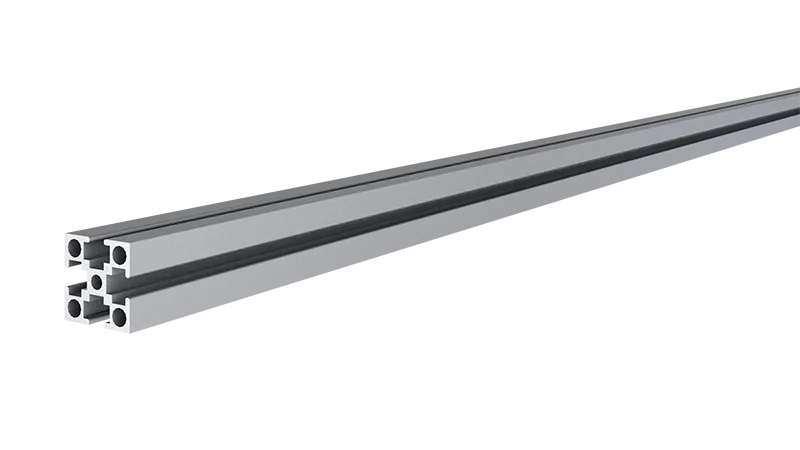
Before we get into heat-related headaches, let's clarify what makes the 2020 national standard profile so popular. At its core, it's a slim, versatile aluminum extrusion with a 20mm x 20mm cross-section, featuring T-slots along all four sides for easy attachment of aluminum profile accessories like brackets, connectors, and panels. Its small size makes it ideal for lightweight applications: think benchtop tool holders, small-part conveyors, or modular material racks. It's also cost-effective, easy to cut, and pairs seamlessly with accessories like corner codes, hinges, and end caps—all designed to keep assembly fast and flexible.
But here's the catch: its compact design means less material to absorb and distribute heat. Unlike larger profiles (say, the 4040 or 3030), the 2020 profile has less structural mass, making it more sensitive to temperature swings. When heat hits, it expands more uniformly but also more noticeably relative to its size. For example, a 2020 profile rail on a workbench might bow slightly under high heat, while a 4040 rail of the same length—with twice the cross-sectional area—would show minimal deflection. That's why understanding its thermal behavior is critical for anyone using it in high-temperature settings.
The Numbers: Thermal Expansion Coefficient of 2020 Profile
To ground this in data, let's compare the thermal expansion coefficients of common aluminum extrusion profiles. The table below shows how the 2020 national standard profile stacks up against others you might find in your facility:
| Profile Type | Cross-Section (mm) | Thermal Expansion Coefficient (μm/m·°C) | Typical Applications |
|---|---|---|---|
| 2020 National Standard Profile | 20x20 | 23.5 | Small workbenches, lightweight racks, component holders |
| 3030 National Standard Profile | 30x30 | 23.2 | Medium-duty workbenches, material racks, conveyor frames |
| 4040 EU Standard Profile | 40x40 | 23.0 | Heavy-duty conveyor systems, industrial workstations |
| Steel Pipe (1.5mm wall) | — | 11.7 | Structural supports, high-heat environments |
Notice a pattern? All aluminum profiles have nearly identical coefficients—around 23 μm/m·°C—regardless of size. The difference lies in how they respond to that expansion. A 2020 profile, being thinner, has less rigidity to resist bending when it expands, while larger profiles like the 4040 can "absorb" the movement without warping. This is why the 2020 profile's thermal behavior becomes a bigger issue in high-heat setups: its small size amplifies the effects of expansion.
When Heat Strikes: How Thermal Expansion Affects Your Workflow
Let's move from theory to real-world impact. In manufacturing, the 2020 national standard profile is everywhere—from workbench frames to the rails on flow racks and the supports for conveyor systems. Here's how thermal expansion can disrupt each of these:
1. Workbench Stability: The Wobble That Wrecks Precision
Picture a workbench E (single deck, without casters) built using 2020 profiles. It's a staple in electronics assembly, where technicians need a flat, stable surface to handle delicate components. Now, imagine that workbench sits near a heat source—a curing oven, for example—and the ambient temperature climbs from 22°C to 38°C over a shift. That's a 16°C increase.
The 2020 profile rails on the workbench's top frame will expand by 23.5 μm/m·°C x 16°C = 376 μm/m, or about 0.38 mm per meter of length. If the workbench is 1.2 meters wide, the top rail will stretch by ~0.46 mm. Sounds small, right? But when paired with rigid aluminum profile accessories like fixed corner codes or non-adjustable joints, that expansion has nowhere to go. The result? A slight bow in the top deck, creating a uneven surface. For someone soldering tiny circuit boards or aligning parts, that "slight" wobble can mean misaligned components or even defective products.
2. Conveyor and Flow Rack Jams: When Rollers Refuse to Roll
Flow racks and conveyor systems rely on precision alignment to keep materials moving smoothly. Many use 2020 profiles to frame the roller tracks, paired with aluminum profile accessories like roller track connectors and placon mounts. In high-heat environments—say, a plastic molding facility where molten materials pass through—the 2020 rails can expand faster than the plastic or steel roller tracks they support.
Consider a 3-meter-long flow rack using 2020 side rails. With a 20°C temperature spike, those rails expand by 23.5 x 20 = 470 μm/m, or 1.41 mm over 3 meters. If the roller track is mounted rigidly to the rails, that extra length can push the track out of alignment, causing rollers to bind or even seize. Suddenly, the "fluent" flow of bins or parts grinds to a halt, leading to bottlenecks and frustrated operators.
3. Material Rack Integrity: When Stability Slips
Material Rack B (3 rows, 3 floors) is another common application for 2020 profiles. These racks hold everything from raw materials to finished goods, and their stability is non-negotiable. But thermal expansion doesn't affect all parts equally: vertical columns and horizontal beams expand at the same rate, but their different lengths mean different total movements. A 2-meter vertical column on the rack will expand by 23.5 x ΔT μm/m, while a 1.5-meter horizontal beam will expand less. Over time, this uneven growth can loosen joints, shift shelf levels, or even cause the rack to lean—putting stored items at risk of falling.
Fighting Back: 3 Strategies to Tame Thermal Expansion
The good news? Thermal expansion is predictable, and with the right approach, you can minimize its impact. Here's how to keep your 2020 profile systems performing even when temperatures rise:
1. Choose the Right Aluminum Profile Accessories
Not all accessories are created equal. Rigid, fixed joints (like standard 90° corner codes) leave no room for movement, turning small expansions into big problems. Instead, opt for flexible or adjustable aluminum profile accessories :
- Slotted brackets: These allow rails to shift slightly without binding. For example, using slotted placon mounts on roller tracks gives the 2020 rails space to expand without warping the track.
- Spring-loaded joints: In critical areas like workbench corners, spring-loaded connectors absorb expansion forces, keeping the frame stable.
- Adjustable feet: For floor-mounted systems like material racks, adjustable leveling feet let you fine-tune alignment if expansion causes slight tilting.
2. Design with "Breathing Room" in Mind
When planning your setup, factor in expansion gaps. For example, if you're building a 2020 profile frame that spans 2 meters, add a 1-2 mm gap between sections where they meet at joints. This tiny space acts as a buffer, letting the material expand without stress. Similarly, when mounting panels to 2020 rails (like a workbench top), use oversized holes in the panel and secure with washers—this lets the panel shift slightly relative to the rails.
3. Know When to Upgrade (or Mix) Profiles
Sometimes, the solution is simpler than you think: use the 2020 profile where it shines (lightweight, low-heat areas) and pair it with more heat-resistant options elsewhere. For example:
- Use 2020 profiles for upper shelves of a material rack (less weight, lower heat exposure) and 3030 profiles for lower, heat-prone sections.
- On a workbench near a heat source, use a 2020 frame but top it with an aluminum honeycomb panel —its rigid, heat-resistant core minimizes warping.
Conclusion: Heat Doesn't Have to Be the Enemy
The 2020 national standard profile is a workhorse in manufacturing, loved for its flexibility and cost-effectiveness. But in high-temperature processes, its thermal expansion coefficient isn't a flaw—it's a factor to respect. By understanding how heat affects this aluminum extrusion profile , choosing the right aluminum profile accessories , and designing with expansion in mind, you can keep your workbench stable, your conveyors rolling, and your material racks secure—no matter how hot it gets.
At the end of the day, manufacturing is about problem-solving. And when it comes to thermal expansion, the solution isn't avoiding the 2020 profile—it's working with it. After all, even the most detail, like how a piece of aluminum reacts to heat, can be the difference between a day of smooth production and a day of costly delays. So next time you're planning a setup with 2020 profiles, take a moment to think about the heat. Your team, your products, and your bottom line will thank you.