- Company Articles
- Industry articles
- Industry standards
- 2020r EU Standard Aluminum Profile for 3C Assembly Fixtures: Quick Changeover Capabilities

2020r EU Standard Aluminum Profile for 3C Assembly Fixtures: Quick Changeover Capabilities
Related Product
2020R EU Standard Aluminum Profile
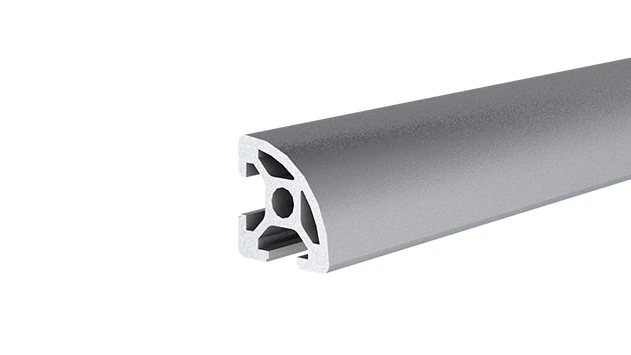
2020R is a 2.00 x 2.00CM fractional 20 series square extrusion T-slot profile with four open T-slots, two side with 2.00cm face, the other side with round face. The profile has align-a-grooves to assist in aligning connecting profiles.
In the fast-paced world of 3C manufacturing—where smartphones, laptops, smartwatches, and other consumer electronics evolve by the month—assembly lines face a relentless challenge: keeping up with frequent product updates. One of the biggest bottlenecks? The time it takes to reconfigure assembly fixtures when switching from one product model to another. Traditional setups, often built with welded steel or fixed plastic components, can take hours (or even days) to adjust, eating into production time and delaying product launches. But what if there was a way to cut that changeover time by half, or more? Enter the 2020r EU Standard Aluminum Profile—a modular, lightweight, and highly adaptable solution that's quietly revolutionizing how 3C factories approach assembly line flexibility.
The 3C Industry's Hidden Enemy: Changeover Delays
Let's start with a scenario many 3C manufacturers know all too well. Imagine a factory floor assembling the latest smartphone model, "Model X." After a successful run of 10,000 units, the design team announces a minor update: a slimmer camera module for "Model X Pro." Overnight, the assembly line needs to adjust—workbenches must be repositioned, material racks reorganized, and conveyor tracks realigned to accommodate the new component. With traditional steel fixtures, this means calling in welders to modify frames, drilling new holes for brackets, and wrestling with heavy, rigid structures. By the time the line is ready, half a day has passed, and hundreds of potential units are left unassembled.
This isn't just a hypothetical. Industry reports estimate that 3C manufacturers lose an average of 15-20% of production time annually to equipment changeovers. For a mid-sized factory producing 50,000 units per month, that's 7,500-10,000 units left on the table—all because the tools meant to enable production are holding it back. The root cause? Rigidity. Traditional fixtures are built to last "forever," but in an industry where product lifespans are measured in months, "forever" becomes a liability.
Meet the 2020r EU Standard Aluminum Profile: Flexibility by Design
The 2020r EU Standard Aluminum Profile wasn't created in a vacuum. It emerged from a simple question: What if assembly fixtures could be as adaptable as the products they help build? Developed to meet strict EU manufacturing standards, this aluminum extrusion profile is a masterclass in modular engineering. Let's break down what makes it tick.
The Basics: What Is 2020r Aluminum Profile?
At its core, the 2020r is a precision-engineered aluminum extrusion with a square cross-section measuring 20mm x 20mm (hence the "2020" in its name). The "r" denotes its rounded edges—a subtle but crucial detail that reduces the risk of component damage during assembly and improves worker safety. Unlike generic aluminum pipes, this profile is manufactured using a high-precision extrusion process, ensuring consistent dimensions and smooth surfaces across every piece. This consistency is key: when you're building fixtures that need to align perfectly, even a 0.1mm deviation can throw off an entire assembly line.
But the real magic lies in its T-slot design. Running along each of the profile's four sides are narrow, recessed channels (the "T-slots") that act as universal attachment points. These slots allow accessories—joints, brackets, shelves, casters, and more—to be secured with simple bolts or clips, no welding or drilling required. It's like building with high-tech Lego blocks, but for industrial manufacturing.
Why Aluminum? The Material Advantage
Aluminum extrusion profile was chosen for a reason. Aluminum is naturally lightweight—about 1/3 the weight of steel—making it easy for workers to handle and reposition fixtures without heavy machinery. Yet, thanks to alloying elements like magnesium and silicon, the 2020r profile offers impressive strength: it can support up to 50kg per linear meter, more than enough for most 3C components (think circuit boards, display panels, and small mechanical parts).
Durability is another win. The profile's surface is anodized—a process that creates a hard, corrosion-resistant oxide layer—protecting it from scratches, chemical spills, and the humidity common in electronics factories. Unlike steel, it won't rust, and unlike plastic, it won't warp under heat or heavy use. This longevity means the 2020r isn't just a "quick fix" but a long-term investment that pays dividends over multiple product cycles.

Aluminum Profile Accessories: The Building Blocks of Quick Changeover
A profile is only as good as the accessories that bring it to life. The 2020r system shines here, with a ecosystem of aluminum profile accessories designed to snap into its T-slots and transform it into virtually any fixture you need. Let's explore some of the most game-changing ones for 3C assembly:
Internal Rotary Aluminum Joints: Angles on Demand
Ever tried to adjust the angle of a welded steel workbench? It's not happening. With internal rotary aluminum joints, reconfiguring angles is as simple as loosening a screw, rotating the joint to the desired position, and tightening it back down. These joints fit snugly into the 2020r's T-slots and allow 360° rotation, making it easy to tilt work surfaces for ergonomic assembly or adjust material racks to accommodate taller components. For example, switching from assembling a flat-screen tablet to a curved smartwatch might require a 15° incline on the workbench—with a rotary joint, that adjustment takes 2 minutes, not 2 hours.
Aluminum Guide Rails: Smooth Sailing for Components
In 3C assembly, moving delicate components (like camera lenses or microchips) from one station to the next requires precision. Aluminum guide rails—available in types A and B—mount directly to 2020r profiles to create smooth, low-friction tracks for slides, carriers, or even mini conveyor systems. Type A rails are designed for light loads and tight spaces, while Type B rails offer extra rigidity for heavier components. Both integrate seamlessly with roller track accessories, turning a static workbench into a dynamic material flow system in minutes.
Casters and Accessories: Mobility Without Compromise
Not all fixtures need to be stationary. When you need to move an entire workbench to a new line or reposition a material rack, casters and accessories make it possible. Lockable caster wheels attach to 2020r profile bases via simple brackets, allowing workers to roll fixtures into place and lock them down with a foot pedal. This mobility is a game-changer during changeovers: instead of disassembling a workbench, you can wheel it to a staging area, reconfigure it, and wheel it back—all without disrupting the rest of the line.
Workbench E: A Case Study in Modularity
Take Workbench E, a single-deck 2020r-based workbench (without casters, though casters can be added later). Out of the box, it's a simple flat surface supported by 2020r legs. But with the right accessories, it transforms: add aluminum guide rails to create a component slide, attach a small material rack using three-way aluminum joints, and mount a tool holder via T-slot brackets. When Model X Pro arrives, swap out the flat surface for an angled one using rotary joints, adjust the guide rails to fit the new component dimensions, and you're done. No welding, no drilling, no downtime.
Quick Changeover in Action: A 3C Assembly Line Example
Let's put theory into practice with a step-by-step example of a changeover using 2020r aluminum profile. Suppose we're switching an assembly line from "Model A" (a budget smartphone) to "Model B" (a premium model with a larger battery and camera module). Here's how it would play out with traditional fixtures vs. 2020r:
| Changeover Step | Traditional Steel Fixtures | 2020r Aluminum Profile Fixtures |
|---|---|---|
| 1. Reposition workbench height | Weld new leg extensions; 2 hours | Adjust telescoping 2020r legs via T-slot bolts; 15 minutes |
| 2. Modify material rack to hold larger batteries | Cut and reweld shelf supports; 3 hours | Add adjustable aluminum brackets to existing 2020r rack; 30 minutes |
| 3. Realign conveyor tracks for camera module | Disassemble and rebuild track sections; 4 hours | Loosen roller track connectors, adjust aluminum guide rails, retighten; 45 minutes |
| 4. Test alignment and stability | Recheck welds, reinforce weak points; 1 hour | Verify T-slot bolts are tight, test mobility (if using casters); 15 minutes |
| Total Time | 10 hours | 1 hour 45 minutes |
The difference is staggering: 10 hours vs. 1 hour 45 minutes. For a factory running two shifts, that's 8+ hours of lost production with traditional fixtures—time that could be used to assemble hundreds of additional units. With 2020r, the line is back up and running before lunch, and workers can focus on what they do best: building products, not fixing fixtures.
Real-World Impact: XYZ Electronics Cuts Changeover Time by 75%
XYZ Electronics, a mid-sized 3C manufacturer in Southeast Asia, was struggling with monthly changeovers that ate up 40 hours of production time. After switching to 2020r EU Standard Aluminum Profile fixtures, they reduced that time to just 10 hours. "We used to dread model updates," says Maria Santos, XYZ's production manager. "Now, our team jokes that changeovers are 'coffee break projects.' We recently switched from a 6.7-inch to a 7.0-inch smartphone model in under 2 hours—and the line ran perfectly on the first try." The results? XYZ increased monthly output by 12% and reduced tooling costs by 18% (no more paying welders for custom modifications).
Beyond Changeover: Other Benefits of 2020r in 3C Assembly
Quick changeover is the headline benefit, but the 2020r aluminum profile offers advantages that ripple through the entire manufacturing process. Let's explore a few:
Durability That Keeps Up with 3C's Pace
Aluminum extrusion profile isn't just lightweight—it's tough. The 2020r's anodized finish resists scratches from daily use, and its structural integrity holds up to repeated reconfigurations. Unlike plastic fixtures, which can crack under stress, or steel, which rusts in humid factory environments, aluminum stands the test of time. XYZ Electronics reported that their 2020r fixtures showed no signs of wear after 18 months of weekly changeovers—something they couldn't say about their old steel setups, which needed replacement every 2 years.
Cost-Effectiveness Over the Long Haul
It's true: 2020r aluminum profile has a higher upfront cost than generic steel or plastic fixtures. But consider the total cost of ownership. Traditional fixtures require ongoing investments in welding, painting, and replacement parts. 2020r's modular design means you can reuse components across multiple product cycles—swap a workbench top from Model A to Model B, or repurpose a material rack as a conveyor support. Over 3-5 years, most manufacturers see a 30-40% reduction in fixture-related costs.
Sustainability: Green Manufacturing Made Simple
3C brands are under increasing pressure to reduce their environmental footprint, and fixtures are no exception. Aluminum is 100% recyclable, and the 2020r's long lifespan means less waste. Unlike steel, which requires energy-intensive welding and painting, aluminum extrusion uses minimal resources, and the anodizing process is eco-friendly. For manufacturers aiming for carbon neutrality, 2020r isn't just a flexible choice—it's a responsible one.
Looking Ahead: 2020r and the Future of 3C Manufacturing
The 3C industry isn't slowing down. If anything, product cycles will get shorter, and customization will become more common (think limited-edition smartphone colors or region-specific laptop models). In this landscape, flexibility will be the ultimate competitive advantage. The 2020r EU Standard Aluminum Profile is more than a tool for today—it's a foundation for tomorrow's smart factories.
Imagine a future where assembly lines reconfigure themselves automatically, with 2020r profiles integrated with IoT sensors that detect product changes and adjust fixtures in real time. Or where augmented reality (AR) glasses guide workers through changeovers, highlighting which T-slot bolts to loosen and which accessories to add. While we're not there yet, the modularity of 2020r makes these innovations possible—unlike rigid traditional fixtures, which would need to be scrapped entirely.
Final Thoughts: Why 2020r Matters for Your 3C Factory
At the end of the day, manufacturing is about balance: speed vs. precision, cost vs. quality, rigidity vs. adaptability. The 2020r EU Standard Aluminum Profile tips that balance in favor of adaptability—without sacrificing speed, precision, or cost. It's not just a profile; it's a mindset shift. Instead of building fixtures for "the way things are," you're building them for "the way things will be."
For 3C manufacturers tired of losing time to changeovers, struggling with rigid fixtures, or looking to future-proof their lines, the choice is clear. The 2020r aluminum profile isn't just keeping up with the industry—it's leading the charge.