- Company Articles
- Industry articles
- Industry standards
- 2020r EU Standard Aluminum Profile: Material Composition & Manufacturing Process

2020r EU Standard Aluminum Profile: Material Composition & Manufacturing Process
Related Product
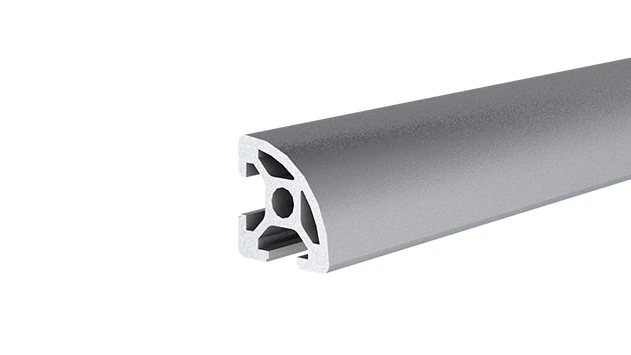
2020R EU Standard Aluminum Profile
2020R is a 2.00 x 2.00CM fractional 20 series square extrusion T-slot profile with four open T-slots, two side with 2.00cm face, the other side with round face. The profile has align-a-grooves to assist in aligning connecting profiles.
Walk into any modern factory, workshop, or even a tech startup's prototyping lab, and you'll likely spot a common workhorse quietly powering efficiency: aluminum profiles. These unassuming metal structures—sleek, modular, and surprisingly versatile—are the backbone of everything from assembly workbenches to automated conveyor systems. Among the countless profiles available, the 2020r EU Standard Aluminum Profile stands out as a favorite for its balance of strength, precision, and adaptability. But what exactly makes this profile so reliable? Let's peel back the layers and explore its material makeup, how it's made, and why it's become a staple in lean manufacturing and beyond.
Why Aluminum Profiles Matter in Today's Workspaces
Before diving into the specifics of the 2020r, let's take a step back. Why do manufacturers, engineers, and designers reach for aluminum profiles time and again? Unlike rigid steel structures or flimsy plastic alternatives, aluminum profiles offer a unique mix of benefits: they're lightweight yet strong, corrosion-resistant, and infinitely customizable. Add to that their compatibility with a vast array of aluminum profile accessories —think connectors, end caps, and guide rails—and you've got a building block that can adapt to almost any need, from a simple storage rack to a complex automated workstation.
The 2020r, in particular, is part of the EU standard series, which means it adheres to strict quality and dimensional guidelines. This consistency is a game-changer for businesses: whether you're ordering 10 profiles or 10,000, you know they'll fit together perfectly, reducing assembly headaches and downtime. But to truly appreciate its value, we need to start at the beginning: the materials that go into making it.
Material Composition: The Science Behind the Strength
At its core, the 2020r is an aluminum extrusion profile , which means it's formed by pushing heated aluminum through a die to create its signature shape. But not all aluminum is created equal. The 2020r relies on a carefully formulated alloy that balances strength, machinability, and cost-effectiveness.
Alloy Selection: 6063 vs. Other Grades
Most EU standard aluminum profiles, including the 2020r, are made from 6063 aluminum alloy. Why 6063? Let's break down its composition:
- Aluminum (97.5-99%): The base metal, providing lightweight properties.
- Silicon (0.2-0.6%): Improves fluidity during extrusion, ensuring the profile maintains sharp, precise edges.
- Magnesium (0.45-0.9%): Works with silicon to form Mg₂Si particles, boosting strength through heat treatment.
- Iron (max 0.35%): Kept low to avoid brittle intermetallic compounds that weaken the alloy.
- Other elements (trace amounts): Manganese, zinc, and copper are added in tiny quantities to fine-tune properties like corrosion resistance.
Compare this to 6061, another popular alloy: 6061 has higher magnesium and silicon content, making it stronger but harder to extrude into complex shapes. For profiles like the 2020r, which require intricate T-slots and consistent dimensions, 6063's extrusion-friendly nature is far more practical. It's the sweet spot between formability and function.
EU Standards Compliance: Ensuring Quality
The "EU Standard" in 2020r isn't just a marketing term—it's a promise of quality. The profile must meet EN 755 standards, which govern mechanical properties, dimensional tolerances, and surface finish. For example:
| Property | EN 755 Requirement | 2020r Typical Value |
|---|---|---|
| Tensile Strength | ≥110 MPa | 140-160 MPa |
| Yield Strength | ≥80 MPa | 110-130 MPa |
| Elongation | ≥8% | 10-12% |
| Surface Finish | Ra ≤ 1.6 μm | Ra 0.8-1.2 μm |
These numbers translate to a profile that can support heavy loads without bending, resist wear in high-traffic environments, and maintain a smooth surface that's easy to clean—critical for industries like food processing or electronics manufacturing where hygiene matters.

Manufacturing Process: From Raw Billet to Finished Profile
Creating a 2020r profile is a multi-step journey that blends art and engineering. Let's walk through each stage, from raw aluminum to the finished product you'd bolt together in a workshop.
Step 1: Billet Casting & Homogenization
It all starts with molten aluminum. The 6063 alloy is melted in a furnace at around 700°C, then poured into cylindrical molds to form "billets"—logs of solid aluminum typically 200-300mm in diameter and 3-6 meters long. But these billets aren't ready for extrusion yet. They undergo homogenization : a heat treatment where they're heated to 570°C for 4-6 hours, then slowly cooled. This process breaks up unevenly distributed alloy elements, ensuring the metal flows uniformly during extrusion.
Step 2: Extrusion – Shaping the Profile
Extrusion is where the magic happens. A billet is loaded into a hydraulic press, heated to 480-520°C (soft enough to flow but not melt), and pushed through a steel die under extreme pressure (up to 10,000 tons). The die is precision-machined with the exact cross-section of the 2020r: a 20x20mm square with T-slots along two or four sides. As the billet exits the die, it emerges as a continuous length of profile, cooled instantly with water sprays to lock in shape.
Fun fact: Extrusion speeds vary based on profile complexity. For the 2020r's simple shape, the press might move at 5-10 meters per minute. More intricate profiles? Sometimes as slow as 1 meter per minute to avoid distorting the design.
Step 3: Heat Treatment – Strengthening the Metal
Freshly extruded aluminum is soft—too soft for structural use. That's where heat treatment comes in. The 2020r undergoes the T5 or T6 temper process:
- T5 Temper: The profile is quenched (rapidly cooled with water) immediately after extrusion, then aged at room temperature for 48-72 hours. This forms fine Mg₂Si particles that strengthen the metal without additional heating.
- T6 Temper: For higher strength, the profile is solution annealed (heated to 520°C, then quenched), followed by artificial aging at 175°C for 8-12 hours. This creates even more Mg₂Si particles, boosting yield strength by 20-30% compared to T5.
Most 2020r profiles use T5 temper for a balance of strength and cost, but T6 is available for heavy-duty applications like industrial workbenches.
Step 4: Surface Treatment – Protection & Aesthetics
Aluminum naturally forms a thin oxide layer that resists corrosion, but extra protection never hurts. The 2020r typically gets one of two treatments:
- Anodizing: The profile is submerged in an acid bath and electrified, thickening the oxide layer to 5-20μm. This gives it a matte, durable finish in colors like silver, black, or gold.
- Powder Coating: A dry powder is electrostatically applied, then baked at 180°C to melt and cure. This offers a wider color range and a smoother finish, ideal for consumer-facing applications like retail displays.
Step 5: Cutting & Finishing
Finally, the continuous profile is cut to standard lengths (usually 2-6 meters) with a circular saw or laser cutter. Ends are deburred to remove sharp edges, and holes may be drilled for aluminum profile accessories like connectors or brackets. The finished profiles are then packaged and shipped to suppliers, ready to be turned into workbenches, racks, or whatever else a customer needs.
Key Features of the 2020r: Why It's a Workshop Favorite
Now that we know how it's made, let's talk about why the 2020r is so popular. Its appeal boils down to three key traits:
1. Modularity – Build Anything, Anywhere
The T-slots are the 2020r's secret weapon. These grooves run along the profile's length, allowing you to slide in nuts, brackets, or aluminum guide rail a without drilling. Need a workbench? Bolt a plywood top to 2020r legs. A material rack? Add shelves using angle brackets. It's like industrial Lego for adults—no welding, no custom fabrication, just quick, tool-free adjustments.
2. Strength-to-Weight Ratio – Tough Without the Bulk
Aluminum is 1/3 the weight of steel, but the 2020r holds its own. A 1-meter length weighs just 0.4-0.5kg yet can support 50-80kg when used as a vertical leg. That makes it perfect for mobile setups like rolling workbenches or temporary assembly lines—easy to move, but sturdy enough for daily use.
3. Precision – Consistency You Can Count On
Thanks to EU standards, every 2020r profile is within ±0.1mm of its 20x20mm dimensions. That means parts from different suppliers fit together seamlessly. No more "this bracket is too loose" or "that hole is misaligned" headaches—critical for lean manufacturing, where downtime from ill-fitting parts can derail production.
Applications: Where the 2020r Shines
The 2020r's versatility means it pops up in more places than you might think. Here are a few real-world examples:
Industrial Workbenches
In electronics factories, 2020r frames support ESD (electrostatic discharge) work surfaces, keeping sensitive components safe. Add aluminum pipe accessories like cable management clips, and you've got a clutter-free workspace that adapts as production needs change.
Material Handling Racks
Warehouses use 2020r to build lightweight, adjustable shelving. T-slots let workers add dividers or bins on the fly, while casters (another common accessory) turn static racks into mobile trolleys for picking orders.
Prototyping & DIY Projects
Hobbyists and startups love the 2020r for its affordability and ease of use. From 3D printer enclosures to custom robot frames, it's a go-to for quick, durable prototypes that don't break the bank.
Accessories: Making the 2020r Even More Versatile
A profile is only as good as its accessories, and the 2020r has a robust ecosystem to choose from. Here are some must-haves:
- Connectors: Angle brackets, corner cubes, and T-joints let you join profiles at 90°, 45°, or straight angles.
- End Caps: Plastic or metal caps cover sharp ends, preventing cuts and giving a clean look.
- Aluminum Guide Rail A: Slotted rails that mount to T-slots, guiding rollers or slides in conveyor systems.
- Fasteners: T-nuts, bolts, and screws that lock accessories securely in T-slots—no drilling required.
These accessories turn the 2020r from a simple bar of aluminum into a building block for almost any structure. It's why suppliers often bundle profiles with accessories, making it easy for customers to get everything they need in one order.
Conclusion: The 2020r – More Than Just Metal
The 2020r EU Standard Aluminum Profile is a testament to the power of smart engineering. Its carefully chosen alloy, precision manufacturing, and modular design make it a cornerstone of modern manufacturing, prototyping, and beyond. Whether you're building a factory workbench or a DIY robot, it's a material that adapts to your needs—strong enough to rely on, flexible enough to evolve with you.
So the next time you walk into a workshop and see those sleek, silver frames holding up tools, parts, or products, take a closer look. Chances are, you're looking at the 2020r: a small profile with a big impact on how we build, create, and work.