- Company Articles
- Industry articles
- Industry standards
- 2020r EU Standard Aluminum Profile Tolerances: Meeting Precision Requirements in 3C Industry

2020r EU Standard Aluminum Profile Tolerances: Meeting Precision Requirements in 3C Industry
Related Product
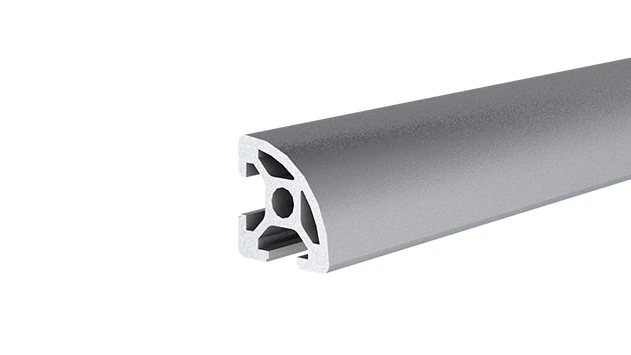
2020R EU Standard Aluminum Profile
2020R is a 2.00 x 2.00CM fractional 20 series square extrusion T-slot profile with four open T-slots, two side with 2.00cm face, the other side with round face. The profile has align-a-grooves to assist in aligning connecting profiles.
In the fast-paced world of 3C manufacturing—where smartphones, laptops, and smartwatches are assembled with microscopic precision—every component matters. From the tiniest screw to the structural frameworks that support production lines, consistency and accuracy can make or break a product's quality, efficiency, and ultimately, a brand's reputation. Among these critical components, aluminum profiles stand out as unsung heroes, forming the backbone of workbenches, material racks, and assembly stations. But not all aluminum profiles are created equal. For 3C manufacturers striving to meet global standards, the 2020r EU Standard Aluminum Profile has emerged as a benchmark for precision, thanks to its stringent tolerance requirements. Let's dive into why these tolerances matter, how they're achieved, and the role they play in keeping 3C production lines running like well-oiled machines.
The 3C Industry's Obsession with Precision: Why Tolerances Can't Be an Afterthought
If you've ever held a premium smartphone, you've experienced the result of meticulous engineering. The seamless fit of the glass screen, the alignment of buttons, and the absence of gaps—these details are the product of components that adhere to tight dimensional standards. In 3C manufacturing, even a deviation of 0.1mm can cause assembly jams, misaligned circuit boards, or faulty product closures. This is where aluminum profiles, and specifically their tolerances, step in. Aluminum profiles are used to build everything from workbenches where technicians assemble motherboards to flow racks that transport delicate components between stations. If a profile is too thick, too short, or slightly bowed, it can throw off the entire workflow, leading to delays, rework, and increased costs.
Consider a typical 3C assembly line: workbenches must be level to ensure tools and components stay in place; flow racks rely on straight, evenly spaced roller tracks to move parts smoothly; and material trolleys need stable frames to prevent vibrations that could damage sensitive electronics. All of these depend on aluminum profiles that meet precise specifications. The 2020r EU Standard Aluminum Profile was designed with this reality in mind, setting strict limits on how much a profile can deviate from its intended dimensions, straightness, and surface finish. For manufacturers, choosing profiles that meet these standards isn't just about compliance—it's about building a foundation for reliability.
What Exactly Is the 2020r EU Standard Aluminum Profile?
Before we dive into tolerances, let's clarify what the "2020r" designation means. The "2020" refers to the profile's cross-sectional dimensions: 20mm in width and 20mm in height, making it a compact yet sturdy option for lightweight structures. The "r" often denotes a rounded edge design, which reduces the risk of scratches on components and improves safety for workers handling the profiles. As part of the EU standard, this profile undergoes rigorous testing to ensure it meets criteria set by organizations like the European Committee for Standardization (CEN), covering everything from material composition to mechanical properties. But what truly sets it apart is its tolerance specifications—detailed limits on how much a profile can vary from its ideal measurements.
Tolerances are essentially the "acceptable range" for a dimension. For example, a 20mm width might have a tolerance of ±0.1mm, meaning the actual width can be between 19.9mm and 20.1mm. In the EU standard, these tolerances are tighter than many national standards, reflecting the region's focus on high-quality manufacturing. For 3C producers exporting to Europe or aiming for global quality benchmarks, adopting the 2020r EU Standard isn't just a choice—it's a necessity.

Breaking Down 2020r EU Standard Tolerances: The Key Metrics That Matter
To understand why the 2020r EU Standard is critical for 3C manufacturing, let's break down its key tolerance metrics. These aren't just numbers on a spec sheet; they directly impact how well the profile integrates with aluminum profile accessories, how stable structures like workbenches are, and how smoothly production lines operate.
1. Dimensional Tolerances: Staying Within the Lines
Dimensional tolerances cover the profile's width, height, and wall thickness. For the 2020r EU Standard, the width and height (both 20mm) typically have a tolerance of ±0.1mm. Wall thickness, which affects the profile's strength, is usually specified at 1.2mm with a tolerance of ±0.05mm. Why does this matter? Imagine assembling a workbench using aluminum profile accessories like 90° connectors. If one profile is 20.2mm wide and another is 19.8mm, the connectors might not fit snugly, leading to a wobbly structure. In 3C assembly, a wobbly workbench could cause a technician to misplace a solder joint or damage a circuit board—costly mistakes that add up quickly.
2. Straightness Tolerances: No Room for Bowing
Even if a profile's cross-section is perfect, if it's slightly curved along its length, it's useless for applications like roller tracks or level workbenches. The 2020r EU Standard specifies straightness tolerances, typically limiting deviation to 0.5mm per meter of length. To put that in perspective, a 2-meter profile can only bow by 1mm at most. This ensures that when profiles are mounted together to form a flow rack or conveyor, the surface remains flat, and components glide smoothly without getting stuck. For 3C manufacturers, this translates to fewer production halts and more consistent output.
3. Surface Finish Tolerances: Smoothness for Sensitive Components
3C components like camera lenses or display panels are scratched, so the surface of aluminum profiles must be smooth and free of burrs. The EU standard sets limits on surface roughness (measured in Ra, or roughness average), often requiring Ra values below 1.6μm. This ensures that when components come into contact with the profile—whether on a workbench or in a material rack—they're not marred by rough edges. Additionally, the standard may specify limits on surface defects like dents, pits, or discoloration, ensuring the profile not only functions well but also maintains a professional appearance in cleanroom environments common in 3C facilities.
How 2020r Tolerances Compare: A Look at the Data
To truly appreciate the stringency of the 2020r EU Standard, it helps to compare it with other common aluminum profiles. Below is a table contrasting key tolerances of the 2020r EU Standard with a hypothetical "national standard" profile and a larger 4040 EU Standard profile (40mm x 40mm), often used for heavier structures.
| Tolerance Type | 2020r EU Standard | Hypothetical National Standard (2020) | 4040 EU Standard | Impact on 3C Production |
|---|---|---|---|---|
| Width/Height (±mm) | ±0.1 | ±0.3 | ±0.2 | Tighter tolerances reduce assembly gaps, improving workbench stability. |
| Straightness (mm/m) | 0.5 | 1.0 | 0.8 | Reduced bowing ensures smoother roller track operation for component transport. |
| Surface Roughness (Ra, μm) | ≤1.6 | ≤3.2 | ≤1.6 | Smoother surfaces prevent scratches on delicate 3C parts like screens and lenses. |
| Wall Thickness (±mm) | ±0.05 | ±0.1 | ±0.08 | Consistent thickness ensures uniform strength, critical for load-bearing workbenches. |
As the table shows, the 2020r EU Standard outperforms the hypothetical national standard in every category, with tolerances that are 2–3 times tighter in some cases. While the 4040 EU Standard matches it in surface roughness, the 2020r's smaller size and tighter dimensional tolerances make it ideal for the compact, precision-focused world of 3C manufacturing.
From Raw Material to Finished Profile: How 2020r Tolerances Are Achieved
Meeting these tight tolerances isn't easy—it requires careful control at every stage of the manufacturing process, starting with the aluminum extrusion profile itself. Aluminum extrusion is the process of forcing heated aluminum billets through a die to create the desired cross-sectional shape. For 2020r profiles, the die must be machined with extreme precision to ensure the 20mm x 20mm dimensions and rounded edges are consistent. Even a tiny imperfection in the die can lead to dimensional variations in thousands of profiles.
After extrusion, the profiles undergo cooling and aging to strengthen the material. During cooling, temperature control is critical: uneven cooling can cause warping, which would violate straightness tolerances. Modern extrusion facilities use computer-controlled cooling systems to ensure profiles cool uniformly, minimizing distortion. Once cooled, profiles are cut to length using high-precision saws that maintain length tolerances within ±0.5mm. Finally, surface finishing—such as anodizing or powder coating—is applied, with automated inspection systems checking for roughness, defects, or color consistency.
Quality control doesn't stop there. Reputable suppliers of 2020r EU Standard Aluminum Profiles conduct random sampling of finished products, using tools like coordinate measuring machines (CMMs) to verify dimensions, laser scanners to check straightness, and profilometers to measure surface roughness. This rigorous testing ensures that only profiles meeting the EU standard make it to customers. For 3C manufacturers, partnering with a reliable aluminum profile supplier isn't just about getting parts—it's about gaining access to the quality control processes that underpin precision.
Beyond the Profile: How Aluminum Profile Accessories Play a Role
A profile is only as good as the accessories that connect it. Aluminum profile accessories—like connectors, end caps, and brackets—must also meet tight tolerances to ensure they fit seamlessly with 2020r profiles. For example, a 90° aluminum profile connector designed for 20mm profiles must have a slot width that matches the profile's wall thickness, allowing for a secure, rattle-free joint. If the connector's slot is too loose, the joint will wobble; if it's too tight, assembly becomes difficult and may damage the profile's surface.
EU-standard accessories are engineered to work with 2020r profiles, with tolerances that complement the profile's own specifications. Take end caps, for instance: these plastic or metal caps fit over the ends of profiles to prevent dust buildup and protect components from sharp edges. A well-designed end cap for 2020r profiles will have an inner diameter tolerance of ±0.1mm, ensuring a snug fit without requiring excessive force. Similarly, brackets used to mount roller tracks or workbench surfaces must align perfectly with the profile's T-slots (the grooves along the profile's length) to ensure stability. When profiles and accessories are designed as a system, the result is a structure that's not just strong, but also easy to assemble, disassemble, and reconfigure—key features for lean system adoption in 3C manufacturing.
Lean System Integration: How 2020r Profiles Reduce Waste and Boost Efficiency
Lean manufacturing is all about eliminating waste—whether it's time, materials, or labor. In 3C production, where margins are tight and product cycles are short, lean principles are essential. 2020r EU Standard Aluminum Profiles support lean system goals in several ways. First, their modular design allows for quick reconfiguration of workbenches, flow racks, and assembly lines. If a new smartphone model requires a different assembly process, manufacturers can disassemble existing structures and rebuild them using the same profiles and accessories, reducing the need to purchase new equipment.
Second, the precision of 2020r profiles reduces waste from rework. When profiles fit together perfectly, assembly is faster, and there's less need to adjust or replace misaligned components. This translates to lower labor costs and higher throughput. Third, the lightweight nature of 2020r profiles (thanks to their 20mm size and aluminum material) makes material handling easier, reducing the risk of worker fatigue and injuries. Even small improvements like these add up in a high-volume 3C facility, where every second counts.
Consider a scenario where a manufacturer switches from non-standard profiles to 2020r EU Standard profiles. Previously, their workbenches required constant readjustment due to loose joints, and flow racks often jammed because of bowed profiles. After the switch, assembly time per workbench dropped by 15%, and flow rack jams decreased by 90%. The result? A 10% increase in daily production and a 20% reduction in rework costs. These are the tangible benefits of prioritizing precision.
Challenges and Solutions: Overcoming Barriers to Adopting 2020r Standards
While the benefits of 2020r EU Standard Aluminum Profiles are clear, some manufacturers may hesitate to adopt them due to perceived higher costs. It's true that EU-standard profiles and accessories often cost more than non-standard alternatives, but the long-term savings in rework, downtime, and efficiency typically outweigh the upfront investment. To mitigate costs, many manufacturers start by upgrading critical systems—like workbenches in final assembly areas—before gradually transitioning other parts of the production line.
Another challenge is finding reliable suppliers. Not all suppliers claiming to offer "EU-standard" profiles actually meet the strict tolerance requirements. To avoid this, manufacturers should look for suppliers with certifications like ISO 9001 (for quality management) and ask for test reports verifying dimensional, straightness, and surface finish tolerances. Reputable suppliers will also offer technical support, helping customers design structures that maximize the benefits of 2020r profiles.
Conclusion: Precision as a Competitive Advantage in 3C Manufacturing
In the 3C industry, where innovation happens at breakneck speed and consumer expectations are higher than ever, precision isn't just a nice-to-have—it's a competitive advantage. The 2020r EU Standard Aluminum Profile embodies this precision, with tolerances that ensure reliability, efficiency, and flexibility in production. From the extrusion process to the final assembly of a smartphone, every step benefits from profiles that meet strict dimensional, straightness, and surface standards.
For manufacturers looking to stay ahead, investing in 2020r EU Standard Aluminum Profiles and compatible aluminum profile accessories is more than a purchase—it's a commitment to quality. Whether building a workbench for delicate electronics assembly or a flow rack for transporting components, these profiles provide the foundation for a production line that can adapt, scale, and deliver consistent results. In the end, it's simple: precision profiles lead to precision products, and precision products win in the 3C market.
So, the next time you pick up a sleek smartphone or a lightweight laptop, take a moment to appreciate the unseen components that made it possible. Behind that perfect finish is a network of aluminum profiles, connectors, and workbenches—all working together, thanks to the strict tolerances of standards like the 2020r EU Standard. It's a reminder that in manufacturing, the smallest details often make the biggest difference.