- Company Articles
- Industry articles
- Industry standards
- 2040 National Standard Profile Certification: What the Mark Means for Manufacturers

2040 National Standard Profile Certification: What the Mark Means for Manufacturers
Related Product
2040 National Standard Profile
45° external bending joint, used for 45° external connection of two aluminum pipes.
In the bustling world of manufacturing, where every component plays a role in the smooth flow of production, few things are as yet critical as the aluminum profiles that form the backbone of workbenches, material racks, and assembly lines. For years, manufacturers have grappled with inconsistent quality, ill-fitting parts, and unexpected delays caused by subpar components. But in recent years, a quiet revolution has been taking place: the rise of national standard certifications for these essential building blocks. Among them, the 2040 National Standard Profile Certification has emerged as a game-changer. For manufacturers, this mark isn't just a stamp of approval—it's a promise of reliability, efficiency, and long-term savings. Let's dive into what this certification really means, why it matters, and how it's reshaping the way products are built.
What Exactly Is a 2040 Aluminum Profile?
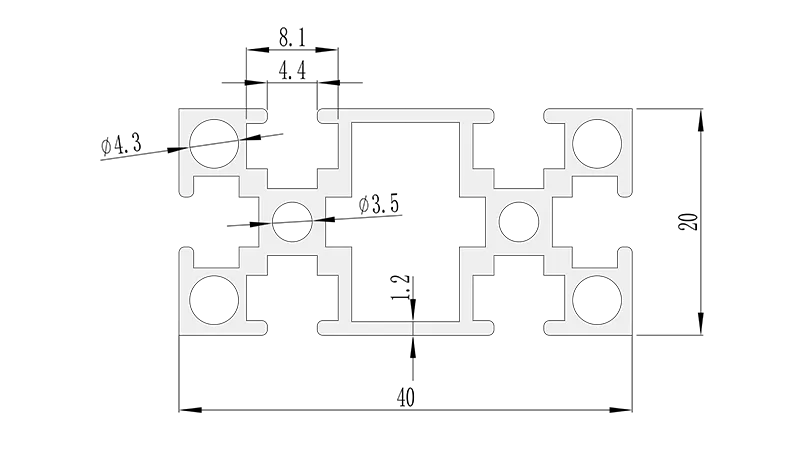
Before we unpack the certification, let's start with the basics: What is a 2040 aluminum profile? In simple terms, it's a type of aluminum extrusion profile—meaning it's formed by pushing heated aluminum through a die to create a specific cross-sectional shape. The "2040" refers to its dimensions: 20 millimeters in width and 40 millimeters in height. This compact yet sturdy profile has become a workhorse in manufacturing because it strikes a perfect balance between strength and lightweight design. Think of it as the "Swiss Army knife" of industrial profiles: it's versatile enough to build everything from small workbenches to large material racks, and it pairs seamlessly with a range of aluminum profile accessories, from connectors to guide rails.
What makes the 2040 profile so popular? For one, its size is ideal for mid-weight applications. It's strong enough to support tools, components, and even small machinery, but not so bulky that it adds unnecessary weight to structures like turnover trolleys or mobile workstations. Its T-slot design—those grooves running along its length—allows for easy attachment of accessories without welding or drilling, making assembly and reconfiguration a breeze. Whether you're building a single-deck workbench (like the aptly named Workbench E) or a multi-tier material rack (such as Material Rack B with 3 rows and 3 floors), the 2040 profile provides the flexibility to adapt to changing production needs.
The Journey to Certification: What Goes Into the 2040 National Standard Mark?
Not all 2040 aluminum profiles are created equal. The National Standard Certification is awarded only after a rigorous evaluation process conducted by accredited bodies. This isn't a quick check or a box-ticking exercise—it's a deep dive into every aspect of the profile's quality, performance, and safety. Let's break down the key steps:
1. Material Testing: The Foundation of Quality
It all starts with the aluminum itself. Certified 2040 profiles must be made from high-grade alloys, typically 6063-T5, known for its excellent extrudability and mechanical properties. Testing labs analyze the alloy composition to ensure it meets strict standards for elements like magnesium, silicon, and copper—too much of one or too little of another can weaken the profile or make it prone to corrosion. They also test tensile strength (how much force it can withstand before breaking) and yield strength (the point at which it starts to deform permanently). For manufacturers, this means a profile that won't bend or warp under the weight of daily use, whether it's holding heavy tools on a workbench or supporting stacked materials in a rack.
2. Dimensional Accuracy: Precision That Matters
If you've ever tried to assemble furniture with misaligned holes, you know how frustrating poor dimensional accuracy can be. For manufacturers, the stakes are much higher: a profile that's even 0.1mm off spec can throw off an entire assembly line. Certified 2040 profiles undergo meticulous checks to ensure their width, height, and wall thickness match the exact measurements outlined in national standards. This precision ensures that aluminum profile accessories—like connectors, brackets, and guide rails—fit snugly every time. No more forcing a joint onto a profile or wasting time filing down edges to make parts align.
3. Surface Treatment and Durability
Aluminum is naturally resistant to corrosion, but the certification takes this a step further. Profiles must pass tests for surface finish, including anodizing thickness (a protective layer applied to the surface) and resistance to scratches, chemicals, and UV radiation. For manufacturers working in harsh environments—like automotive plants with oil and grease or electronics facilities requiring ESD (electrostatic discharge) protection—this durability translates to longer-lasting equipment and fewer replacements. Imagine a food processing plant using certified 2040 profiles for material racks: the corrosion-resistant surface ensures the racks stay clean and structurally sound, even with daily exposure to cleaning chemicals.
4. Environmental and Safety Compliance
Modern manufacturing isn't just about building products—it's about building them responsibly. The 2040 certification includes checks for compliance with environmental regulations, such as restrictions on hazardous substances (like lead or mercury) under standards like RoHS. It also verifies that the profile meets safety requirements, such as fire resistance and load-bearing limits. For manufacturers, this isn't just about avoiding fines; it's about protecting workers and end-users. A certified profile used in a workbench, for example, ensures that the structure can safely support the weight of equipment without collapsing, reducing the risk of workplace accidents.
Why Certification Matters: The Tangible Benefits for Manufacturers
At this point, you might be thinking, "This all sounds great, but is certification really worth the extra cost?" The short answer: Yes. For manufacturers, the benefits of using certified 2040 aluminum profiles far outweigh the initial investment. Let's break down the most impactful advantages:
1. Consistency That Eliminates Headaches
Anyone who's managed a production line knows that inconsistency is the enemy of efficiency. A batch of non-certified profiles might have slight variations in width or slot placement, leading to parts that don't fit, assembly delays, or even rework. Certified profiles, on the other hand, are produced to strict tolerances, meaning every piece is identical. This consistency reduces downtime, as workers don't have to waste time sorting through parts or adjusting assembly processes to accommodate variations. For example, a manufacturer building Workbench E (a single-deck workbench without casters) can trust that every 2040 profile in the batch will align perfectly with the tabletop and legs, cutting assembly time by up to 20%.
2. Compatibility with Accessories (No More "Almost Fits")
One of the biggest frustrations with non-certified profiles is their poor compatibility with aluminum profile accessories. A T-slot that's slightly too narrow might make it impossible to insert a connector, or a guide rail that's misaligned could cause jams in a roller track system. Certified 2040 profiles are designed to work seamlessly with standardized accessories—from aluminum guide rails (like Aluminum Guide Rail A and B) to roller track placon mounts. This means manufacturers can mix and match components without worrying about fit issues. For instance, a company using Material Rack B (with 3 rows and 3 floors) can confidently add plastic roller track guide rails (whether yellow or grey) knowing they'll slide into the profile's slots smoothly, ensuring materials glide effortlessly from one shelf to the next.
3. Long-Term Cost Savings (Beyond the Price Tag)
It's true: certified profiles often cost a bit more upfront than non-certified alternatives. But when you factor in the long-term savings, they're actually cheaper. Think about it: Non-certified profiles are more likely to fail prematurely, leading to replacement costs, production delays, or even product recalls. A single defect in a material rack could cause a stack of components to topple, damaging inventory and halting assembly. Certified profiles, with their rigorous testing, have far lower failure rates. Plus, their compatibility with accessories reduces waste—you won't end up with a box of unusable connectors because they don't fit your profiles. Over time, these savings add up: manufacturers report cutting maintenance costs by 15-25% after switching to certified 2040 profiles.
| Feature | Certified 2040 Aluminum Profile | Non-Certified 2040 Aluminum Profile |
|---|---|---|
| Material Consistency | Alloy composition tested and verified; uniform strength across batches | May use recycled or low-grade aluminum; inconsistent strength |
| Dimensional Accuracy | Tolerances within ±0.1mm; slots and edges aligned perfectly | Tolerances up to ±0.5mm; slots may be misaligned or misshapen |
| Accessory Compatibility | Works with 99% of standardized aluminum profile accessories | 50-70% compatibility; often requires custom modifications |
| Failure Rate | Less than 0.5% over 5 years | 5-10% over 5 years (due to corrosion, warping, or weak points) |
| Long-Term Cost (per 100 units) | $5,000 initial + $500 maintenance = $5,500 total | $4,000 initial + $2,000 maintenance/replacement = $6,000 total |
Real-World Impact: How Manufacturers Are Using Certified 2040 Profiles
To truly understand the value of the 2040 certification, let's look at how real manufacturers are putting it to work. Take, for example, a mid-sized electronics manufacturer in Guangdong that specializes in assembling circuit boards. A few years ago, they were struggling with frequent delays in their ESD workstation production line. The issue? The non-certified aluminum profiles they were using for the workbenches (similar to Workbench E) had inconsistent slot sizes, making it impossible to attach ESD-safe mats and grounding clips securely. Workers were spending hours filing down slots or improvising with tape, leading to a 10% drop in daily output.
After switching to certified 2040 profiles, the transformation was immediate. The slots aligned perfectly with the ESD accessories, cutting assembly time by 30%. What's more, the certified profiles' uniform strength meant the workbenches could support heavier testing equipment without wobbling, reducing errors in circuit board testing. Today, the company estimates the switch has saved them over $100,000 annually in labor and rework costs.
Another example comes from the automotive parts industry. A supplier of brake components was using non-certified profiles to build flow racks for transporting parts between assembly stations. The racks often jammed because the plastic roller track guide rails (grey ones, in this case) didn't fit snugly in the profile slots, causing rollers to stick. After upgrading to certified 2040 profiles, the guide rails slid into place without issue, and the racks now operate 24/7 with zero jams. The result? A 15% increase in parts throughput and a happier team that no longer has to stop production to fix stuck rollers.
Busting Myths: Common Misconceptions About Certification
Despite its benefits, the 2040 National Standard Profile Certification still faces some skepticism. Let's address the most common myths:
Myth #1: "Certification is just a marketing gimmick."
This couldn't be further from the truth. The certification process involves independent third-party testing, not just self-declaration by manufacturers. Labs use specialized equipment to measure everything from alloy composition to tensile strength, and profiles that fail even one test don't get certified. It's a rigorous, transparent process—hardly a "gimmick."
Myth #2: "Non-certified profiles are 'good enough' for small manufacturers."
Small manufacturers often operate on tight budgets, so it's tempting to cut costs with non-certified parts. But small operations are actually more vulnerable to the risks of subpar profiles: a single production delay or equipment failure can have a bigger impact on their bottom line. Many small manufacturers who've made the switch report that the certification pays for itself within months, thanks to reduced downtime and rework.
Myth #3: "All 2040 profiles are the same—certification doesn't change that."
Walk into a hardware store, and you might find a dozen "2040 aluminum profiles" at varying price points. But looks can be deceiving. A non-certified profile might have the same 20x40mm dimensions, but its internal structure—like wall thickness or T-slot design—could be compromised. One manufacturer we spoke to discovered that their non-certified profiles had wall thicknesses ranging from 1.2mm to 1.8mm within the same batch, leading to uneven load distribution in their material racks. Certified profiles eliminate this variability.
Looking Ahead: The Future of National Standard Profiles
As manufacturing evolves, so too will the standards that govern it. The 2040 National Standard Profile Certification is just the beginning. We're already seeing trends toward stricter environmental requirements, with future certifications likely to emphasize recycled aluminum content and lower carbon footprints. There's also growing interest in integrating smart features into profiles—think embedded sensors that monitor stress or wear, allowing for predictive maintenance. For manufacturers, staying ahead of these trends means embracing certifications today to build a foundation for tomorrow's innovations.
Another emerging trend is the integration of certified profiles with lean system principles. Lean manufacturing relies on eliminating waste and optimizing flow, and certified 2040 profiles are perfect for this. Their modular design allows for quick reconfiguration of workstations or material racks as production needs change, reducing the waste of time and resources. A certified profile used in a lean system isn't just a component—it's a tool for continuous improvement.
The Bottom Line: Certification as a Competitive Edge
In the end, the 2040 National Standard Profile Certification is more than a mark on a piece of aluminum. It's a symbol of a manufacturer's commitment to quality, efficiency, and reliability. For those building everything from workbenches to assembly lines, it's a tool that reduces stress, cuts costs, and opens doors to new opportunities—whether that's bidding on contracts that require certified components or simply sleeping better at night knowing your production line won't grind to a halt due to a faulty profile.
So the next time you walk through a factory and see those unassuming aluminum frames holding up the operation, take a closer look. Chances are, the ones with the 2040 certification mark are the ones keeping the whole place running smoothly. And for manufacturers, that's not just a detail—it's the difference between falling behind and leading the pack.