- Company Articles
- Industry articles
- Industry standards
- 2040 National Standard Profile Compliance: Meeting Industry Safety Standards

2040 National Standard Profile Compliance: Meeting Industry Safety Standards
Related Product
2040 National Standard Profile
45° external bending joint, used for 45° external connection of two aluminum pipes.
In the bustling world of manufacturing, warehousing, and industrial operations, the difference between a smooth workflow and a costly disruption often lies in the quality of the tools and materials we rely on. Every beam, bracket, and component plays a silent but vital role in keeping operations running safely, efficiently, and sustainably. Among these unsung heroes is the 2040 national standard profile—a versatile, durable aluminum extrusion profile that has become a cornerstone of modern industrial setups. But what makes this profile stand out, and why is compliance with national standards not just a box to check, but a promise to the workers who use it daily and the businesses that depend on its reliability?
Compliance isn't just about following rules; it's about building trust. When a factory floor is lined with workbenches, racks, or conveyors built from compliant materials, it's a signal that the company prioritizes safety over shortcuts, and long-term stability over quick fixes. The 2040 national standard profile, in particular, has emerged as a gold standard in this regard, thanks to its rigorous adherence to safety protocols, precision engineering, and compatibility with a wide range of aluminum profile accessories. In this article, we'll dive deep into what makes this profile compliant, how it meets industry safety standards, and why it has become indispensable for businesses aiming to thrive in a competitive, safety-conscious market.
Understanding the 2040 National Standard Profile: More Than Just Metal
At first glance, the 2040 national standard profile might look like just another piece of aluminum extrusion. But beneath its sleek, uniform surface lies a carefully engineered solution designed to balance strength, flexibility, and safety. To truly appreciate its compliance, we need to start with the basics: what exactly is a 2040 national standard profile, and how does it differ from non-compliant alternatives?
Defining the 2040 Profile: Dimensions and Design
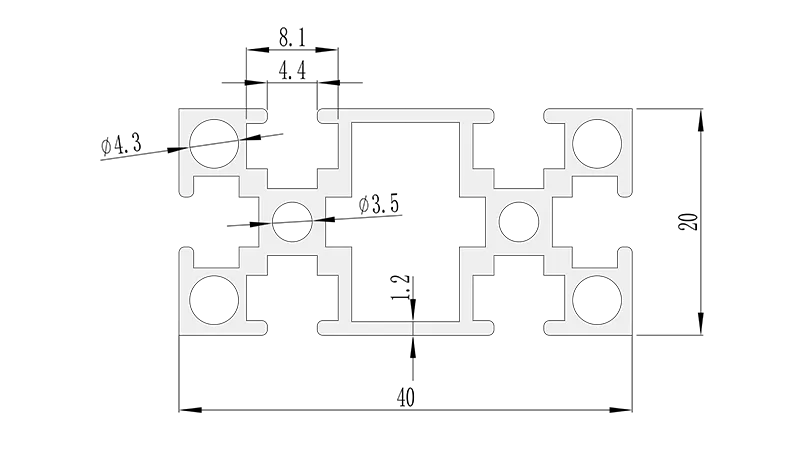
The "2040" in its name refers to its cross-sectional dimensions: 20mm in width and 40mm in height. This standardized sizing is no accident—it's the result of years of industry research into the optimal balance between structural support and material efficiency. Unlike generic aluminum extrusion profiles that may vary in size by millimeters (or more), the 2040 national standard profile adheres to strict dimensional tolerances set by national regulatory bodies. This precision ensures that when you order a 2040 profile from a reputable supplier, you know exactly what you're getting: a component that will fit seamlessly with other standardized parts, reducing assembly time and minimizing errors.
But dimensions are just the start. The profile's design includes T-slots—longitudinal grooves along its length—that allow for easy attachment of aluminum profile accessories like connectors, brackets, and panels. These slots are not only spaced uniformly but also engineered to distribute weight evenly, preventing stress points that could lead to bending or breakage over time. For workers on the factory floor, this means less time troubleshooting ill-fitting parts and more time focusing on productive tasks.
Material Matters: The Aluminum Alloy Behind the Safety
Compliance isn't just about shape—it's about substance. The 2040 national standard profile is typically crafted from high-grade aluminum alloys, such as 6063 or 6061, chosen for their exceptional strength-to-weight ratio, corrosion resistance, and thermal stability. These alloys undergo rigorous testing to ensure they meet national standards for mechanical properties, including tensile strength, yield strength, and elongation. For context, a compliant 2040 profile made from 6063 aluminum can withstand tensile forces of up to 180 MPa (megapascals)—more than enough to support the weight of tools, materials, and even workers in applications like workbenches or mezzanines.
Non-compliant profiles, by contrast, often cut corners with cheaper alloys or recycled materials that lack consistent properties. Imagine a scenario where a workbench built with subpar aluminum suddenly buckles under the weight of heavy machinery—this isn't just a productivity issue; it's a safety hazard. The 2040 national standard profile's material integrity eliminates such risks, giving workers the confidence that the structures they rely on won't fail when put to the test.
Safety Standards: The Backbone of Compliance
Compliance with national standards isn't a one-time achievement; it's a continuous commitment to meeting or exceeding safety benchmarks. For the 2040 national standard profile, this means adhering to a suite of regulations that cover everything from material composition to structural performance. Let's break down the key safety standards that make this profile a trusted choice in industrial settings.
Load-Bearing Capacity: Ensuring Structural Integrity
One of the most critical safety considerations for any industrial profile is its ability to bear weight without deforming or collapsing. National standards for the 2040 profile specify strict load-bearing limits, which are determined through rigorous testing in controlled environments. These tests simulate real-world conditions, including static loads (e.g., stored materials on a rack), dynamic loads (e.g., moving parts on a conveyor), and even impact loads (e.g., accidental bumps from forklifts).
For example, a standard 2040 profile with a wall thickness of 1.5mm (a common specification) is rated to support a maximum static load of approximately 200 kg per linear meter when properly mounted. This isn't a arbitrary number—it's the result of calculating factors like bending moment, shear stress, and deflection. By adhering to these limits, businesses can avoid catastrophic failures that could injure workers or damage equipment.
Corrosion Resistance: Longevity in Harsh Environments
Industrial environments are rarely gentle. Factories may expose materials to moisture, chemicals, or extreme temperatures, all of which can weaken non-compliant profiles over time. The 2040 national standard profile addresses this through its corrosion-resistant properties, often enhanced by surface treatments like anodizing. Anodizing creates a protective oxide layer on the aluminum surface, making it resistant to rust, chemical spills, and UV damage. This not only extends the profile's lifespan but also ensures it maintains its structural integrity—even in environments like food processing plants (where moisture is constant) or automotive workshops (where oils and solvents are prevalent).
Non-compliant profiles, lacking such treatments, may start to corrode within months, leading to weakened joints, unstable structures, and the need for frequent replacements. Over time, this not only drives up costs but also increases the risk of accidents as corroded parts become unpredictable.
Fire Safety: A Critical Overlooked Standard
Fire safety is often an afterthought in industrial material selection, but it's a critical aspect of compliance. Aluminum, by nature, has a high melting point (around 660°C), making it far more fire-resistant than materials like plastic or wood. The 2040 national standard profile takes this a step further by ensuring that its composition and surface treatments do not release toxic fumes when exposed to high heat—a requirement under many national fire safety codes. In the event of a workplace fire, this can mean the difference between a contained incident and a disaster that puts lives at risk.
Compliant vs. Non-Compliant: A Side-by-Side Comparison
| Feature | 2040 National Standard Aluminum Extrusion Profile | Non-Compliant Aluminum Profile |
|---|---|---|
| Material Alloy | High-grade 6063/6061 aluminum (tested for strength and consistency) | Recycled or low-grade alloys (inconsistent properties, prone to weakness) |
| Dimensional Tolerance | ±0.1mm (ensures compatibility with accessories) | ±0.5mm or more (leads to ill-fitting parts and assembly errors) |
| Load-Bearing Capacity | Up to 200 kg/m (static load, tested and certified) | Unspecified or inconsistent (may fail under moderate loads) |
| Corrosion Resistance | Anodized surface (resistant to moisture, chemicals, UV) | Untreated or poorly treated (prone to rust and degradation) |
| Safety Certification | Meets national standards (e.g., GB/T, ISO) with documentation | No formal certification; may lack safety testing |
Integration with Aluminum Profile Accessories: Building a Cohesive System
A profile is only as good as its ability to work with other components—and the 2040 national standard profile truly shines in this regard. Its compliance extends beyond the profile itself to its compatibility with a wide range of aluminum profile accessories, creating a modular system that can be customized for almost any industrial need. From connectors and brackets to panels and casters, these accessories are designed to complement the profile's precision, ensuring that the entire structure remains safe, stable, and efficient.
Accessories That Enhance, Not Hinder, Compliance
Aluminum profile accessories are the unsung partners of the 2040 profile. Take, for example, the 90° aluminum profile connector—a small but critical component that joins two profiles at a right angle. Compliant connectors are engineered to fit the 2040 profile's T-slots precisely, with tight tolerances that prevent wobbling or slipping. They're often made from the same high-grade aluminum as the profile, ensuring they match its strength and corrosion resistance. Non-compliant connectors, on the other hand, may be made from plastic or low-quality metal, prone to cracking or bending under stress. When paired with a compliant profile, these accessories create a system where every part works in harmony—no loose joints, no unexpected failures, just reliable performance.
Another essential accessory is the adjustable leveling foot, which helps stabilize workbenches or racks on uneven floors. Compliant leveling feet for the 2040 profile are designed to distribute weight evenly, preventing the structure from tilting or rocking. They often include anti-slip rubber bases, reducing the risk of accidents caused by shifting equipment. In contrast, generic leveling feet may not fit the profile's mounting points correctly, leading to instability that could compromise the entire setup.
Modularity: The Power of a Unified System
One of the greatest advantages of the 2040 national standard profile and its accessories is their modularity. Businesses can mix and match components—adding shelves to a rack, extending a conveyor, or reconfiguring a workbench—without worrying about compatibility issues. This flexibility is a cornerstone of lean system principles, which emphasize minimizing waste and maximizing efficiency. For example, a manufacturer might start with a basic 2040 profile workbench, then add aluminum profile accessories like tool hooks, LED light strips, or storage bins as needs evolve. Because every accessory is designed to fit the profile's standardized T-slots, these upgrades can be done quickly, with minimal downtime.
This modularity also supports sustainability. Instead of replacing an entire structure when needs change, businesses can simply reconfigure the existing profile and accessories—reducing waste and lowering costs. In a world where sustainability is increasingly a business imperative, this is more than just a convenience; it's a competitive advantage.
Real-World Applications: Where Compliance Drives Success
Compliance is easy to praise in theory, but its true value shines in practice. Let's explore how the 2040 national standard profile is making a difference in real industrial settings, from small workshops to large-scale manufacturing plants.
Case Study 1: Automotive Manufacturing Workstations
A leading automotive parts manufacturer was struggling with frequent downtime due to unstable workbenches. Their old setup used generic aluminum profiles that, over time, had warped and loosened, leading to wobbly surfaces and misaligned tools. This not only slowed down production but also increased the risk of errors—costing the company thousands in rework. After switching to 2040 national standard profiles and compatible aluminum profile accessories, the difference was immediate. The workbenches, now stable and level, reduced tool misalignment by 40%, and the modular design allowed the company to add custom storage solutions (using profile brackets and shelves) that cut down on time spent searching for tools. Within six months, production efficiency had increased by 15%, and workplace accidents related to unstable equipment dropped to zero.
Case Study 2: Warehouse Flow Racks for E-Commerce
An e-commerce fulfillment center was facing challenges with its old wooden flow racks, which were prone to damage from forklifts and struggled to support the weight of heavy packages. The center switched to flow racks built with 2040 national standard profiles and steel roller tracks (another compatible accessory). The aluminum profiles' corrosion resistance meant the racks held up well in the warehouse's humid environment, while their load-bearing capacity allowed them to support heavier packages without bending. The modular design also made it easy to adjust rack heights and add dividers as inventory needs changed. As a result, the center saw a 25% reduction in package damage and a 30% increase in picking speed—directly boosting customer satisfaction and reducing operational costs.
Case Study 3: Pharmaceutical Clean Rooms
Pharmaceutical manufacturing requires strict adherence to cleanliness and safety standards. A pharmaceutical company needed workstations and material racks that could withstand frequent sanitization and wouldn't introduce contaminants into the production process. The 2040 national standard profile, with its anodized surface (resistant to chemicals and easy to clean), was the perfect fit. The company paired the profiles with ESD (electrostatic discharge) workbench accessories to prevent static electricity from damaging sensitive electronic components used in drug testing equipment. The result? A compliant, low-maintenance setup that met regulatory requirements and reduced the risk of product contamination—critical in an industry where even small errors can have life-or-death consequences.
Choosing the Right Supplier: Your Partner in Compliance
Even the most well-designed profile is only as good as the supplier who manufactures it. When selecting a supplier for 2040 national standard profiles, compliance should be at the top of your checklist. Here's what to look for:
Certifications: Proof of Compliance
A reputable supplier will readily provide certification documents proving their 2040 profiles meet national standards. Look for certifications from recognized bodies, such as ISO 9001 (quality management) or specific national material standards (e.g., GB/T in China). These certifications indicate that the supplier has undergone third-party audits to verify their manufacturing processes, material sourcing, and quality control measures.
Quality Control: From Raw Material to Finished Product
Compliance isn't just about the final product—it's about every step of the manufacturing process. Ask suppliers about their quality control protocols: Do they test raw aluminum alloys for strength and consistency? Do they inspect profiles for dimensional accuracy before shipping? A supplier with robust in-house testing labs and strict inspection processes is far more likely to deliver profiles that meet your safety needs.
Technical Support: Beyond the Sale
Industrial setups can be complex, and even the best profiles may require customization or troubleshooting. A good supplier offers technical support to help you design structures that maximize the profile's benefits. Whether you need help calculating load capacities, selecting the right aluminum profile accessories, or modifying a design for a specific application, responsive technical support can save you time, money, and headaches.
Conclusion: Compliance as a Commitment to People and Progress
The 2040 national standard profile is more than just a piece of aluminum. It's a symbol of a commitment—to safety, to quality, and to the people who rely on industrial structures every day. In a world where cutting corners can seem tempting, choosing compliant materials like the 2040 profile is a statement that your business values its workers, its reputation, and its long-term success.
From its precision-engineered dimensions and high-grade aluminum alloy to its compatibility with aluminum profile accessories and adherence to strict safety standards, the 2040 national standard profile sets the bar for industrial materials. It's a tool that empowers businesses to build lean systems, adapt to changing needs, and create workplaces where efficiency and safety go hand in hand.
As industries continue to evolve, one thing remains constant: the need for reliable, compliant materials. The 2040 national standard profile isn't just keeping up with this need—it's leading the way. So the next time you walk through a factory, warehouse, or workshop, take a closer look at the structures around you. Chances are, if they're built with care, they're built with compliance in mind—and that's a future we can all stand behind.