- Company Articles
- Industry articles
- Industry standards
- 2040 National Standard Profile Connectors: Ensuring Stability in Modular Structures

2040 National Standard Profile Connectors: Ensuring Stability in Modular Structures
Related Product
2040 National Standard Profile
45° external bending joint, used for 45° external connection of two aluminum pipes.
Walk into any modern manufacturing plant, warehouse, or workshop, and you'll notice a quiet revolution happening right under your feet. The rigid, one-size-fits-all structures of the past—fixed conveyor belts, immovable workbenches, static material racks—are being replaced by something far more dynamic: modular systems. These flexible setups adapt to shifting production needs, scale with business growth, and reduce waste by reusing components. But what makes this flexibility possible? At the core of every modular structure lies a critical, often overlooked component: the connectors. And when it comes to balancing strength, versatility, and precision, few connectors stand out like those designed for the 2040 National Standard Profile.
In this article, we'll dive into the world of 2040 National Standard Profile Connectors—what they are, how they work, and why they're the unsung heroes of stable, adaptable modular systems. Whether you're a plant manager looking to optimize your production line, a small business owner building a custom workspace, or simply curious about the engineering behind everyday industrial tools, understanding these connectors will change how you see the structures that keep our industries moving.
The Rise of Modular Structures: Why Flexibility Matters
Before we zoom in on connectors, let's step back and ask: why modular structures? In a world where consumer demands change overnight, and manufacturing processes evolve to keep up, rigidity is a liability. A factory that can't reconfigure its assembly line to produce a new product variant risks falling behind. A warehouse that can't adjust its material racks to store larger boxes wastes valuable space. Modular systems solve this by treating structures as a collection of interchangeable parts—like building blocks for adults.
These systems thrive in industries ranging from automotive and electronics to aerospace and logistics. For example, an electronics manufacturer might use modular workbenches to assemble smartphones one month and smartwatches the next, simply by rearranging components. A third-party logistics provider could reconfigure conveyor paths during peak seasons to handle higher order volumes. The key is that modular structures aren't just "temporary"—they're designed to be durable enough for daily use while remaining easy to modify. And none of this would work without reliable, standardized components.
Meet the 2040 National Standard Profile: The Backbone of Modular Design
At the heart of many modular systems is the aluminum profile—a long, extruded piece of aluminum with a specific cross-section. Profiles come in various sizes, but the 2040 National Standard Profile has emerged as a favorite for medium-duty applications. Let's break down why:
Dimensions That Strike a Balance
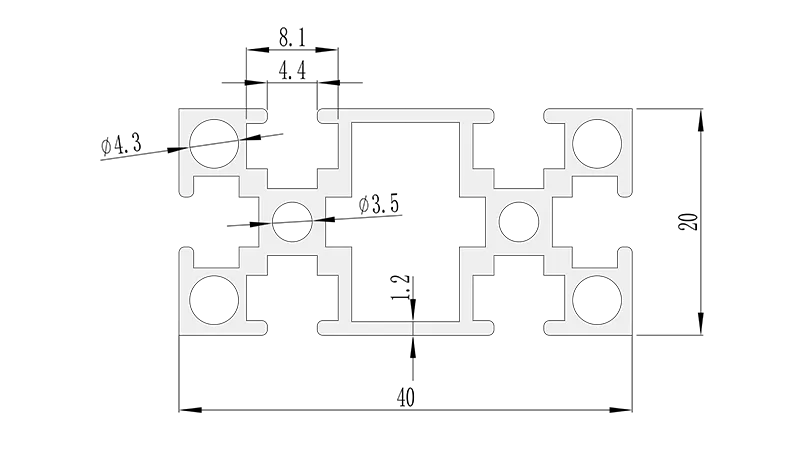
The "2040" in its name refers to its cross-sectional dimensions: 20 millimeters in width and 40 millimeters in height. This size hits a sweet spot: it's sturdy enough to support tools, parts bins, and even small machinery, yet lightweight enough to be handled by a single person during installation. Unlike bulkier profiles (like the 4040, which is 40x40mm), the 2040 doesn't overcomplicate simple setups. And unlike smaller profiles (like the 2020, at 20x20mm), it offers enough surface area and load capacity for most workbench, shelf, and light conveyor applications.
Aluminum: The Material of Choice
2040 profiles are typically made from 6063 aluminum alloy, a material prized for its strength-to-weight ratio, corrosion resistance, and malleability. Aluminum is lighter than steel, making modular structures easier to transport and reconfigure. It's also naturally resistant to rust, which is crucial in environments where moisture, oils, or coolants are present (think automotive repair shops or food processing plants). Many profiles are anodized—coated with a protective layer of oxide—to enhance durability and give them a clean, professional finish.
The T-Slot: A Design Game-Changer
What truly makes aluminum profiles modular is their T-slot design. Running the length of the 2040 profile are one or more longitudinal slots with a T-shaped cross-section. These slots aren't just grooves—they're precision-engineered channels that allow accessories to lock into place. Slide a nut into the slot, rotate it 90 degrees, and it cinches tight against the slot walls. Now you can bolt on a shelf, a tool holder, or a sensor without drilling holes or welding. This adaptability is why aluminum profile accessories—from brackets to casters—are so versatile: they all leverage the T-slot to connect.
But here's the catch: the T-slot is only as useful as the connectors that interact with it. A profile without a way to join to others is just a long piece of metal. That's where 2040 National Standard Profile Connectors come in. They're the bridge between individual profiles, turning separate pieces into a unified, stable structure.
2040 National Standard Profile Connectors: The Glue That Holds It All Together
If the 2040 profile is the "bone" of a modular structure, connectors are the "ligaments" and "joints." They determine how profiles meet, how much weight the structure can bear, and how easily it can be reconfigured. Not all connectors are created equal, though. A poorly designed connector can turn a rigid frame into a wobbly mess, risking safety, efficiency, and product quality. So what makes 2040 connectors special?
First, they're engineered for precision. The tolerances on these connectors are tight—often measured in hundredths of a millimeter—to ensure a snug fit with the 2040 profile's T-slots. This eliminates "play" (looseness) between components, which is a common source of vibration and instability. Second, they're versatile. Whether you need to join profiles at a right angle, a 45-degree angle, or in a straight line, there's a connector designed for the job. Third, they're durable. Made from materials like hardened steel (for heavy loads) or aluminum (for lightweight applications), they're built to withstand the daily grind of industrial use.
A Closer Look: Common Types of 2040 Connectors
To understand how these connectors work, let's explore some of the most widely used types. The table below summarizes their key features, but we'll dive deeper into each afterward:
| Connector Type | Primary Function | Material | Typical Application |
|---|---|---|---|
| 90° Aluminum Profile Connector | Joins two profiles at a right angle | Steel or aluminum | Workbench corners, vertical/horizontal frame joints |
| T-Slot Nut & Bolt | Attaches accessories (shelves, brackets) to profiles | Steel (nut), steel (bolt) | Mounting table tops, tool holders, casters |
| Hinge Connector | Allows rotational movement between profiles | Aluminum with steel pins | Fold-down shelves, adjustable work surfaces |
| End Cap | Covers exposed profile ends | Plastic or aluminum | Safety (prevents cuts), dust/moisture protection |
| 45° Angle Connector | Joins profiles at a 45-degree angle | Steel | Diagonal bracing, sloped surfaces (chutes, ramps) |
1. 90° Aluminum Profile Connector: The Workhorse of Right Angles
Walk into any factory, and you'll see right angles everywhere: the corner of a workbench, the junction of a vertical support and a horizontal shelf, the frame of a material rack. For these connections, the 90° connector is indispensable. These compact, L-shaped components fit into the T-slots of two perpendicular 2040 profiles, locking them together. Some designs use set screws that dig into the profile's slot walls, while others rely on bolts that tighten against the T-slot, creating a friction fit. Either way, the goal is zero movement—no twisting, no pulling apart, even when the structure is loaded with tools or parts.
Heavy-duty 90° connectors are often made from carbon steel with a zinc-plated finish to resist corrosion. Lighter versions, for applications like display shelves or temporary workstations, use aluminum to save weight. What sets quality 90° connectors apart is their precision: the angle is exactly 90 degrees (no more, no less), and the contact points with the profile are smooth to avoid damaging the anodized surface.
2. T-Slot Nuts & Bolts: The Swiss Army Knife of Connectors
If 90° connectors handle the "corners," T-slot nuts and bolts handle everything else. These simple yet ingenious components are the reason aluminum profiles are so adaptable. A T-slot nut is a small, cylindrical or rectangular nut with a T-shaped cross-section that slides into the profile's T-slot. Once inserted, you rotate the nut 90 degrees, and it locks into place—no tools needed for this step. Then, you thread a bolt through an accessory (say, a shelf bracket) and into the nut. As you tighten the bolt, the nut pulls against the slot walls, clamping the accessory tightly to the profile.
T-slot nuts come in various sizes to fit different T-slot widths, and bolts can be short (for thin accessories) or long (for thick ones like wooden table tops). This versatility makes them ideal for mounting everything from caster wheels to LED lights. They're also reusable: loosen the bolt, rotate the nut back to its original position, and slide it out. No holes drilled, no permanent modifications—perfect for modularity.
3. Hinge Connectors: Adding Movement to Modularity
Not all modular structures are static. Sometimes you need parts that move: a fold-down work surface that saves space when not in use, a tilt-out bin for easy access to small parts, or a adjustable monitor arm. Hinge connectors make this possible by joining two profiles with a pivot point. These connectors typically consist of two plates (one attached to each profile) connected by a steel pin. Some have built-in locks to hold the hinge at specific angles (e.g., 90 degrees open, 45 degrees closed), while others allow free rotation.
Hinge connectors are a favorite in workshops where space is limited. Imagine a workbench with a fold-down extension: during the day, it's locked horizontal to provide extra surface area; at night, it folds up to let a cleaning cart pass. The hinge's durability is key here—since it's used repeatedly, it needs smooth rotation and a secure lock to prevent accidental collapse.
4. End Caps: Small Parts, Big Impact
End caps might seem like an afterthought, but they play two critical roles: safety and longevity. Aluminum profiles have sharp, raw ends when cut to length. An end cap covers these edges, preventing cuts to workers' hands or snags on clothing. They also seal the T-slot, keeping out dust, debris, and moisture that could corrode the interior or jam accessories. Most end caps are made from plastic (polypropylene or nylon) for cost-effectiveness, but metal end caps are available for heavy-duty applications where impact resistance is needed (e.g., profiles used as bumpers).
End caps often snap into place without tools, making installation a breeze. Some even come in colors (black, gray, blue) to match company branding or color-code different zones in a facility (e.g., red for "danger," green for "safe").
Why Stability Matters: The Hidden Cost of Wobbly Structures
At this point, you might be thinking: "Connectors hold things together—so what? Isn't that obvious?" But stability in modular structures is about more than just "not falling over." It's about precision, safety, and efficiency. Let's break down why poorly designed or installed connectors can cost businesses far more than the price of a replacement part.
Precision: The Enemy of Vibration
In manufacturing, even tiny vibrations can ruin quality. A workbench that wobbles by just a few millimeters can cause a technician to misalign a circuit board, leading to product defects. A material rack that sways might cause delicate components to shift, leading to scratches or damage. 2040 connectors are engineered to eliminate this "play" by creating a rigid connection. The tight tolerances between the connector and the profile mean no gaps, so vibrations are minimized. High-quality connectors also distribute loads evenly across the structure, preventing stress points that could amplify movement.
Safety: No Room for Error
A unstable structure is a safety hazard. A shelf held up by loose connectors could collapse, injuring workers or damaging equipment. A caster wheel mounted with a stripped T-slot nut might come loose, causing a loaded cart to tip over. OSHA (Occupational Safety and Health Administration) regulations mandate that industrial structures meet strict stability standards, and connectors are a critical part of compliance. Reputable manufacturers test their connectors to ensure they can withstand specified loads—for example, a 90° steel connector might be rated to hold 500 kg vertically without deforming. Cutting corners with cheap, untested connectors isn't just risky—it's illegal.
Efficiency: Time Saved, Money Earned
Loose connectors mean downtime. A wobbly conveyor might need frequent repairs, halting production. A workbench that shifts out of level could force technicians to readjust their tools repeatedly, slowing down assembly. Quality connectors reduce these headaches by staying tight over time. They also save time during installation: well-designed connectors (like quick-release T-slot nuts) cut setup time from hours to minutes. When you need to reconfigure a line for a new product, fast, reliable connectors mean less downtime and faster time-to-market.
Building with 2040 Profiles and Connectors: A Workbench Case Study
To see how these connectors work in practice, let's walk through building a modular workbench—a project many small businesses and workshops tackle. The goal: a sturdy, 120cm x 60cm work surface that can hold a vice, a parts bin, and a small drill press, with a lower shelf for storage. We'll use 2040 National Standard Profiles and a mix of connectors to make it happen.
Step 1: Frame Construction
The frame is the skeleton of the workbench, so we start with four vertical 2040 profiles (legs) cut to 80cm (standard workbench height). Then we add horizontal rails: two along the top (front and back), two along the bottom (to stabilize the legs), and two halfway up for the lower shelf. To join the vertical legs to the horizontal rails, we use 90° steel connectors at each corner. Each connector is inserted into the T-slots of the vertical and horizontal profiles, then secured with bolts. We torque the bolts to the manufacturer's specs (typically 4-5 Nm for steel connectors) to ensure a tight fit without stripping the threads.
Step 2: Adding the Lower Shelf
The lower shelf needs to support heavy toolboxes, so we use 2040 profiles for the shelf frame (same width as the workbench, 60cm deep). We attach angle brackets to the vertical legs using T-slot nuts and bolts—slide the nuts into the T-slots of the legs, align the brackets, and tighten the bolts. Then we set the shelf frame on the brackets and secure it with more T-slot nuts. The result? A shelf that's level, sturdy, and easy to remove if we need more legroom later.
Step 3: Mounting the Table Top
For the table top, we use a 18mm thick plywood sheet cut to size. To attach it to the top rails, we drill holes through the plywood (where the T-slots are) and use long T-slot bolts. The bolts pass through the plywood, into T-slot nuts in the top rails, and are tightened until the table top is clamped firmly. We add washers under the bolt heads to prevent the wood from cracking.
Step 4: Adding Mobility (Optional)
To make the workbench mobile, we mount caster wheels to the bottom rails. Each caster has a mounting plate with pre-drilled holes. We use T-slot nuts and bolts to attach the plates to the bottom rails, ensuring the casters are spaced evenly for stability. We choose locking casters so the workbench stays put when in use—no unwanted rolling during assembly.
Step 5: Finishing Touches
Finally, we snap end caps onto all exposed profile ends to cover sharp edges. We add a fold-down tool holder using hinge connectors on one side—perfect for storing screwdrivers and pliers without cluttering the table top. A quick check with a level confirms the workbench is horizontal, and a shake test (yes, we literally shake it!) proves there's no wobble. Total build time? About 2 hours, thanks to the ease of using T-slot nuts and 90° connectors.
The best part? Next month, if we need to add a light above the workbench, we can slide T-slot nuts into the top rail, bolt on a lamp bracket, and we're done. If we move to a larger space, we can disassemble the workbench, transport the profiles and connectors, and rebuild it in minutes. That's the power of modular design—and it all starts with reliable connectors.
Choosing the Right Connectors: What to Look For
Not all 2040 National Standard Profile Connectors are created equal. To ensure your modular structure is stable and long-lasting, keep these factors in mind when shopping:
Material Matters
For heavy loads (e.g., workbenches holding machinery), choose steel connectors—they're stronger and more resistant to bending. For lightweight applications (e.g., display shelves), aluminum connectors save weight. Plastic connectors are fine for end caps or non-load-bearing parts but avoid them for structural joints.
Tolerance and Fit
Cheap connectors often have loose tolerances—gaps between the connector and the profile that lead to wobble. Look for connectors labeled as "precision-machined" or "ISO 9001 certified," which indicate strict quality control. The connector should slide into the T-slot smoothly but not loosely—you should feel resistance when inserting it, a sign of a snug fit.
Load Rating
Manufacturers typically list load ratings for structural connectors (e.g., "90° connector: 300kg vertical load"). Always choose connectors rated for more than your expected load—over-engineering prevents failure. For example, if your workbench will hold 100kg, use a 90° connector rated for 150kg or more.
Ease of Installation
Look for connectors that don't require special tools. Quick-release T-slot nuts, for example, save time during setup and reconfiguration. Avoid connectors with complicated locking mechanisms that might jam or require training to use.
The Future of 2040 Connectors: Smart, Sustainable, and Stronger
As manufacturing evolves, so too do the components that power it. 2040 National Standard Profile Connectors are no exception, and we're seeing exciting trends that could redefine modular design in the years ahead:
Smart Connectors: Sensors for Predictive Maintenance
Imagine a T-slot nut with a built-in strain gauge that measures how much force it's under. If the nut starts to loosen (and the strain drops), it sends an alert to a maintenance app on your phone. Or a hinge connector with a Bluetooth chip that tracks how many times it's been folded, predicting when it might need lubrication. These "smart" connectors could prevent failures before they happen, reducing downtime and extending the life of modular structures.
Sustainable Materials
Aluminum profiles are already recyclable, but connector manufacturers are exploring greener options. Some are using recycled steel for heavy-duty connectors, while others are testing bioplastics for end caps and light-duty parts. There's also a push for "circular" connector design—components that can be disassembled, repaired, and reused instead of thrown away.
3D-Printed Custom Connectors
For unique applications—say, a connector that joins a 2040 profile to a non-standard pipe—3D printing is game-changing. Engineers can now design custom connectors on a computer, print them in high-strength plastic or metal, and test them in hours. This reduces lead times for one-off projects and opens up new possibilities for modular design.
Conclusion: The Quiet Heroes of Modular Design
2040 National Standard Profile Connectors might not be the flashiest components in a factory, but they're the ones that make flexibility possible. They turn aluminum profiles into workbenches that adapt, material racks that grow, and conveyor systems that evolve. They ensure stability in a world of constant change, keeping workers safe, products precise, and businesses efficient.
The next time you walk through a workshop or manufacturing plant, take a moment to look at the structures around you. Chances are, you'll spot 2040 profiles and their connectors hard at work—quietly, reliably, and without fanfare. And now that you know their story, you'll appreciate the engineering that goes into making modularity possible.
Whether you're building a simple shelf or a complex production line, remember: the strength of your structure depends on the strength of your connectors. Choose wisely, build carefully, and let modularity work for you.