- Company Articles
- Industry articles
- Industry standards
- 2040 National Standard Profile for Automated Guided Vehicle (AGV) Integration

2040 National Standard Profile for Automated Guided Vehicle (AGV) Integration
Related Product
2040 National Standard Profile
45° external bending joint, used for 45° external connection of two aluminum pipes.
The Rise of AGVs and the Need for Adaptive Infrastructure
In the humming heart of modern factories and warehouses, a quiet revolution is unfolding. Automated Guided Vehicles (AGVs) glide along predefined paths, ferrying components between assembly lines, delivering raw materials to workstations, and transporting finished goods to storage. These tireless machines have become the backbone of efficient logistics, reducing human error, cutting down on labor costs, and accelerating production cycles. But behind every smooth AGV operation lies a critical, often overlooked element: the infrastructure that supports them. Without the right framework—flexible, durable, and adaptable—even the most advanced AGVs can stumble, slowing down workflows and defeating the purpose of automation.
Consider a mid-sized electronics manufacturer I visited last year. Their factory had recently invested in a fleet of AGVs to streamline component delivery to their soldering workstations. Initially, they used a patchwork of steel racks and wooden pallets to create loading points. Within months, the steel racks began to rust from coolant spills, the wooden pallets warped under heavy loads, and reconfiguring paths for new product lines meant days of dismantling and rebuilding. The AGVs, designed for precision, often got stuck at uneven transitions between surfaces. It was a costly lesson: AGVs don't just need space to move—they need a support system that can keep up with their speed, adapt to changing demands, and stand up to the rigors of industrial environments.
This is where the 2040 National Standard Profile enters the picture. More than just a length of aluminum, it's a modular building block that transforms how factories design AGV-integrated systems. Lightweight yet strong, customizable yet standardized, it bridges the gap between rigid traditional infrastructure and the dynamic needs of modern automation. In this article, we'll explore why the 2040 National Standard Profile has become the go-to choice for AGV integration, how it pairs with essential components like aluminum profile accessories and roller track, and why it's redefining the way we build workbenches and mobile support units in automated facilities.
Understanding 2040 National Standard Profile: The Backbone of AGV Integration
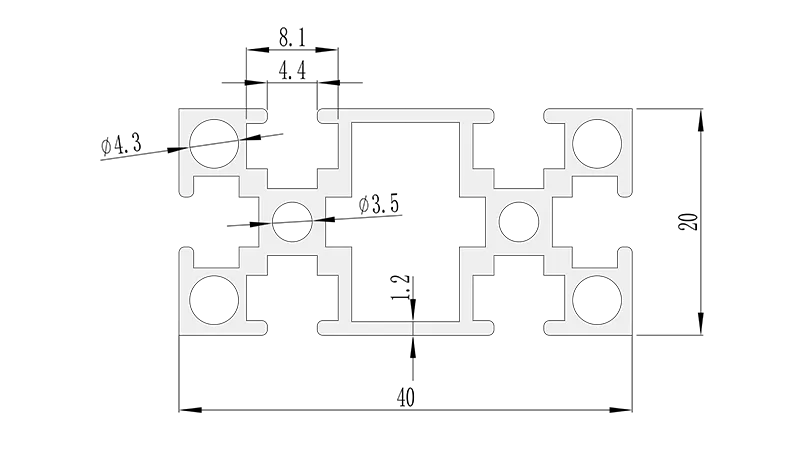
Let's start with the basics: What exactly is the 2040 National Standard Profile? At its core, it's an extruded aluminum profile with a cross-sectional dimension of 20mm by 40mm—hence the name "2040." But those numbers only tell part of the story. What makes it a "national standard" is its adherence to uniform specifications for T-slot dimensions, wall thickness, and material composition, ensuring compatibility across manufacturers. This standardization is a game-changer for factories: whether you source profiles from Supplier A or Supplier B, they'll fit together seamlessly, eliminating the headache of mismatched parts.
Aluminum is the material of choice here, and for good reason. Unlike steel, it's lightweight—about a third the weight—making it easy to handle during installation and reconfiguration. Yet it doesn't skimp on strength: with a tensile strength of around 150-200 MPa (depending on the alloy), it can support heavy loads, from stacks of circuit boards to full pallets of automotive parts. Its natural corrosion resistance is another boon, especially in environments where moisture, coolants, or chemicals are present—no more rusted racks or flaking paint.
But the real magic lies in its T-slot design. Running along the length of the profile are grooves (T-slots) that act as built-in channels for accessories. Need to attach a bracket? Slide a T-bolt into the slot and tighten. Want to add a roller track for material transfer? Use a slot nut to secure it in place. This design turns the 2040 profile into a blank canvas—one that can be transformed into almost any structure, from AGV guide rails to workbench frames, with minimal tools and no welding. For factories that need to reconfigure their layouts quarterly (or even monthly) to keep up with product changes, this flexibility is invaluable.
To put it in perspective: A traditional steel frame might take a team of workers a full day to assemble and bolt into place. A 2040 profile frame? Two people can have it up and running in an hour, using nothing more than hex keys and a rubber mallet. And when the layout changes? Disassemble, rearrange the profiles, and reassemble—no cutting, no grinding, no waste. It's modularity at its finest, and it's exactly what AGV systems need to thrive.
The Role of Aluminum Profile Accessories in Seamless AGV Workflows
A 2040 National Standard Profile is only as good as the accessories that bring it to life. Aluminum profile accessories—the connectors, brackets, end caps, and hinges that join profiles together—are the unsung heroes of AGV integration. They turn individual lengths of aluminum into cohesive, functional structures that can withstand the daily grind of a busy factory.
Take connectors, for example. The 90° aluminum profile connector is a staple in AGV guide rail systems. These small, unassuming pieces allow two 2040 profiles to be joined at a right angle, creating the corners of AGV pathways or the frames of loading platforms. What makes them special is their precision: they lock the profiles into place with zero play, ensuring the guide rail remains straight and true, even as AGVs bump against it during loading. I once saw a food packaging plant use these connectors to build a U-shaped AGV lane around their filling machines. After six months of constant use—with AGVs passing through every 30 seconds—the corners showed no signs of loosening. The secret? The connectors' design distributes stress evenly across the profiles, preventing warping or shifting.
Then there are end caps—simple plastic or aluminum covers that snap onto the ends of 2040 profiles. At first glance, they might seem like an afterthought, but in AGV environments, they're critical. Exposed profile ends can have sharp edges, which pose a risk to workers and can catch on AGV wiring or cargo. End caps smooth those edges, adding a layer of safety. They also keep dust, debris, and liquids out of the T-slots, preventing jams when accessories need to be adjusted. In a pharmaceutical facility I consulted with, end caps even played a role in compliance: their smooth, easy-to-clean surface helped meet strict standards, as there were no crevices for bacteria to hide.
Brackets are another essential accessory, especially when integrating AGV systems with existing infrastructure. L-shaped brackets, for instance, let factories mount 2040 profile frames to walls or ceilings, freeing up floor space for AGV traffic. Angle brackets reinforce joints in high-load areas, like the bases of workbenches where AGVs deposit heavy components. And adjustable brackets? They're a lifesaver for aligning AGV loading platforms with workstation heights. A car parts manufacturer I worked with used adjustable brackets to raise and lower their roller tracks by 5cm increments, ensuring AGVs could dock perfectly with both their low-profile assembly line and their taller storage racks.
What ties all these accessories together is their compatibility with the 2040 National Standard Profile. Because the T-slot dimensions are standardized, accessories from different suppliers work interchangeably. A bracket from Supplier X will fit a connector from Supplier Y, and both will slide into a profile from Supplier Z. This interoperability eliminates vendor lock-in, giving factories the freedom to source parts based on cost, lead time, or local availability. For global manufacturers with facilities in multiple countries, this consistency is a logistical dream—no more re-engineering structures when moving production to a new location.
Roller Track: Enhancing Material Flow Between AGVs and Workstations
AGVs excel at moving goods from Point A to Point B, but once they reach their destination—say, a workstation where a worker assembles components—there's still the matter of transferring the load from the AGV to the worker. This is where roller track shines. A series of small, rotating rollers mounted on a frame, roller track creates a low-friction surface that lets materials glide from AGV beds to workbenches (or vice versa) with minimal effort. And when paired with 2040 National Standard Profiles, roller track becomes a versatile tool for bridging the gap between automated and human workflows.
Let's break down how this works. Imagine an AGV arrives at a workstation carrying a bin of circuit boards. The workstation is built around a 2040 profile frame, with a roller track mounted along the edge facing the AGV path. The AGV stops, aligning its bed with the roller track. A worker simply pushes the bin—now on the rollers—and it slides smoothly onto the workstation. No heavy lifting, no awkward reaching, no risk of straining muscles. This seamless transfer cuts down on the time between AGV arrival and the start of work, boosting overall productivity.
But not all roller tracks are created equal, and their compatibility with 2040 profiles is key. Aluminum roller track, for example, is lightweight and corrosion-resistant, making it ideal for clean environments like electronics assembly. Steel roller track, on the other hand, offers higher load capacity, better suited for automotive parts or heavy machinery components. Both can be easily mounted to 2040 profiles using T-slot nuts and bolts, allowing factories to mix and match based on their needs. A furniture manufacturer I worked with used aluminum roller track for their wooden panel stations (to avoid scratching the wood) and steel roller track for metal frame assembly—all on the same 2040 profile frames.
Another advantage of roller track is its adaptability. Need to change the direction of material flow? Add a 90° roller track connector to redirect the path. Want to create a buffer zone where AGVs can unload multiple bins? Extend the track using roller track placon mounts, which attach to 2040 profiles with a simple twist. Even the height can be adjusted by swapping out brackets, ensuring the track aligns perfectly with AGV beds of different sizes. This flexibility was a game-changer for a beverage bottling plant that switched between glass and plastic bottles—each requiring different AGV bed heights. With 2040 profiles and adjustable roller track mounts, they could reconfigure their loading stations in under an hour.
Perhaps the most underrated benefit of roller track, though, is its impact on worker satisfaction. In factories without roller track, workers often spend 10-15% of their shift manually lifting and moving heavy bins from AGVs. Over time, this leads to fatigue, increased absenteeism, and even injuries. By reducing physical strain, roller track turns tedious, repetitive tasks into quick, effortless actions. A line supervisor at a medical device plant summed it up best: "Since we added roller track to our AGV stations, I've had zero complaints about back pain. The team is more focused, and they're getting through more orders in a day. It's not just about the AGVs—it's about making the workers' jobs easier, too."
Workbenches: Human-Machine Collaboration Hubs Built on 2040 Profiles
AGVs and automation are transforming manufacturing, but humans still play an irreplaceable role—especially in tasks that require dexterity, problem-solving, or quality control. Workbenches are where this human-machine collaboration happens: AGVs deliver materials, workers assemble, inspect, or package products, and AGVs collect the finished items. To make this collaboration effective, workbenches need to be more than just tables—they need to be ergonomic, durable, and integrated with the AGV ecosystem. Enter the 2040 National Standard Profile workbench: a customizable, AGV-friendly hub that puts workers first while keeping pace with automation.
Let's start with ergonomics. A poorly designed workbench can lead to chronic pain, reduced productivity, and even errors. The 2040 profile's modular design lets factories tailor workbench height, depth, and layout to fit their workers, not the other way around. For example, a workbench built with 2040 profiles can be adjusted in 5cm increments using height-adjustable aluminum feet, ensuring workers of different heights can stand comfortably (or sit, if paired with a stool). The T-slot design also allows for easy attachment of accessories like tool holders, monitor arms, or anti-fatigue matting—all positioned exactly where the worker needs them.
Take the "Workbench E (single deck-without caster)" model, a popular choice for AGV-integrated lines. Built with 2040 profiles and a plywood or aluminum honeycomb top, it's lightweight but sturdy enough to support 200kg loads. What makes it AGV-ready is its compatibility with roller track: a section of track can be mounted along the edge facing the AGV path, allowing materials to slide directly from the AGV onto the workbench. I visited a cosmetics manufacturer that used these workbenches for their lipstick assembly line. Their AGVs would deliver trays of lipstick tubes to the roller track edge, and workers would glide the trays into position. The workbench height was set to elbow level for their average worker, reducing shoulder strain, and a small tool holder—mounted via T-slot accessories—kept applicators and labels within arm's reach. The result? A 20% reduction in assembly time and fewer errors in labeling.
Durability is another key factor. Workbenches in industrial settings take a beating: tools get dropped, chemicals spill, and heavy parts are slammed down. The 2040 profile's aluminum construction resists dents and corrosion, while the T-slot design protects internal components from debris. Unlike wooden workbenches, which splinter, or steel ones, which rust, a 2040 profile workbench can last for years with minimal maintenance. A automotive parts supplier I know has had the same set of 2040 profile workbenches for over a decade—they've repainted the tops twice, replaced a few roller track rollers, but the profiles themselves look as good as new.
But perhaps the biggest advantage of 2040 profile workbenches is their ability to evolve with the factory. When product lines change, the workbench can change with them. Need to add a shelf for new tools? Bolt on a few 2040 profiles and a plywood board. Want to move the roller track to the other side to align with a new AGV path? Loosen the T-bolts, reposition, and tighten. This adaptability means factories don't have to buy new workbenches every time they launch a new product—a huge cost-saver. A toy manufacturer I consulted with recently reconfigured 12 workbenches in a single weekend to switch from making action figures to dollhouses, using leftover 2040 profiles and new accessories. The total cost? Less than $500, compared to $12,000 for new workbenches.
Caster Wheels and Mobility: Ensuring Flexibility in AGV Support Systems
Not all AGV support structures need to be fixed in place. Sometimes, you need mobility—workstations that can follow AGV paths, mobile racks that can be positioned where needed, or temporary loading points for peak production periods. This is where caster wheels come into play, and when paired with 2040 National Standard Profiles, they create mobile units that are both stable and easy to maneuver.
Caster wheels might seem simple, but choosing the right ones for AGV-integrated systems is critical. The wrong casters can lead to wobbly workstations, difficulty aligning with AGV paths, or even damage to factory floors. That's why 2040 profile systems often use specialized caster accessories: swivel casters with brakes for easy positioning, heavy-duty wheels for load-bearing, and non-marking rubber tires to protect floors. These casters attach directly to 2040 profile bases using caster mounting plates—another aluminum profile accessory that slides into T-slots and secures with bolts.
Consider a scenario where a factory needs a mobile inspection station that can move along an AGV route. The station is built on a 2040 profile frame with four swivel casters (two with brakes). When an AGV arrives with a batch of products, the worker unlocks the brakes, pushes the station into position, and locks the brakes—securing it firmly in place. The caster wheels, with their precision bearings, roll smoothly over concrete floors, even when the station is loaded with inspection tools and a monitor. After inspection, the worker unlocks the brakes again and moves the station out of the AGV path, clearing the way for the next vehicle. This kind of mobility is impossible with fixed steel or wooden structures, which would require forklifts to reposition.
Heavy-duty applications call for heavy-duty casters. A mobile rack loaded with 500kg of automotive parts, for example, needs casters with high load ratings and sturdy construction. 2040 profiles, with their high strength-to-weight ratio, provide a stable base for these casters, distributing the load evenly across all four wheels. I visited a truck manufacturing plant that used such a setup: their mobile parts racks, built with 2040 profiles and 8-inch heavy-duty casters, could hold entire engine blocks. The casters' locking mechanisms ensured the racks stayed put during loading/unloading by AGVs, and the workers could move them with one hand when needed. "Before, we had to use a pallet jack to move these racks," one worker told me. "Now, I can reposition them myself in 30 seconds. It's like night and day."
Even small details matter when it comes to casters and 2040 profiles. For example, caster accessories like floor locks add an extra layer of stability, preventing mobile units from shifting during AGV docking. Rubber caster wheels absorb vibrations, protecting sensitive components (like circuit boards) during transport. And corrosion-resistant casters ensure longevity in damp environments, such as food processing plants or washing stations. All these features, when combined with the 2040 profile's modularity, create mobile support systems that are not just flexible, but reliable—exactly what AGV operations need to stay efficient.
Comparing 2040 National Standard Profile with Other Materials
To truly appreciate the value of 2040 National Standard Profile for AGV integration, it helps to compare it with other common materials used in factory infrastructure. Below is a breakdown of how it stacks up against steel profiles and plastic extrusions in key areas:
| Feature | 2040 National Standard Profile (Aluminum) | Steel Profiles | Plastic Extrusions |
|---|---|---|---|
| Weight (kg/m) | 1.2-1.5 (lightweight, easy to handle) | 5.0-8.0 (heavy, requires equipment to move) | 0.8-1.0 (lightest, but less durable) |
| Tensile Strength (MPa) | 150-200 (strong enough for most AGV loads) | 300-400 (stronger, but overkill for many applications) | 30-50 (weak, prone to bending under heavy loads) |
| Corrosion Resistance | High (natural oxide layer; no rust) | Low (requires painting/coating; rusts in damp environments) | High (resists chemicals, but UV-sensitive) |
| Customization | Excellent (T-slot design allows easy accessory attachment; no welding needed) | Poor (requires cutting, welding, and drilling for modifications) | Limited (accessories often require adhesives or specialized fasteners) |
| Cost (Relative) | Moderate (higher upfront than plastic, lower long-term than steel) | High (expensive to buy, ship, and install; high maintenance costs) | Low (cheap upfront, but needs frequent replacement) |
| AGV Compatibility | Excellent (smooth surfaces, easy roller track integration, precise alignment) | Good (strong, but heavy and hard to reconfigure) | Poor (flexible, leading to uneven paths; low load capacity) |
As the table shows, 2040 aluminum profiles strike a balance between strength, flexibility, and cost that steel and plastic simply can't match. They're lightweight enough for easy reconfiguration, strong enough for heavy AGV loads, and durable enough to withstand industrial environments. For factories investing in AGVs, this balance translates to lower operational costs, faster adaptation to change, and a longer lifespan for their infrastructure.
Future Trends: 2040 Profiles and the Next Generation of AGV Systems
The future of manufacturing is smart, connected, and increasingly automated. As AGVs evolve—becoming more autonomous, equipped with AI for dynamic path planning, and integrated with IoT sensors—so too will the infrastructure that supports them. The 2040 National Standard Profile, with its modular design and adaptability, is poised to play a central role in this evolution, enabling innovations that we're only beginning to imagine.
One emerging trend is the integration of smart sensors directly into 2040 profile structures. The T-slot design, already ideal for mechanical accessories, can also house wiring, sensors, and even small cameras. Imagine an AGV guide rail built with 2040 profiles that includes embedded proximity sensors. These sensors could detect when an AGV is approaching a workstation, triggering the roller track to power up (using built-in motors) and automatically transfer materials. Or temperature sensors in workbench frames that alert workers if components (like sensitive electronics) are stored outside their optimal range. This "smart infrastructure" would turn passive support systems into active participants in the production process, further reducing human intervention and improving efficiency.
Sustainability is another area where 2040 profiles are set to make an impact. As factories strive to reduce their carbon footprints, aluminum's recyclability becomes a major advantage. Unlike steel (which requires energy-intensive recycling) or plastic (which often ends up in landfills), 2040 profiles can be melted down and reused repeatedly without losing quality. Additionally, their lightweight nature reduces shipping emissions, and their modularity minimizes waste—no more cutting steel beams to length and discarding the scraps. A European automotive manufacturer I spoke with recently set a goal to be carbon-neutral by 2030, and part of their plan is to replace all steel infrastructure with 2040 aluminum profiles. They estimate this switch will reduce their annual waste by 15% and cut shipping emissions by 20%.
Finally, the rise of collaborative robots (cobots) working alongside AGVs will drive demand for even more flexible workspaces. Cobots, unlike traditional industrial robots, work in close proximity to humans, requiring workbenches and support structures that can adapt to both human and machine needs. 2040 profiles, with their ability to be quickly reconfigured, will be the foundation for these hybrid workspaces. For example, a workbench might start the day as a cobot assembly station, then be reconfigured in the afternoon into an AGV loading point, with tool holders and roller tracks moved to accommodate the new workflow. This kind of agility will be essential for factories competing in fast-changing markets.
Conclusion: Building the Future of Automation, One Profile at a Time
Automated Guided Vehicles are more than just machines—they're a testament to how far manufacturing has come, and a glimpse of where it's headed. But for all their advanced technology, AGVs rely on something surprisingly simple: the infrastructure that supports them. The 2040 National Standard Profile, with its strength, flexibility, and compatibility with aluminum profile accessories, roller track, workbenches, and caster wheels, has emerged as the backbone of this infrastructure. It's not just a material choice; it's a strategic one—one that empowers factories to adapt, grow, and thrive in an era of rapid automation.
From the electronics manufacturer that eliminated AGV jams with roller track-equipped workbenches to the toy factory that reconfigured workstations in a weekend, the stories of 2040 profile success are as varied as the industries that use them. They all share a common thread: the profile's ability to turn complex challenges into simple solutions. It's a reminder that sometimes, the most innovative advances in manufacturing aren't in the robots themselves, but in the quiet, unassuming components that make their work possible.
As we look to the future—with smarter AGVs, more connected factories, and a greater focus on sustainability—the 2040 National Standard Profile will continue to evolve, adapting to new needs and new technologies. But one thing will remain constant: its role as a bridge between automation and human ingenuity, ensuring that as machines get smarter, the people who work alongside them have the tools they need to succeed. After all, the best automation isn't about replacing humans—it's about empowering them. And with 2040 profiles, that empowerment starts with the very structure of the factory itself.