- Company Articles
- Industry articles
- Industry standards
- 2040 National Standard Profile for Ergonomic Workstations: Design Principles

2040 National Standard Profile for Ergonomic Workstations: Design Principles
Related Product
2040 National Standard Profile
45° external bending joint, used for 45° external connection of two aluminum pipes.
Introduction: Why Workstation Design Matters More Than You Think
Think about your average workday. Whether you're assembling components on a factory floor, analyzing samples in a lab, or crunching numbers at a desk, the space around you shapes how you feel, how productive you are, and even how healthy you stay. A workstation that's too low forces you to hunch, straining your neck and back. One that's cluttered with tools scattered everywhere eats up precious time as you hunt for what you need. And if it's fixed in place, you might find yourself constantly walking back and forth just to grab materials—wasting energy that could go into actual work.
This is where ergonomic design comes in. Ergonomics isn't just a buzzword; it's the science of fitting a workspace to the people who use it. And at the heart of many modern ergonomic workstations lies a quiet hero: the 2040 national standard profile. This unassuming aluminum extrusion has become a go-to choice for designers and facility managers who want workstations that are flexible, durable, and—most importantly—tailored to human needs. In this article, we'll dive into the design principles that make 2040 national standard profile workstations stand out, and how they're transforming workplaces from rigid, one-size-fits-all setups into dynamic, people-first environments.
This is where ergonomic design comes in. Ergonomics isn't just a buzzword; it's the science of fitting a workspace to the people who use it. And at the heart of many modern ergonomic workstations lies a quiet hero: the 2040 national standard profile. This unassuming aluminum extrusion has become a go-to choice for designers and facility managers who want workstations that are flexible, durable, and—most importantly—tailored to human needs. In this article, we'll dive into the design principles that make 2040 national standard profile workstations stand out, and how they're transforming workplaces from rigid, one-size-fits-all setups into dynamic, people-first environments.
Understanding the 2040 National Standard Profile: More Than Just a Piece of Aluminum
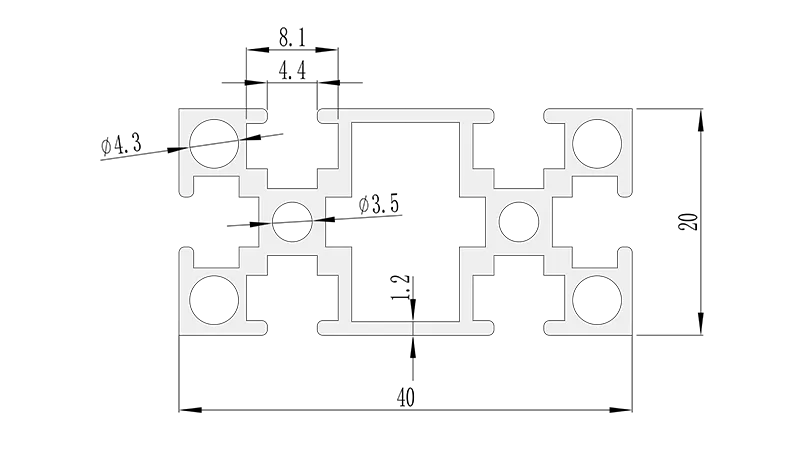
Before we jump into design principles, let's get to know the star of the show: the 2040 national standard profile. At first glance, it might look like a simple rectangular tube, but its design is anything but basic. Measuring 20mm in width and 40mm in height, this aluminum extrusion is engineered with a T-slot running along its length—a small groove that opens up a world of possibilities.
Why aluminum? For starters, it's lightweight enough to be easily maneuvered during setup but strong enough to support heavy tools, materials, or equipment. Unlike steel, it resists corrosion, so it holds up well in damp environments or factories where spills happen. And let's not forget sustainability: aluminum is 100% recyclable, making it a choice that aligns with modern eco-friendly goals.
The T-slot is where the magic happens. Imagine a row of tiny, evenly spaced "tracks" along the profile's edges. These slots let you slide in accessories—brackets, joints, shelves, or even lighting—without drilling holes or welding. Need to add a tool holder? Slide a bracket into the T-slot and tighten a screw. Want to reposition a shelf? Loosen the screw, move it, and retighten. This flexibility is a game-changer, especially in fast-paced environments where workflows evolve overnight.
Why aluminum? For starters, it's lightweight enough to be easily maneuvered during setup but strong enough to support heavy tools, materials, or equipment. Unlike steel, it resists corrosion, so it holds up well in damp environments or factories where spills happen. And let's not forget sustainability: aluminum is 100% recyclable, making it a choice that aligns with modern eco-friendly goals.
The T-slot is where the magic happens. Imagine a row of tiny, evenly spaced "tracks" along the profile's edges. These slots let you slide in accessories—brackets, joints, shelves, or even lighting—without drilling holes or welding. Need to add a tool holder? Slide a bracket into the T-slot and tighten a screw. Want to reposition a shelf? Loosen the screw, move it, and retighten. This flexibility is a game-changer, especially in fast-paced environments where workflows evolve overnight.
Real Talk:
Maria, a production supervisor at a electronics plant, puts it this way: "A few years ago, if we needed to reconfigure our assembly line, we'd have to call in a welder or buy entirely new workbenches. Now, with 2040 profile, my team can swap out components in an hour. Last month, we shifted from assembling small circuit boards to larger displays—all we did was add longer brackets and adjust the shelf height. No downtime, no extra costs. It's like having a workstation that grows with us."
Key Design Principles: Building Workstations Around People
The best ergonomic workstations don't just "work"—they work
with
the people using them. Let's break down the core principles that guide 2040 national standard profile workstation design, and how each one contributes to a better, more human-centered workspace.
1. Ergonomic Height & Adjustability: One Size Fits None
Walk into any workplace, and you'll notice something immediately: people come in all shapes and sizes. A workstation that's perfect for a 5'2" operator might be a nightmare for someone who's 6'4". That's why adjustability is the first rule of thumb when designing with 2040 profile.
Enter adjustable leveling feet —small but mighty components that screw into the base of the workstation. These feet aren't just for keeping the table steady on uneven floors (though that's a big plus). They let users tweak the height by fractions of an inch, ensuring elbows rest at a 90-degree angle when typing or assembling, and wrists stay straight to avoid strain. For seated workstations, the ideal height is typically around 29-30 inches, but with leveling feet, you can dial it up to 34 inches for standing setups or down to 26 inches for tasks that require closer inspection.
Then there's mobility. Not every task stays in one spot. A quality control inspector might need to move their workstation to different parts of the factory floor, or a lab technician might shift between benches to test multiple samples. That's where caster wheels come in. These swiveling wheels attach to the 2040 profile's base, turning a stationary bench into a mobile workstation. Lockable casters add safety, ensuring the workstation stays put when in use, then rolls smoothly when it's time to relocate.
The beauty? Both leveling feet and caster wheels integrate seamlessly with the 2040 profile's T-slot design. No special tools, no permanent modifications—just attach, adjust, and go. This means one workstation can serve multiple users throughout the day, adapting to whoever needs it next.
Enter adjustable leveling feet —small but mighty components that screw into the base of the workstation. These feet aren't just for keeping the table steady on uneven floors (though that's a big plus). They let users tweak the height by fractions of an inch, ensuring elbows rest at a 90-degree angle when typing or assembling, and wrists stay straight to avoid strain. For seated workstations, the ideal height is typically around 29-30 inches, but with leveling feet, you can dial it up to 34 inches for standing setups or down to 26 inches for tasks that require closer inspection.
Then there's mobility. Not every task stays in one spot. A quality control inspector might need to move their workstation to different parts of the factory floor, or a lab technician might shift between benches to test multiple samples. That's where caster wheels come in. These swiveling wheels attach to the 2040 profile's base, turning a stationary bench into a mobile workstation. Lockable casters add safety, ensuring the workstation stays put when in use, then rolls smoothly when it's time to relocate.
The beauty? Both leveling feet and caster wheels integrate seamlessly with the 2040 profile's T-slot design. No special tools, no permanent modifications—just attach, adjust, and go. This means one workstation can serve multiple users throughout the day, adapting to whoever needs it next.
2. Modularity & Flexibility: Workstations That Adapt, Not Obstruct
Industries change fast. A manufacturer might switch from producing parts for cars to parts for drones in a matter of months. A lab could shift from chemical testing to biological research, requiring entirely new storage and workflow setups. In these cases, rigid, fixed workstations become dead weight—literally.
2040 national standard profile thrives here, thanks to its modular design and compatibility with aluminum profile accessories . Think of the profile as a "building block" and accessories as the "connectors" that let you stack, bend, and extend those blocks into any shape. Need a shelf above the work surface? Use a 90-degree bracket in the T-slot. Want to add a side table for tools? Attach a parallel joint and slide in another 2040 profile section.
Accessories like internal straight aluminum joints or parallel fixation brackets make reconfiguration a breeze. These small, often overlooked components act like the "hinges" of the workstation, letting you pivot shelves, add extensions, or even fold parts down when not in use. For example, a workbench in a small workshop might have a fold-down side shelf that's only used during peak hours, then folded up to save space overnight.
This modularity also future-proofs your investment. Instead of replacing an entire workstation when needs change, you just swap out the accessories. It's like upgrading a phone case instead of buying a new phone—cost-effective, sustainable, and infinitely customizable.
2040 national standard profile thrives here, thanks to its modular design and compatibility with aluminum profile accessories . Think of the profile as a "building block" and accessories as the "connectors" that let you stack, bend, and extend those blocks into any shape. Need a shelf above the work surface? Use a 90-degree bracket in the T-slot. Want to add a side table for tools? Attach a parallel joint and slide in another 2040 profile section.
Accessories like internal straight aluminum joints or parallel fixation brackets make reconfiguration a breeze. These small, often overlooked components act like the "hinges" of the workstation, letting you pivot shelves, add extensions, or even fold parts down when not in use. For example, a workbench in a small workshop might have a fold-down side shelf that's only used during peak hours, then folded up to save space overnight.
This modularity also future-proofs your investment. Instead of replacing an entire workstation when needs change, you just swap out the accessories. It's like upgrading a phone case instead of buying a new phone—cost-effective, sustainable, and infinitely customizable.
3. Material Flow & Accessibility: Keep What You Need Within Reach
Ever noticed how much time is wasted walking to grab tools, materials, or documents? In a typical factory, workers might spend up to 20% of their shift just moving things around. Ergonomic workstations designed with 2040 profile tackle this by prioritizing material flow—ensuring everything you need is within arm's reach, exactly where you need it.
A well-designed workbench using 2040 profile often features zones: a primary work area (where the main task happens), a secondary zone for tools and materials, and a tertiary zone for finished products or waste. For example, an assembly workbench might have a flat surface in the center (primary zone), a tool rail along the back (secondary zone) with hanging pliers and screwdrivers, and a sloped shelf in front (tertiary zone) where completed parts slide into a bin.
The T-slot design makes it easy to add dividers, bins, or even small roller tracks to guide materials. Want to keep screws and nuts organized? Attach a pegboard or a set of small drawers using T-slot brackets. Need to move finished parts to the next station? Add a mini roller track along the edge of the workbench, so gravity does the work for you.
Accessibility also means reducing unnecessary bending or stretching. By using adjustable shelves (via, you guessed it, 2040 profile accessories), you can position heavy tools at waist height instead of on the floor, and frequently used items at eye level. This not only saves time but also cuts down on strain injuries—a win-win for both workers and employers.
A well-designed workbench using 2040 profile often features zones: a primary work area (where the main task happens), a secondary zone for tools and materials, and a tertiary zone for finished products or waste. For example, an assembly workbench might have a flat surface in the center (primary zone), a tool rail along the back (secondary zone) with hanging pliers and screwdrivers, and a sloped shelf in front (tertiary zone) where completed parts slide into a bin.
The T-slot design makes it easy to add dividers, bins, or even small roller tracks to guide materials. Want to keep screws and nuts organized? Attach a pegboard or a set of small drawers using T-slot brackets. Need to move finished parts to the next station? Add a mini roller track along the edge of the workbench, so gravity does the work for you.
Accessibility also means reducing unnecessary bending or stretching. By using adjustable shelves (via, you guessed it, 2040 profile accessories), you can position heavy tools at waist height instead of on the floor, and frequently used items at eye level. This not only saves time but also cuts down on strain injuries—a win-win for both workers and employers.
4. Safety & Comfort: No Compromises on Well-Being
A workstation can be adjustable and flexible, but if it's unsafe or uncomfortable, none of that matters. 2040 national standard profile addresses this with design features that prioritize user well-being, starting with the material itself. Aluminum's smooth, non-porous surface is easy to clean, which is crucial in environments like labs or food processing plants where hygiene is key. Unlike steel, it doesn't rust, so there's no risk of sharp, corroded edges cutting hands.
Many 2040 profile workstations also incorporate rounded edges, a small detail that makes a big difference. Sharp corners can lead to bumps and bruises—especially in busy areas where people move quickly. Rounded edges reduce that risk, turning a potential hazard into a gentle, user-friendly surface.
Caster wheels play a role here too, but not just for mobility. Lockable caster wheels ensure the workstation stays put when in use, preventing accidental slips or shifts. Heavy-duty casters with rubber wheels also absorb vibrations, which is a boon for tasks that require precision—like assembling delicate electronics or performing lab tests.
Comfort extends to the little things, too. For example, some workbench tops made with 2040 profile use anti-fatigue mats, or the profile itself can be fitted with rubber strips (another aluminum profile accessory) to dampen noise from tools hitting the surface. These touches might seem minor, but over a 8-hour shift, they add up to a much more pleasant work experience.
Many 2040 profile workstations also incorporate rounded edges, a small detail that makes a big difference. Sharp corners can lead to bumps and bruises—especially in busy areas where people move quickly. Rounded edges reduce that risk, turning a potential hazard into a gentle, user-friendly surface.
Caster wheels play a role here too, but not just for mobility. Lockable caster wheels ensure the workstation stays put when in use, preventing accidental slips or shifts. Heavy-duty casters with rubber wheels also absorb vibrations, which is a boon for tasks that require precision—like assembling delicate electronics or performing lab tests.
Comfort extends to the little things, too. For example, some workbench tops made with 2040 profile use anti-fatigue mats, or the profile itself can be fitted with rubber strips (another aluminum profile accessory) to dampen noise from tools hitting the surface. These touches might seem minor, but over a 8-hour shift, they add up to a much more pleasant work experience.
5. Durability & Sustainability: Built to Last, Designed to Recycle
A workstation is an investment, and no one wants to replace it every few years. 2040 national standard profile checks the durability box with flying colors. Aluminum is inherently strong—while it's lightweight (about 1/3 the weight of steel), it has a high strength-to-weight ratio, meaning it can support heavy loads without bending or warping. This is why it's used in everything from airplanes to construction beams.
The T-slot design also contributes to durability. By distributing weight evenly across the profile (instead of concentrating it on a single weld or bolt), the workstation can handle repeated use without weakening. Even with frequent reconfigurations, the slots and accessories hold up—no stripped threads or loose connections.
Then there's sustainability. Aluminum is one of the most recyclable materials on the planet—recycling it uses just 5% of the energy needed to produce new aluminum, and it can be recycled infinitely without losing quality. For companies aiming to reduce their carbon footprint, this is a huge plus. When a 2040 profile workstation finally reaches the end of its life (which, with proper care, could be decades), the aluminum can be melted down and turned into new profiles, accessories, or even other products.
Compare that to workstations made with particleboard or plastic, which often end up in landfills. With 2040 profile, you're not just building a workstation—you're making a choice that's good for your team, your budget, and the planet.
The T-slot design also contributes to durability. By distributing weight evenly across the profile (instead of concentrating it on a single weld or bolt), the workstation can handle repeated use without weakening. Even with frequent reconfigurations, the slots and accessories hold up—no stripped threads or loose connections.
Then there's sustainability. Aluminum is one of the most recyclable materials on the planet—recycling it uses just 5% of the energy needed to produce new aluminum, and it can be recycled infinitely without losing quality. For companies aiming to reduce their carbon footprint, this is a huge plus. When a 2040 profile workstation finally reaches the end of its life (which, with proper care, could be decades), the aluminum can be melted down and turned into new profiles, accessories, or even other products.
Compare that to workstations made with particleboard or plastic, which often end up in landfills. With 2040 profile, you're not just building a workstation—you're making a choice that's good for your team, your budget, and the planet.
2040 Profile & Accessories: A Match Made in Workstation Heaven
A 2040 national standard profile is only as good as the accessories that bring it to life. From adjustable feet to tool holders, these components turn a simple aluminum extrusion into a fully functional workstation. Let's take a closer look at some key accessories and how they work with the 2040 profile to enhance ergonomics.
The table below highlights common accessories, their functions, and why they're essential for a well-designed workstation:
The table below highlights common accessories, their functions, and why they're essential for a well-designed workstation:
| Accessory Type | Key Examples | Function | Why It Matters for Ergonomics |
|---|---|---|---|
| Aluminum Profile Accessories | Internal straight joints, 90° brackets, parallel fixation clips | Connect profiles to build shelves, frames, or extensions | Enables modular reconfiguration—swap parts to fit user needs |
| Adjustable Leveling Feet | M10*56 rubber leveling feet, anti-slip adjustable feet | Fine-tune workstation height; stabilize on uneven floors | Customizes height for users of different sizes, reducing strain |
| Caster Wheels | Flat swivel casters with brake, 360° swivel stem casters | Add mobility; lock in place when stationary | Allows users to move workstations to materials, reducing walking |
| Workbench Components | Shelves, tool rails, bin holders | Organize tools and materials within reach | Reduces bending/stretching; keeps work area clutter-free |
Each of these accessories leverages the 2040 profile's T-slot design, making installation a breeze. For example, attaching adjustable leveling feet involves sliding a threaded insert into the T-slot, screwing in the foot, and twisting to raise or lower the workstation. No special skills required—even someone with minimal DIY experience can do it.
What's more, many accessories are interchangeable across different profile sizes (like 2020 or 3030), giving you even more flexibility. If you decide to expand your workstation with a wider profile later, you can reuse most of your existing accessories—a cost-saving feature that adds to the 2040 profile's appeal.
What's more, many accessories are interchangeable across different profile sizes (like 2020 or 3030), giving you even more flexibility. If you decide to expand your workstation with a wider profile later, you can reuse most of your existing accessories—a cost-saving feature that adds to the 2040 profile's appeal.
Real-World Applications: 2040 Profile in Action
To truly understand the impact of these design principles, let's look at how 2040 national standard profile workstations are transforming workplaces across different industries.
Manufacturing: At a automotive parts plant in Michigan, workers assemble intricate engine components on 2040 profile workstations. Each station is equipped with adjustable leveling feet to accommodate operators of varying heights, and caster wheels so the workstation can be rolled right up to the assembly line. Tool rails along the back (attached via 90° aluminum brackets) hold wrenches and screwdrivers, while a sloped shelf in front uses gravity to feed small parts into reach. "Since switching to these workstations, our error rate has dropped by 15%," says the plant manager. "Workers aren't straining to reach tools, and they can adjust the height in seconds. It's made a huge difference in both quality and morale."
Laboratories: A research lab at a university uses 2040 profile workstations for chemical analysis. The aluminum construction is corrosion-resistant, making it safe for spills, and the T-slot design lets researchers add custom shelving for test tubes and equipment. Adjustable leveling feet ensure the work surface stays perfectly flat—critical for precise measurements. "We often collaborate with different teams, each with unique needs," explains a lab technician. "One week, we're testing water samples; the next, we're analyzing soil. With 2040 profile, we can reconfigure the workstation overnight. It's like having a custom lab setup without the custom price tag."
Offices: Even traditional offices are getting in on the action. A tech startup in California uses 2040 profile standing desks, where employees can adjust the height with a simple crank (powered by, you guessed it, adjustable leveling feet). The T-slot holds cable management clips, keeping wires organized, and caster wheels let workers roll their desks into collaborative pods for meetings. "Our team is all about flexibility," says the office manager. "People move between focused work and group projects all day. These desks adapt to that—no more one-person, one-desk rigidity."
Manufacturing: At a automotive parts plant in Michigan, workers assemble intricate engine components on 2040 profile workstations. Each station is equipped with adjustable leveling feet to accommodate operators of varying heights, and caster wheels so the workstation can be rolled right up to the assembly line. Tool rails along the back (attached via 90° aluminum brackets) hold wrenches and screwdrivers, while a sloped shelf in front uses gravity to feed small parts into reach. "Since switching to these workstations, our error rate has dropped by 15%," says the plant manager. "Workers aren't straining to reach tools, and they can adjust the height in seconds. It's made a huge difference in both quality and morale."
Laboratories: A research lab at a university uses 2040 profile workstations for chemical analysis. The aluminum construction is corrosion-resistant, making it safe for spills, and the T-slot design lets researchers add custom shelving for test tubes and equipment. Adjustable leveling feet ensure the work surface stays perfectly flat—critical for precise measurements. "We often collaborate with different teams, each with unique needs," explains a lab technician. "One week, we're testing water samples; the next, we're analyzing soil. With 2040 profile, we can reconfigure the workstation overnight. It's like having a custom lab setup without the custom price tag."
Offices: Even traditional offices are getting in on the action. A tech startup in California uses 2040 profile standing desks, where employees can adjust the height with a simple crank (powered by, you guessed it, adjustable leveling feet). The T-slot holds cable management clips, keeping wires organized, and caster wheels let workers roll their desks into collaborative pods for meetings. "Our team is all about flexibility," says the office manager. "People move between focused work and group projects all day. These desks adapt to that—no more one-person, one-desk rigidity."
Conclusion: Designing Workstations That Respect the Human Element
At the end of the day, ergonomic workstations aren't just about tools or materials—they're about people. They're about recognizing that every operator, technician, or researcher deserves a space that fits
them
, not the other way around. The 2040 national standard profile, with its focus on adjustability, modularity, and safety, embodies this philosophy.
By prioritizing design principles like ergonomic height (via adjustable leveling feet), flexibility (through aluminum profile accessories), and accessibility (with well-organized workbench zones), 2040 profile workstations do more than improve productivity—they improve lives. They reduce strain, cut down on injuries, and turn "workspaces" into "work homes " where people feel valued and supported.
So the next time you walk into a workplace, take a closer look at the workstations. Chances are, if they're built with 2040 national standard profile, there's a team behind them that cares about more than just getting the job done—they care about who is doing the job. And in today's fast-paced world, that's a difference that matters.
By prioritizing design principles like ergonomic height (via adjustable leveling feet), flexibility (through aluminum profile accessories), and accessibility (with well-organized workbench zones), 2040 profile workstations do more than improve productivity—they improve lives. They reduce strain, cut down on injuries, and turn "workspaces" into "work homes " where people feel valued and supported.
So the next time you walk into a workplace, take a closer look at the workstations. Chances are, if they're built with 2040 national standard profile, there's a team behind them that cares about more than just getting the job done—they care about who is doing the job. And in today's fast-paced world, that's a difference that matters.