- Company Articles
- Industry articles
- Industry standards
- 2040 National Standard Profile for Mobile Carts: Enhancing Factory Mobility

2040 National Standard Profile for Mobile Carts: Enhancing Factory Mobility
Related Product
2040 National Standard Profile
45° external bending joint, used for 45° external connection of two aluminum pipes.
In the fast-paced world of modern manufacturing, every second counts. From the moment raw materials enter the factory floor to the final product rolling off the assembly line, efficiency isn't just a goal—it's the lifeblood of staying competitive. Yet, one often-overlooked bottleneck quietly drains productivity: how materials, tools, and components move around the workspace. Heavy, clunky carts that creak under load, rigid structures that can't adapt to shifting production needs, and frequent breakdowns that bring workflows to a halt—these are the silent productivity killers in factories worldwide. But what if there was a solution that combined strength, flexibility, and lightweight design to transform how your team moves goods? Enter the 2040 National Standard Profile, a humble yet revolutionary aluminum extrusion that's redefining factory mobility, one cart at a time.
The Hidden Cost of Poor Factory Mobility
Let's start with a scenario many factory managers know all too well: A line worker needs a batch of small components from the storage area to keep the assembly line running. They grab the nearest cart—a heavy steel behemoth with rusted wheels that wobble with every push. Maneuvering it through narrow aisles takes extra effort; turning corners requires brute strength, and if the load shifts, the cart threatens to tip. By the time they return, precious minutes have slipped away, and the line is already showing signs of slowdown. Multiply this by dozens of trips daily, across hundreds of workers, and the cumulative loss in productivity becomes staggering.
Traditional mobile carts, often made of solid steel or low-grade plastic, come with a long list of drawbacks. Steel carts are durable but punishingly heavy, increasing the risk of worker fatigue and injury. Their fixed designs mean they can't be easily modified if your production line reconfigures next month—you either live with inefficiency or invest in a brand-new cart. Plastic carts, while lighter, lack the structural integrity to handle heavy loads, cracking under pressure and needing replacement every year or two. And let's not forget maintenance: rusted axles, seized wheels, and broken frames require constant repairs, eating into your maintenance budget and creating unplanned downtime.
The root of the problem? A mismatch between the tools and the task. Factories today need mobility solutions that are agile —light enough to move with ease, strong enough to carry critical loads, and flexible enough to adapt to changing needs. That's where the 2040 National Standard Profile steps in.
What Is the 2040 National Standard Profile?
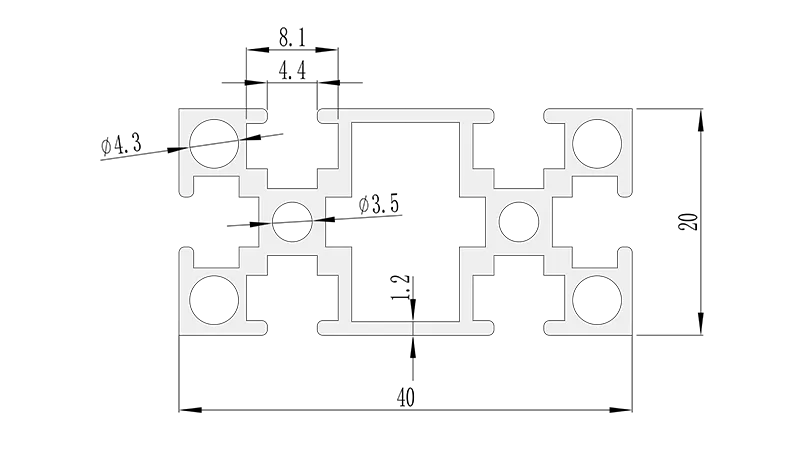
At first glance, the 2040 National Standard Profile might look like just another aluminum extrusion—a long, slender piece with a rectangular cross-section. But its simplicity is deceptive. Defined by strict national manufacturing standards, this profile measures 20mm in width and 40mm in height, with a precision-engineered T-slot running along its length. This slot isn't just a design quirk; it's the key to its versatility. Made from high-grade aluminum alloy (typically 6063-T5), it balances two critical properties: strength and lightness. Aluminum's natural resistance to corrosion means it won't rust, even in humid factory environments, and its malleability allows for intricate extrusion designs without sacrificing durability.
The "national standard" label is crucial here. Unlike generic aluminum extrusions, which can vary in dimensions and quality between suppliers, the 2040 National Standard Profile adheres to uniform specifications for wall thickness, slot size, and material composition. This consistency ensures that components from different manufacturers—whether brackets, connectors, or accessories—will fit together seamlessly. Imagine building a cart where you can mix and match parts from multiple suppliers without worrying about compatibility issues. That's the power of standardization.
But what truly sets the 2040 profile apart is its modularity . The T-slot design allows for quick, tool-free attachment of accessories: caster wheels, shelves, handles, bins, or even custom fixtures like laptop mounts for digital work instructions. No welding, no drilling, no complicated assembly—just slide a bolt into the slot, tighten a nut, and you're done. This modularity transforms the profile from a static piece of metal into a building block for endless possibilities, especially when paired with the right aluminum profile accessories.
Why Aluminum? The Material Advantage
You might be wondering: Why aluminum, and why now? For decades, steel has been the go-to for industrial carts, prized for its raw strength. But steel's Achilles' heel is its weight. A 1-meter length of 20x40 steel profile can weigh 3–4 kg, while the same length of aluminum 2040 profile weighs just 1.2–1.5 kg—less than half! This weight reduction is a game-changer for mobile carts. A fully loaded 2040 aluminum cart might weigh 30–40 kg, compared to 60–80 kg for a steel equivalent with the same load capacity. For workers pushing carts 50+ times a day, that difference translates to less fatigue, fewer injuries, and more energy to focus on the task at hand.
Aluminum also brings sustainability to the table. Unlike steel, it doesn't require painting or coating to resist corrosion, reducing chemical use in your facility. It's 100% recyclable, so even at the end of its lifespan, the profile can be melted down and repurposed—aligning with the growing push for eco-friendly manufacturing practices. And let's talk about maintenance: A quick wipe with a damp cloth is all it takes to keep aluminum profiles looking and performing like new. No rust, no flaking paint, no hidden decay—just reliable performance year after year.
Building Better Mobile Carts: The 2040 Profile in Action
So, how do you turn a simple aluminum extrusion into a high-performance mobile cart? Let's break down the key components, starting with the star of the show: the 2040 National Standard Profile.
The Frame: The Backbone of Mobility The cart's frame is built by cutting 2040 profiles to length and joining them using aluminum profile accessories like corner brackets, T-connectors, and end caps. The T-slot allows for precise alignment—no more guesswork or misaligned holes. For example, a basic cart frame might use four vertical 2040 profiles for the corners, connected by horizontal profiles at the top, bottom, and midsection for stability. The result? A lightweight yet rigid structure that can support loads up to 200–300 kg (depending on design), all while weighing a fraction of a steel frame.
Caster Wheels: Smooth Movement, Even Under Load What good is a lightweight frame if the wheels can't keep up? The 2040 profile pairs perfectly with high-quality caster wheels—swivel casters with brakes for easy maneuvering and stability when parked. Thanks to the T-slot, casters can be mounted anywhere along the frame, allowing you to adjust the wheelbase for optimal balance. Heavy-duty caster wheels with rubberized treads glide over concrete floors, reducing noise and vibration, while sealed bearings prevent dust and debris from jamming the mechanism. It's a small detail, but anyone who's pushed a cart with sticky wheels knows: smooth-rolling casters are worth their weight in gold.
Shelves and Work Surfaces: Customizable Storage Need to carry small parts? Add a middle shelf using 2040 profiles and a lightweight aluminum honeycomb panel. Transporting bulky items? Skip the shelf and use a single large work surface. The T-slot makes it easy to adjust shelf heights or add dividers, bins, or tool hooks—whatever your load requires. For example, a cart used in electronics assembly might have a lower shelf for heavy components, a middle shelf with divided bins for screws and washers, and a top surface with a non-slip mat to keep delicate circuit boards secure.
Handles and Safety Features: Designed for Workers Ergonomics matter. The 2040 profile lets you mount handles at the perfect height—no more stooping or reaching. Add edge guards to prevent items from sliding off, or reflective strips for visibility in low-light areas. Some carts even include a push bar with integrated storage for gloves or a barcode scanner, keeping essential tools within arm's reach. It's these small, worker-centric details that turn a "functional" cart into a "loved" cart.
2040 Profile vs. the Competition: Why Size Matters
You might be thinking: "We already use aluminum profiles—why switch to 2040?" It's true that profiles like 3030 (30mm x 30mm) or 4040 (40mm x 40mm) are common, but the 2040 National Standard Profile hits a sweet spot between size, strength, and weight that makes it ideal for mobile applications. Let's compare:
| Profile Type | Dimensions (WxH) | Weight (kg/m) | Typical Load Capacity (kg per linear meter) | Best For |
|---|---|---|---|---|
| 2040 National Standard | 20mm x 40mm | 1.2–1.5 | 150–250 | Mobile carts, light-to-medium duty transport, workstations on wheels |
| 3030 National Standard | 30mm x 30mm | 1.8–2.2 | 200–300 | Fixed workbenches, shelving units, stationary racks |
| 4040 National Standard | 40mm x 40mm | 2.5–3.0 | 300–500 | Heavy-duty machinery frames, industrial storage systems |
The 2040 profile's narrow 20mm width makes it perfect for tight spaces—navigating between assembly lines or through doorways that would jam a bulkier 4040-based cart. Its 40mm height provides vertical strength, ensuring the frame doesn't flex under load, while its lightweight design keeps the cart easy to push. For mobile applications, where maneuverability is as important as strength, the 2040 profile is the clear winner.
From Assembly Lines to Warehouses: Where 2040 Carts Excel
The beauty of 2040 profile carts lies in their versatility. They're not limited to one department—they thrive across the factory floor:
Assembly Line Support In automotive or electronics assembly, where parts arrive in waves, 2040 carts act as "mobile buffers." A cart loaded with the next batch of components can wait at the line's edge, then slide into place the moment the previous batch is empty. Their lightweight design means line workers can reposition them single-handedly, keeping the line flowing without interruption.
Warehouse Picking and Packing Order pickers love 2040 carts for their customizable shelves and easy maneuverability. A picking cart can be fitted with dividers labeled by order number, reducing errors, while swivel casters make it easy to navigate tight warehouse aisles. At the packing station, a cart with a fold-down work surface provides extra space during peak hours, then folds flat for storage when not needed.
Maintenance and Repair Maintenance teams rely on 2040 carts to carry tools, spare parts, and equipment to where they're needed. A cart with a tool board, a shelf for replacement parts, and a locked bin for small hardware becomes a mobile workshop, eliminating trips back to the tool room. And when tools change, the cart can be reconfigured in minutes—no need to buy a new one.
Cleanrooms and Sensitive Environments Aluminum's corrosion resistance and easy-to-clean surface make 2040 carts ideal for cleanrooms, food processing, or pharmaceutical facilities. Unlike steel, they won't shed rust or paint chips, and a quick wipe with disinfectant keeps them sterile. Add ESD (electrostatic discharge) accessories, and they're safe for handling sensitive electronics, too.
Lean System Integration: More Than Just a Cart
The 2040 National Standard Profile isn't just about building better carts—it's about building a better factory. In the world of lean manufacturing, where the goal is to eliminate waste and maximize value, 2040 carts are a natural fit. Here's how:
Flexibility for 5S and Kaizen 5S (Sort, Set in Order, Shine, Standardize, Sustain) thrives on organization and visual management. 2040 carts can be color-coded by department or function, with clearly labeled shelves and bins that make it easy to "set in order" and "sort" materials. When your team conducts a kaizen event to improve workflow, the cart can be reconfigured on the spot to match the new process—no delays, no wasted resources.
Just-In-Time (JIT) Delivery JIT manufacturing relies on delivering materials exactly when they're needed, in the right quantity. Heavy, slow carts make JIT nearly impossible—by the time you deliver, the line has either starved or overstocked. 2040 carts, with their speed and agility, ensure materials arrive "just in time," reducing inventory waste and freeing up floor space.
Employee Engagement Lean isn't just a top-down initiative—it requires input from the workers on the floor. When employees see that their feedback (e.g., "This cart needs a taller handle" or "We need a bin for scrap") can be implemented quickly using 2040 profiles and accessories, they feel valued and empowered to contribute more ideas. It's a small change that fosters a culture of continuous improvement.
The Long-Term Value: Cost, Maintenance, and Sustainability
Investing in 2040 profile carts might cost slightly more upfront than a cheap steel or plastic cart, but the long-term savings are undeniable. Let's break it down:
Lower Total Cost of Ownership (TCO) Steel carts need frequent repairs—rusted wheels, bent frames, and seized axles add up. Plastic carts need replacement every 1–2 years. A 2040 aluminum cart, with its durable frame and replaceable parts (casters, shelves, accessories), can last 5–7 years or more. When you factor in reduced maintenance costs and longer lifespan, the TCO of a 2040 cart is often 30–50% lower than traditional options.
Minimal Maintenance Aluminum doesn't rust, so there's no need for painting or rust treatment. Caster wheels and accessories are standard, off-the-shelf parts, so replacing a worn wheel takes 10 minutes and a wrench—no special tools or custom parts required. Even the T-slots stay clean with occasional vacuuming to remove dust and debris.
Sustainability In an era of increasing environmental awareness, aluminum's recyclability is a major plus. At the end of its life, the 2040 profile can be melted down and reused, reducing your factory's carbon footprint. And since the cart is modular, you're less likely to discard the entire unit when needs change—just reconfigure or replace individual parts.
The Future of Factory Mobility: Where 2040 Profile Goes Next
As factories embrace automation, IoT, and smart manufacturing, the 2040 National Standard Profile is evolving right alongside them. Imagine a 2040 cart fitted with sensors that track its location in real time, alerting managers when it's low on stock or due for maintenance. Or a cart with a built-in battery and motor, assisting workers with heavy loads and reducing strain. With its modular design, the 2040 profile is ready to integrate these technologies—no need for a complete overhaul.
Even as new materials and designs emerge, the 2040 profile's strength lies in its simplicity and standardization. It's a platform that adapts to new needs, rather than becoming obsolete. Whether your factory is a small workshop or a large-scale production facility, the 2040 National Standard Profile offers a path to better mobility, happier workers, and a more efficient bottom line.
Final Thoughts: More Than Metal—A Mobility Revolution
The 2040 National Standard Profile isn't just a piece of aluminum. It's a symbol of how thoughtful design can transform the mundane into the extraordinary. It's the difference between a worker dreading the next cart run and gliding through the factory with ease. It's the end of "that old cart is broken again" and the start of "we can fix this in 10 minutes." It's a tool that doesn't just carry materials—it carries your factory's potential for greater efficiency, safety, and innovation.
So, the next time you watch a worker struggle with a heavy cart, or your maintenance team spends hours fixing a rusted frame, ask yourself: What could my team accomplish with a mobility solution that works with them, not against them? The answer might be simpler than you think: a few lengths of 2040 profile, some caster wheels, and a vision for a more mobile future.
The 2040 National Standard Profile is here. Are you ready to move forward?