- Company Articles
- Industry articles
- Industry standards
- 2040 National Standard Profile for Temporary vs Permanent Production Structures

2040 National Standard Profile for Temporary vs Permanent Production Structures
Related Product
2040 National Standard Profile
45° external bending joint, used for 45° external connection of two aluminum pipes.
Walk into any manufacturing facility, and you'll quickly realize that the unsung heroes of productivity aren't just the machines or the workers—they're the structures that organize the chaos. From the workbench where an assembler pieces together components to the material rack holding raw parts, these structures form the backbone of daily operations. But here's the thing: not all structures are created equal. Some are built to last decades, while others need to shift and adapt with the tides of production demands. That's where the debate between temporary and permanent production structures comes in—and it's a debate that's increasingly being settled by one versatile player: the 2040 national standard profile .
In this article, we're diving deep into how this aluminum extrusion profile bridges the gap between temporary flexibility and permanent reliability. We'll explore why manufacturers across industries are turning to it, how it pairs with aluminum profile accessories to adapt to changing needs, and why even something as basic as a workbench can become a symbol of operational agility when built with the right materials. Let's start by understanding what temporary and permanent structures really mean in the context of modern manufacturing.
Temporary vs Permanent: More Than Just Time
When we talk about "temporary" production structures, we're not just referring to something that gets taken down after a week. Temporary structures are designed for adaptability—they're the chameleons of the factory floor. Think of a seasonal product line that ramps up for three months, then scales back. Or a prototype assembly area where engineers test new workflows before rolling them out company-wide. These setups need to be quick to assemble, easy to reconfigure, and affordable enough that investing in them doesn't break the bank for short-term use.
Permanent structures, on the other hand, are the anchors. They're the conveyor systems that run 24/7, the heavy-duty material racks that hold thousands of pounds of inventory, and the workbenches that have been in the same spot for years, churning out consistent output. They're built for durability, stability, and long-term cost efficiency. For high-volume production lines or facilities with stable, predictable workflows, permanence isn't just a choice—it's a necessity.
The problem? For years, manufacturers had to choose one or the other. Temporary structures often felt flimsy, made of plastic or lightweight steel that couldn't handle heavy use. Permanent structures, meanwhile, were rigid—once bolted to the floor, reconfiguring them meant costly renovations and downtime. But the 2040 national standard profile is changing that narrative. Let's take a closer look at what makes this profile so special.
The 2040 National Standard Profile: A Quick Primer
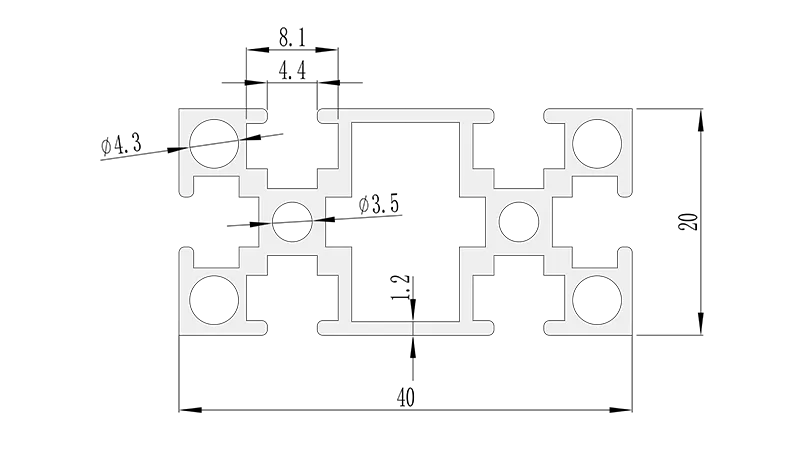
First things first: what exactly is the 2040 national standard profile? In simple terms, it's a type of aluminum extrusion—a long, uniform piece of aluminum shaped with a specific cross-section. The "2040" refers to its dimensions: typically 20mm in width and 40mm in height (though exact specs can vary slightly by manufacturer). What makes it a "national standard" is its adherence to consistent sizing and mounting standards, meaning that no matter which supplier you buy from, the profile will work with most aluminum profile accessories —think brackets, connectors, end caps, and hinges.
But why aluminum? For starters, it's lightweight—about a third the weight of steel—making it easy to handle during assembly, even for temporary setups. Yet despite its lightness, it's surprisingly strong, thanks to the extrusion process that aligns the metal's grains for added durability. It's also resistant to corrosion, which is a big plus in factories where moisture or chemicals might be present. And let's not forget recyclability: aluminum is 100% recyclable, aligning with the sustainability goals many manufacturers now prioritize.
What truly sets the 2040 profile apart, though, is its versatility. Its T-slot design—those grooves running along its length—lets you slide in accessories like nuts, bolts, and brackets without welding or drilling. Need to add a shelf to a material rack? Just slot in a bracket. Want to reposition a workbench light? Loosen a bolt, adjust, and tighten. This "build-as-you-go" flexibility is why it's become a favorite for both temporary and permanent structures. Let's break down how it performs in each scenario.
Temporary Structures: Agility Without Compromise
Temporary production structures thrive on one thing: speed. Whether you're setting up a pop-up assembly line for a product launch, creating a temporary testing station for a new prototype, or scaling up for a seasonal rush, you need something that can be built, modified, and dismantled quickly. The 2040 national standard profile excels here, and much of that success comes down to how it pairs with aluminum profile accessories .
Take a temporary workbench, for example. Traditional temporary workbenches might be made of particleboard or lightweight plastic, which can warp under heavy tools or wear out after a few months. But a workbench built with 2040 profiles? It starts with a frame of interconnected 2040 rails, joined by quick-connect brackets. Add a plywood or aluminum honeycomb panel top, and you've got a sturdy surface that can handle the weight of power tools or assembly fixtures. Need to add a shelf below for storage? Slide in some angle brackets and a crossbar—no drilling required. When the project ends, disassemble it in minutes, pack the profiles and accessories into a crate, and reuse them for the next temporary setup.
Another example: temporary material racks. Maybe your factory needs extra storage for a bulk shipment of components, but you don't want to invest in a permanent rack that will sit empty half the year. With 2040 profiles, you can build a multi-tier rack using connectors and shelf brackets, then take it apart once the shipment is processed. The lightweight nature of aluminum means you won't need heavy machinery to move the parts around, and the T-slot design lets you adjust shelf heights on the fly if you get components of different sizes.
Cost is another factor here. Temporary structures built with 2040 profiles are often more affordable than permanent steel setups because they require less labor to assemble (no welding or specialized tools) and can be reused multiple times. Instead of buying new materials for each temporary project, you're essentially investing in a kit of profiles and accessories that can be reconfigured endlessly. It's like having a set of building blocks that grow with your needs.
Permanent Structures: Durability That Grows With You
Now, let's shift to permanent structures. These are the workhorses of the factory—think conveyor systems that run 12-hour shifts, heavy-duty material racks that hold thousands of pounds of inventory, or assembly lines that produce the same product day in and day out for years. For these, durability and stability are non-negotiable. So how does the 2040 national standard profile hold up here?
Surprisingly well, thanks to its structural integrity and the right accessories. While aluminum is lighter than steel, the 2040 profile's design—with its internal ribs and thick walls—distributes weight evenly, making it strong enough for most permanent applications. For example, a permanent workbench built with 2040 profiles can easily support 200-300 pounds (or more, depending on the frame design). Pair it with heavy-duty casters (yes, even permanent structures can have mobility if needed!) and you've got a stable, long-lasting workstation that can still be moved for deep cleaning or floor maintenance.
Material racks are another area where the 2040 profile shines in permanent setups. A 3-row, 3-floor material rack (similar to the "Material Rack B" in some supplier catalogs) built with 2040 profiles can hold hundreds of pounds of parts without bending or warping. By using reinforced brackets and end caps, you can further strengthen the structure, ensuring it lasts for decades. And because of the T-slot system, you're not stuck with the initial design. If your inventory needs change—say, you start storing taller boxes—you can adjust the shelf heights by moving the brackets, no need to replace the entire rack.
Conveyor systems, too, benefit from the 2040 profile's precision. Many roller track and chain conveyor components are designed to mount directly into the T-slots of 2040 profiles, creating a seamless, low-friction flow of materials. Unlike permanent steel conveyors that require welding and fixed mounting, an aluminum conveyor frame can be disassembled and reconfigured if you need to reroute the production line—though in a permanent setup, you'll likely want to secure it to the floor with heavy-duty feet for added stability.
A Side-by-Side Comparison: Temporary vs Permanent with 2040 Profile
To better understand how the 2040 national standard profile performs in both temporary and permanent roles, let's put it all in a table. We'll compare key factors like assembly time, cost, lifespan, and adaptability to see where each setup excels.
| Factor | Temporary Structures (2040 Profile) | Permanent Structures (2040 Profile) |
|---|---|---|
| Assembly Time | Fast (1-2 hours for a basic workbench or rack using aluminum profile accessories) | Moderate (3-6 hours for larger structures; may require securing to floor) |
| Initial Cost | Lower (fewer accessories needed; focus on portability) | Higher (more reinforced accessories; heavier-duty components) |
| Lifespan | 3-5 years with regular reuse and proper storage | 10-15+ years with minimal maintenance |
| Adaptability | Very high (easily disassembled, reconfigured, or repurposed) | High (adjustable via T-slots; major reconfigurations possible with effort) |
| Typical Use Cases | Seasonal production lines, prototype testing, pop-up workstations | High-volume assembly lines, long-term material storage, dedicated workbenches |
| Key Accessories | Lightweight brackets, casters for mobility, basic end caps | Reinforced brackets, floor-mount feet, heavy-duty hinges, locking casters |
| Weight Capacity | Moderate (up to 150 lbs per shelf/workbench surface) | High (200-500 lbs+ per shelf with reinforced design) |
As you can see, the 2040 profile isn't just a "one-size-fits-all" solution—it's a "one-size-fits-most" that adapts to your needs. For temporary setups, you prioritize speed and portability; for permanent ones, you lean into durability and reinforcement. And in both cases, the T-slot system and aluminum profile accessories are the glue that holds it all together.
Aluminum Profile Accessories: The Unsung Heroes of Adaptability
If the 2040 national standard profile is the star of the show, then aluminum profile accessories are the supporting cast that makes it shine. These small, often overlooked components—brackets, connectors, casters, end caps—are what turn a pile of aluminum rails into a functional structure. Let's highlight a few that are particularly useful for bridging temporary and permanent needs.
Take 90° aluminum profile connectors, for example. These L-shaped brackets slide into the T-slots of two 2040 profiles, joining them at a right angle with a few bolts. In a temporary setup, you might use basic plastic or light aluminum connectors for quick assembly. For a permanent structure, you'd opt for reinforced steel or heavy-duty aluminum connectors to add stability. The best part? They're interchangeable—so you can start with temporary connectors and upgrade to permanent ones later if your needs change.
Casters are another accessory that blur the line between temporary and permanent. Swivel stem casters with brakes let you move a temporary workbench around the factory floor with ease. When the project ends, lock the brakes, and it becomes a stationary station. For permanent setups, you can swap out the casters for fixed aluminum feet that bolt to the floor, turning a mobile structure into a grounded one.
End caps might seem trivial, but they're essential for safety and longevity. Plastic end caps keep dust and debris out of the T-slots in temporary structures, making disassembly and storage cleaner. In permanent setups, metal end caps add a finished look and prevent workers from catching clothing or hands on sharp edges. And let's not forget T-slot rubber seal covers—these soft, flexible strips fill the grooves in the profile, reducing noise (a big plus in busy factories) and protecting the slots from damage during heavy use.
Real-World Example: From Temporary Prototype Line to Permanent Production
To bring this all to life, let's look at a hypothetical (but realistic) scenario. Imagine a small electronics manufacturer that's developing a new smartwatch. They need a temporary assembly line to build prototypes and test the workflow. Using 2040 national standard profiles, they build a series of workbenches (similar to "Workbench E" in some catalogs—single deck, no casters initially) with lightweight aluminum brackets and plastic end caps. They add a few mobile material racks with swivel casters to hold components, and a mini roller track to move parts between stations.
The prototype line is a hit, and the company decides to mass-produce the smartwatch. Now they need a permanent line. Instead of scrapping the temporary setup, they upgrade it: they replace the lightweight brackets with reinforced steel ones, swap the plastic end caps for metal ones, and bolt the workbenches to the floor using aluminum foot bases. The mobile material racks get fixed feet, and the mini roller track is extended and integrated with a larger conveyor system. By reusing the 2040 profiles and upgrading key accessories, they save time and money—no need to design a new line from scratch.
This example illustrates the core advantage of the 2040 profile: it grows with your business. What starts as a temporary solution can evolve into a permanent fixture, all while retaining the flexibility to adjust as needed. It's not just about saving on materials; it's about saving on downtime, redesign costs, and the stress of starting over.
Why Choose 2040 National Standard Profile Over Other Materials?
You might be wondering: why not use steel for permanent structures and plastic for temporary ones? Let's address that. Steel is strong, but it's heavy—assembling a steel workbench requires multiple people and heavy tools, which is a hassle for temporary setups. It's also prone to rust, meaning you'll need to paint or coat it regularly, adding to maintenance costs. Plastic, on the other hand, is lightweight but lacks the strength to handle heavy use; a plastic material rack might sag under the weight of metal components, leading to safety risks.
Wood is another option for temporary structures, but it's susceptible to moisture, warping, and pests. It also can't be easily reconfigured—once you cut a piece of wood, you can't un-cut it. The 2040 aluminum profile avoids all these pitfalls: it's lightweight but strong, corrosion-resistant, and infinitely reconfigurable. And because it's a national standard, you're not locked into one supplier—you can source profiles and accessories from multiple vendors, keeping costs competitive.
Conclusion: The Future of Manufacturing Structures is Adaptable
In the end, the choice between temporary and permanent production structures isn't about picking one or the other—it's about finding a solution that can do both. The 2040 national standard profile , paired with the right aluminum profile accessories , does exactly that. It lets manufacturers build temporary setups that don't feel "cheap" and permanent structures that don't feel "stuck." Whether you're assembling a quick prototype workbench or building a conveyor system for high-volume production, this profile adapts to your needs, not the other way around.
So the next time you walk through a factory, take a closer look at the structures around you. Chances are, if they're lightweight, adaptable, and built to last, they're made with aluminum profiles like the 2040. And as manufacturing continues to evolve—with shorter product lifecycles, higher customization demands, and a focus on sustainability—this versatile profile will only become more essential. After all, in a world where change is the only constant, the best structures are the ones that can change with it.