- Company Articles
- Industry articles
- Industry standards
- 2040 National Standard Profile in Aerospace Manufacturing: Lightweight Solutions

2040 National Standard Profile in Aerospace Manufacturing: Lightweight Solutions
Related Product
2040 National Standard Profile
45° external bending joint, used for 45° external connection of two aluminum pipes.
Aerospace manufacturing is a world where precision isn't just a goal—it's a necessity. Every gram of weight, every millimeter of tolerance, and every second of production time can impact everything from fuel efficiency to mission success. In an industry that constantly pushes the boundaries of innovation, the tools and materials used on the factory floor matter as much as the engineering that goes into the final product. Today, we're diving into a component that's quietly revolutionizing how aerospace teams build, adapt, and optimize their workflows: the 2040 National Standard Profile. This unassuming aluminum extrusion profile isn't just a piece of metal; it's a cornerstone of lightweight, flexible manufacturing systems that align with the rigorous demands of aerospace production.
What Is the 2040 National Standard Profile, Anyway?
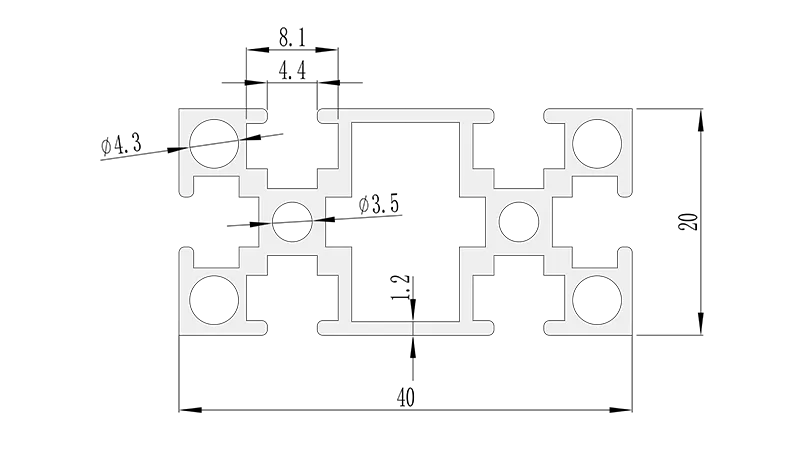
Let's start with the basics. The 2040 National Standard Profile is a type of aluminum extrusion profile—a long, uniform piece of aluminum shaped through a specialized extrusion process. The "2040" refers to its dimensions: 20mm in width and 40mm in height. But don't let those numbers fool you. What makes this profile stand out is its T-slot design—longitudinal grooves running along its length that allow for easy attachment of aluminum profile accessories like brackets, connectors, and panels. Think of it as a modular building block: strong enough to support heavy loads, light enough to reconfigure without heavy machinery, and versatile enough to adapt to almost any manufacturing need.
In aerospace, where production lines often shift between different components (think wing flaps one month, engine housings the next), rigidity is the enemy. Traditional steel frames or fixed workbenches lock teams into a single workflow, making it hard to scale or pivot. The 2040 profile, by contrast, is designed for change. Its lightweight aluminum construction (about 1/3 the weight of steel) means teams can disassemble, reconfigure, and rebuild workstations or material racks in hours, not days. And because it's aluminum, it resists corrosion—a critical feature in facilities where precision parts can't risk exposure to rust or contaminants.
Why Aerospace Manufacturing Needs Lightweight Solutions
Aerospace manufacturing isn't just about building airplanes or rockets—it's about building them efficiently, safely, and with zero room for error. Let's break down the challenges that make lightweight solutions like the 2040 profile so valuable:
- Weight Reduction Beyond the Final Product: While much of aerospace engineering focuses on reducing the weight of the aircraft itself (to cut fuel costs and improve performance), the tools used to build those aircraft matter too. Heavy steel workbenches or fixed material racks require more energy to move, increase the risk of workplace injuries, and limit floor space flexibility. Lightweight aluminum profiles reduce physical strain on workers and make it easier to reposition workstations as production needs change.
- Modularity for Low-Volume, High-Complexity Production: Unlike automotive manufacturing, which often relies on high-volume, repetitive assembly lines, aerospace production frequently involves low-volume, highly customized components. A single facility might build parts for commercial jets, military drones, and satellite components—each with unique requirements. The 2040 profile's modular design, paired with aluminum profile accessories like hinges, clamps, and adjustable feet, lets teams quickly retool workstations without investing in entirely new equipment.
- Durability in Harsh Environments: Aerospace facilities are no strangers to strict cleanliness standards, temperature fluctuations, and exposure to lubricants or solvents. Aluminum's natural resistance to corrosion and its ability to withstand these conditions without degrading make it a safer choice than materials like untreated steel, which can rust and contaminate sensitive parts.
2040 Profile in Action: Key Applications in Aerospace
To understand the impact of the 2040 National Standard Profile, let's look at how it's used in real-world aerospace manufacturing scenarios. From workbenches to material handling systems, this profile is the backbone of lean, adaptable workflows.
1. Workstations for Precision Assembly
Building aerospace components—whether a turbine blade or a satellite antenna—requires workbenches that are stable, adjustable, and ergonomic. A workbench constructed with 2040 profiles checks all these boxes. The T-slot design allows teams to attach tool holders, LED task lights, anti-static mats (critical for electronics), and even custom fixtures for holding delicate parts. Because the aluminum extrusion profile is lightweight, the workbench can be fitted with casters (another type of aluminum profile accessory) for easy movement, while still supporting loads up to 200kg or more, depending on the configuration.
Consider a team assembling avionics components. One week, they might need a narrow workstation for small circuit boards; the next, a wider surface for integrating those boards into a larger housing. With 2040 profiles, they can adjust the bench height, add side shelves, or even reconfigure the entire frame—all without welding or heavy tools. This flexibility reduces setup time between projects and ensures workers always have the right workspace for the task at hand.
2. Material Racks and Kanban Systems
Aerospace manufacturing thrives on lean system principles—eliminating waste, streamlining workflows, and ensuring parts are available exactly when needed. Material racks built with 2040 profiles are a perfect fit for this mindset. These racks can be customized with adjustable shelves, roller tracks (another key accessory), and dividers to organize everything from fasteners to large subassemblies. Because the aluminum profile is lightweight, even fully loaded racks can be moved or repositioned to align with changing production lines, reducing the time workers spend walking to retrieve parts.
Take, for example, a facility using a kanban system to manage inventory. With 2040-based racks, teams can color-code shelves, add label holders, and adjust shelf heights to fit different part sizes—from small bolts to large composite panels. When production shifts to a new component, the racks can be quickly reconfigured instead of replaced, saving both time and money.
3. Lean System Integration: From Assembly Lines to Testing Stations
Lean manufacturing isn't just a buzzword in aerospace—it's a way of life. It's about creating workflows that minimize waste, maximize efficiency, and empower workers to identify and solve problems. The 2040 National Standard Profile plays a key role here by enabling the creation of modular assembly lines and testing stations that adapt to lean principles like "5S" (sort, set in order, shine, standardize, sustain) and continuous improvement.
Imagine a production line where each station is built with 2040 profiles. If a bottleneck forms at the quality control step, teams can quickly extend the testing area by adding more profile sections and attaching new tools. If a new safety protocol requires barriers between work zones, aluminum profile accessories like panels or mesh screens can be slotted into the T-slots in minutes. This agility ensures the production line evolves with the team, not against them.
How 2040 Profiles Compare to Other Materials
You might be wondering: Why not use steel, wood, or even plastic for these applications? To answer that, let's compare the 2040 National Standard Profile to three common alternatives using a few key metrics critical to aerospace manufacturing:
| Material | Weight (kg/m) | Strength-to-Weight Ratio | Corrosion Resistance | Modularity | Cost (Relative) |
|---|---|---|---|---|---|
| 2040 Aluminum Extrusion Profile | 1.2–1.5 | High (Aluminum alloy: ~200 MPa strength) | Excellent (Natural oxide layer) | High (T-slot design + accessories) | Moderate (Higher upfront, lower long-term) |
| Mild Steel (1.5mm thickness) | 3.8–4.2 | Moderate (Steel: ~300 MPa strength, but heavier) | Poor (Requires painting/coating) | Low (Welding/bolting required for changes) | Low (Upfront), High (Maintenance/replacement) |
| Wood (Plywood/Particleboard) | 2.5–3.0 | Low (Prone to warping, splitting) | Poor (Susceptible to moisture, rot) | Very Low (Fixed dimensions, no reconfiguration) | Low (Upfront), Very High (Frequent replacement) |
| Plastic (PVC/Composite) | 0.8–1.0 | Very Low (Low tensile strength) | Good (Resistant to chemicals) | Moderate (Limited accessory compatibility) | Low (Upfront), High (Not durable for heavy loads) |
The data speaks for itself. While steel is stronger in absolute terms, its weight makes it impractical for flexible, mobile systems. Wood and plastic can't match aluminum's durability or load capacity, especially in industrial settings. The 2040 profile's sweet spot is its strength-to-weight ratio: it's light enough to move and reconfigure, yet strong enough to support aerospace-grade tools and parts. When paired with aluminum profile accessories like reinforced joints or heavy-duty casters, it can handle even the most demanding tasks.
Cost is another factor. While aluminum profiles have a higher upfront cost than steel or wood, their longevity and modularity mean lower long-term expenses. A steel workstation might need to be replaced entirely when production needs change; a 2040-based system can be reconfigured with new accessories, extending its lifespan by years.
The Role of Aluminum Profile Accessories: Making the 2040 Profile Shine
A profile is only as good as the accessories that bring it to life. The 2040 National Standard Profile's T-slot design is useless without the right aluminum profile accessories to connect, support, and customize it. Let's highlight a few that are indispensable in aerospace manufacturing:
- Internal Straight Aluminum Joints: These compact connectors slide into the T-slots of two 2040 profiles, locking them together at 90° or 180° angles without protruding. In aerospace workbenches, this means a clean, uncluttered surface with no sharp edges to catch on tools or parts.
- Adjustable Leveling Feet: Precision work requires level surfaces. These feet screw into the base of 2040 profiles, letting teams (fine-tune) workstation height by fractions of a millimeter to compensate for uneven factory floors.
- Roller Track Guide Rails: For material racks or assembly lines, these aluminum or plastic rails attach to 2040 profiles, creating a smooth surface for sliding parts bins or pallets. In aerospace, where delicate components can't be dropped or jostled, roller tracks reduce the risk of damage during transport.
- Anti-Slip Workbench Tops: Paired with the 2040 frame, these tops (often made of aluminum honeycomb or rubber) provide a stable, non-slip surface for assembling small parts like circuit boards or fasteners.
The beauty of these accessories is their interoperability. A single 2040 profile can use the same joint to connect to a workbench, a material rack, or a testing fixture. This standardization reduces inventory costs (fewer unique parts to stock) and makes training new team members easier—they don't need to learn a new system for every tool.
Case Study: How One Aerospace Supplier Cut Setup Time by 40%
Let's put this all into context with a real-world example (adapted from industry trends). A mid-sized aerospace supplier specializing in satellite components was struggling with a common problem: their production line couldn't keep up with the demand for customized parts. Their fixed steel workbenches and rigid material racks meant retooling for a new component took 8–10 hours, eating into valuable production time. Workers were frustrated, and deadlines were tight.
The solution? They replaced their steel infrastructure with 2040 National Standard Profile systems. Here's what happened:
- Setup Time Plummeted: By using 2040 profiles and aluminum profile accessories, reconfiguring a workstation for a new component took just 3–4 hours—40% faster than before. Workers could swap out tool holders, adjust bench height, and reposition material racks using basic hand tools, no welding required.
- Space Efficiency Improved: The lighter weight of aluminum allowed the team to stack material racks vertically, freeing up 25% of floor space for new equipment.
- Worker Satisfaction Rose: With workstations that adjusted to their height and workflow, ergonomic injuries decreased, and team morale improved. One supervisor noted, "It feels like the tools finally work with us, not against us."
This isn't an isolated success story. Across the aerospace industry, manufacturers are adopting modular aluminum systems like the 2040 profile to stay competitive in a market that demands both precision and agility.
The Future of 2040 Profiles in Aerospace
As aerospace manufacturing continues to evolve—with trends like additive manufacturing, automation, and AI-driven quality control—the role of the 2040 National Standard Profile is only growing. Here's what we can expect to see next:
Integration with Automation: Cobots (collaborative robots) are becoming common in aerospace facilities, handling repetitive tasks like part inspection or material transport. 2040 profiles, with their precise dimensions and modularity, are ideal for building cobot workstations. Aluminum profile accessories like sensor mounts or protective barriers can be added to the T-slots, creating safe, customized spaces for human-robot collaboration.
Sustainability Focus: Aluminum is 100% recyclable, and recycling it uses just 5% of the energy required to produce new aluminum. As aerospace companies aim to reduce their carbon footprints, the 2040 profile's recyclability makes it a greener alternative to steel or plastic, which often end up in landfills after use.
Advanced Alloys: Manufacturers are developing new aluminum alloys for extrusion profiles that offer even higher strength-to-weight ratios. Imagine a 2040 profile that's 10% lighter but just as strong—perfect for aerospace applications where every gram counts.
Final Thoughts: More Than a Profile—A Mindset Shift
The 2040 National Standard Profile is more than a material solution; it's a reflection of how aerospace manufacturing is changing. It's about moving from rigid, one-size-fits-all systems to flexible, team-centric workflows where adaptability is as important as precision. In a industry where the only constant is change, having tools that can keep up isn't just an advantage—it's a necessity.
Whether you're building a workbench for assembling drone components or a material rack for jet engine parts, the 2040 profile and its aluminum profile accessories offer a lightweight, durable, and infinitely customizable foundation. It's not just about making manufacturing easier—it's about making it smarter, safer, and more sustainable. And in aerospace, that's how innovation takes flight.