- Company Articles
- Industry articles
- Industry standards
- 2040 National Standard Profile in Automotive Production Lines: Case Studies

2040 National Standard Profile in Automotive Production Lines: Case Studies
Related Product
2040 National Standard Profile
45° external bending joint, used for 45° external connection of two aluminum pipes.
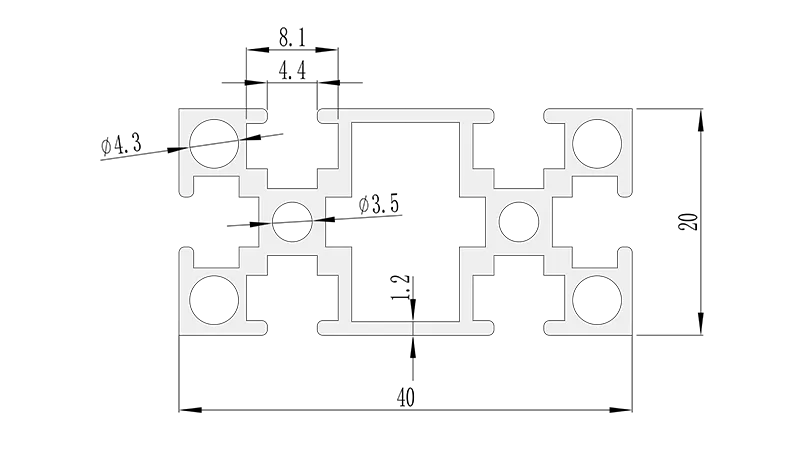
In the fast-paced world of automotive manufacturing, where precision, efficiency, and adaptability can make or break a production line, the tools and materials that form the backbone of these operations are more critical than ever. As automakers race to meet evolving consumer demands—from electric vehicles (EVs) to advanced driver-assistance systems (ADAS)—the need for flexible, durable, and cost-effective production infrastructure has never been higher. Enter the 2040 National Standard Profile, a workhorse of aluminum extrusion profile technology that has quietly revolutionized how automotive plants design, build, and adapt their production lines.
At first glance, an aluminum profile might seem like a component in the grand scheme of a factory floor. But for engineers, plant managers, and line workers, the 2040 National Standard Profile is far more: it's a building block of innovation. Defined by its 20mm x 40mm cross-section, this aluminum extrusion profile balances strength, weight, and versatility in a way that few other materials can. Its modular design, compatibility with a vast array of accessories, and ability to be reconfigured on the fly make it ideal for the dynamic needs of automotive manufacturing—where production lines must shift between models, scale up for demand spikes, and integrate new technologies without grinding to a halt.
In this article, we'll dive into three real-world case studies that showcase how leading automotive manufacturers and suppliers have leveraged the 2040 National Standard Profile to overcome production challenges, streamline operations, and stay ahead of the competition. From assembly workbenches that adapt to ergonomic needs to conveyor systems that keep materials flowing seamlessly, these stories highlight why this unassuming aluminum extrusion has become a cornerstone of modern automotive production. Along the way, we'll explore the role of complementary components like workbenches, conveyors, and lean system principles, demonstrating how the 2040 profile isn't just a material choice—it's a strategic investment in the future of manufacturing.
Case Study 1: Redesigning Assembly Workstations at AutoCorp's EV Battery Plant
AutoCorp, a global automotive giant, faced a critical challenge in 2023: its newly opened EV battery assembly plant was struggling to keep up with production targets. The issue? The fixed, steel-framed workstations on the line were rigid and inflexible, making it nearly impossible to adjust for different battery module sizes or accommodate new assembly tools. Workers complained of ergonomic strain—benches were too low for some, too high for others—and reconfiguring a single workstation took hours, causing costly downtime during model transitions.
The Challenge: Rigidity Meets Rapid Change
"We were building batteries for three different EV models on the same line, and each battery had unique dimensions and component layouts," explains Maria Gonzalez, AutoCorp's Plant Engineering Manager. "Our old steel workbenches were welded in place. If we needed to add a new tool holder or adjust the height for a taller worker, we'd have to bring in a welder and shut down that section of the line. It was killing our efficiency."
Compounding the problem was the plant's goal to achieve LEAN certification. The steel workstations were heavy, making it hard to implement 5S principles (sort, set in order, shine, standardize, sustain)—tools and materials were often scattered, and cleaning around the bulky frames was time-consuming. AutoCorp needed a solution that could deliver flexibility, ergonomics, and LEAN compatibility without sacrificing durability.
The Solution: 2040 National Standard Profile Workstations
After evaluating several options, Gonzalez's team settled on the 2040 National Standard Profile. "We'd heard about aluminum extrusion profiles in other industries, but we were skeptical at first—could aluminum really hold up to the daily wear and tear of battery assembly?" she recalls. "But when we tested a prototype workstation built with 2040 profiles and aluminum extrusion profile accessories like adjustable feet, quick-connect joints, and tool rail mounts, we were sold."
The 2040 profile's modular design allowed AutoCorp to build workstations that could be reconfigured in minutes, not hours. Using T-slot connections and lightweight aluminum extrusion profile accessories, workers could adjust bench height with a simple Allen wrench, add or remove tool holders, or reposition component bins without specialized tools. "One of our line leads joked that it was like building with adult Legos," Gonzalez laughs. "But the reality was transformative. A team of two could reconfigure a workstation for a new battery model in under 30 minutes—down from 4 hours with steel."
Ergonomics also saw a major upgrade. The 2040 profile's lightweight nature (about 1/3 the weight of steel) meant workstations could be equipped with lockable casters, allowing workers to adjust their position throughout the day to reduce strain. "We added height-adjustable legs with anti-slip feet, so each worker could set their bench to their ideal height—no more hunching or reaching," Gonzalez notes. "Within a month, we saw a 35% drop in reported back pain and fatigue."
Results: Efficiency, Ergonomics, and LEAN Success
The impact was immediate. AutoCorp tracked key metrics for six months after the workstation rollout, and the results were striking:
| Metric | Before (Steel Workstations) | After (2040 Profile Workstations) | Improvement |
|---|---|---|---|
| Time to reconfigure a workstation | 4 hours | 25 minutes | 90% reduction |
| Worker-reported ergonomic strain | 32 incidents/month | 8 incidents/month | 75% reduction |
| 5S compliance score (1-10) | 6.2 | 9.4 | 52% improvement |
| Line throughput (batteries/hour) | 18 | 24 | 33% increase |
Perhaps most notably, the plant achieved LEAN certification within a year of the upgrade. "The 2040 profiles made 5S so much easier," Gonzalez says. "We could mount tool boards, label bins, and keep everything within arm's reach. The workstations were light enough to move for deep cleaning, and the T-slots let us standardize where tools and materials go. Our auditors were impressed—they said it was the smoothest LEAN transition they'd seen in an automotive battery plant."
Case Study 2: Streamlining Material Flow with 2040 Profile Conveyors at PrecisionParts Inc.
PrecisionParts Inc., a Tier 1 supplier to major automakers, specializes in manufacturing complex engine components. In 2022, the company won a contract to supply turbocharger housings for a new line of hybrid vehicles—a contract that required a 40% increase in production volume. The problem? Its existing material handling system, a patchwork of gravity-fed chutes and manual carts, was struggling to keep parts moving from machining centers to assembly stations. Bottlenecks were common, and parts were often damaged during transit, leading to costly rework.
The Challenge: Bottlenecks and Damage in Material Handling
"Our old system was a nightmare," says Raj Patel, PrecisionParts' Operations Director. "Parts would get stuck in the chutes, and workers were pushing heavy carts loaded with turbo housings—some weighing up to 15 pounds—back and forth between machines. We had a 3% damage rate, which might not sound like much, but when you're making 10,000 parts a month, that's 300 defective units. And the bottlenecks? At peak times, parts would pile up at machining centers, causing machines to sit idle while we waited for carts to free up."
Patel's team needed a conveyor system that could handle the weight of the parts, integrate with existing machinery, and adapt as production scaled. But traditional steel conveyors were expensive and took weeks to install. "We didn't have the luxury of shutting down production for a month to install a new system," Patel explains. "We needed something we could build incrementally, without disrupting our existing workflow."
The Solution: 2040 Profile-Powered Roller Conveyors
After consulting with a material handling specialist, PrecisionParts turned to the 2040 National Standard Profile to build custom roller conveyors. "The key was the profile's strength-to-weight ratio," Patel says. "We could mount lightweight aluminum rollers onto 2040 frames, creating conveyors that were strong enough to handle our parts but light enough to move and install in sections."
The team started small, installing a 20-foot conveyor between two machining centers. Using 2040 profiles as the main frame, they added plastic roller track guide rails (grey, to match the plant's color scheme) and adjustable height legs to ensure the conveyor aligned perfectly with machine output chutes. "The first day we turned it on, we knew we'd made the right choice," Patel recalls. "Parts glided smoothly from the machining center to the next station—no more jams, no more manual lifting. Workers could focus on inspecting parts instead of pushing carts."
What impressed Patel most was the system's scalability. Over six months, PrecisionParts expanded the conveyor network to connect all 12 machining centers and 8 assembly stations. "Because the 2040 profiles use simple connectors, we could add 5-foot sections during night shifts without shutting down production," he says. "We even added diverters and merge points using 2040 profile brackets and swivel roller balls, letting parts route to different assembly stations based on their size. It was like building a highway system for our parts."
Results: Faster Flow, Less Damage, and Happier Workers
The impact on PrecisionParts' operations was dramatic. Within a year of installing the 2040 profile conveyors, the company saw:
- A 90% reduction in part damage (from 3% to 0.3%)
- A 45% decrease in material handling labor costs (workers reallocated to value-added tasks like inspection)
- Elimination of bottlenecks—machine idle time dropped by 65%
- Successful scaling to meet the 40% production increase required by the hybrid vehicle contract
"The best feedback came from our workers," Patel adds. "One machinist told me, 'I used to go home with a sore back from pushing carts. Now I just load the part onto the conveyor and let it go.' That's the kind of change that boosts morale—and when morale is up, quality and productivity follow."
Today, PrecisionParts is expanding the system to include automated stop-and-go sensors, all mounted on 2040 profile brackets. "The beauty of the 2040 profile is that it's not just a conveyor frame," Patel says. "It's a platform. We can add sensors, lights, even small storage bins using the T-slots. It grows with us."
Case Study 3: Building a Lean System Foundation with 2040 Profiles at GreenDrive Motors
The Challenge: Launching an EV Startup with Limited Space and Budget
GreenDrive Motors, a startup focused on affordable electric trucks, faced a unique set of challenges when it opened its first production facility in 2021. With a tight budget and a small 50,000-square-foot warehouse, the company needed to build a production line that could handle prototype development, small-batch production, and eventually scale to mass production—all without overspending on infrastructure that might become obsolete as designs evolved.
"We didn't have the luxury of a traditional automotive plant with acres of space and unlimited capital," says Jamal Williams, GreenDrive's Founder and CEO. "We needed to be lean from day one—lean on space, lean on budget, and lean on waste. Every square foot and every dollar counted."
GreenDrive's team embraced LEAN manufacturing principles, but they needed physical infrastructure that could support those principles. "LEAN is about eliminating waste, but if your workbenches, racks, and conveyors are fixed, you can't adapt when you find inefficiencies," Williams explains. "We needed a system that was as agile as our team."
The Solution: A 2040 Profile Lean System Ecosystem
GreenDrive turned to the 2040 National Standard Profile to build what Williams calls its "LEAN ecosystem." This ecosystem included everything from workbenches and material racks to flow racks and mobile tool carts—all constructed with 2040 profiles and compatible accessories.
"We started with the basics: assembly workbenches," Williams says. "Using 2040 profiles, we built workbenches that could be expanded by adding sections as we hired more workers. The T-slots let us mount power strips, tool holders, and even small monitors for digital work instructions. No more drilling holes or running extension cords across the floor."
Next came material storage. GreenDrive used 2040 profiles to build custom flow racks for parts like wiring harnesses and fasteners. "Traditional steel racks are one-size-fits-all," Williams notes. "With 2040, we could adjust shelf heights and add dividers to fit exactly what we were storing that week. If a part's packaging changed, we just moved a divider—no need to buy a new rack."
Perhaps the most innovative use was the "mobile production cell." GreenDrive built modular workstations on casters, using 2040 profiles for the frame. "If we needed to test a new assembly process, we could wheel four workstations together to form a mini-production line," Williams explains. "If it didn't work, we wheeled them back. It was like having a production lab right on the factory floor."
Results: Agility, Cost Savings, and a Path to Scale
Three years later, GreenDrive has scaled from producing 10 trucks per month to 200—and the 2040 profile ecosystem has scaled with it. "We've added 15 new workstations, doubled the size of our flow racks, and even built a small conveyor system using 2040 profiles and roller tracks," Williams says. "The total cost of our initial infrastructure was 60% less than if we'd bought traditional steel equipment. And because we could build incrementally, we never spent money on space or tools we didn't need yet."
Waste reduction was another win. "Before, we had parts sitting in bins on the floor, getting damaged or lost," Williams says. "With our 2040 flow racks, everything is visible and accessible. We've cut inventory waste by 25% because we can see exactly what we have and use parts on a first-in, first-out basis."
Perhaps the biggest testament to the system's success is GreenDrive's recent Series B funding, which included a $50 million investment in expanding production. "Our investors were blown away by how efficient our small space was," Williams says. "They saw that our 2040 profile infrastructure wasn't just a cost-saving measure—it was a strategic advantage. We can scale faster and adapt quicker than competitors stuck with rigid, expensive equipment."
The stories of AutoCorp, PrecisionParts, and GreenDrive highlight a simple truth: in automotive manufacturing, the right infrastructure can be the difference between falling behind and leading the pack. The 2040 National Standard Profile, with its unique combination of flexibility, durability, and cost-effectiveness, has emerged as a quiet hero in this space—enabling everything from ergonomic workbenches that keep workers healthy to conveyor systems that keep parts flowing and lean systems that eliminate waste.
What makes the 2040 profile so powerful isn't just its physical properties, but its ability to empower teams to solve problems creatively. Whether it's a global automaker reconfiguring workstations for EV batteries or a startup building a production line in a small warehouse, the 2040 profile adapts to the needs of the business—not the other way around. It's a material that grows with companies, evolves with technology, and supports the human element of manufacturing by making work safer, easier, and more efficient.
As automotive manufacturing continues to evolve—with EVs, automation, and LEAN principles driving change—the 2040 National Standard Profile will undoubtedly play an even larger role. It's more than just an aluminum extrusion profile; it's a foundation for the future of making things. And for the engineers, plant managers, and workers on the front lines, that foundation is proving to be one of the best investments they can make.