- Company Articles
- Industry articles
- Industry standards
- 2040 National Standard Profile in Computer Peripheral Assembly: Efficiency Boosters

2040 National Standard Profile in Computer Peripheral Assembly: Efficiency Boosters
Related Product
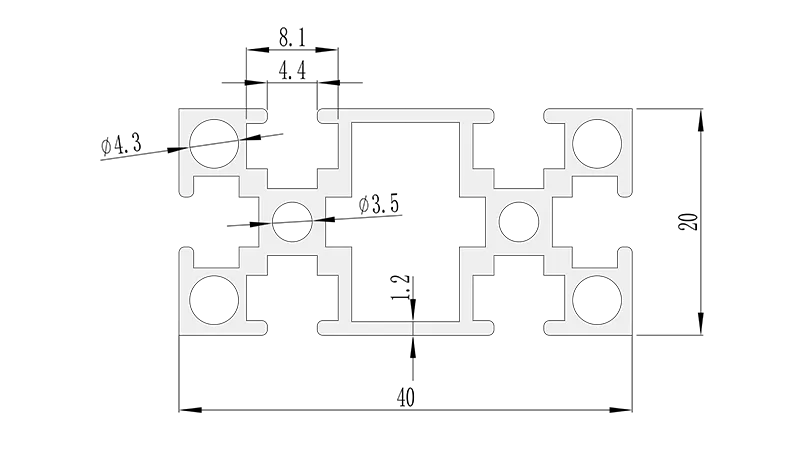
2040 National Standard Profile
45° external bending joint, used for 45° external connection of two aluminum pipes.
The Unsung Hero of Modern Assembly Lines
In the fast-paced world of computer peripheral manufacturing—where keyboards, mice, monitors, and printers roll off production lines by the thousands daily—efficiency isn't just a buzzword. It's the difference between meeting tight deadlines, adapting to sudden design changes, and staying ahead in a market that demands constant innovation. Yet, for years, many assembly lines have been held back by rigid, one-size-fits-all setups: heavy steel frames that take days to reconfigure, wooden workbenches that warp under wear, and systems that resist the flexibility modern manufacturing needs.
Enter the 2040 national standard profile —a humble aluminum extrusion that's quietly revolutionizing how computer peripheral assembly lines operate. At first glance, it's easy to mistake this 20mm x 40mm aluminum beam for just another industrial part. But scratch the surface, and you'll find a tool that embodies the principles of adaptability, durability, and lean thinking. In this article, we'll dive into how this unassuming profile, paired with the right aluminum profile accessories , is transforming workbenches, material racks, and entire production cells into efficiency powerhouses.
What Makes the 2040 National Standard Profile So Special?
Let's start with the basics: what exactly is a 2040 national standard profile? It's an aluminum extrusion—meaning it's formed by forcing heated aluminum through a die to create a consistent, precision shape—with a cross-section of 20 millimeters in width and 40 millimeters in height. But its true magic lies in its T-slot design : long, narrow grooves running along its length that act as built-in channels for bolts, nuts, and accessories. This simple feature turns the profile from a static beam into a modular building block, capable of connecting to almost any other component with minimal effort.
Aluminum, the material of choice, is no accident. Unlike steel, it's lightweight (about one-third the density), making it easy for workers to handle without heavy lifting equipment. Yet, it's surprisingly strong—strong enough to support the weight of circuit boards, tool holders, and even small automated machines. It's also corrosion-resistant, a must in factories where spills or humidity are common, and infinitely recyclable, aligning with the growing push for sustainable manufacturing.
But the 2040 profile doesn't work alone. Its versatility shines when paired with aluminum profile accessories : corner brackets, end caps, connector bolts, and hinge joints, to name a few. These accessories snap into the T-slots with a satisfying "click," no welding or drilling required. Need to add a shelf to a workbench? Slide a bracket into the slot and tighten a bolt. Want to reposition a tool holder? Loosen the nut, adjust, and retighten. It's assembly line Legos for adults—and it's changing the game.
From Chaos to Order: The Workbench Revolution
Walk into any computer peripheral assembly plant, and the workbench is the heart of the operation. It's where workers spend 8+ hours a day, meticulously attaching keycaps to keyboards, soldering wires onto circuit boards, or testing the sensitivity of a mouse sensor. A poorly designed workbench isn't just uncomfortable—it's a productivity killer. Cluttered surfaces, fixed heights that don't suit all workers, and tool storage that's out of reach can slow down even the most skilled operators.
Traditional workbenches often exacerbate these issues. Wooden tops scratch easily, making it hard to keep small components like screws or microchips from rolling off. Steel frames, while sturdy, are heavy and nearly impossible to adjust without cutting or welding. And when a new peripheral model is introduced—say, a slimmer keyboard with a different layout—the entire workbench might need to be replaced, costing time and money.
2040 national standard profile workbenches solve these problems in ways that feel almost intuitive. Let's break down the benefits:
- Ergonomic Customization: With adjustable height legs (thanks to telescoping 2040 profiles and locking collars), a single workbench can be raised or lowered by up to 30cm to fit workers of different heights. No more hunching over or straining to reach—reducing fatigue and cutting down on repetitive strain injuries.
- Tool Integration: T-slots along the workbench edges let workers attach magnetic tool holders, cable management clips, or even small LED task lights exactly where they need them. No more fumbling for a screwdriver across the bench—everything stays within arm's reach.
- Quick Reconfiguration: When a new product line launches, swapping out a keyboard assembly fixture for a mouse testing station takes minutes, not days. Simply loosen the bolts holding the old fixture, slide it out, and lock in the new one. One manufacturer we spoke to reported cutting changeover time from 48 hours to just 2 hours after switching to 2040 profile workbenches.
- Durability: Aluminum tops resist scratches and stains, while the T-slot design means accessories stay secure even during high-speed assembly. Unlike wood, they won't warp if spilled coffee is wiped up quickly, and unlike steel, they won't rust if the floor is mopped nearby.
It's no wonder that workbench setups built with 2040 profiles are becoming the gold standard. They don't just make workers more comfortable—they make them more efficient, too.
Lean System Alignment: Waste Reduction in Action
At its core, manufacturing efficiency is about eliminating waste—whether it's wasted time, wasted space, or wasted effort. This is the philosophy behind lean system practices, and the 2040 national standard profile was practically designed with lean in mind. Let's see how it aligns with key lean principles:
1. Just-In-Time (JIT) Production
JIT thrives on minimizing inventory and adapting to demand in real time. Traditional assembly lines often struggle with this because their fixed material racks can't adjust to sudden shifts in component needs. A 2040 profile material rack, however, can be expanded or contracted in hours. Need to add a shelf for incoming USB-C connectors? Snap on a few brackets. Running low on mouse sensors? Remove a shelf to make space for a bulk bin. No more overstocking parts "just in case"—the rack adapts to what's needed, when it's needed.
2. Continuous Improvement (Kaizen)
Kaizen encourages workers to suggest small, incremental changes to boost efficiency. But how can a worker propose repositioning a tool holder if it means calling in a welder? With 2040 profiles, employees can make those changes themselves. A line operator at a major keyboard manufacturer told us, "I noticed the cable management tray was too low, so I moved it up 10cm during my lunch break. Now, no one bends down to grab wires anymore—it saved us 5 seconds per unit. Multiply that by 10,000 units a day, and that's over an hour of saved time."
3. Value Stream Mapping
Value stream mapping identifies bottlenecks in the production process. Often, these bottlenecks are physical: a conveyor that's too short, a material rack that's too far from the workbench. 2040 profiles let teams redesign these flows on the fly. For example, a monitor assembly line was struggling with delays when moving screens from testing to packaging. By adding a 2040 profile roller track (using aluminum guide rails and plastic roller track guide rails) between stations, they cut transport time by 30%—no need for a costly automated conveyor upgrade.
Traditional vs. 2040 Profile: A Side-by-Side Comparison
| Aspect | Traditional Assembly Setup | 2040 National Standard Profile Setup |
|---|---|---|
| Reconfiguration Time | 3–5 days (requires welding, cutting, or new parts) | 1–2 hours (tools: hex key and wrench) |
| Weight | Heavy (steel/wood: 20–30kg per workbench section) | Lightweight (aluminum: 5–8kg per workbench section) |
| Durability | Prone to rust (steel), warping (wood), or scratches (plastic) | Corrosion-resistant, scratch-resistant, and warp-free |
| Accessory Compatibility | Limited (custom brackets required for new tools) | Unlimited (T-slots accept standard aluminum profile accessories) |
| Cost Over Time | High (frequent replacements, downtime during reconfigurations) | Low (reusable profiles, minimal downtime, long lifespan) |
| Worker Satisfaction | Low (fixed heights, cluttered spaces, hard-to-reach tools) | High (ergonomic adjustments, personalized setups, reduced fatigue) |
Real-World Impact: A Manufacturer's Success Story
To put these benefits into perspective, let's look at a case study from a mid-sized computer peripheral manufacturer based in Guangdong, China. Prior to 2022, their keyboard assembly line relied on steel workbenches and wooden material racks. When they decided to launch a new line of ergonomic keyboards with adjustable palm rests, they faced a problem: their existing setup couldn't accommodate the new assembly steps without a complete overhaul, which would take two weeks and cost over $50,000.
Instead, they invested in 2040 national standard profiles and aluminum profile accessories. Here's what happened next:
- Setup Time: The new line was up and running in 3 days, not 14. Workers assembled the workbenches, material racks, and tool holders themselves using only hex keys and instruction manuals.
- Cost Savings: Total investment was $18,000—less than half the cost of a steel overhaul. Plus, they repurposed 80% of the profiles from their old keyboard line, further cutting expenses.
- Productivity Boost: Assembly time per keyboard dropped from 4.5 minutes to 3.2 minutes. Workers reported less strain from adjustable-height benches, and tool access via T-slot holders reduced "search time" for small parts.
- Scalability: Six months later, when they added a wireless version of the keyboard, they reconfigured the line in a single shift by adding a small testing station to the existing 2040 profile frame.
"We didn't just buy aluminum profiles—we bought flexibility," said the plant manager. "Now, when the design team sends over a new prototype, we don't panic. We just grab some brackets and start building. That's the kind of agility you need to survive in this industry."
Beyond the Assembly Line: Future-Proofing Manufacturing
As computer peripherals grow more complex—think mechanical keyboards with customizable switches, wireless mice with advanced sensors, and monitors with curved displays—manufacturing setups need to keep pace. The 2040 national standard profile isn't just solving today's problems; it's preparing factories for tomorrow's challenges.
Consider the rise of collaborative robots, or "cobots," which work alongside human workers to handle repetitive tasks. 2040 profiles integrate seamlessly with cobot mounts, allowing factories to add automation without rebuilding entire lines. Similarly, as IoT (Internet of Things) becomes more common, sensors and data-collection devices can be mounted directly into T-slots, turning workbenches into smart stations that track productivity in real time.
And let's not forget sustainability. Aluminum is 100% recyclable, and the modular nature of 2040 profiles means less waste when lines are updated—profiles can be disassembled and reused elsewhere, rather than being sent to landfills. For manufacturers aiming to reduce their carbon footprint, this is a win-win.
Final Thoughts: Small Profile, Big Impact
In the grand scheme of computer peripheral manufacturing, the 2040 national standard profile might not get the same attention as high-tech robots or cutting-edge software. But its impact is undeniable. By combining lightweight strength, modular flexibility, and lean system alignment, it's turning assembly lines from rigid obstacles into adaptable partners in productivity.
Whether you're a plant manager looking to cut downtime, a worker tired of straining at a fixed-height bench, or a business owner aiming to stay competitive in a crowded market, the message is clear: the future of efficient manufacturing isn't in flashy gadgets. It's in the details—the unassuming aluminum profiles that make every other part of the process work better.
So the next time you type on a keyboard or click a mouse, take a moment to appreciate the assembly line that built it. Chances are, behind that smooth, precise product is a 2040 profile workbench, quietly doing what it does best: making efficiency look easy.