- Company Articles
- Industry articles
- Industry standards
- 2040 National Standard Profile in Consumer Electronics Manufacturing: Key Use Cases

2040 National Standard Profile in Consumer Electronics Manufacturing: Key Use Cases
Related Product
2040 National Standard Profile
45° external bending joint, used for 45° external connection of two aluminum pipes.
In the fast-paced world of consumer electronics manufacturing, where every second counts and precision is non-negotiable, the tools and systems that keep production lines running smoothly are more critical than ever. From smartphone assembly lines churning out thousands of devices daily to intricate PCB (Printed Circuit Board) manufacturing facilities, the industry demands solutions that are adaptable, durable, and efficient. Enter the 2040 national standard profile—a yet powerful component that has quietly become a backbone of modern manufacturing floors. More than just a piece of aluminum, this profile, paired with the right aluminum profile accessories, is redefining how factories design workspaces, manage materials, and streamline operations. Let's dive into why this unassuming profile has become a game-changer and explore its key use cases in consumer electronics manufacturing.
Understanding the 2040 National Standard Profile: A Quick Overview
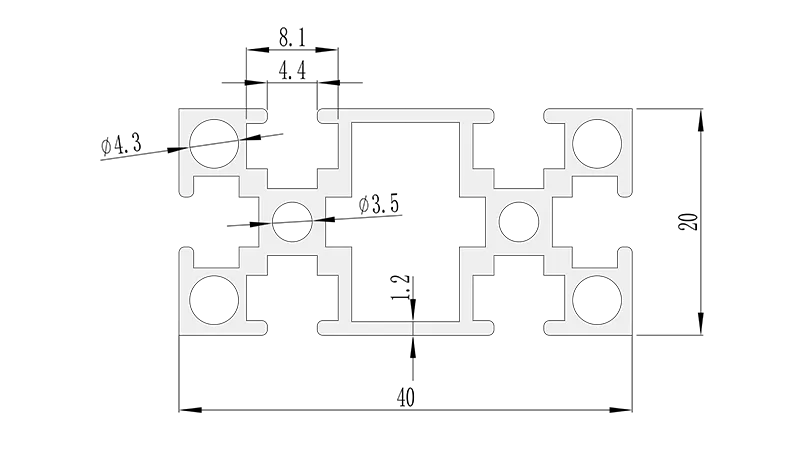
Before we jump into its applications, let's clarify what the 2040 national standard profile is. Simply put, it's a type of aluminum extrusion—meaning it's formed by pushing heated aluminum through a die to create a specific cross-sectional shape. The "2040" refers to its dimensions: 20mm in width and 40mm in height. What makes it "national standard" is its adherence to uniform specifications, ensuring compatibility across manufacturers and accessories. This standardization is a big deal in factories, where mixing and matching components from different suppliers is often necessary.
But why aluminum? Aluminum brings a winning combination of strength, lightweight, and corrosion resistance—essential in electronics manufacturing, where exposure to cleaning agents, humidity, and static electricity is common. Unlike heavier materials like steel, aluminum profiles are easy to handle, reducing worker fatigue during installation or reconfiguration. And because they're modular, built with T-slots (longitudinal grooves) along their length, they can be quickly assembled with aluminum profile accessories like brackets, connectors, and fasteners—no welding or specialized tools required. This modularity is where the 2040 profile truly shines, especially in an industry where production lines are constantly evolving to meet new product designs or market demands.
Use Case 1: Building Custom Workbenches for Precision Assembly
Walk into any electronics manufacturing plant, and you'll notice one thing immediately: workbenches are everywhere. These are the workhorses of the factory floor—where technicians assemble tiny components, test circuit boards, or package finished products. But not just any workbench will do. In consumer electronics, where components can be as small as a grain of rice (looking at you, smartphone camera modules), workbenches need to be stable, ergonomic, and customizable to the task at hand. This is where the 2040 national standard profile steps in as a star player.
Imagine a technician assembling laptop motherboards. They need a workspace that's at the right height to avoid hunching, has built-in storage for tools, and can accommodate ESD (Electrostatic Discharge) mats to protect sensitive components from static damage. With 2040 profiles, manufacturers can build workbenches that check all these boxes—and more. Here's how:
Ergonomic Design: The 2040 profile's lightweight nature makes it easy to adjust the height of workbench legs using simple connectors. Technicians of different heights can have workbenches tailored to their needs, reducing strain on shoulders and backs during long shifts. Some factories even add adjustable footrests or tilting work surfaces, all attached via T-slot accessories, to further enhance comfort.
Modular Storage: Tools like screwdrivers, tweezers, and magnifying glasses need to be within arm's reach. Using 2040 profiles, factories can attach shelves, tool hooks, or small drawers directly to the workbench frame. Since the T-slots run the length of the profile, these accessories can be repositioned in minutes if the workflow changes—say, when switching from assembling smartwatches to tablets, which require different tools.
Integration with ESD Solutions: Static electricity is the enemy of electronics manufacturing, as it can fry delicate microchips. Workbenches built with 2040 profiles can easily incorporate ESD mats, wrist strap holders, or grounding clips. The aluminum itself is conductive, so with the right accessories, the entire workbench can be grounded, creating a safe zone for sensitive components.
Durability for Heavy Use: Despite being lightweight, 2040 profiles are surprisingly strong. A typical workbench frame made with these profiles can support hundreds of pounds—more than enough for a laptop motherboard, testing equipment, and a technician's tools. And because aluminum resists corrosion, the workbench won't rust or degrade over time, even in factories that use cleaning solutions daily.
One electronics manufacturer in Guangdong, for example, recently replaced their old wooden workbenches with 2040 profile-based ones. They reported a 20% reduction in technician complaints about back pain (thanks to adjustable heights) and a 15% faster assembly time (due to better tool organization). The best part? When they introduced a new smartphone model with a different assembly process, they reconfigured the workbenches in a weekend using leftover profiles and new accessories—no need to buy entirely new furniture.
Use Case 2: Streamlining Material Flow with Roller Track Systems
In consumer electronics manufacturing, materials and semi-finished products are constantly on the move. PCBs need to go from soldering stations to testing areas, batteries from storage to assembly lines, and finished devices from packaging to shipping. Any bottleneck in this flow can slow down production, increase lead times, and raise costs. This is where roller track systems—often built with 2040 national standard profiles—come into play, turning chaotic material movement into a smooth, efficient process.
Roller tracks are exactly what they sound like: tracks lined with small rollers that allow materials (like circuit boards, component trays, or even small assemblies) to glide from one workstation to the next with minimal effort. And the 2040 profile is the perfect foundation for these tracks, thanks to its strength, T-slot design, and compatibility with roller track accessories.
Customizable Track Layouts: Factories rarely have straight, unobstructed spaces for material flow. Production lines might need to navigate around machinery, turn corners, or even go up small inclines. 2040 profiles can be cut to length and connected with angle brackets or hinges, allowing roller tracks to be shaped into L-turns, U-shapes, or even spirals. For example, a PCB manufacturer might design a roller track that starts at the soldering station, curves around a quality control desk, and ends at the testing area—all built with 2040 profiles and roller track connectors.
Controlled Speed and Precision: Not all materials move at the same speed. Delicate components might need to glide slowly to avoid jostling, while sturdier assemblies can move faster. With 2040 profiles, factories can adjust the angle of the track (using height-adjustable legs made from the same profiles) to control speed. They can also add brakes or speed bumps (small rubber accessories inserted into the T-slots) to slow materials down at key points, like before a technician's workstation.
Integration with Lean Systems: Lean manufacturing—focused on reducing waste and maximizing value—is a core principle in electronics production. Roller tracks built with 2040 profiles align perfectly with lean goals. For instance, a "kanban" system (where materials are restocked only when needed) can be implemented by placing bins on roller tracks that trigger a restock alert when they reach a certain point. Since the tracks are modular, adding or removing sections to adapt to new lean processes is simple—no major construction required.
Cost-Effective Scalability: As a factory grows, its material handling needs grow too. With 2040 profiles, scaling a roller track system is as easy as adding new sections. Because the profiles are standardized, new pieces fit seamlessly with existing ones. A small startup making smart home sensors might start with a 10-foot roller track and expand to 50 feet a year later—all using the same 2040 profiles and accessories.
A case in point: a manufacturer of wireless earbuds was struggling with delays when moving component trays between assembly stations. Workers were manually carrying trays, which led to bottlenecks and occasional drops (costing thousands in damaged parts). After installing a roller track system built with 2040 profiles, they eliminated manual carrying. The trays now glide smoothly from station to station, and the team reclaimed 15 hours a week previously spent on material transport. Plus, when they added a second production line for a new earbud model, they extended the track in just two days using extra profiles and connectors.
Use Case 3: Supporting Lean System Integration for Adaptive Production
Consumer electronics is an industry defined by rapid change. A manufacturer might produce 100,000 units of a particular smartphone model one quarter and switch to a completely redesigned model the next. To keep up, factories need production lines that can adapt quickly—without shutting down for weeks of retooling. This is where lean system integration, powered by 2040 national standard profiles, becomes invaluable. Lean systems focus on flexibility, waste reduction, and continuous improvement, and the 2040 profile's modularity makes it the ideal building block for such systems.
Quick Changeovers with Modular Fixtures: Fixtures—tools that hold components in place during assembly—are critical in electronics manufacturing. But when a new product is introduced, old fixtures often become obsolete. With 2040 profiles, factories can build modular fixtures that can be reconfigured in hours, not days. For example, a fixture for holding a smartphone case during screen installation can have its clamps or supports adjusted by loosening T-slot fasteners, moving them to new positions, and retightening. No need to machine a new fixture from scratch; the 2040 frame stays, and only the accessories change.
Visual Management Systems: Lean manufacturing relies heavily on visual cues to keep processes transparent. Things like Andon boards (status displays), production timers, or "5S" organization labels (sort, set in order, shine, standardize, sustain) need to be visible and accessible. 2040 profiles can be used to build stands or frames for these visual tools, positioned above workstations or along roller tracks. Since the profiles are lightweight, these stands can be moved if the production line is rearranged, ensuring visual cues always stay where they're needed most.
Waste Reduction Through Space Optimization: Floor space is precious in electronics factories, where every square foot could be used for production. 2040 profiles help maximize space with vertical storage solutions. For example, overhead racks built with 2040 profiles can hold rarely used tools or excess components, freeing up floor space for workstations or material flow. These racks are easy to install (no drilling into concrete floors) and can be adjusted in height or width as storage needs change.
Team Collaboration Zones: Lean systems also emphasize teamwork and problem-solving. Factories are increasingly creating "huddle spaces" where technicians and supervisors can quickly meet to address issues like bottlenecks or quality concerns. 2040 profiles can be used to build lightweight, mobile whiteboards or flipchart stands that can be wheeled to any part of the production line. Some factories even build small, modular tables (using 2040 profiles and aluminum honeycomb panels for the tabletop) for impromptu meetings—no need for a dedicated conference room.
Real-World Lean Success Story: A major electronics contract manufacturer (producing components for brands like Samsung and Huawei) recently underwent a lean transformation. They replaced rigid, fixed production lines with modular setups built around 2040 profiles. The result? Changeover time between product models dropped from 48 hours to just 8 hours. Technicians could now rearrange workbenches, roller tracks, and fixtures themselves using basic tools, without waiting for maintenance crews. Waste from excess inventory also decreased by 30%, as the modular system made it easier to implement "just-in-time" material delivery. The plant manager noted, "The 2040 profile didn't just change our production lines—it changed our mindset. We're no longer afraid to experiment with new layouts or processes because reconfiguring takes hours, not weeks."
2040 Profile vs. Other Aluminum Profiles: A Comparison
You might be wondering: with so many aluminum profiles available (like 2020, 3030, or 4040), why choose the 2040 national standard profile? The answer lies in its balance of size, strength, and versatility. Let's compare it to two common alternatives to see why it's often the top pick for consumer electronics manufacturing:
| Feature | 2040 National Standard Profile | 2020 Profile (20mm x 20mm) | 4040 Profile (40mm x 40mm) |
|---|---|---|---|
| Load Capacity | Moderate-high (ideal for workbenches, roller tracks) | Low (best for lightweight structures like shelving) | High (overkill for most electronics tasks, adds unnecessary weight) |
| Weight | Lightweight (easy to handle during assembly/reconfiguration) | Very lightweight (but less stable for heavy tools) | Heavy (harder to move, increases installation time) |
| Space Efficiency | Balanced (fits in tight spaces without sacrificing strength) | Very compact (but limited T-slot space for accessories) | Bulky (takes up more floor/vertical space) |
| Accessory Compatibility | Excellent (works with most standard aluminum profile accessories) | Good (but fewer accessory options due to smaller T-slots) | Excellent (but accessories are often larger/heavier) |
| Cost | Mid-range (affordable for small to large-scale projects) | Low (but may require more profiles for stability) | High (increases material costs unnecessarily for many tasks) |
As the table shows, the 2040 profile hits the sweet spot for most consumer electronics applications. It's strong enough to support workbenches and roller tracks but not so heavy that it's hard to reconfigure. Its size fits well in the tight quarters of electronics factories, and its compatibility with aluminum profile accessories means factories can mix and match components to create exactly what they need—without overspending on larger profiles or compromising on stability with smaller ones.
Beyond the Factory Floor: Sustainability and the 2040 Profile
In today's manufacturing landscape, sustainability isn't just a buzzword—it's a business imperative, especially for consumer electronics brands under pressure to reduce their carbon footprints. The 2040 national standard profile contributes to sustainability in several ways:
Recyclability: Aluminum is 100% recyclable, and recycling it uses just 5% of the energy required to produce new aluminum. When a 2040 profile reaches the end of its life (which, given its durability, could be decades), it can be melted down and reused to make new profiles or other aluminum products—no waste sent to landfills.
Reduced Material Waste: The modular design of 2040 profiles means factories buy only what they need. Unlike custom-built steel structures, which often result in leftover scrap, aluminum profiles can be cut to precise lengths, minimizing waste. And if a project changes mid-stream, unused profiles can be stored and repurposed later—no need to discard them.
Lower Energy Use: Because 2040 profiles are lightweight, transporting them requires less fuel than heavier materials like steel. Additionally, their modularity reduces the need for energy-intensive manufacturing processes (like welding) on the factory floor. Workers can assemble structures with hand tools, cutting down on electricity use.
For electronics manufacturers aiming for green certifications (like ISO 14001), these sustainability benefits are more than just bonuses—they're requirements. And the 2040 profile makes meeting those requirements easier without sacrificing performance.
The Future of 2040 Profiles in Consumer Electronics
As consumer electronics continue to shrink in size (think foldable phones, IoT sensors) and grow in complexity, the need for adaptable manufacturing solutions will only increase. The 2040 national standard profile, with its modularity, strength, and compatibility with aluminum profile accessories, is poised to play an even bigger role. We may see innovations like smart T-slots with embedded sensors that track material flow or wireless charging pads integrated directly into workbench frames—all built on the foundation of 2040 profiles.
Moreover, as more factories adopt "Industry 4.0" (the integration of digital technologies like IoT and AI into manufacturing), the 2040 profile's flexibility will be key. For example, robots or automated guided vehicles (AGVs) might need to navigate around production lines that change daily. With 2040 profiles, barriers or guides for AGVs can be quickly added or removed, ensuring seamless collaboration between humans and machines.
Conclusion: Why the 2040 Profile is More Than Just Metal
At first glance, the 2040 national standard profile might seem like just another piece of aluminum. But in the hands of creative manufacturers, it's a tool for innovation—a way to build workspaces that adapt to people, not the other way around. Whether it's supporting a technician assembling the latest smartphone, guiding component trays through a lean production line, or reducing waste in a sustainability-focused factory, the 2040 profile is quietly transforming consumer electronics manufacturing from rigid and inflexible to dynamic and responsive.
So the next time you pick up your smartphone or tablet, take a moment to appreciate the unseen heroes of its creation—like the 2040 profile and the aluminum profile accessories that helped bring it to life. In an industry where change is the only constant, having a reliable, adaptable foundation isn't just a luxury; it's the key to staying ahead. And for consumer electronics manufacturers, that foundation is increasingly made of 2040 aluminum profiles.