- Company Articles
- Industry articles
- Industry standards
- 2040 National Standard Profile in E-Commerce Warehousing: Order Fulfillment Optimization

2040 National Standard Profile in E-Commerce Warehousing: Order Fulfillment Optimization
Related Product
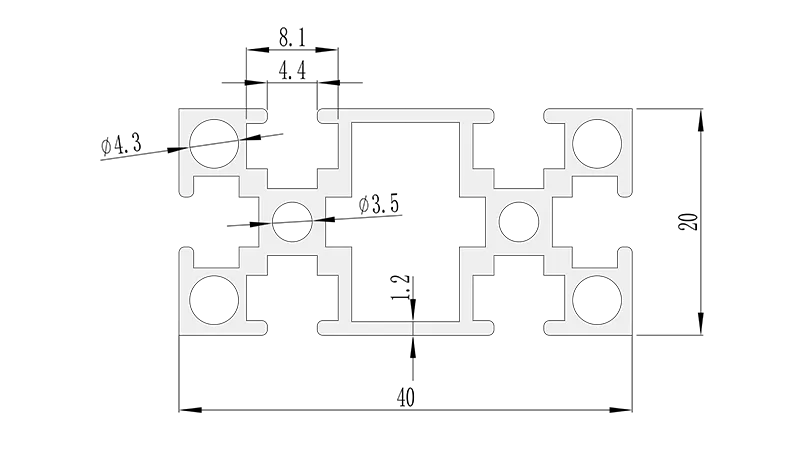
2040 National Standard Profile
45° external bending joint, used for 45° external connection of two aluminum pipes.
In the fast-paced world of e-commerce, where customers expect next-day—or even same-day—deliveries, the backbone of success lies in the efficiency of order fulfillment. Behind every "your package is out for delivery" notification is a warehouse bustling with activity: pickers racing to gather items, packers securing boxes, and conveyors humming as products move from shelves to shipping docks. But what happens when the warehouse itself becomes a bottleneck? When rigid layouts slow down workflows, or flimsy structures can't keep up with growing order volumes? This is where modern warehouse infrastructure, specifically the 2040 National Standard Profile, steps in to transform chaos into precision.
E-commerce growth shows no signs of slowing. Global online sales are projected to surge past $8 trillion by 2026, and with that comes a tidal wave of orders. For warehouse managers, the pressure is on to do more with less—less space, less time, and fewer resources. Traditional warehousing setups, often built with fixed wooden shelves, heavy steel racks, or one-size-fits-all workbenches, simply can't adapt. They're slow to reconfigure, prone to wear and tear, and often waste precious square footage. Enter the 2040 National Standard Profile: a modular aluminum solution that's quietly revolutionizing how warehouses operate, one adjustable bracket and customizable rail at a time.
What is the 2040 National Standard Profile?
At first glance, the 2040 National Standard Profile might look like just another piece of metal. But dive deeper, and you'll discover a engineering marvel designed for adaptability. Part of the broader family of aluminum extrusion profiles, the "2040" refers to its dimensions: 20mm in width and 40mm in height. This slim yet sturdy profile is crafted from high-grade aluminum alloy, treated with anodization to resist corrosion, and built to meet strict national standards for load-bearing capacity and durability.
What truly sets it apart, though, is its modularity. Unlike traditional steel or wooden structures that require welding, drilling, or permanent fasteners, the 2040 profile features a T-slot design along its length. These slots allow for quick attachment of aluminum profile accessories—connectors, brackets, shelves, and even conveyor components—using simple bolts or sliding nuts. Need to adjust a workbench height? Swap out a bracket. Expand a flow rack to accommodate more inventory? Add a few extra profiles and connectors. It's like building with industrial-grade Legos, but for warehouses.
Compliance with national standards is another key selling point. The "National Standard" designation ensures that every 2040 profile meets uniform specifications for material thickness, slot dimensions, and structural integrity. This means warehouse managers don't have to worry about compatibility issues when sourcing from different suppliers; a 2040 profile from one vendor will work seamlessly with accessories from another. For e-commerce operations scaling across regions, this consistency is a game-changer.
The Hidden Pain Points of Modern Warehousing
To understand why the 2040 National Standard Profile is gaining traction, let's first look at the daily struggles warehouse managers face. These aren't just minor inconveniences—they're costly, efficiency-killing problems that directly impact the bottom line.
1. Space Inefficiency: When Every Square Foot Counts
E-commerce warehouses are often squeezed for space. Urban locations, rising real estate costs, and the need to store thousands of SKUs (from tiny electronics to bulky home goods) mean that wasted space isn't just a luxury—it's a liability. Traditional steel racks, for example, are often overbuilt, with thick beams and fixed depths that leave gaps between shelves. Wooden workbenches, too, are often heavier and bulkier than necessary, eating up floor space that could be used for storage or workflow lanes.
2. Rigid Layouts: Stuck in the Past
Seasonal spikes—Black Friday, back-to-school, holiday shopping—demand warehouses that can pivot quickly. A warehouse optimized for summer's swimwear and sunscreen needs a complete overhaul when winter coats and holiday gifts start rolling in. But with fixed structures, reconfiguration is a nightmare. Moving a traditional steel flow rack might require a team of workers, heavy machinery, and hours (or days) of downtime. By the time the layout is updated, the peak season is already halfway over.
3. Ergonomic Struggles: Workers Burned Out, Orders Delayed
Warehouse pickers and packers are the unsung heroes of e-commerce, but their productivity suffers when workstations aren't designed with ergonomics in mind. A workbench that's too low forces employees to hunch over, leading to back pain and slower packing times. A flow rack that's too high requires stretching or ladder use, increasing the risk of injury and delays. Traditional setups rarely prioritize adjustability, leaving workers to adapt to the equipment—instead of the other way around.
4. Durability vs. Cost: The Never-Ending Tradeoff
Warehouses are tough environments. Forklifts bump into racks, boxes are dropped on shelves, and constant foot traffic wears down floors and work surfaces. Steel structures are durable but expensive and heavy. Plastic or wooden setups are cheaper but warp, crack, or rot over time, leading to frequent replacements. For budget-conscious operations, this tradeoff is a headache: spend too much on steel, and profits shrink; cut corners with cheaper materials, and you're stuck with constant repairs.
How 2040 National Standard Profile Solves These Problems
The 2040 National Standard Profile wasn't designed to be just another warehouse tool—it was built to address these pain points head-on. Let's break down how its unique features translate to real-world efficiency gains.
1. Flexibility: Adapt in Hours, Not Days
The T-slot design and aluminum profile accessories are the stars here. Imagine a warehouse gearing up for Black Friday. In years past, reconfiguring flow racks to prioritize high-demand items would take a weekend of labor: disassembling old racks, hauling them to storage, and rebuilding new ones. With 2040 profiles, it's a matter of loosening a few bolts, sliding off the old accessories, and attaching new ones. A team of two workers can reconfigure a 50-foot section of flow rack in under an hour.
This flexibility also extends to seasonal changes. After the holidays, when demand shifts from toys to fitness equipment, the same flow racks can be adjusted to accommodate larger boxes. Workstations can be expanded or contracted as temporary staff is added or reduced. For e-commerce warehouses with unpredictable order patterns, this adaptability is priceless.
2. Space Optimization: More Storage, Less Waste
Aluminum's high strength-to-weight ratio is a game-changer for space. The 2040 profile is lightweight—about 1/3 the weight of steel—yet can support up to 150kg per linear meter (depending on the setup). This means thinner, slimmer structures that take up less space but still handle heavy loads. For example, a 2040-based flow rack can be built with narrower uprights than a steel equivalent, freeing up 10-15% more aisle space. Over a 100,000-square-foot warehouse, that's 10,000-15,000 square feet of reclaimed space—enough to add hundreds of additional storage positions.
The T-slot design also allows for vertical optimization. Accessories like shelves and bins can be mounted at precise heights, eliminating gaps between storage levels. In one case study, a cosmetics e-commerce warehouse reported a 22% increase in SKU storage density after switching to 2040 profile racks, simply by better utilizing vertical space.
3. Ergonomics: Happy Workers, Faster Fulfillment
A workbench that adjusts to a worker's height isn't a luxury—it's a productivity booster. The 2040 profile makes ergonomic customization easy. Using height-adjustable brackets (another type of aluminum profile accessory), workbenches can be raised or lowered by as much as 30cm, ensuring pickers and packers can stand or sit comfortably. This reduces fatigue, cuts down on workplace injuries, and speeds up tasks like packing, where precision and speed matter.
Even small touches make a difference. For example, adding a tilting bracket to a packing station allows workers to adjust the angle of a box, reducing strain on wrists. Flow racks built with 2040 profiles can be tilted slightly to let products "flow" toward pickers, eliminating the need to reach deep into shelves. These small adjustments add up: one study found that ergonomically optimized workstations using 2040 profiles increased packing speeds by 18% and reduced worker absences by 25%.
4. Durability & Cost-Efficiency: Built to Last, Without the Price Tag
Aluminum's anodized finish resists scratches, rust, and corrosion—critical in warehouses where spills, humidity, and heavy use are common. Unlike wood, which warps or rots, or steel, which can rust if the paint chips, 2040 profiles maintain their integrity for decades. This longevity means fewer replacements, lower maintenance costs, and a better return on investment over time.
And while aluminum profiles may have a higher upfront cost than wood or low-grade steel, the savings add up quickly. A mid-sized e-commerce warehouse might spend $50,000 on traditional wooden workbenches and steel racks, only to replace them every 5-7 years. A 2040 profile setup, costing $70,000 initially, could last 15-20 years with minimal repairs. When factoring in reduced labor for reconfiguration, lower injury costs, and space savings, the 2040 profile often pays for itself within 2-3 years.
Real-World Applications: From Workbenches to Flow Racks
The 2040 National Standard Profile isn't just a theoretical solution—it's already transforming warehouses across the globe. Let's look at three key applications where it's making the biggest impact.
1. Workbenches: The Heart of the Fulfillment Process
The workbench is where orders come to life. It's where pickers verify items, packers seal boxes, and labels are applied. A poorly designed workbench can slow down every step of this process. Traditional wooden workbenches are often fixed in height, lack storage, and can't be customized for specific tasks. 2040 profile workbenches, by contrast, are a blank canvas for customization.
Take, for example, a packing station. Using 2040 profiles, warehouse managers can add: adjustable shelves for packing materials (tape, bubble wrap, labels), a hanging rod for shipping bags, and even a built-in conveyor track (using roller track accessories) to move packed boxes to the shipping area. Need to add a scale or a barcode scanner? Simply attach a mounting bracket to the T-slot. When the station needs to be moved, casters (another aluminum profile accessory) can be added in minutes.
One e-commerce giant specializing in electronics reported that switching to 2040 profile workbenches reduced packing time by 12% per order. Workers no longer wasted time searching for tape or reaching for labels—everything was within arm's reach, thanks to customized storage solutions.
2. Flow Racks: Streamlining Picking with FIFO Logic
First-In-First-Out (FIFO) is critical for e-commerce, especially for perishable goods or items with expiration dates (like cosmetics or food supplements). Flow racks, which use gravity to move products from the back (where they're stocked) to the front (where they're picked), are the gold standard for FIFO. But traditional flow racks are often bulky, hard to adjust, and limited in the types of products they can handle.
2040 profile flow racks solve this. Using aluminum guide rails (another aluminum profile accessory) and roller tracks, these racks can be customized to fit everything from small poly mailers to large boxes. The T-slot design allows for easy adjustment of rail width and angle, ensuring products flow smoothly without jamming. Need to add dividers for smaller items? Snap them into the T-slot. Want to increase capacity? Add a second level by attaching more profiles.
A food e-commerce startup recently replaced its steel flow racks with 2040 profile versions. The result? A 30% reduction in stockouts (thanks to better visibility of FIFO inventory) and a 22% faster picking rate, as workers no longer had to dig through disorganized shelves.
3. Conveyor Systems: Lightweight, Adaptable, and Efficient
Conveyors are the arteries of a warehouse, moving products from receiving to storage to shipping. Traditional steel conveyor frames are heavy, difficult to extend, and prone to rust. 2040 profile conveyors, by contrast, are lightweight and modular. The aluminum frames can be extended by adding more profiles, and the T-slot design allows for easy integration of sensors, diverters, and sorting mechanisms.
For example, during peak seasons, a warehouse might need to add a temporary conveyor lane to handle overflow. With 2040 profiles, this can be done in hours, not days. The lightweight frames can be moved by a small team, and aluminum profile accessories like brackets and clamps ensure the conveyor is stable and secure. When the season ends, the lane can be disassembled and stored compactly until next year.
Case Study: How "FastShip" E-Commerce Boosted Fulfillment Speed by 35% with 2040 Profiles
The Challenge: FastShip, a mid-sized e-commerce retailer specializing in apparel and home goods, was struggling to keep up with order growth. Their 50,000-square-foot warehouse was using a mix of wooden workbenches, steel racks, and fixed conveyors. During peak seasons, order processing times ballooned from 2 hours to over 5 hours, leading to missed delivery deadlines and unhappy customers. Workers complained of back pain from poorly designed workstations, and the warehouse was running out of storage space.
The Solution: FastShip's operations team decided to invest in a 2040 National Standard Profile overhaul. They replaced all wooden workbenches with adjustable 2040 profile workstations, swapped steel racks for modular flow racks, and added lightweight 2040 profile conveyors to connect picking and packing areas.
The Results:
- Faster Fulfillment: Order processing time dropped from 5 hours to 3.25 hours—a 35% improvement. This was due to ergonomic workstations (reducing worker fatigue), flow racks (speeding up picking), and flexible conveyors (eliminating bottlenecks).
- Space Savings: By replacing bulky steel racks with 2040 profile flow racks, FastShip freed up 7,500 square feet of space—enough to add 2,000 new storage positions for seasonal inventory.
- Happier Workers: After switching to height-adjustable workbenches, worker complaints about back pain dropped by 60%. Absenteeism decreased by 15%, and productivity per worker rose by 20%.
- Scalability: During the next Black Friday, FastShip was able to reconfigure their flow racks and conveyors in just 8 hours (down from 3 days with the old setup), allowing them to handle 40% more orders than the previous year.
The Verdict: "The 2040 National Standard Profile wasn't just an upgrade—it was a transformation," said Maria Gonzalez, FastShip's Warehouse Manager. "We're now processing more orders with the same space and staff, and our customers are happier than ever. It's the best investment we've made in our operations."
Choosing the Right Aluminum Profile Accessories: The Key to Success
The 2040 National Standard Profile is only as good as the accessories that accompany it. From connectors to casters, the right aluminum profile accessories ensure your warehouse setup is safe, efficient, and adaptable. Here's what to look for:
1. Compatibility: Stick to National Standards
Not all accessories are created equal. To ensure a snug, secure fit, choose accessories designed for the 2040 National Standard Profile. Look for suppliers that explicitly state compliance with national standards—this guarantees the T-slot dimensions, bolt sizes, and load capacities will match your profiles.
2. Durability: Invest in High-Quality Materials
Accessories should be made from the same high-grade aluminum or steel as the profiles. Avoid plastic accessories for heavy-duty applications (like load-bearing brackets), as they can crack under stress. For example, aluminum connectors with reinforced corners are better for high-load racks than flimsy plastic versions.
3. Versatility: Think Long-Term
Choose accessories that can be reused across different setups. For example, a height-adjustable bracket can be used on a workbench today and a flow rack tomorrow. Casters with locking mechanisms are useful for both mobile workstations and temporary conveyors. The more versatile the accessory, the more value you'll get from your investment.
Comparison: Traditional vs. 2040 Profile Warehouse Setups
| Feature | Traditional Setup (Wood/Steel) | 2040 National Standard Profile Setup |
|---|---|---|
| Reconfiguration Time | Days (requires disassembly/welding) | Hours (using T-slot accessories) |
| Space Efficiency | Low (bulky, fixed designs) | High (slim profiles, vertical optimization) |
| Ergonomic Customization | Limited (fixed heights, no adjustability) | High (adjustable brackets, tilting surfaces) |
| Durability | 5-7 years (wood rots, steel rusts) | 15-20 years (anodized aluminum resists corrosion) |
| Cost Over Time | Higher (frequent replacements, labor costs) | Lower (long lifespan, minimal maintenance) |
The Future of E-Commerce Warehousing: 2040 Profiles and Beyond
As e-commerce continues to evolve, so too will warehouse technology. The 2040 National Standard Profile is poised to play a central role in this evolution, thanks to its adaptability to emerging trends:
Automation Integration: The T-slot design makes it easy to mount robots, sensors, and IoT devices. Imagine a 2040 profile workbench with a collaborative robot (cobot) attached via brackets, helping pack orders alongside human workers. Or flow racks with built-in sensors that alert managers when stock is low—all powered by the profile's T-slot for wiring and mounting.
Sustainability: Aluminum is 100% recyclable, making 2040 profiles a greener alternative to steel or wood. As consumers demand more eco-friendly supply chains, warehouses using recyclable materials will have a competitive edge.
On-Demand Warehousing: The rise of flexible, pay-as-you-go warehouse spaces means structures need to be portable and reconfigurable. 2040 profiles, with their lightweight design and modular accessories, are perfect for these dynamic environments.
Conclusion: The 2040 Profile—More Than Metal, It's a Fulfillment Revolution
In the world of e-commerce, where milliseconds matter and customer expectations are sky-high, the difference between success and failure often lies in the details. The 2040 National Standard Profile isn't just a piece of aluminum—it's a tool that empowers warehouses to be faster, more flexible, and more efficient. It turns rigid, frustrating workspaces into dynamic, adaptable hubs where every square foot is optimized, every worker is supported, and every order is fulfilled on time.
For warehouse managers tired of fighting with outdated structures, constant reconfigurations, and wasted space, the 2040 profile offers a path forward. It's an investment in the future—one that pays dividends in happier workers, faster deliveries, and a bottom line that can keep up with the ever-growing demands of e-commerce.
So, the next time you track a package and wonder how it got to your door so quickly, remember: behind that speed is likely a warehouse quietly revolutionized by a simple yet powerful tool—the 2040 National Standard Profile.