- Company Articles
- Industry articles
- Industry standards
- 2040 National Standard Profile in Electronics Repair Stations: Customization Options

2040 National Standard Profile in Electronics Repair Stations: Customization Options
Related Product
2040 National Standard Profile
45° external bending joint, used for 45° external connection of two aluminum pipes.
Walk into any bustling electronics repair station, and you'll quickly realize that the workspace isn't just a backdrop—it's the engine that drives efficiency. Technicians hunched over tiny circuit boards, tools scattered across cluttered surfaces, cables tangling like spaghetti, and parts vanishing into the chaos—sound familiar? For years, many repair shops made do with generic workbenches, wooden shelves, or flimsy metal racks, never quite solving the puzzle of how to organize their unique needs. But what if there was a building block so versatile, so adaptable, that it could transform even the most chaotic repair station into a streamlined, technician-friendly hub? Enter the 2040 national standard profile: a humble aluminum extrusion that's quietly revolutionizing how electronics repair businesses design their workspaces. In this article, we'll dive deep into why this profile has become a favorite among repair shop owners, how it pairs with aluminum profile accessories to unlock endless customization, and why building a workspace around it might just be the best investment you make for your team's productivity.
The Problem with "One-Size-Fits-All" in Electronics Repair
Electronics repair is a world of tiny details and big demands. A smartphone screen replacement requires a steady hand and precise tool access; a laptop motherboard repair needs space for diagnostic equipment and anti-static mats; a vintage radio restoration might call for specialized parts storage. The idea that a single, pre-made workbench could cater to all these tasks is as outdated as the flip phones some shops still fix. Generic workspaces often come with fixed heights that leave tall technicians stooping or short ones stretching, shelves that are either too deep (hiding small screws) or too shallow (overflowing with tools), and zero flexibility to add, remove, or reconfigure components as your business grows. Worse, many are built from materials that scratch easily, harbor static electricity (a death sentence for sensitive electronics), or simply can't support the weight of heavy diagnostic machines. It's no wonder technicians spend as much time searching for tools or untangling cables as they do actually repairing devices.
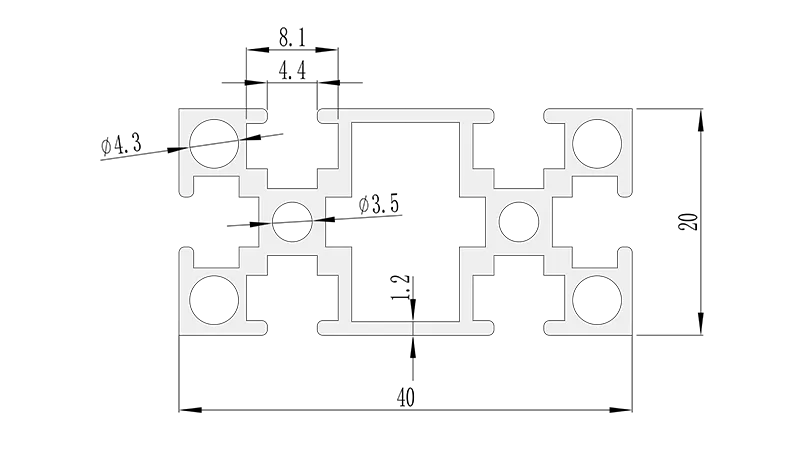
Here's the truth: your workspace should adapt to your workflow, not the other way around. And that's where the 2040 national standard profile steps in. This unassuming aluminum extrusion—measuring 20mm in width and 40mm in height—has become the backbone of customizable workspaces, thanks to its unique design, durability, and compatibility with a universe of aluminum profile accessories. But before we get into the "how," let's take a closer look at what makes this profile so special.
Meet the 2040 National Standard Profile: More Than Just Aluminum
At first glance, the 2040 national standard profile might look like any other aluminum bar—but that's where appearances deceive. What sets it apart is its adherence to strict national manufacturing standards, ensuring consistent dimensions, material quality, and compatibility across brands. Unlike off-brand extrusions that vary slightly in slot size or wall thickness (making (pèijiàn, accessories) a frustrating guessing game), the 2040 profile is a "universal language" for workspace builders. Its T-slot design—long, parallel grooves running along its length—acts like a series of built-in connection points, allowing you to attach brackets, shelves, tools, or almost anything else with just a bolt and a nut. And because it's made from high-grade aluminum, it's lightweight enough to assemble without heavy machinery but strong enough to support hundreds of pounds of equipment. For electronics repair stations, this means no more worrying about whether your workbench can hold that 50-pound oscilloscope or if your parts shelf will sag under a load of capacitors and resistors.
But the real magic of the 2040 profile isn't just its strength or standardization—it's its modularity . Think of it as the Lego brick of workspace design: you start with a few basic lengths, connect them with aluminum profile accessories like corner brackets or T-joints, and suddenly you've got a workbench. Need a shelf above it? Add two more profiles and some crossbars. Want to mount a magnetic tool strip? Screw a bracket into the T-slot. Six months later, when you expand to repairing tablets and need more surface area? Disassemble, reconfigure, and rebuild—no saws, no drills, no wasted materials. For repair shops that evolve with technology (and let's face it, what tech business doesn't?), this adaptability is priceless. You're not just buying a workbench; you're investing in a system that grows with you.
Customization Starts Here: Aluminum Profile Accessories as the "Secret Sauce"
If the 2040 national standard profile is the backbone of your workspace, then aluminum profile accessories are the muscles, tendons, and nerves that bring it to life. These small, often overlooked components—think end caps, brackets, hinges, or slot covers—are what turn a pile of aluminum extrusions into a fully functional workstation. Let's break down some of the most game-changing accessories for electronics repair stations and how they solve everyday problems.
End Caps: The Finishing Touch (That Matters More Than You Think)
At first, 2020 national standard profile end caps might seem like a cosmetic afterthought—just little plastic or aluminum plugs to cover the raw ends of the extrusion. But in a repair shop, details matter. Uncapped profile ends are sharp, posing a risk of nicking wires, scratching device casings, or even cutting a technician's hand during a late-night repair session. A simple end cap eliminates that hazard, creating a smooth, safe edge. Plus, they come in colors! A pop of blue, red, or black can add a touch of personality to your workspace, making it feel less like a factory and more like a place your team enjoys spending time. For a shop that prides itself on precision, it's the small things—like capped edges—that signal professionalism.
Connectors: The Glue That Holds It All Together
What good is a pile of aluminum profiles without a way to join them? Aluminum profile connectors are the unsung heroes of modular design, and the 2040 profile works with a wide range of them. The 90° corner bracket is a staple for building square frames (like workbench legs), while T-joints let you add a crossbar or shelf at a right angle. For more complex setups, 45° connectors can create angled surfaces (perfect for sloped parts bins that let components roll forward), and three-way connectors allow you to branch out in multiple directions. The best part? Most connectors require no drilling—just slide a bolt through the T-slot, tighten a nut, and you've got a rock-solid joint. This means you can experiment with designs without committing permanently, which is a lifesaver for shops still figuring out their ideal layout.
Slot Covers: Taming the Cable Monster
If there's one universal struggle in electronics repair, it's cables. Power cords for soldering irons, USB cables for diagnostics, LED lights for illuminating circuit boards—they multiply like rabbits, turning workbenches into trip hazards and creating static electricity risks. Enter the T-slot rubber seal cover: a flexible, often colored strip that snaps into the profile's T-slots, transforming them into built-in cable channels. Run your power strip's cord through the slot, feed your soldering iron cable along the edge of the workbench, or hide USB wires beneath the surface—suddenly, what was once a tangled mess becomes a clean, organized system. Some covers even have notches for branching cables, so you can route a wire exactly where you need it without unsightly loops. For technicians who spend hours staring at their workbench, this isn't just about aesthetics—it's about reducing distractions and focusing on the repair at hand.
Building Your Dream Workbench: 2040 Profile in Action
Enough theory—let's get practical. How do you actually build a customized workbench using the 2040 national standard profile and aluminum profile accessories? Let's walk through a real-world example: a mid-sized smartphone repair shop with three technicians, each specializing in different tasks (screen replacements, battery swaps, and motherboard repairs). Their goal? A workspace where each technician has their own bench, but all share a consistent, adaptable design that can evolve as new phone models hit the market.
First, the base: Each workbench frame is built with 2040 profiles cut to 120cm (length) x 60cm (depth) x 85cm (height)—a standard depth for smartphone work, but adjustable for taller or shorter technicians using height-adjustable feet (another handy aluminum profile accessory). The frame uses 90° corner brackets at each joint, with crossbars halfway up the legs for stability. The work surface itself is a 18mm anti-static laminate board, bolted to the frame using flat brackets that slide into the T-slots—no need to drill into the aluminum, which preserves the profile for future reconfigurations.
Next, tool organization: Each bench gets a vertical 2040 profile mounted to the back edge, fitted with hooks for soldering irons, tweezers, and spudgers, plus a magnetic strip for metal tools. A small shelf, mounted 30cm above the work surface using T-joints, holds diagnostic tools like multimeters and magnifying lamps. For parts storage, the team adds three small bins (each 15cm x 15cm) along the side of the bench, attached with angle brackets—one for screws, one for adhesive strips, and one for spare screens. Because the bins are mounted via the T-slots, they can be moved up, down, or removed entirely if a technician prefers a different layout.
Cable management is handled with T-slot rubber seal covers in gray (to match the shop's color scheme), running along the back of the bench and down the legs to a power strip mounted under the shelf. Each technician's bench has a small cutout in the back edge, allowing cables to feed through the slot cover and into the power strip, keeping the surface clear. Finally, the team adds 2020 national standard profile end caps in blue to the exposed edges, adding a pop of color and preventing snags.
The result? A workspace where every tool has a home, every cable is tamed, and every technician can adjust their setup to their liking. Six months later, when the shop starts repairing foldable phones (which require more surface area for alignment tools), they simply add an extension to each bench using extra 2040 profiles and T-joints—no need to buy new workbenches. That's the power of customization.
Beyond the Bench: Expanding Your Workspace with 2040 Profile
While the workbench is the heart of any repair station, the 2040 national standard profile's versatility doesn't stop there. Let's explore a few more ways repair shops are using this profile and aluminum profile accessories to solve common workspace challenges:
Parts Storage Racks: No More Lost Screws
Small parts—screws, resistors, capacitors—are the lifeblood of electronics repair, but they're also the easiest to lose. Generic plastic bins stacked on shelves might work for a while, but they're hard to label, tough to access, and impossible to rearrange. A 2040 profile parts rack, on the other hand, can be built to fit your exact bin sizes. Mount vertical 2040 profiles to the wall, add horizontal crossbars at 15cm intervals (using T-joints), and suddenly you've got a grid where bins slide in and out easily. Label each section by device type (iPhone, Samsung, laptop) or part category (screws, batteries, ports), and even color-code with different bin colors. Because the crossbars are adjustable, you can add more as your parts collection grows, or respace them if you switch to larger bins for bulk items. For a shop that deals with hundreds of tiny parts daily, this isn't just organization—it's peace of mind.
Mobile Workstations: Taking Repairs On the Go
Not all repairs happen at the bench. Maybe a customer drops off a large TV that's too heavy to carry to the back, or you offer on-site repair for local businesses. A mobile workstation built with 2040 profiles and heavy-duty casters (another aluminum profile accessory) solves this problem. Start with a small frame (80cm x 60cm), add a fold-down work surface, and mount a tool tray and parts bin on the side. The casters lock in place, so it stays steady during repairs, but unlock with a tap of the foot for easy movement. Some shops even add a small shelf for a portable diagnostic monitor, turning the cart into a mini repair station that can go anywhere. It's versatility like this that makes the 2040 profile indispensable for growing businesses.
Anti-Static Stations: Protecting Sensitive Electronics
Static electricity is the enemy of electronics repair, capable of frying a motherboard in an instant. While anti-static mats and wristbands are standard, a truly safe workspace needs more: grounded surfaces, static-free storage, and no sharp edges that generate static. The 2040 profile, being aluminum, is naturally conductive, making it easy to ground (simply attach a grounding wire to the frame via a bolt in the T-slot). Pair it with an anti-static laminate work surface, and you've got a bench that actively protects sensitive components. Add aluminum profile accessories like grounded tool holders or static-shielded parts bins, and you've created a zone where even the most delicate repairs (like microchip replacement) can happen safely. For shops that specialize in high-end electronics (think MacBooks or gaming consoles), this isn't just a nice-to-have—it's a requirement.
Table 1: Key Customization Features of 2040 Profile Workstations for Electronics Repair
| Customization Feature | 2040 Profile + Accessories Used | Why It Matters for Repair Shops | Example Use Case |
|---|---|---|---|
| Adjustable Height | 2040 Profiles + Height-Adjustable Feet | Reduces technician strain; fits team members of all heights | A 6'5" technician no longer stoops; a 5'2" tech avoids stretching |
| Tool Wall Integration | Vertical 2040 Profiles + Hook Brackets | Tools are visible and accessible; reduces time spent searching | Soldering iron, tweezers, and spudgers hang at arm's reach |
| Modular Shelving | Horizontal 2040 Profiles + T-Joints | Adapts to changing storage needs (e.g., new phone models = new parts) | Add a shelf for foldable phone alignment tools; remove it later if unused |
| Cable Management | T-Slot Rubber Seal Covers + Cable Clips | Eliminates tangles and static risks; creates a cleaner workspace | Power cords for soldering irons and diagnostics hide in T-slots |
| Mobile Workstations | 2040 Frame + Locking Casters | Repairs can happen anywhere in the shop (or on-site) | Move a mini-bench to the customer's location for TV repairs |
Why Aluminum? The Material That Makes It All Possible
You might be wondering: why aluminum? Why not steel, wood, or plastic? The answer lies in aluminum's unique combination of properties, which make it perfect for electronics repair workspaces. First, it's lightweight—much lighter than steel—so even a full workbench frame can be assembled by two people without heavy equipment. This is a game-changer for small shops with limited staff or tight spaces. Second, it's corrosion-resistant, so it won't rust if exposed to soldering flux, cleaning solvents, or the occasional spilled drink (we've all been there). Third, it's easy to work with: aluminum profiles can be cut with a simple hacksaw (though most suppliers will cut to length for you), and drilling (if needed) is a breeze compared to steel. And finally, it's recyclable, which matters for businesses looking to reduce their environmental footprint.
But perhaps the biggest advantage of aluminum—specifically the 2040 national standard profile—is its cost-effectiveness over time. While a generic wooden workbench might be cheaper upfront, it won't last as long, can't be reconfigured, and will need replacing every few years. The 2040 profile, on the other hand, is built to last decades. Its modularity means you can reuse components when you expand or redesign, and its durability ensures it won't warp, crack, or rot. For repair shops operating on tight margins, this long-term value is impossible to ignore. It's not just a purchase; it's an investment in your shop's future.
Choosing the Right Components: A Buyer's Guide
Ready to dive in and build your own 2040 profile workspace? Before you start ordering parts, there are a few key considerations to keep in mind. First, source from a reputable supplier . Not all aluminum profiles are created equal, and non-standard extrusions might have slightly off dimensions that make accessories incompatible. Look for suppliers who specifically mention "2040 national standard profile" and offer a range of aluminum profile accessories—this ensures you're getting parts that work together seamlessly. Second, plan for weight . While the 2040 profile is strong, it has limits: a single 1-meter length can support around 50kg, but if you're mounting heavy equipment (like a large diagnostic monitor), you'll need extra crossbars or thicker profiles. Third, think about future expansion . Order a few extra profiles and connectors—you'll be surprised how quickly you'll find uses for them. And finally, involve your technicians . After all, they're the ones using the workspace daily! Ask what frustrates them about their current setup, what tools they wish were closer, or what storage solutions they've always wanted—you might be surprised by their insights.
From Chaos to Clarity: A Shop Owner's Success Story
To truly understand the impact of a 2040 profile workspace, let's hear from Mike, the owner of QuickFix Electronics, a repair shop in Chicago that upgraded from generic workbenches to custom 2040 profile stations last year. "Before, we had three old wooden benches—they were wobbly, the shelves were too deep, and cables were everywhere," Mike recalls. "My technicians were constantly losing screws, tripping over cords, or complaining about back pain from hunching. We were doing about 15 repairs a day, and I knew we could do more if the space worked for us, not against us."
After researching options, Mike decided to invest in three 2040 profile workbenches, complete with aluminum profile accessories like adjustable shelves, cable management covers, and tool hooks. "The first week, the team was skeptical—'Another workbench?' they said. But by the end of the month, they were converts. One technician added a magnetic strip for his tweezers; another built a small parts rack for iPhone screws (he color-coded the bins by model!). We even added a mobile cart for on-site repairs, which has helped us take on bigger jobs, like fixing restaurant POS systems."
The results? "We're now doing 22 repairs a day—almost a 50% increase—with the same team size," Mike says. "The technicians are happier, the shop looks more professional (customers notice!), and we've cut down on 'lost part' delays by 70%. Best of all, when we expanded to tablet repairs, we just added a shelf to each bench—no new workbench needed. It's the best $3,000 I've ever spent."
Conclusion: Customization Isn't a Luxury—It's a Necessity
In the fast-paced world of electronics repair, where new devices hit the market weekly and customer expectations are higher than ever, your workspace can't afford to be an afterthought. The 2040 national standard profile isn't just a building material—it's a tool for empowerment, giving you the ability to design a workspace that fits your shop's unique needs, adapts to change, and puts your technicians first. Paired with the right aluminum profile accessories, it transforms "making do" into "mastering your craft."
So, whether you're a one-person repair shop outgrowing your garage or a multi-location business looking to standardize operations, consider this: the most successful repair stations aren't just fixing electronics—they're building systems that make those repairs faster, safer, and more efficient. And at the heart of those systems? Often, a simple aluminum extrusion with endless possibilities. The 2040 national standard profile might not be the flashiest investment you'll make, but it could very well be the one that keeps your team smiling, your customers returning, and your bottom line growing—one customized workbench at a time.