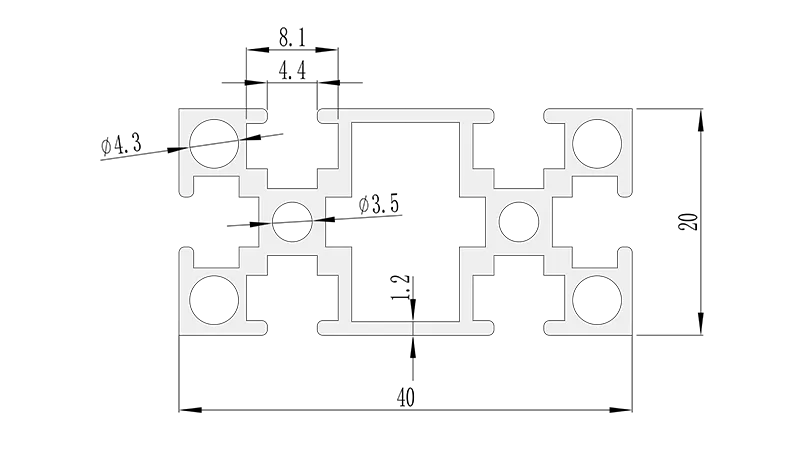
The 2040 National Standard Profile isn't just a theoretical sustainability tool—it's a workhorse in real-world renewable energy factories. Let's dive into specific applications where it's making a difference, starting with solar energy production.
Solar Panel Assembly Workstations
Solar panel manufacturing is a precision process. Workers handle fragile silicon wafers, align delicate wiring, and test electrical connections—tasks that demand stable, ergonomic workstations. 2040 profile workbenches shine here. Their modular design allows factories to customize height, add tool trays (using
aluminum profile accessories
like T-slot brackets), and integrate lighting or ESD (electrostatic discharge) mats to protect sensitive components. Unlike fixed wooden or steel benches, 2040 workstations can be adjusted as panel sizes change (e.g., from 60-cell to 72-cell panels), avoiding the need to build new benches from scratch. This adaptability reduces waste and keeps production lines agile.
Wind Turbine Material Racks
Wind turbines require large, bulky components—gearboxes, rotor hubs, control systems. Storing these parts safely and accessing them efficiently is a challenge. 2040 profile material racks, often paired with roller tracks (another aluminum accessory), solve this. The racks are strong enough to hold heavy parts (thanks to the profile's load capacity) but lightweight enough to reposition as production schedules shift. For example, a factory producing 5MW turbine hubs might use 2040 racks with adjustable shelves to accommodate different hub sizes, ensuring parts are always within reach of assembly teams. The roller tracks allow for easy sliding of components, reducing the need for forklifts and cutting down on energy use.
Battery Production Lines
Energy storage systems, like lithium-ion batteries for solar farms, require clean, organized production environments. 2040 profile conveyor systems, built with aluminum guide rails and plastic roller tracks, transport battery cells between assembly stations without damaging them. The T-slot design makes it easy to add dividers or guides, ensuring cells stay aligned during transport. Additionally, 2040 profile frames support HEPA filters and ventilation systems, maintaining air quality in cleanrooms—a critical factor for battery performance and safety.
Many renewable energy manufacturers adopt
lean system
principles to eliminate waste and improve efficiency. The 2040 profile is a natural fit for lean initiatives. Its modularity supports the "5S" methodology (Sort, Set in Order, Shine, Standardize, Sustain) by allowing factories to organize tools and materials exactly where they're needed. For instance, a solar inverter assembly line might use 2040 profile shadow boards with labeled slots for screwdrivers, pliers, and meters, reducing time spent searching for tools. When production needs change, the shadow boards can be reconfigured in minutes, keeping the line efficient without disrupting workflows.