- Company Articles
- Industry articles
- Industry standards
- 2040 National Standard Profile: Key Features for Lean Manufacturing Systems

2040 National Standard Profile: Key Features for Lean Manufacturing Systems
Related Product
2040 National Standard Profile
45° external bending joint, used for 45° external connection of two aluminum pipes.
In the world of lean manufacturing, where every second counts and waste is the enemy, the tools and materials you choose can make or break your efficiency. Lean isn't just a buzzword—it's a mindset that hinges on creating smooth workflows, eliminating unnecessary steps, and building systems that adapt as your needs change. And if there's one component that quietly powers this adaptability, it's the 2040 National Standard Profile . This unassuming aluminum extrusion profile has become a unsung hero in factories, workshops, and production lines worldwide, and today, we're diving into why it's so critical for building lean systems that actually work.
What Even Is a 2040 National Standard Profile?
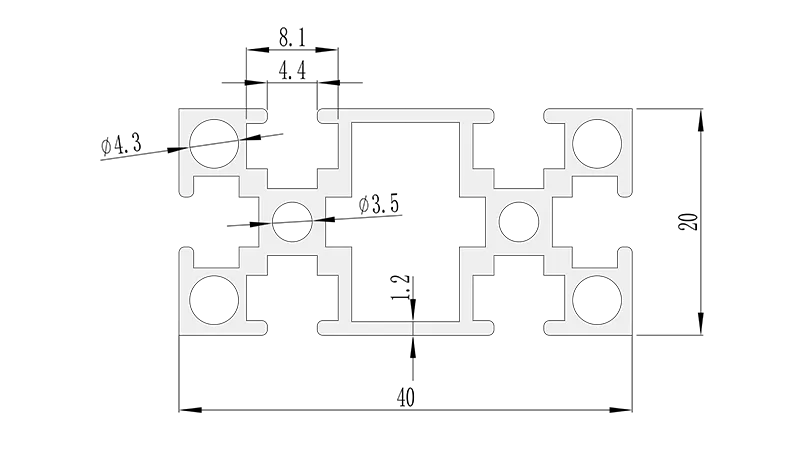
Before we get into its superpowers, let's start with the basics. The 2040 National Standard Profile is a type of aluminum extrusion profile —a long, slender piece of aluminum shaped through a process called extrusion, where molten aluminum is pushed through a die to create a specific cross-section. The "2040" refers to its dimensions: 20 millimeters in width and 40 millimeters in height. Simple enough, right? But don't let the numbers fool you. Those dimensions are carefully engineered to strike a balance between strength, weight, and versatility—three things that matter a lot when you're trying to build a lean system.
Unlike custom-made metal brackets or rigid steel frames, this profile is part of a standardized system. That means it's designed to work seamlessly with a whole ecosystem of parts—think aluminum profile accessories like corner codes, hinges, end caps, and connectors. No more hunting for one-off parts or welding pieces together; with 2040 profiles, you can assemble, disassemble, and reconfigure structures in hours, not days. And in lean manufacturing, that flexibility is gold.
Key Feature 1: Design Flexibility That Grows With Your Needs
Imagine trying to build a workbench for a small electronics assembly line. One week, you need extra space for testing equipment; the next, you're adding a shelf for tools; a month later, you might even need to move the entire setup to a new part of the factory. If you're using a fixed wooden workbench or a welded steel frame, you're stuck—you'd either have to build a whole new one or hack the old one into something it wasn't meant to be (hello, waste!).
The 2040 National Standard Profile solves this problem with its T-slot design. Running along its length are grooves (the "T-slots") that let you slide in bolts, brackets, or accessories without drilling holes or welding. Want to add a shelf? Just slide in some angle brackets and tighten a few screws. Need to attach a light bar overhead? Clip on a bracket and you're done. This isn't just convenience—it's the kind of flexibility that lets you adapt your workspace to your workflow, not the other way around.
Take a real example: A small automotive parts manufacturer I worked with a few years back was struggling with their quality control station. Their old wooden workbench was too low, had no storage, and couldn't fit the new inspection tools they'd invested in. They considered buying a custom steel bench, but the lead time was 6 weeks, and it would cost twice their budget. Instead, they went with 2040 profiles. In a single afternoon, their team assembled a bench with adjustable height (thanks to telescoping legs), built-in tool holders (using aluminum profile accessories like T-slot nuts), and even a small shelf for documentation. Six months later, when they expanded the line, they disassembled the bench, added a few extra profiles, and had a longer, wider setup ready in a day. No waste, no waiting—just lean in action.
Key Feature 2: Material Efficiency That Cuts Waste (and Costs)
Lean manufacturing is all about doing more with less, and the 2040 profile excels here. As an aluminum extrusion profile , it's made by forcing aluminum through a die, which means it's precision-engineered to use exactly the amount of material needed—no excess, no waste. Compare that to traditional steel fabrication, where you might cut a large sheet down to size, leaving scraps that end up in the trash. With extrusion, the material is shaped before it's cut, so you get consistent, uniform pieces with minimal leftover material.
Aluminum itself is also a win for efficiency. It's lightweight—about a third the weight of steel—so structures built with 2040 profiles are easier to move, install, and reconfigure. This might not sound like a big deal until you've tried moving a 300-pound steel workbench across a factory floor. Lighter structures also mean less strain on floors, fewer injuries from heavy lifting, and even lower shipping costs if you're building systems off-site. And because aluminum is naturally resistant to corrosion, you don't need to paint or treat it, saving time and resources on maintenance.
Let's talk numbers: A typical 2040 profile weighs around 0.8 kg per meter, while a comparable steel profile might weigh 2.5 kg per meter. If you're building a 5-meter-long workbench frame, that's a difference of 8.5 kg—enough to make moving it by hand feasible instead of needing a forklift. Over time, that adds up: fewer equipment rentals, less energy used in transport, and a safer workplace. For small to medium-sized businesses, these savings can be game-changing.
Key Feature 3: Compatibility With Aluminum Profile Accessories (Because No One Works Alone)
A profile is only as good as the parts it works with, and the 2040 National Standard Profile plays well with others. It's designed to be fully compatible with a wide range of aluminum profile accessories , from simple nuts and bolts to more complex components like hinges, locks, and even casters. This compatibility means you're never stuck buying proprietary parts or worrying if a new accessory will fit—most standard T-slot accessories work right out of the box.
Let's say you need to add mobility to your workbench. Just grab a set of caster accessories (think: stem casters with T-slot mounting plates), slide them into the profile's T-slots, tighten the bolts, and suddenly your stationary bench is a mobile workstation. Need to route cables for power tools? There are cable management accessories—like plastic channels or clip-on covers—that snap into the T-slots, keeping wires organized and out of the way. Even something as simple as adding a whiteboard to the side of a material rack is easy with bracket accessories designed for 2040 profiles.
This interoperability is a huge boon for lean systems because it lets you mix and match components to solve specific problems. Maybe you need a temporary flow rack for incoming materials: use 2040 profiles for the frame, add roller track (another accessory!) for easy sliding, and top it off with adjustable shelves. When the project ends, disassemble it, return the parts to inventory, and reuse them for the next task. No more buying single-use fixtures that collect dust in a corner—this is how you build a truly circular, waste-free operation.
How Does 2040 Stack Up Against Other Profiles? Let's Compare
To really appreciate the 2040 National Standard Profile, it helps to see how it measures up against other common profiles. Below is a breakdown comparing it to two popular alternatives: the 3030 National Standard Profile (30x30mm) and the 4040 National Standard Profile (40x40mm). This will give you a sense of when 2040 is the right choice—and when another profile might be better.
| Feature | 2040 National Standard Profile | 3030 National Standard Profile | 4040 National Standard Profile |
|---|---|---|---|
| Dimensions (WxH) | 20mm x 40mm | 30mm x 30mm | 40mm x 40mm |
| Material Thickness | 1.2–1.5mm (standard) | 1.5–2.0mm (standard) | 2.0–3.0mm (standard) |
| Weight per Meter | 0.7–0.9 kg | 1.2–1.5 kg | 2.0–2.5 kg |
| Max Load Capacity (per meter, horizontal) | 150–200 kg | 250–350 kg | 400–500 kg |
| Best For | Workbenches, light-duty racks, mobile trolleys, small material handling systems | Medium-duty racks, machine frames, assembly stations, shelving | Heavy-duty workstations, industrial machinery frames, high-load conveyors |
| Cost (per meter, approximate) | $8–$12 | $12–$18 | $20–$30 |
As you can see, the 2040 profile hits a sweet spot: it's lighter and more affordable than larger profiles like the 4040, but still strong enough for most light to medium-duty tasks. It's narrower than the 3030, which makes it ideal for tight spaces—think narrow workbenches in crowded assembly lines or compact material racks in warehouses with limited square footage. And because it's part of the national standard system, you don't have to sacrifice compatibility for size—all the same aluminum profile accessories that work with 3030 or 4040 profiles work with 2040, too.
Real-World Applications: How 2040 Profiles Power Lean Systems
Enough theory—let's look at how businesses are actually using 2040 National Standard Profiles to build better lean systems. From workbenches to flow racks, this profile is quietly transforming workflows across industries.
1. Custom Workbenches That Adapt to Your Team
Workbenches are the heartbeat of any production line, and 2040 profiles make them infinitely customizable. Take the workbench example we mentioned earlier: a team of mechanics at a small auto shop needed a bench that could handle everything from engine parts to electronics. They used 2040 profiles for the frame, added a plywood top (secured with T-slot bolts), and attached tool hooks along the sides (using aluminum profile accessories like hook brackets). They even added a pegboard on one end for small parts, mounted with angle brackets. The best part? When a new technician joined and needed more space, they simply extended the bench by adding two more 2040 rails and a longer top—no tools beyond an Allen wrench required.
Another example: a bakery that specializes in custom cakes. Their old workbenches were too tall for some bakers and too short for others, leading to back pain and slower prep times. With 2040 profiles, they built adjustable-height workbenches using telescoping legs (fitted with locking collars) and added non-slip mats on top (secured with adhesive-backed T-slot strips). Now, each baker can set their bench to the perfect height, and cleanup is easier than ever—no more crumbs getting stuck in crevices, since the smooth aluminum frame wipes clean in seconds.
2. Flow Racks That Keep Materials Moving
Lean systems thrive on smooth material flow—getting the right parts to the right place at the right time. 2040 profiles are perfect for building flow racks, which use gravity to feed materials to workers, eliminating the need for constant reaching or bending. One electronics manufacturer I visited used 2040 profiles to build a flow rack for circuit boards. The rack had three levels, each fitted with roller track (another accessory!) that let boards slide gently to the front as the top ones were used. The frame was lightweight enough that two people could move it closer to the assembly line when needed, and the T-slots made it easy to add dividers to separate different board types. Before the flow rack, workers were walking 15 extra steps per hour to fetch materials; after, that waste was gone, and productivity ticked up by 12%.
3. Mobile Trolleys for On-Demand Material Delivery
In lean terms, "transportation waste" is any unnecessary movement of materials. Mobile trolleys built with 2040 profiles cut this waste by letting teams deliver parts directly to the point of use. A furniture manufacturer I worked with used to have workers carry armrests from the upholstery station to the assembly line in bins—slow, tiring, and prone to damage. Now, they use 2040-based trolleys with caster accessories (swivel casters with brakes for stability) and dividers to hold armrests upright. The trolleys are light enough for one person to push, and the T-slot design lets them add or remove dividers depending on the day's production run. Since switching, they've reduced material damage by 40% and freed up two workers who used to spend hours moving bins—time they now spend on value-adding tasks like quality checks.
Why 2040 Profiles Are a Must for Lean System Suppliers
If you're a supplier or manufacturer building lean solutions for others, the 2040 National Standard Profile should be in your toolkit. Its flexibility means you can offer custom solutions without the custom price tag—no need to design unique frames for every client when you can mix and match profiles and accessories. It also lets you prototype quickly: if a client needs a new workbench design, you can mock it up in a day using 2040 profiles, test it, and adjust on the fly before finalizing the build. This speed to market is a huge competitive advantage in a world where businesses need solutions yesterday.
Plus, because 2040 profiles are part of a national standard, your clients can easily source replacement parts or expand their systems later—no vendor lock-in, no proprietary components. This builds trust: clients know they're investing in a system that can grow with them, not a one-and-done product. And since aluminum is recyclable, you can market your solutions as sustainable, which matters more than ever to eco-conscious businesses.
Final Thoughts: The 2040 Profile—Small in Size, Big in Impact
At first glance, the 2040 National Standard Profile might seem like just another piece of metal. But in the context of lean manufacturing, it's so much more. It's a tool that lets teams build the systems they need, when they need them—without waste, without waiting, and without breaking the bank. Its design flexibility means no more "making do" with ill-fitting equipment; its material efficiency cuts costs and reduces environmental impact; and its compatibility with aluminum profile accessories ensures it can adapt as your business grows.
Whether you're building a simple workbench for a startup workshop or designing a full production line for a large manufacturer, the 2040 profile is proof that the best lean solutions are often the most versatile ones. It's not about overcomplicating things—it's about choosing tools that work with you, not against you. And in a world where lean is no longer optional, that's the kind of advantage that makes all the difference.