- Company Articles
- Industry articles
- Industry standards
- 2040 National Standard Profile Load Testing: Ensuring Safety in Heavy-Duty Applications

2040 National Standard Profile Load Testing: Ensuring Safety in Heavy-Duty Applications
Related Product
2040 National Standard Profile
45° external bending joint, used for 45° external connection of two aluminum pipes.
Walk into any modern manufacturing plant, warehouse, or assembly line, and you'll likely spot a silent workhorse holding everything together: aluminum profiles. These unassuming metal structures are the backbone of countless industrial setups, from workbenches where technicians assemble precision parts to material racks stacked with heavy components. Among the most widely used is the 2040 national standard profile—a versatile, durable extrusion that balances strength, weight, and adaptability. But here's the thing: even the sturdiest-looking profile is only as reliable as its ability to handle real-world loads. That's where load testing comes in. In this article, we're diving deep into what 2040 national standard profile load testing entails, why it's non-negotiable for heavy-duty applications, and how it keeps workers safe and operations running smoothly.
What Is a 2040 National Standard Profile, Anyway?
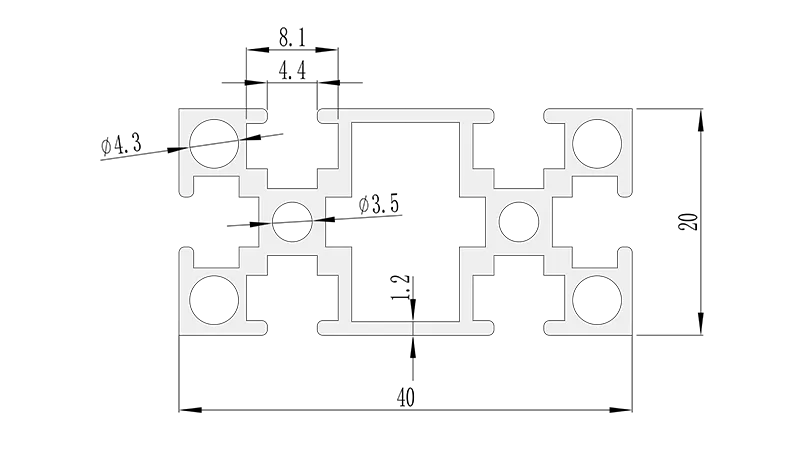
Before we get into the nitty-gritty of load testing, let's make sure we're all on the same page about what a 2040 national standard profile is. Simply put, it's an aluminum extrusion with a cross-sectional dimension of 20mm by 40mm—hence the "2040" name. These profiles are part of a broader family of aluminum extrusion profiles, designed to meet strict national standards for material quality, dimensional accuracy, and structural integrity. What makes them so popular? Their T-slot design. Those grooves running along the length of the profile allow for easy attachment of aluminum profile accessories like connectors, brackets, and shelves, making it a breeze to build custom structures without welding or heavy machining.
Think of it as industrial Lego for adults. Need a workbench for your assembly line? Combine 2040 profiles with a plywood or aluminum honeycomb panel top, add adjustable leveling feet to keep it stable on uneven floors, and you're good to go. Building a material rack to store bulky components? Connect 2040 vertical posts with horizontal crossbars, throw in some roller tracks for easy loading, and you've got a system that can grow with your needs. But here's the catch: every time you add a shelf, a tool, or a box of parts, you're adding weight. And if that weight exceeds what the profile can handle, the whole structure could bend, warp, or even collapse. That's why load testing isn't just a "nice-to-have"—it's a critical step in ensuring these profiles do what they're supposed to do when it matters most.
Why Load Testing Matters: Safety, Reliability, and Peace of Mind
Let's start with the obvious: safety. In a busy factory, the last thing anyone needs is a workbench collapsing under the weight of a 50kg toolbox or a material rack giving way and sending parts crashing to the floor. The consequences aren't just costly—they're dangerous. A falling structure could injure workers, damage expensive equipment, or grind production to a halt. Load testing helps prevent that by verifying exactly how much weight a 2040 profile (and the structures built with it) can safely support before failure.
But it's not just about avoiding disasters. Load testing also ensures reliability. Imagine you're running a 24/7 assembly line where a conveyor system, built with 2040 profiles, moves components between stations. If that conveyor sags under the weight of parts over time, it could throw off the entire production schedule, leading to delays and missed deadlines. By testing the profiles' load capacity upfront, you can design systems that stand up to constant use, day in and day out. This reliability also translates to cost savings: no more unexpected repairs, replacements, or downtime.
And let's not forget compliance. Many industries—especially those with strict safety regulations like automotive, aerospace, or medical device manufacturing—require proof that equipment meets specific load-bearing standards. Load test reports provide that proof, giving inspectors, clients, and stakeholders confidence that your setup isn't just "good enough"—it's built to last.
Types of Load Tests: Static, Dynamic, and Fatigue—What's the Difference?
Load testing isn't a one-size-fits-all process. Depending on how the 2040 profile will be used, different types of tests are needed to simulate real-world conditions. Let's break down the three main ones:
Static Load Testing: When Weight Stays Put
Static load testing is the most straightforward: it measures how a profile handles a constant, stationary weight over time. Think of a workbench in a repair shop where a heavy engine block sits for hours on end. The weight isn't moving, but it's still exerting constant pressure on the profile legs and crossbars. In a static test, we apply a gradually increasing load to the profile (or a structure built with it) and monitor for deflection (how much it bends) and permanent deformation (whether it springs back to its original shape after the load is removed).
For example, a standard 2040 national standard profile might be rated to handle a static load of 500kg per linear meter. To test this, engineers might secure a 2-meter section of the profile between two supports, hang weights from the center, and incrementally add more until they reach (or exceed) 1000kg (500kg/m x 2m). If the profile deflects by more than a specified amount (say, 2mm) or doesn't return to its original shape, it fails the test. This tells manufacturers and users exactly where the breaking point is—and ensures they stay well below it in real use.
Dynamic Load Testing: When Weight Moves
Not all loads are stationary. In conveyor systems, for instance, parts slide or roll along roller tracks attached to 2040 profiles. This creates dynamic loads—weights that are in motion, which can exert additional stress (like impact or vibration) on the structure. Dynamic load testing simulates this by applying moving or suddenly changing weights to the profile.
A common dynamic test involves mounting a 2040 profile section above a conveyor belt and dropping weighted objects onto it to mimic parts falling into a bin. Or, for a roller track setup, engineers might run a series of weighted carts along the track at different speeds, measuring how the profile absorbs the impact. The goal here is to ensure the profile doesn't crack, loosen, or fail when subjected to the kind of jostling and movement it would see in a busy facility.
Fatigue Load Testing: When Weight Repeats
Even if a profile handles static and dynamic loads well, what happens when it's subjected to the same weight over and over again? That's where fatigue testing comes in. Fatigue occurs when a material weakens over time due to repeated stress—think of bending a paperclip back and forth until it snaps. In industrial settings, this could be a material rack that's loaded and unloaded multiple times a day, or a workbench where tools are placed and removed repeatedly.
Fatigue testing involves applying a cyclic load (e.g., 200kg applied and removed every few seconds) to a 2040 profile and counting how many cycles it can withstand before failing. For heavy-duty applications, this number can be in the millions—simulating years of use. If a profile fails after only 10,000 cycles, it's a red flag that it might not hold up in a high-traffic environment.
The Load Testing Process: From Setup to Results
Now that we know what to test, let's walk through how it's done. Load testing a 2040 national standard profile is a methodical process that requires careful setup, precise measurement, and thorough analysis. Here's a step-by-step breakdown:
Step 1: Prepare the Test Specimen
First, you need a sample profile. Engineers typically test multiple specimens to account for variations in manufacturing (even small differences in extrusion quality can affect performance). The profile is cut to a standard length (often 1-2 meters) and inspected for any defects—dents, scratches, or uneven surfaces—that might skew results. If accessories like aluminum profile connectors or adjustable leveling feet are part of the structure, they're included in the test setup too, since the weakest link in the system (not just the profile itself) determines overall strength.
Step 2: Set Up the Testing Rig
The profile is mounted in a rig that mimics real-world conditions. For example, if the profile will be used as a vertical support in a workbench, it's clamped at the base and loaded from the top. If it's part of a horizontal shelf, it's supported at both ends like a beam. Sensors are attached to the profile: strain gauges to measure internal stress, displacement transducers to track deflection, and load cells to monitor the applied weight. These sensors feed data to a computer, which records every change in real time.
Step 3: Apply the Load and Monitor
The load is applied gradually—never all at once—to avoid sudden failure. For static tests, weights are added incrementally (e.g., 50kg every 5 minutes) while engineers watch for signs of stress. For dynamic tests, a hydraulic piston or motor might move a weight back and forth along the profile. For fatigue tests, a machine cycles the load on and off automatically, sometimes for days at a time.
Throughout the test, the team keeps a close eye on the data. If deflection exceeds the allowable limit, or if the profile starts to deform permanently, the test is paused to avoid catastrophic failure. The maximum load the profile handles before failing (or before deformation becomes unacceptable) is recorded as its "ultimate load capacity."
Step 4: Analyze and Report
After the test, engineers analyze the data to determine if the profile meets the required standards. They compare deflection rates, failure points, and fatigue cycles to industry benchmarks or client specifications. If the profile passes, a report is generated detailing the test conditions, results, and conclusions. If it fails, the team investigates why—was the material flawed? Was the accessory (like a connector) the weak point?—and adjusts accordingly.
Real-World Results: What Do Load Tests Tell Us About 2040 Profiles?
To put this in perspective, let's look at some actual load test data for 2040 national standard profiles. The table below summarizes results from a recent test series conducted on 1.5mm wall thickness 2040 profiles, paired with common aluminum profile accessories like 90° connectors and adjustable leveling feet. The goal was to determine how different configurations affect load capacity in static and dynamic scenarios.
| Test Configuration | Test Type | Maximum Load Applied | Deflection at Max Load | Failure Point | Pass/Fail (vs. 500kg Standard) |
|---|---|---|---|---|---|
| 2040 Profile (single, unsupported, 1m length) | Static | 320kg | 4.2mm | Profile bent at midpoint | Fail |
| 2040 Profile + 90° Aluminum Connectors (2m length, supported at ends) | Static | 650kg | 1.8mm | No failure (deflection within limit) | Pass |
| 2040 Profile + Adjustable Leveling Feet (workbench setup) | Static | 800kg | 2.1mm | No failure (deflection within limit) | Pass |
| 2040 Profile + Roller Track (conveyor setup) | Dynamic (50kg cart moving at 0.5m/s) | Repeated 50kg loads (10,000 cycles) | 0.5mm (stable) | No failure after 10,000 cycles | Pass |
| 2040 Profile (single, unsupported, 1m length) | Fatigue (100kg cycled on/off) | 100kg (cycled) | N/A (failed after 2,500 cycles) | Profile cracked at midpoint | Fail |
What stands out here? The importance of system design . A single, unsupported 2040 profile fails under 320kg, but when paired with aluminum profile accessories like 90° connectors or adjustable leveling feet, it can handle 650kg or more. That's because the accessories distribute the load more evenly, reducing stress on any single point. The workbench setup, with leveling feet anchoring the profile to the floor, performed even better—handling 800kg with minimal deflection. For dynamic applications like conveyors, the profile held up to 10,000 cycles of 50kg loads, proving its durability in moving scenarios.
These results also highlight a key lesson: never rely on a profile's strength alone. The accessories and how the structure is assembled matter just as much. A well-designed system using 2040 profiles and quality aluminum profile accessories can far exceed basic load ratings, making it suitable for heavy-duty applications.
Common Mistakes to Avoid: When Load Testing Reveals Preventable Issues
Even with load testing, issues can crop up if corners are cut during design or installation. Let's look at some common mistakes and how load testing helps catch them:
Using Substandard Accessories
It's tempting to save money by buying cheap aluminum profile accessories, but load tests often reveal that these are the weak link. For example, a low-quality plastic connector might snap under 300kg, even if the 2040 profile itself can handle 600kg. Testing the entire system (profile + accessories) ensures you're not compromising on strength.
Overlooking Assembly Torque
How tightly you fasten connectors to the profile matters. If bolts are too loose, the joint can shift under load, increasing deflection. If they're too tight, they can strip the T-slot or crack the profile. Load testing with torque-monitored assemblies helps determine the optimal tightness for maximum stability.
Ignoring Environmental Factors
Heat, cold, and humidity can affect aluminum's performance. A 2040 profile that passes a load test in a climate-controlled lab might behave differently in a hot factory or a freezing warehouse. Some advanced load tests include environmental chambers to simulate these conditions, ensuring reliability year-round.
Why This Matters for Your Business
At the end of the day, 2040 national standard profile load testing isn't just about numbers on a report—it's about protecting your team, your equipment, and your bottom line. When you invest in load-tested profiles and accessories, you're investing in peace of mind. You'll know that the workbench where your technicians stand for hours is stable, the material rack holding expensive inventory won't collapse, and the conveyor moving products to customers won't fail mid-shift.
Plus, in an industry where downtime costs can run into thousands of dollars per minute, reliability is everything. Load-tested 2040 profiles minimize the risk of unexpected failures, keeping your operations running smoothly and your customers happy. And let's not forget safety: a single accident due to a failed profile can lead to injuries, lawsuits, and damaged reputations. Load testing is your first line of defense against that.
Wrapping Up: Load Testing as a Foundation for Safety
The 2040 national standard profile is more than just a piece of aluminum—it's a critical component in the machinery that powers modern industry. But its true value lies not in its design alone, but in its proven ability to handle the loads it was built for. Load testing transforms guesswork into certainty, ensuring that every workbench, material rack, and conveyor built with these profiles is safe, reliable, and ready for the demands of heavy-duty applications.
So the next time you walk through your facility and see those aluminum profiles holding everything together, take a moment to appreciate the testing that went into them. Behind every stable workbench and sturdy rack is a team of engineers who pushed, pulled, and measured until they knew—without a doubt—that it could handle the job. That's the power of load testing: turning metal into trust.