- Company Articles
- Industry articles
- Industry standards
- 2040 National Standard Profile vs Custom Extrusions: When to Choose Standard

2040 National Standard Profile vs Custom Extrusions: When to Choose Standard
Related Product
2040 National Standard Profile
45° external bending joint, used for 45° external connection of two aluminum pipes.
Aluminum extrusions are the silent backbone of modern industry. They're in the shelves that organize your garage, the frames that hold up factory conveyor belts, and even the structures that support solar panels on rooftops. Lightweight yet surprisingly strong, resistant to rust, and endlessly adaptable, they've become the material of choice for engineers and DIY enthusiasts alike. But here's the catch: not all extrusions are created equal. When you're planning a project, you're faced with a critical decision: stick with an off-the-shelf standard profile or invest in a custom design. It's a choice that can make or break your budget, timeline, and even the success of the end product. Today, we're focusing on one of the most popular standard options out there—the 2040 National Standard Profile. We'll explore what makes it tick, how it compares to custom extrusions, and help you figure out when going standard is the smartest move for your next project.
First Things First: What Is a 2040 National Standard Profile?
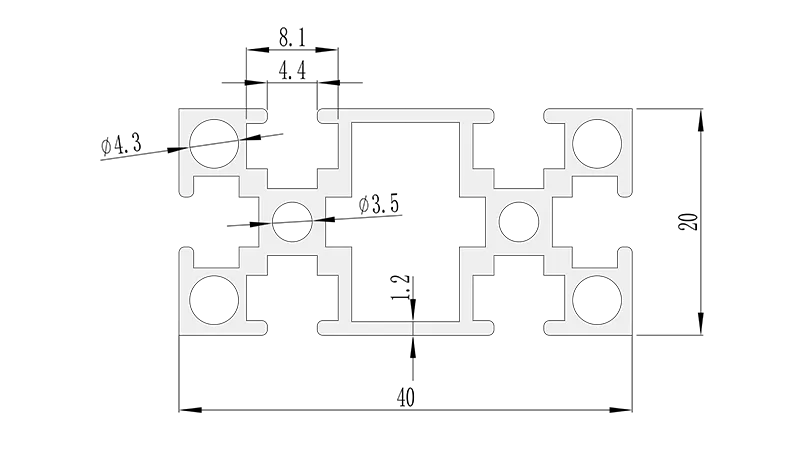
If you're new to the world of aluminum extrusions, the term "2040 National Standard Profile" might sound intimidating, but it's actually refreshingly simple. Let's break it down: the numbers "20" and "40" refer to its cross-sectional dimensions—20 millimeters wide and 40 millimeters tall. Picture a long, rectangular tube with a consistent shape, and you're pretty much there. The "National Standard" part means it's manufactured to strict, government-regulated specifications for material quality, wall thickness, and dimensional accuracy. Most often, this profile is made from 6063-T5 aluminum alloy, a reliable material known for its ideal mix of strength, flexibility, and resistance to corrosion. It's the kind of aluminum that can handle the daily grind of a busy workshop without bending or wearing down, which is why it's a favorite in lean system setups and industrial workspaces.
But what really sets the 2040 profile apart is its T-slot design. Run your hand along its length, and you'll notice grooves (called "slots") along the edges. These slots are a stroke of genius—they let you attach accessories like brackets, shelves, or casters without welding, drilling, or special tools. Need to add a monitor arm to a workbench? Slide a connector into the slot. Want to adjust the height of a shelf? Swap out a bracket. This modularity turns the 2040 profile into a building block that can be reconfigured in minutes, not days. And because it's a national standard, you never have to worry about compatibility. Walk into any hardware store or industrial supplier, and you'll find bins of aluminum profile accessories—brackets, end caps, hinges—that fit perfectly into those T-slots. It's like having a universal language for building.
So where do you actually see 2040 profiles in use? Everywhere. They're the frames behind workbenches in electronics factories, holding tools and circuit boards at just the right height. They're the uprights in material racks, keeping boxes of parts organized and easy to reach. In lean system environments, they're used to build flow racks that let materials glide smoothly from one workstation to the next. Even hobbyists love them—you'll find 2040 profiles in DIY 3D printer enclosures, garage storage systems, and custom workbenches. Their popularity isn't an accident: they're reliable, affordable, and ready to use right out of the box. Which begs the question: if standard profiles like the 2040 are so versatile, why would anyone ever bother with custom extrusions?
Custom Extrusions: When "One Size Fits All" Isn't Enough
Custom extrusions are exactly what they sound like: aluminum profiles designed from scratch to meet a project's unique needs. Maybe you need a profile with a weirdly shaped cross-section to fit into a tight space, or a specific wall thickness to support an unusually heavy load. Perhaps you want to integrate built-in channels for wiring or unique mounting points that no standard profile offers. In these cases, custom extrusions are the only way to go. But here's the reality: custom comes with a price tag—both in money and time.
The biggest hurdle with custom extrusions is the die. To create a custom shape, you need a custom die—a steel mold that shapes the molten aluminum as it's pushed through an extruder. Designing and manufacturing a die isn't cheap. Depending on how complex the shape is, a die can cost anywhere from $5,000 to $50,000 or more. And that's before you even start producing the extrusions. Then there's the lead time: designing the die, testing it, and making adjustments can take 4–12 weeks. Once the die is ready, most suppliers require minimum order quantities (MOQs)—you might have to buy 1,000 meters of extrusion even if you only need 100. For small projects or businesses on a tight schedule, that's a dealbreaker.
But when custom extrusions are done right, they're transformative. Take the automotive industry, for example. Car manufacturers often use custom extrusions for structural components like door frames. A custom shape can reduce weight by 20% compared to a standard profile, improving fuel efficiency without sacrificing safety. Or consider the renewable energy sector: wind turbine components need to be lightweight yet incredibly strong. A custom extrusion with a hollow, ribbed interior can handle the stress of high winds while keeping the turbine's overall weight down. In these cases, the upfront cost and time are worth it because there's no standard profile that can do the job.
2040 vs. Custom: The Ultimate Comparison
So how do you decide between the 2040 National Standard Profile and a custom extrusion? Let's break it down by the factors that matter most to businesses and project managers: cost, time, flexibility, and performance. To make it easier, we've put together a side-by-side comparison:
| Factor | 2040 National Standard Profile | Custom Extrusions |
|---|---|---|
| Upfront Cost | No die fees; profiles are mass-produced, so per-meter cost is low (typically $5–$15/meter). | High die fees ($5k–$50k+); per-meter cost decreases with large orders but remains higher than standard for small runs. |
| Lead Time | Off-the-shelf availability; most suppliers stock it, so delivery in 1–5 business days. | 4–12 weeks for die design, testing, and production; longer for complex shapes or tight tolerances. |
| Design Flexibility | Limited to standard T-slot shape, but highly adaptable with accessories (brackets, shelves, casters). | Unlimited shape options; can integrate unique features like internal channels, custom mounting points, or specialized alloys. |
| Accessory Compatibility | Widely available aluminum profile accessories (end caps, hinges, locks) from hundreds of suppliers, starting at $2–$10 each. | Accessories often need to be custom-made, increasing cost and lead time (custom brackets can cost $50–$200 each). |
| Performance | Engineered for general industrial use; handles typical loads (50–200kg per linear meter) and environments (indoor, moderate humidity). | Tailored to specific performance needs (e.g., high-temperature resistance, extreme weight capacity, or unique structural demands). |
| Minimum Order Quantity (MOQ) | No MOQ; buy 1 meter or 1,000 meters—whatever you need. | Typically 500–10,000 meters, depending on the supplier and die complexity. |
Let's dig deeper into a few of these. Cost is often the first thing people think about, and here the 2040 profile shines for small to medium projects. If you're building a single workbench, the die cost for a custom extrusion would make that bench cost more than a used car. With the 2040, you can buy a 3-meter length for $20, cut it to size, and assemble it with $30 worth of accessories. For businesses watching the bottom line, that's a no-brainer.
Time is another critical factor. Imagine you're a small manufacturer and a client needs a prototype assembly line built in two weeks. With custom extrusions, you'd be lucky to get the die designed in that time, let alone the extrusions produced. With the 2040 profile, you can walk into a supplier's warehouse today, load up on profiles and accessories, and start building tomorrow. I've seen teams build entire lean system workstations in a weekend using 2040 profiles—something that would take months with custom.
Design flexibility is where custom extrusions have an edge, but don't sleep on the 2040's adaptability. Let's say you need a workstation with a sloped surface for easy document viewing. With custom, you'd need a die for that slope. With 2040, you can buy a sloped panel accessory and bolt it to the frame. Need to add a drawer? There's a T-slot drawer slide for that. The 2040 profile might not do everything, but it does 90% of what most projects need—without the hassle of custom design.
When to Choose 2040 National Standard Profile: The Sweet Spot
So when is the 2040 profile not just a good option, but the best option? Let's look at the scenarios where standard makes more sense than custom.
1. Small to Medium Production Runs
If you're building 5 workbenches, not 500, custom extrusions are overkill. The die cost alone would make each bench prohibitively expensive. With 2040 profiles, you buy exactly what you need, cut it to length, and assemble. It's like buying pre-made cookies instead of building a bakery—fast, cheap, and just as satisfying for a small gathering.
2. Tight Budgets
Startups and small businesses know that every dollar counts. The 2040 profile's low cost and abundance of affordable accessories (think $3 brackets instead of $30 custom ones) keep projects on budget. Even large companies use 2040 for non-critical components—why spend $10,000 on a custom extrusion when a $15 standard one works just as well?
3. Quick Turnaround Projects
When time is of the essence, the 2040 profile is your best friend. A local furniture manufacturer I worked with once needed to build 10 packing stations in a week to handle a holiday rush. They used 2040 profiles for the frames, added plywood tops, and rolled casters into the T-slots. Total cost? $800. Total time? 3 days. With custom extrusions, they would have missed the rush entirely.
4. Standard Applications
Some projects don't need to reinvent the wheel. Workbenches, shelving, tool racks, and simple conveyor frames are all standard jobs that the 2040 profile was designed for. It's like using a hammer to drive a nail—you don't need a custom tool when the standard one works perfectly. A warehouse manager I know recently replaced all their old wooden shelves with 2040-based racks. The new racks are lighter, stronger, and took half the time to build. And because the T-slots let them adjust shelf heights, they can now store everything from small boxes to large pallets without rebuilding.
5. Projects That Might Change
Businesses evolve, and so do their needs. A workshop that builds smartphones today might switch to tablets tomorrow, requiring different workbench setups. With custom extrusions, changing that setup means scrapping the old extrusions and buying new ones. With 2040 profiles, you can take the workbench apart, rearrange the frames, and add new accessories—all in an afternoon. It's the difference between building with Legos and building with concrete blocks.
Real-World Example: How a Local Factory Saved Big with 2040
Let's put this in context with a real story. A few years back, I consulted with a mid-sized electronics manufacturer in Michigan. They needed to expand their production line and wanted 15 new workbenches, plus material racks to hold circuit boards and components. Their initial plan was to go custom—their engineering team thought a unique, curved design would make workers more comfortable. But when we ran the numbers, the die cost was $30,000, and the MOQ was 50 units (they only needed 15). The total cost? Over $50,000, with a 10-week lead time.
We suggested switching to 2040 National Standard Profiles. We designed the workbenches with 2040 frames, added height-adjustable legs (using T-slot brackets), and topped them with ESD (electrostatic discharge) laminate to protect sensitive components. For the material racks, we used 2040 uprights with wire shelving (another standard accessory). Total cost? $9,200. Lead time? 5 days. Six months later, the manufacturer decided to rearrange their factory floor. With custom workbenches, that would have meant starting over. With the 2040 ones? They disassembled them in a morning and rebuilt them in the new layout by lunch. No extra cost, no downtime. That's the power of standard profiles.
When to Consider Custom (Because It's Not Always Standard)
To be clear, we're not saying custom extrusions are never a good idea. There are times when they're worth every penny. If you're producing 100,000 units and the per-unit savings from a custom extrusion will offset the die cost, go for it. If your project needs a shape that no standard profile can match—like a heat-dissipating design for LED lighting—custom is the way to go. Or if safety regulations require a specific material or tolerance that standard profiles can't meet (think medical equipment or aerospace parts), custom is non-negotiable.
The key is to be honest about your needs. Ask: Is there a standard profile that can do most of what I need? If yes, the 2040 (or another standard profile) is probably all you need. If the answer is no—if that missing "most" is critical—then custom is worth exploring. But for most businesses, most of the time, the 2040 National Standard Profile hits that sweet spot of cost, speed, and flexibility.
Final Thoughts: The 2040 Profile as Your Project's Foundation
At the end of the day, the 2040 National Standard Profile isn't just a piece of aluminum—it's a tool for efficiency. It lets you build what you need, when you need it, without breaking the bank. It's the reason small workshops can compete with big manufacturers, why startups can launch products faster, and why even large companies keep stacks of 2040 profiles in their warehouses for quick projects.
So the next time you're planning a project, take a hard look at the 2040 profile. Chances are, it can do more than you think. And if it can, you'll save time, money, and headaches—leaving you free to focus on what really matters: making your project a success.