- Company Articles
- Industry articles
- Industry standards
- 3030 National Standard Profile A Compliance: Understanding National Standards & Certifications

3030 National Standard Profile A Compliance: Understanding National Standards & Certifications
Related Product
3030 National Standard Profile A
Workbench, production line, logistic rack, warehouse rack Industry: Manufacturer workshop, Automobile, Electronic, Assembling, logistic
In the world of industrial manufacturing and workflow optimization, the smallest components often play the biggest roles. Take aluminum profiles, for instance—those unassuming metal rails and beams that form the backbone of workbenches, material racks, conveyors, and lean production lines. But not all profiles are created equal. When precision, safety, and reliability matter, compliance with national standards isn't just a checkbox; it's the foundation of efficient, durable, and cost-effective operations. Today, we're diving deep into one such critical component: the 3030 National Standard Profile A. We'll unpack what it is, why national standards matter, the certifications that validate its quality, and how choosing compliant profiles can transform your workflow from chaotic to streamlined.
What Is 3030 National Standard Profile A?
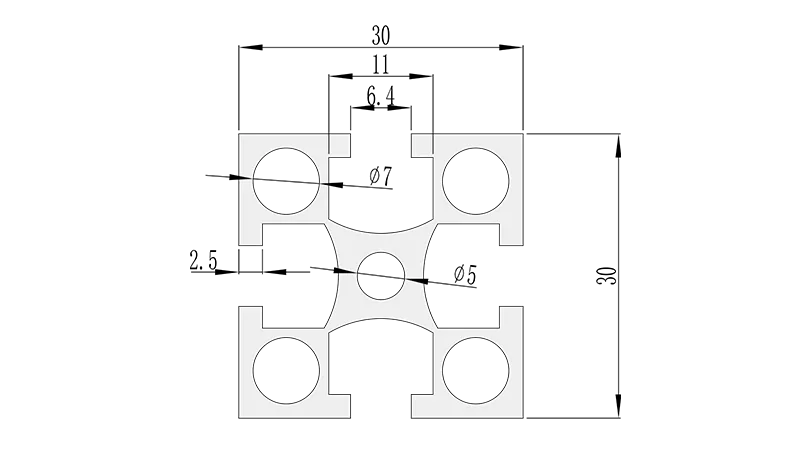
Let's start with the basics. The 3030 National Standard Profile A is a type of aluminum extrusion profile—a long, rigid structure formed by pushing heated aluminum alloy through a die to create a specific cross-sectional shape. As the name suggests, its core dimension is 30mm x 30mm, making it a versatile middleweight in the world of industrial profiles (smaller than 4040 profiles but sturdier than 2020 options). But what sets the "National Standard Profile A" apart is its adherence to strict manufacturing guidelines set by national regulatory bodies, ensuring consistency in everything from material composition to dimensional accuracy.
Think of it as the "Goldilocks" of aluminum profiles: not too big, not too small, but just right for a wide range of applications. You'll find it in factories building assembly workstations, warehouses constructing material racks, and even in labs setting up modular testing stations. Its T-slot design—those grooves running along its length—allows for easy attachment of aluminum profile accessories like brackets, end caps, and guide rails, making it infinitely customizable without welding or complex tools. This modularity is why it's a favorite in lean system setups, where adaptability and quick reconfiguration are key to minimizing waste and maximizing productivity.
National Standards: The Backbone of Quality
National standards are the rulebooks that ensure products like the 3030 National Standard Profile A meet minimum requirements for safety, performance, and compatibility. Without them, manufacturers could cut corners—using subpar alloys, ignoring dimensional tolerances, or skipping corrosion-resistant treatments—leaving you with profiles that bend under stress, fail prematurely, or don't fit with standard accessories. So, who sets these standards, and what do they cover?
Who Writes the Rules?
In most countries, national standards are developed by government-backed or industry-led organizations. For example, in China, the GB/T (Guobiao/Tuijian) standards are widely recognized, with specific guidelines for aluminum extrusion profiles under standards like GB/T 6892. In Europe, DIN (Deutsches Institut für Normung) sets benchmarks, while ASTM International leads in the United States. These bodies bring together engineers, manufacturers, and safety experts to create standards that balance technical feasibility with real-world needs.
Key Requirements for 3030 National Standard Profile A
Let's break down the critical standards that define a compliant 3030 Profile A:
- Dimensional Accuracy: The 30mm x 30mm cross-section isn't just a rough estimate. National standards specify tight tolerances—often as low as ±0.1mm for the width and height. This ensures that when you buy a 3030 profile from Supplier A, it will fit perfectly with accessories from Supplier B, eliminating the frustration of "close enough" parts that require filing, drilling, or shimming to work together.
- Material Composition: Not all aluminum is the same. Standards dictate the alloy type (typically 6063, a heat-treatable alloy known for its strength and corrosion resistance) and temper (the heat treatment process). For 3030 Profile A, the T6 temper is common, which involves solution heat treatment followed by artificial aging to achieve a tensile strength of at least 180 MPa—strong enough to support heavy loads without permanent deformation.
- Surface Treatment: Raw aluminum is prone to corrosion, especially in humid or industrial environments. National standards require protective finishes like anodizing (creating a hard, oxide layer) or powder coating (baking on a durable paint layer). Anodized finishes, for example, must meet thickness requirements (often ≥10μm) to ensure long-term resistance to rust and wear.
- Mechanical Properties: Beyond strength, standards also cover properties like hardness (measured via the Brinell or Vickers scale) and impact resistance. A compliant 3030 Profile A should withstand accidental knocks from forklifts or heavy tools without cracking, ensuring workplace safety and reducing replacement costs.
Certifications: Your Quality Assurance Badge
National standards set the bar, but certifications are the independent stamps of approval that prove a manufacturer has met (or exceeded) those standards. When shopping for 3030 National Standard Profile A, look for these key certifications to avoid "fake compliant" products:
CE Marking
If you operate in the European union (or export to it), the CE mark is non-negotiable. It indicates that the profile complies with EU health, safety, and environmental requirements—including the Machinery Directive, which governs equipment used in workplaces. To earn the CE mark, manufacturers must conduct rigorous testing (think stress tests, corrosion resistance trials, and dimensional checks) and maintain technical documentation proving compliance.
RoHS Compliance
RoHS (Restriction of Hazardous Substances) is all about safety—for your workers and the planet. It restricts the use of 10 hazardous materials (like lead, mercury, and cadmium) in electronic and electrical equipment, but its scope has expanded to include components like aluminum profiles used in manufacturing setups. A RoHS-compliant 3030 Profile A ensures that even if the profile is eventually recycled, it won't leach toxic substances into the environment.
ISO 9001
ISO 9001 isn't specific to aluminum profiles, but it's a powerful indicator of a manufacturer's commitment to quality. This certification focuses on quality management systems (QMS), ensuring that the company has consistent processes for design, production, and customer service. For you, this means fewer defects, reliable delivery times, and a supplier who's proactive about fixing issues when they arise. When a 3030 Profile A supplier has ISO 9001, you're not just buying a product—you're buying peace of mind.
Compliance in Practice: How Manufacturers Ensure Quality
Compliance doesn't happen by accident. It's the result of meticulous processes at every stage of production. Let's pull back the curtain and see how a reputable manufacturer would produce a compliant 3030 National Standard Profile A:
Raw Material Inspection
It starts with the aluminum itself. Suppliers source 6063 alloy ingots and test them for composition (using spectrometers to check for impurities) and mechanical properties (like melting point and flowability). Only ingots that meet the national standard's alloy requirements move to the next step.
Extrusion: Precision in Motion
The ingots are heated to around 500°C (soft enough to flow but not melt) and pushed through a steel die shaped like the 3030 Profile A cross-section. During extrusion, operators monitor pressure, speed, and temperature in real time to ensure the profile doesn't warp or develop internal cracks. After extrusion, the profiles are quenched (rapidly cooled with water) to lock in the T6 temper, then aged in ovens for several hours to maximize strength.
Post-Extrusion Testing
Now comes the quality check. Each batch of profiles undergoes a battery of tests:
- Dimensional Accuracy: Calipers and coordinate measuring machines (CMMs) verify that the 30mm x 30mm dimensions are within the ±0.1mm tolerance. Even the T-slot width and depth are checked to ensure compatibility with standard accessories.
- Hardness Testing: A portable durometer presses a diamond tip into the profile's surface to measure hardness, ensuring it meets the T6 temper requirement (typically ≥80 HB).
- Corrosion Resistance: Samples are submerged in a salt spray chamber for 48 hours. If the surface shows more than a tiny amount of rust, the batch is rejected.
Surface Treatment & Finishing
Profiles that pass testing move to anodizing or powder coating. Anodized profiles are submerged in an electrolyte bath and exposed to an electric current, creating a porous oxide layer that's then sealed to prevent moisture penetration. The thickness of this layer is measured with a micrometer to ensure it meets the ≥10μm standard.
The Benefits of Choosing Compliant 3030 Profiles
At this point, you might be thinking, "Compliance sounds great, but does it really make a difference in day-to-day operations?" The short answer: absolutely. Here's how compliant 3030 National Standard Profile A transforms your workflow:
Safety First
Non-compliant profiles are ticking time bombs. Imagine a material rack loaded with 50kg boxes supported by a profile that bends under stress—that rack could collapse, injuring workers and damaging inventory. Compliant profiles, with their T6 temper and strict strength standards, are designed to handle the loads they're rated for, keeping your team safe.
Cost Savings (Yes, Really)
It's tempting to opt for cheap, non-compliant profiles to save upfront. But consider the hidden costs: profiles that crack require replacement, ill-fitting accessories mean wasted time modifying parts, and corrosion leads to early failure. Compliant profiles last longer, fit perfectly with standard accessories, and resist rust, reducing long-term maintenance and replacement costs. One manufacturer we spoke to reported a 30% drop in downtime after switching to compliant 3030 profiles—savings that far outweighed the initial price difference.
Seamless Compatibility
Remember those T-slots? A compliant 3030 Profile A's slots are precisely sized to fit aluminum profile accessories from any reputable supplier. Need to add a shelf? Snap on a bracket. Want to mount a light? Slide in a T-nut. No drilling, no welding, no guesswork. This compatibility is a game-changer for lean system setups, where reconfiguring a workstation for a new product line can take hours instead of days.
Real-World Applications: Where 3030 Profile A Shines
To bring this to life, let's look at how three different industries use compliant 3030 National Standard Profile A to solve unique challenges:
Automotive Manufacturing: Lean Assembly Lines
A major car parts manufacturer was struggling with rigid, welded assembly lines that took weeks to reconfigure for new models. They switched to 3030 Profile A workstations with aluminum honeycomb panels (lightweight but strong work surfaces) and roller tracks for sliding parts bins. Now, when a new model launches, workers use Allen keys to disassemble and rebuild stations in hours, cutting changeover time by 70%. The compliant profiles' strength ensures the stations handle the daily wear of heavy tools and parts, while their modularity aligns perfectly with lean manufacturing principles.
E-Commerce Warehousing: Dynamic Material Racks
An e-commerce fulfillment center needed to store small electronics components (think phone chargers, earbuds) in a way that allowed pickers to access items quickly. They built multi-level material racks using 3030 Profile A and aluminum guide rails, with plastic bins sliding along the rails. The profiles' corrosion resistance stands up to the warehouse's humid environment, and the T-slots let them add or remove shelves as inventory levels change. Best of all, the racks are so lightweight (thanks to aluminum's low density) that they can be moved with casters when the warehouse layout is redesigned.
Medical Labs: Sterile Testing Stations
A research lab required workstations that could be easily sanitized and reconfigured for different experiments. They chose 3030 Profile A with anodized finishes (resistant to chemicals and easy to wipe clean) and mounted lab equipment via adjustable brackets. The profiles' smooth surfaces prevent bacteria buildup, and their modularity allows scientists to add sinks, shelves, or microscopes as needed—all without compromising sterility.
Compliant vs. Non-Compliant: The Critical Differences
Still on the fence? Let's put compliant and non-compliant 3030 profiles side by side to see how they stack up:
| Feature | Compliant 3030 Profile A | Non-Compliant Profile |
|---|---|---|
| Dimensional Accuracy | ±0.1mm tolerance; fits standard accessories | ±0.5mm tolerance; requires filing/shimming |
| Material Strength | T6 temper; tensile strength ≥180 MPa | Unknown temper; may bend under 50kg loads |
| Surface Finish | Anodized (≥10μm thick); resists corrosion | Poor paint finish; rusts in humid environments |
| Certifications | CE, RoHS, ISO 9001 | No certifications; manufacturer can't provide test reports |
| Longevity | 10+ year lifespan with minimal maintenance | 3–5 year lifespan; may fail suddenly |
Choosing the Right Supplier: What to Look For
Now that you know why compliance matters, how do you find a supplier you can trust? Here are four red flags to avoid and four green flags to prioritize:
Red Flags
- Vague Certifications: If a supplier says, "We meet national standards" but can't provide copies of CE, RoHS, or ISO 9001 certificates, walk away.
- Inconsistent Pricing: Prices that are 50% lower than competitors often mean corners are being cut on material or testing.
- No Sample Testing: Reputable suppliers will send free samples for you to test (dimensional accuracy, hardness, finish). If they refuse, they have something to hide.
- Limited Accessories: If they don't stock standard aluminum profile accessories, their profiles may not be compatible with mainstream parts.
Green Flags
- Transparent Testing Reports: They readily share dimensional, material, and corrosion test results for each batch.
- Customization Options: While compliance is non-negotiable, they can still offer custom lengths, colors, or finishes (e.g., black anodizing for labs) without compromising standards.
- Technical Support: Their team can help you design workstations or racks using 3030 Profile A, ensuring you maximize its potential.
- Positive Reviews: Other customers rave about durability and compatibility in online reviews or case studies.
Conclusion: Compliance as a Catalyst for Success
The 3030 National Standard Profile A is more than just a piece of aluminum—it's a building block for efficient, safe, and adaptable operations. By choosing profiles that comply with national standards and hold key certifications, you're not just investing in metal; you're investing in reliability, compatibility, and long-term cost savings. Whether you're building lean system workstations, dynamic material racks, or sterile lab setups, compliant profiles ensure your workflow stays flexible, your team stays safe, and your bottom line stays healthy.
So the next time you're sourcing aluminum extrusion profiles, remember: compliance isn't optional. It's the difference between a workstation that lasts a decade and one that fails in a year. It's the difference between a production line that adapts to change and one that gets left behind. And in today's fast-paced industrial world, that difference is everything.