- Company Articles
- Industry articles
- Industry standards
- 3030 National Standard Profile A Dimensions: Understanding Width, Height & Thickness

3030 National Standard Profile A Dimensions: Understanding Width, Height & Thickness
Related Product
3030 National Standard Profile A
Workbench, production line, logistic rack, warehouse rack Industry: Manufacturer workshop, Automobile, Electronic, Assembling, logistic
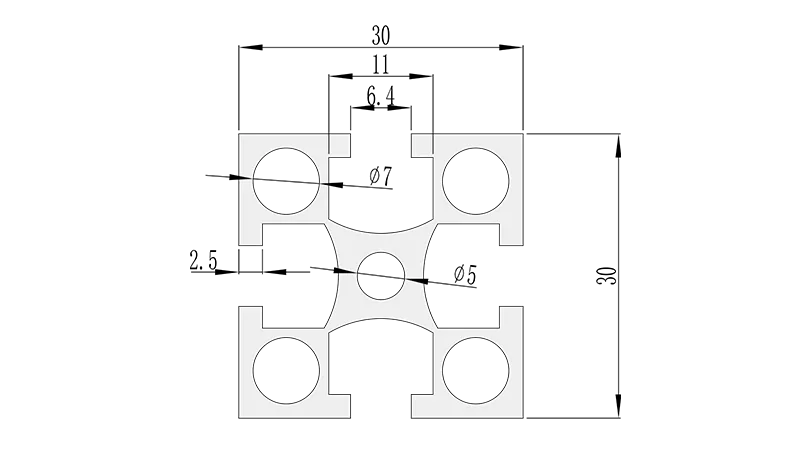
In the world of manufacturing, warehousing, and DIY projects, aluminum profiles are the unsung heroes that hold everything together. These lightweight yet sturdy structures form the backbone of workbenches, material racks, production lines, and even custom furniture. Among the countless profiles available, one stands out for its versatility and reliability: the 3030 National Standard Profile A. But to truly harness its potential, you need to get up close and personal with its dimensions—width, height, and thickness. These measurements aren't just numbers on a spec sheet; they're the key to ensuring your projects are stable, compatible with accessories, and built to last. Whether you're a seasoned engineer, a small business owner setting up a production line, or a hobbyist building a workshop, understanding the 3030 National Standard Profile A's dimensions will save you time, money, and headaches down the line.
What Exactly Is 3030 National Standard Profile A?
Before diving into dimensions, let's clarify what we're talking about. The 3030 National Standard Profile A is part of a broader family of aluminum extrusion profiles designed to meet strict national standards for consistency and performance. The name itself gives you a hint: "3030" refers to the approximate width and height of the profile's cross-section, while "A" denotes a specific design variant within the 3030 series. Think of it as a model number—like how a car might have a "3000 Series" with different trims, the "A" here signifies unique features, such as T-slot placement, wall thickness, or corner design.
Most 3030 National Standard Profile A products are extruded from 6063 aluminum alloy, a material prized for its excellent balance of strength, corrosion resistance, and workability. This alloy is a favorite in extrusion because it can be shaped into complex cross-sections with precision, making it ideal for profiles that need to connect with accessories like brackets, connectors, and panels. Surface treatments like anodizing or powder coating are common, adding durability and a clean, professional finish that holds up in industrial environments.
But why "national standard"? In many industries, consistency is non-negotiable. Imagine ordering a batch of profiles from one supplier and brackets from another—if they don't adhere to the same standards, the brackets might not fit the T-slots, or the profiles might be slightly off in width, throwing off your entire assembly. National standards ensure that regardless of the manufacturer, a 3030 National Standard Profile A will have dimensions and tolerances that align with compatible accessories, making it a reliable choice for projects big and small.
Breaking Down the Dimensions: Width, Height, and Thickness
At first glance, "3030" might seem straightforward—30mm by 30mm, right? While that's the general idea, real-world manufacturing involves tolerances, and the "A" variant adds specific design nuances. Let's break down each dimension to understand how they impact performance and compatibility.
Width: More Than Just a Number
The width of the 3030 National Standard Profile A is typically specified as 30mm, but in practice, you'll often see a slightly smaller measurement—around 29.8mm. This isn't a mistake; it's a tolerance built into the extrusion process to account for minor variations in temperature, die wear, and material flow. For most applications, this 0.2mm difference is negligible, but it becomes critical when pairing the profile with accessories designed to fit snugly into its T-slots.
Why does width matter? Think about T-slot aluminum pipe accessories like nuts, bolts, or brackets. These components are engineered to slide into the T-slots along the profile's length, and their width is matched to the profile's internal dimensions. If the profile's width is too large, the accessory might jam; too small, and it might wobble, compromising stability. For example, a 3030-specific bracket relies on the profile's width to distribute weight evenly across its surface, ensuring a secure connection that won't loosen over time.
In practical terms, this means that when you're shopping for accessories—say, 3030 aluminum angle yards or Gusset Alp 3030 for reinforcing corners—you can trust that they'll work seamlessly with the 3030 National Standard Profile A, thanks to that consistent width tolerance.
Height: Symmetry and Stability
Like the width, the height of the 3030 National Standard Profile A is approximately 30mm, with a similar tolerance of around ±0.2mm. This symmetry (width and height being roughly equal) gives the profile a square-like cross-section, which is a key reason for its stability. Unlike rectangular profiles, which might be prone to twisting if loaded unevenly, the 3030 A's balanced dimensions make it resistant to bending and torsion, making it an excellent choice for vertical supports in structures like workbenches or material racks.
Consider a workbench frame built with 3030 profiles. The vertical uprights (measuring 30mm in both width and height) can support the weight of tools, materials, and even the user without flexing, while the horizontal beams (also 30mm) distribute that weight evenly across the structure. This symmetry also simplifies assembly—since width and height are the same, you don't have to worry about flipping the profile upside down or sideways; it fits together consistently from any angle.
Thickness: The Hidden Strength Factor
While width and height are visible at a glance, wall thickness is the hidden dimension that determines how much weight the profile can support. The 3030 National Standard Profile A typically comes with wall thicknesses ranging from 1.5mm to 2.0mm, depending on the manufacturer and intended use. This might seem like a small difference, but it has a big impact on load capacity.
A 1.5mm wall thickness is ideal for lighter applications, such as shelving for small parts or frames for lightweight machinery guards. It offers enough strength to support moderate loads (think 30-40kg per linear meter) while keeping the profile lightweight and easy to handle. On the other hand, a 2.0mm wall thickness steps up the game, supporting 50kg or more per linear meter—perfect for heavy-duty workbenches, material racks holding bulky items, or structural components in lean manufacturing systems.
To put this in context, take Material Rack B (3 row and 3 floor) from common warehouse setups. If built with 2.0mm thick 3030 profiles, it can safely hold multiple layers of inventory, from boxes of electronics to automotive parts, without sagging over time. A thinner 1.5mm profile might work for lighter items like plastic components but could struggle with heavier loads, leading to premature wear or even structural failure.
A Quick Reference Table: Key Dimensions
| Dimension | Nominal Size | Typical Actual Size | Tolerance | Material | Surface Treatment |
|---|---|---|---|---|---|
| Width | 30mm | 29.8mm | ±0.2mm | 6063 Aluminum Alloy | Anodized/Powder Coated |
| Height | 30mm | 29.8mm | ±0.2mm | 6063 Aluminum Alloy | Anodized/Powder Coated |
| Wall Thickness | 1.5mm / 2.0mm | 1.45-1.55mm / 1.95-2.05mm | ±0.05mm | 6063 Aluminum Alloy | Anodized/Powder Coated |
Why Dimensions Matter in Real-World Applications
Understanding the 3030 National Standard Profile A's dimensions isn't just about memorizing numbers—it's about ensuring your projects work as intended. Let's look at three common applications where these dimensions play a starring role.
Workbenches: Stability for Precision Work
A workbench is the heart of any workshop or production line, and its frame needs to be rock-solid. The 3030 National Standard Profile A is a popular choice for building workbenches like Workbench E (single deck-without caster), thanks to its balanced width, height, and thickness. The 30mm dimensions provide a stable base, while the 1.5mm or 2.0mm wall thickness ensures the frame can support heavy tools, clamps, and materials without shaking or flexing.
For example, a 2.0mm thick 3030 frame can easily support a wooden or aluminum honeycomb panel top, along with a vice, drill press, and piles of workpieces. The T-slots along the profile's length also let you attach accessories like tool holders or monitor arms, customizing the workbench to your needs. If the profile were too narrow or thin, the bench might wobble during precision tasks like assembly or machining, leading to errors or accidents.
Material Racks: Organizing Inventory Safely
Warehouses and factories rely on material racks to keep inventory organized and accessible. Material Rack B (3 row and 3 floor) is a common design, and its uprights and (crossbeams) are often made from 3030 National Standard Profile A. The profile's 30mm width and height provide enough surface area to mount shelf boards or roller tracks, while the wall thickness determines how much weight each shelf can hold.
A rack with 2.0mm thick profiles can safely hold multiple boxes or bins on each of its three floors, even when fully loaded. The symmetry of the 30mm dimensions ensures the uprights stand straight, preventing the rack from leaning or collapsing under heavy loads. In contrast, using a thinner or narrower profile might save money upfront but could lead to sagging shelves or, worse, a dangerous collapse.
Lean Systems: Efficiency in Production
Lean manufacturing is all about eliminating waste and streamlining workflows, and aluminum extrusion profiles are a cornerstone of lean system design. The 3030 National Standard Profile A is used in everything from flow racks to turnover trolleys, where its dimensions contribute to smooth, efficient operations. For instance, a flow rack built with 3030 profiles uses roller tracks to move materials from one workstation to the next. The profile's width and height ensure the roller tracks are mounted at the correct angle for gravity-fed flow, while the thickness supports the weight of the materials as they glide along.
In a lean system, every component needs to work in harmony. If the 3030 profile's dimensions were off, the roller tracks might not align, causing materials to jam or slow down. The T-slots also allow for quick adjustments—adding or removing shelves, repositioning guides, or modifying the rack's height—all without welding or drilling, which aligns perfectly with lean principles of flexibility and continuous improvement.
Compatibility with Aluminum Profile Accessories
One of the 3030 National Standard Profile A's biggest strengths is its compatibility with a wide range of aluminum profile accessories. From connectors to end caps, these accessories are designed to work with the profile's specific dimensions, making assembly quick and frustration-free.
Take 3030 aluminum angle yards, for example. These L-shaped brackets are used to join two profiles at a 90° angle, and their holes are spaced to match the T-slots on the 3030 A profile. The bracket's width and thickness are also optimized to fit the profile's dimensions, ensuring a tight, rattle-free connection. Similarly, Gusset Alp 3030 brackets reinforce corners by distributing stress across the profile's surface, relying on the 30mm width and height to make full contact and prevent bending.
Even small accessories like 3030 National Standard Profile A end caps depend on accurate dimensions. These plastic or metal caps snap onto the ends of the profile, protecting users from sharp edges and preventing debris from collecting in the T-slots. If the profile's width or height were outside the standard tolerance, the end caps might not fit, leaving the profile's ends exposed.
How 3030 A Compares to Other Profiles
The 3030 National Standard Profile A isn't the only aluminum extrusion profile on the market. Let's see how it stacks up against two common alternatives: the 2020 National Standard Profile and the 4040 National Standard Profile.
- 2020 National Standard Profile: Smaller (20mm x 20mm) and lighter, with thinner walls (often 1.0-1.2mm). Ideal for lightweight projects like display shelves or small machine guards but too flimsy for heavy workbenches or material racks.
- 4040 National Standard Profile: Larger (40mm x 40mm) and thicker (2.0-3.0mm walls). Built for heavy-duty applications like industrial machinery frames or loading docks. Overkill for most workbenches or material racks, adding unnecessary weight and cost.
The 3030 A hits the sweet spot: big enough to be stable, strong enough for medium-duty tasks, and lightweight enough to be easy to work with. It's the "goldilocks" profile for many projects, balancing performance and practicality.
Final Thoughts: Dimensions as the Foundation of Success
The 3030 National Standard Profile A's dimensions—width, height, and thickness—are more than just specs on a datasheet. They're the foundation of its versatility, strength, and compatibility. Whether you're building a workbench, a material rack, or a lean system, understanding these dimensions ensures your project is stable, safe, and built to last. And with a wide range of aluminum profile accessories designed to fit its T-slots, you can customize your creation to meet your exact needs.
So the next time you're planning a project, take a moment to appreciate the 3030 A's dimensions. They might seem small, but they're the reason this profile has become a staple in workshops, factories, and warehouses around the world. After all, in the world of manufacturing, the right dimensions make all the difference.