- Company Articles
- Industry articles
- Industry standards
- 3030 National Standard Profile A for Automated Guided Vehicles (AGV) Frames

3030 National Standard Profile A for Automated Guided Vehicles (AGV) Frames
Related Product
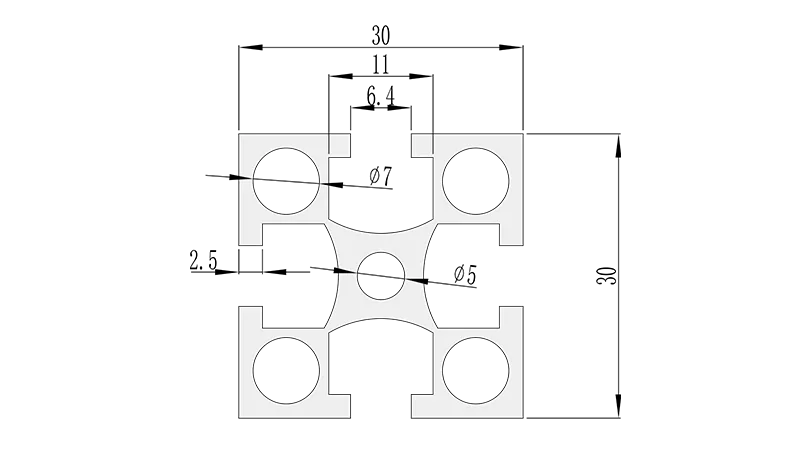
3030 National Standard Profile A
Workbench, production line, logistic rack, warehouse rack Industry: Manufacturer workshop, Automobile, Electronic, Assembling, logistic
AGVs: The Silent Workhorses Reshaping Our Factories and Warehouses
Walk into any modern factory, warehouse, or distribution center today, and you'll likely spot them: sleek, boxy machines gliding smoothly along the floor, ferrying pallets, bins, or components from one spot to another with barely a sound. These are Automated Guided Vehicles, or AGVs—small but mighty players in the global push toward smarter, more efficient operations. From automotive plants assembling cars to e-commerce giants fulfilling orders at lightning speed, AGVs have become the backbone of industries that thrive on precision and productivity.
But here's the thing about AGVs: we often marvel at their fancy sensors, their ability to navigate tight spaces, or how they "talk" to warehouse management systems. Rarely do we stop to think about what holds all those high-tech components together—the frame. It's the skeleton of the AGV, the foundation that supports its weight, protects its internal parts, and ensures it can handle the daily grind of industrial life. And when it comes to building a frame that's strong, flexible, and ready to adapt to whatever the job throws at it, there's one material that's quietly become the go-to choice for engineers and manufacturers alike: the 3030 National Standard Profile A .
Why the Frame Matters: It's Not Just Metal—It's the AGV's Lifeline
Let's start with the basics: what does an AGV frame actually do? Think of it as the AGV's backbone. It carries the weight of the battery (which can be hundreds of pounds), the drive system, the control unit, and whatever payload the AGV is transporting—whether that's a 500-pound crate of automotive parts or a stack of fragile electronics. It also has to absorb vibrations from uneven floors, resist dents from accidental bumps (because let's face it, even the smartest AGV can have a "oops" moment near a forklift), and keep all those sensitive sensors and wiring safe from dust, moisture, and the chaos of a busy workspace.
But here's the kicker: AGVs aren't one-size-fits-all. A warehouse AGV moving boxes might need a flat, open frame for easy loading. A factory AGV working on an assembly line might need custom brackets to hold tools or robotic arms. And as operations scale, AGVs often need upgrades—more batteries for longer shifts, new sensors for better navigation, or bigger payload capacities. That means the frame can't be a rigid, "set-it-and-forget-it" piece of metal. It needs to be flexible . It needs to grow and change with the AGV's job.
For years, manufacturers struggled with this. Early AGV frames were often welded steel—strong, but heavy and impossible to modify without cutting and rewelding. Plastic frames were lighter but too flimsy for heavy loads. Then came aluminum, but not just any aluminum. Engineers needed a material that could balance strength, weight, and customization. Enter the aluminum extrusion profile —and more specifically, the 3030 National Standard Profile A. It's not the flashiest part of the AGV, but it's the reason so many of today's AGVs can do more, last longer, and adapt faster than ever before.
What Even Is 3030 National Standard Profile A? Let's Break It Down
First off, let's demystify the name. "3030" refers to the profile's cross-section: 30mm by 30mm. That's a standard size, which matters because it means manufacturers don't have to reinvent the wheel every time they design a new AGV. "National Standard" tells us it meets strict quality and dimensional guidelines set by industry regulators, so you know you're getting a consistent product, whether you buy it from Supplier A or Supplier B. And "Profile A"? That's just a way to differentiate it from other 30x30 profiles (like Profile B or Profile C) that might have different slot designs or wall thicknesses.
But the real magic is in how it's made. 3030 Profile A is an aluminum extrusion profile , which means it's created by pushing a heated aluminum billet through a die (a metal mold) to form its shape. This process isn't just efficient—it's precise. The die ensures every inch of the profile has the exact same dimensions, so when you're building a frame, you don't have to worry about pieces that don't line up. It also lets engineers design complex cross-sections, like the T-slots that run along the length of the profile. Those T-slots are game-changers, and we'll get to them in a minute.
Material-wise, 3030 Profile A is typically made from 6063 aluminum alloy—a popular choice for extrusions because it's strong, lightweight, and corrosion-resistant. Think about it: aluminum is about 1/3 the weight of steel, which means AGVs built with aluminum frames use less battery power to move around. That translates to longer run times between charges, which is a big deal for facilities running 24/7 operations. And unlike steel, aluminum doesn't rust, so even in damp warehouses or factories with chemical exposure, the frame stays strong for years.
T-Slots: The Secret to Making AGV Frames as Flexible as Legos
Remember those T-slots we mentioned? They're the reason 3030 Profile A is so beloved by AGV designers. Imagine a long, narrow groove running along each side of the profile, shaped like a "T." At the top, the slot is narrow, but it widens out inside the profile. This design lets you slide in special nuts (called T-nuts) that lock into place when you tighten a bolt. No drilling, no welding—just slide, tighten, and you're done.
Why does this matter for AGVs? Let's say you need to add a new sensor to the front of the AGV. With a welded steel frame, you'd have to drill a hole (which weakens the frame) or weld a bracket (which takes time and requires a skilled worker). With 3030 Profile A, you just slide a T-nut into the T-slot, attach the sensor bracket with a bolt, and you're ready to go. Need to move the sensor later? Loosen the bolt, slide the T-nut to the new position, and retighten. It's like building with Legos, but for industrial machines.
And it's not just sensors. T-slots make it easy to add: battery holders, cable management clips, bumpers, wheels, even custom work surfaces. This flexibility is a huge win for manufacturers. Instead of designing a brand-new frame for every AGV model, they can start with 3030 Profile A and mix-and-match aluminum profile accessories to create exactly what they need. Need a taller frame? Add longer profile sections. Need a wider base for stability? Bolt on crossbars. It cuts down on design time, reduces waste, and makes it easy to repair or upgrade AGVs down the line.
From Drawing Board to Factory Floor: How 3030 Profile A Solves Real-World AGV Headaches
Let's get practical. What does 3030 Profile A actually do for AGV operators and manufacturers? Let's look at a few real-world scenarios.
Scenario 1: The E-Commerce Warehouse That Needed Faster AGVs
A major online retailer was struggling with slow order fulfillment during peak seasons. Their old AGVs, with steel frames, were heavy—so heavy that their batteries died after only 4 hours of use. That meant constant charging, which slowed down operations. The engineering team switched to 3030 Profile A frames. The new frames were 40% lighter, which let the AGVs run for 8 hours on a single charge. They also used aluminum profile accessories like lightweight brackets and cable clips to cut even more weight. Result? The warehouse increased AGV uptime by 50% and processed 30% more orders during the next holiday rush.
Scenario 2: The Automotive Plant with a "Bumpy" Problem
An auto parts manufacturer had AGVs moving engine components across a factory floor with uneven concrete. The constant vibrations were shaking loose sensors and damaging delicate wiring, leading to frequent breakdowns. Their steel frames were rigid and didn't absorb shocks well. They switched to 3030 Profile A frames with custom shock-absorbing brackets (attached via T-slots, of course). The aluminum's natural flexibility helped dampen vibrations, and the modular design made it easy to add rubber gaskets between profile sections for extra cushioning. Breakdowns dropped by 70%, and maintenance costs plummeted.
Scenario 3: The Small Manufacturer That Couldn't Afford Custom Frames
A small electronics manufacturer wanted to add AGVs to their assembly line but couldn't afford to design custom frames for each machine. They turned to 3030 Profile A and a set of off-the-shelf aluminum profile accessories: corner brackets, end caps, and adjustable feet. Using basic hand tools, their in-house team built three different AGV frames in a week—one for moving circuit boards, one for carrying tools, and one for waste removal. The total cost was a fraction of what custom steel frames would have cost, and when they expanded production, they just added more profile sections to the existing frames. Today, they have a fleet of 10 AGVs, all built on the same 3030 Profile A base.
Steel vs. Plastic vs. 3030 Aluminum: The Material Showdown
We've talked a lot about why 3030 Profile A is great, but how does it stack up against other common frame materials? Let's break it down in a table:
| Feature | Steel Frames | Plastic Frames | 3030 Aluminum Extrusion Profile A |
|---|---|---|---|
| Weight | Heavy (3x denser than aluminum) | Light (but less strong) | Lightweight (1/3 the weight of steel) |
| Strength | Very strong (but overkill for many AGVs) | Weak (bends under heavy loads) | Strong enough for most AGV payloads (up to 2,000 lbs with proper design) |
| Customization | Hard (requires welding/drilling) | Limited (molding is expensive for small runs) | Easy (T-slots + aluminum profile accessories) |
| Durability | Corrodes easily (needs painting/coating) | Prone to cracking/UV damage | Corrosion-resistant, scratch-resistant, long lifespan |
| Cost | Low upfront, high long-term (maintenance, fuel/battery costs) | Low upfront, very high long-term (replacement costs) | Moderate upfront, low long-term (no maintenance, energy savings) |
The takeaway? Steel is strong but clunky. Plastic is cheap but flimsy. 3030 Profile A hits that sweet spot: strong enough for most jobs, light enough to save energy, flexible enough to adapt, and durable enough to last. It's not the only material out there, but for the majority of AGVs—especially those in warehousing, manufacturing, and logistics—it's hard to beat.
Beyond AGVs: How 3030 Profile A Supports Lean Systems and Sustainable Manufacturing
Here's another angle: 3030 Profile A isn't just good for AGVs—it's good for the entire operation. Many modern factories and warehouses follow lean system principles, which focus on reducing waste, improving efficiency, and continuous improvement. 3030 Profile A fits right into this mindset.
Lean systems hate waste, and 3030 Profile A is all about minimizing waste. Since it's modular, you only use the materials you need—no cutting giant steel sheets into small pieces and throwing away the scraps. If an AGV is retired, you can disassemble the frame and reuse the profile sections and accessories for a new project. Aluminum is also 100% recyclable, so even if a profile is too damaged to reuse, it can be melted down and turned into new aluminum products. That's a big win for sustainability, which is becoming more important to customers, regulators, and company bottom lines.
Lean systems also thrive on flexibility. In a lean operation, production lines change frequently to meet customer demand. AGVs need to keep up, and 3030 Profile A lets them do that. Need to reconfigure your AGV fleet for a new product? Swap out accessories. Need to move AGVs to a different part of the factory? Their lightweight frames make them easy to transport. It's all about keeping operations agile, which is key in today's fast-paced market.
The Future of AGVs: Why 3030 Profile A Will Keep Leading the Pack
So, what's next for AGVs and their frames? As technology advances, AGVs are getting smarter, smaller, and more capable. We're seeing AGVs with AI-powered navigation, collaborative robots (cobots) mounted on top, and even AGVs that can work alongside humans without safety cages. All of these trends play to 3030 Profile A's strengths.
Smaller AGVs need lighter frames, and 3030 Profile A's 30x30mm size is perfect for compact designs. Cobots and advanced sensors need custom mounting solutions, and T-slots make it easy to attach them securely. And as AGVs become more collaborative, safety is paramount—3030 Profile A's ability to absorb impacts and its corrosion resistance mean these AGVs can keep workers safe for years to come.
We're also seeing more demand for "plug-and-play" AGVs—systems that can be set up and running in days, not weeks. 3030 Profile A and its accessories make this possible. Manufacturers can pre-assemble frame components and ship them to customers, who then add their own sensors and software. It's like building a PC from parts, but for industrial automation. This trend will only grow as more small and medium-sized businesses adopt AGVs.
Final Thoughts: Don't Sleep on the Frame—It's the Heart of Your AGV
At the end of the day, AGVs are only as good as their frames. A weak frame leads to breakdowns, a rigid frame limits innovation, and a heavy frame wastes energy. 3030 National Standard Profile A solves all these problems and more. It's strong but light, rigid but flexible, simple but endlessly customizable. It's the reason so many of the AGVs you see today can do more, last longer, and adapt faster than ever before.
So the next time you watch an AGV glide by, take a second to look at its frame. Chances are, it's made of 3030 Profile A—quietly doing its job, holding everything together, and making modern automation possible. It might not have sensors or software, but it's the unsung hero that turns a pile of parts into a machine that keeps our factories running, our warehouses stocked, and our world moving forward.