- Company Articles
- Industry articles
- Industry standards
- 3030 National Standard Profile A for Material Storage Racks: Maximizing Warehouse Space

3030 National Standard Profile A for Material Storage Racks: Maximizing Warehouse Space
Related Product
3030 National Standard Profile A
Workbench, production line, logistic rack, warehouse rack Industry: Manufacturer workshop, Automobile, Electronic, Assembling, logistic
Walk into any busy warehouse, and you'll likely see the same challenge playing out: stacks of boxes teetering on wobbly shelves, workers navigating tight aisles with forklifts, and managers staring at spreadsheets wondering how to fit just one more pallet. In today's fast-paced supply chain, warehouse space isn't just a commodity—it's the backbone of efficiency. But all too often, traditional storage solutions feel like square pegs in round holes: they're rigid, bulky, and stubbornly resistant to the ever-changing needs of modern operations. That's where the 3030 National Standard Profile A comes in. This unassuming aluminum extrusion is quietly revolutionizing how warehouses store, organize, and access materials, turning cramped chaos into streamlined productivity. Let's dive into how this simple yet powerful tool is helping warehouses everywhere do more with less space.
The Hidden Cost of Wasted Warehouse Space
Before we talk about solutions, let's get real about the problem. Wasted warehouse space isn't just an eyesore—it's a drain on your bottom line. Imagine a warehouse where 30% of the floor area is taken up by oversized, fixed steel racks that can't be adjusted for smaller items. Or a layout where workers spend 20 extra minutes per shift hunting for tools because shelves are disorganized and hard to reach. These inefficiencies add up: studies show that poor space management can increase operational costs by up to 15% annually, from higher labor costs to missed shipment deadlines. And with real estate prices soaring, expanding your warehouse isn't always an option. The answer? Stop trying to "fit more" and start thinking about "using better." That's the mindset shift that makes the 3030 National Standard Profile A a game-changer.
What Exactly Is 3030 National Standard Profile A?
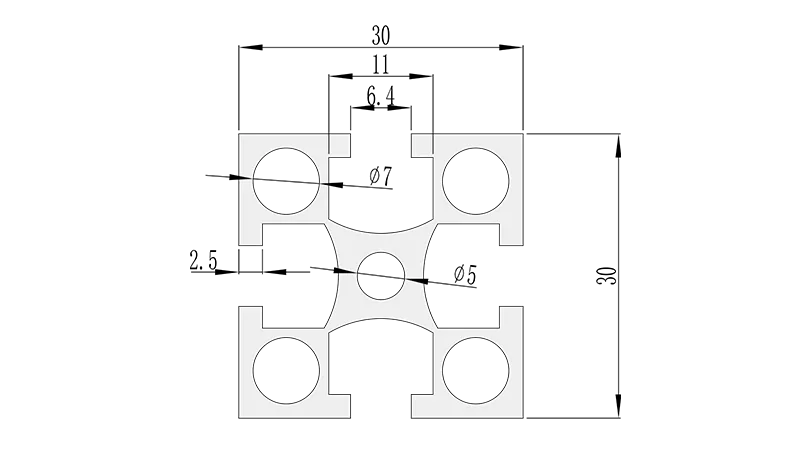
Let's break it down. The 3030 National Standard Profile A is a type of aluminum extrusion—a long, slender piece of aluminum shaped into a specific cross-section. Its name gives away the basics: "3030" refers to its dimensions (30mm in width and 30mm in height), "National Standard" means it adheres to strict manufacturing guidelines for consistency and quality, and "Profile A" denotes its specific design (think of it as a unique "model" within the 3030 family). But what makes it special isn't just the numbers—it's the T-slot design running along its length. These slots are like built-in puzzle pieces, allowing you to attach brackets, shelves, wheels, and other accessories with simple bolts and nuts, no welding required. It's modular, it's flexible, and it's built to adapt to whatever your warehouse throws at it.
Key Features of 3030 Profile A That Make It Perfect for Storage Racks
So, why choose this particular profile over other options? Let's start with strength. Despite being lightweight (aluminum is about 1/3 the weight of steel), the 3030 Profile A is surprisingly tough. Thanks to its hollow, reinforced design, it can support heavy loads—up to 200kg per linear meter in some configurations—making it ideal for stacking boxes, tools, or even small machinery. Then there's the precision. National standard profiles are manufactured to tight tolerances, so every piece fits together perfectly. No more wrestling with warped steel or mismatched parts; with 3030 Profile A, what you order is exactly what you get. And let's not forget corrosion resistance. Aluminum naturally forms a protective oxide layer, so unlike steel, it won't rust or degrade in humid warehouses or outdoor loading areas. That means less maintenance and a longer lifespan for your storage racks.
Why Aluminum Profiles Beat Traditional Storage Materials
You might be thinking, "Steel racks have been around forever—why switch to aluminum?" It's a fair question, but let's compare. Steel is strong, yes, but it's also heavy. Installing steel racks often requires heavy machinery and a team of workers, and if you ever need to reconfigure your layout? Good luck—those bolts are welded tight, and the racks themselves are nearly impossible to move without dismantling them. Wood? It's cheap upfront, but it warps, rots, and can't handle heavy loads without sagging. Plastic? Too flimsy for industrial use. Aluminum profiles, on the other hand, strike the perfect balance. They're lightweight enough to be moved by two people, strong enough to handle daily use, and flexible enough to be reconfigured in hours, not days. Plus, aluminum is 100% recyclable, making it a greener choice for eco-conscious operations. When you factor in installation time, maintenance costs, and longevity, 3030 Profile A often works out cheaper than traditional materials in the long run.
Aluminum Profile Accessories: The Secret to Customization
A profile is only as good as the accessories that go with it, and 3030 Profile A plays well with a whole ecosystem of aluminum profile accessories. Think of it like building with Legos for adults: you start with the base (the profile), then add the pieces that fit your needs. Need shelves? Attach aluminum angle brackets to the T-slots and lay down a plywood or metal deck. Want to add wheels for a mobile rack? Screw on caster mounts and roll it where you need it. Need dividers to separate small parts? Slide in plastic or metal partition brackets. Even specialized parts like label holders, tool hooks, or LED light strips can be attached without drilling or cutting. This flexibility means your storage rack isn't just a "rack"—it's a custom solution tailored to your exact inventory. Whether you're storing tiny electronic components or bulky automotive parts, the right accessories turn 3030 Profile A into a storage Swiss Army knife.
Real-World Win: Material Rack B (3 Row and 3 Floor) in Action
Let's take a concrete example: Material Rack B (3 Row and 3 Floor), a popular configuration built with 3030 Profile A. Picture a rack that stands 1.8 meters tall, with three vertical columns and three horizontal shelves, each divided into three rows. At first glance, it looks like a standard storage unit—but the magic is in the details. Because it's built with 3030 Profile A, the shelves are adjustable. If you start storing taller boxes, you can loosen the bolts, slide the shelf brackets up, and tighten them again—no tools beyond a hex key needed. The T-slots along the sides let you add dividers between rows, so small parts don't roll around and get lost. And because aluminum is lightweight, the entire rack (even fully loaded) can be moved with a pallet jack if you need to rearrange your warehouse layout for a big order. One warehouse manager I spoke with reported that switching to Material Rack B reduced their pick time by 15% because items were easier to access, and they freed up 10% of floor space by stacking more efficiently. That's the power of smart design.
How 3030 Profile A Stacks Up Against Other Profiles
Not all aluminum profiles are created equal. Let's see how 3030 Profile A compares to other common sizes, so you can see why it's the sweet spot for material storage racks:
| Profile Type | Dimensions (mm) | Max Load Capacity (per linear meter) | Space Efficiency | Best For |
|---|---|---|---|---|
| 2020 National Standard Profile | 20x20 | 80-100kg | High (small footprint) | Tiny parts, lightweight tools |
| 3030 National Standard Profile A | 30x30 | 150-200kg | Excellent (balances size and strength) | General storage, medium-weight items, Material Rack B |
| 4040 EU Standard Profile | 40x40 | 250-300kg | Good (but bulkier) | Heavy machinery, large pallets |
As you can see, 3030 Profile A hits the sweet spot: it's strong enough for most warehouse needs without taking up extra space. For Material Rack B, this means you get three floors of storage in a footprint that's just 0.9m x 0.6m—perfect for tucking into tight corners or lining up along walls to maximize floor space.
From Storage to Workflow: Integrating with Workbenches
Storage racks don't exist in a vacuum—they're part of a larger workflow. That's why 3030 Profile A plays so well with workbenches, creating a seamless transition from "storing" to "using." Imagine a workbench built with the same 3030 Profile A as your Material Rack B. The height is adjustable, so workers can stand or sit comfortably. The T-slots on the back let you mount tools, while the top can be fitted with a (ESD) mat for electronics assembly. Best of all, the workbench can be positioned right next to the storage rack, so parts go straight from the shelf to the work surface without extra carrying. It's a small change, but it eliminates wasted steps—exactly the kind of lean system improvement that makes warehouses more efficient. One electronics manufacturer I visited had this setup, and their production line manager noted that "having parts and tools within arm's reach cut down on distractions and made workers 10% more productive."
Installation: No Welding, No Headaches
Let's talk about the elephant in the room: installing new storage racks. Traditional steel racks often require welding, which means hiring a professional, closing off part of the warehouse, and dealing with fumes and sparks. Not with 3030 Profile A. Because everything connects via T-slots and bolts, you can assemble a basic rack in under an hour with just a hex key and a level. No special skills needed—even your existing maintenance team can handle it. And if you make a mistake? Just loosen the bolts and adjust. This not only saves on installation costs but also means you can build racks on-site, exactly where you need them, without worrying about transporting pre-welded (and often oversized) units. One warehouse owner told me they saved $2,000 on installation costs alone by switching to DIY 3030 Profile A racks compared to hiring a crew for steel ones.
Longevity: Making Your Investment Last
Aluminum isn't just lightweight—it's tough. The 3030 National Standard Profile A is made from high-grade aluminum alloy (usually 6063-T5, a common choice for industrial applications), which resists dents, scratches, and corrosion. Unlike steel, it won't rust if it gets wet, so you can use it in cold storage units or outdoor loading docks without worry. And because it's modular, you don't have to replace the entire rack if one part gets damaged. Bent a shelf bracket? Swap it out for a new one. Scratched a profile? Sand it down and touch it up with aluminum paint. With basic care—occasional cleaning with soap and water—your 3030 Profile A racks can last 10-15 years, making them a smart long-term investment. Compare that to wood racks (which rot in 3-5 years) or cheap plastic racks (which crack under heavy loads), and the value becomes clear.
Final Thoughts: More Than a Rack—A Space-Maximizing Strategy
At the end of the day, 3030 National Standard Profile A isn't just a piece of aluminum. It's a tool for solving one of the biggest challenges in warehousing: doing more with less space. By combining strength, flexibility, and compatibility with aluminum profile accessories, it turns static storage into dynamic, adaptable systems that grow with your business. Whether you're setting up a new warehouse or upgrading an old one, configurations like Material Rack B (3 Row and 3 Floor) prove that smart design beats brute force every time. So the next time you look at your crowded warehouse, don't just see a problem—see an opportunity. With 3030 Profile A, you're not just storing items; you're building a more efficient, more profitable operation. And in today's supply chain, that's the real key to success.