- Company Articles
- Industry articles
- Industry standards
- 3030 National Standard Profile A for Packaging Machinery: Stability in High-Speed Operations

3030 National Standard Profile A for Packaging Machinery: Stability in High-Speed Operations
Related Product
3030 National Standard Profile A
Workbench, production line, logistic rack, warehouse rack Industry: Manufacturer workshop, Automobile, Electronic, Assembling, logistic
Walk into any modern packaging facility, and you'll be met with a symphony of motion: conveyor belts hum, robotic arms dart, and products zip through stations at speeds that seem almost. From snack bars to electronics, pharmaceuticals to household goods, packaging machinery is the unsung hero of the supply chain, ensuring products reach shelves (and doorsteps) safely, efficiently, and looking their best. But here's the thing: as these machines get faster—some now handling 500+ packages per minute—there's a silent enemy lurking in the background: instability. A tiny wobble, a split-second vibration, or a misalignment can turn a smooth operation into chaos, leading to damaged goods, costly downtime, and frustrated teams. That's where the right structural foundation comes in. Today, we're diving into one component that's quietly revolutionizing stability in high-speed packaging lines: the 3030 National Standard Profile A, a workhorse of aluminum extrusion profile design that's become a go-to for engineers and facility managers alike.
Why Stability Isn't Just a "Nice-to-Have"—It's Everything
Let's start with the basics: what happens when a packaging machine isn't stable? Picture this: a line packaging delicate cosmetics, where precision is non-negotiable. The filler needs to deposit exactly 15ml of serum into each bottle, the capper must apply just enough torque to seal without cracking, and the labeler has to align graphics perfectly with the bottle's curve. Now, imagine the machine's frame vibrates even slightly at high speeds. That filler might overshoot by 0.5ml, turning a batch of 10,000 bottles into a loss. The capper could loosen, leading to leaks. The labeler? Suddenly, half the bottles have labels that get rejected by retailers. Multiply that by 20 lines in a busy plant, and the costs add up fast—missed deadlines, wasted materials, and a hit to your brand's reputation.
But it's not just about product quality. Instability wears down machinery, too. Metal fatigue from constant vibration weakens welds and joints, turning small issues into major breakdowns. Maintenance teams end up playing whack-a-mole with repairs, and operators dread the inevitable "line down" alerts that grind productivity to a halt. In high-speed environments, where every second counts, even a 10-minute unplanned stop can cost thousands in lost output. So, when engineers design packaging lines, they're not just thinking about speed—they're obsessing over stability. And that's where aluminum extrusion profiles enter the conversation.
Aluminum Extrusion Profiles: The Backbone of Modern Machinery
Aluminum has long been a favorite in industrial design, and for good reason. It's lightweight—about a third the weight of steel—so it doesn't add unnecessary bulk to machinery. It's corrosion-resistant, which matters in facilities where cleaning agents or humidity are part of daily life. And perhaps most importantly, it's endlessly customizable, thanks to the extrusion process. Extrusion, for the uninitiated, is like squeezing toothpaste through a tube, but with industrial precision: heated aluminum billets are pushed through a die to create consistent, complex shapes. This allows manufacturers to design profiles with specific structural properties—think T-slots for easy accessory attachment, reinforced walls for load-bearing, and hollow cores that balance strength and weight.
In packaging machinery, aluminum extrusion profiles form the "skeleton" of everything from conveyor frames and workbenches to guide rails and support structures. But not all profiles are created equal. The market is flooded with options: 2020 series (small, lightweight, ideal for light-duty tasks), 4040 series (beefier, for heavy loads), and the 3030 series, which hits a sweet spot between strength and versatility. Among the 3030 lineup, the National Standard Profile A stands out—not just for its dimensions, but for how it's engineered to tackle the unique challenges of high-speed packaging.
3030 National Standard Profile A: What Makes It Special?
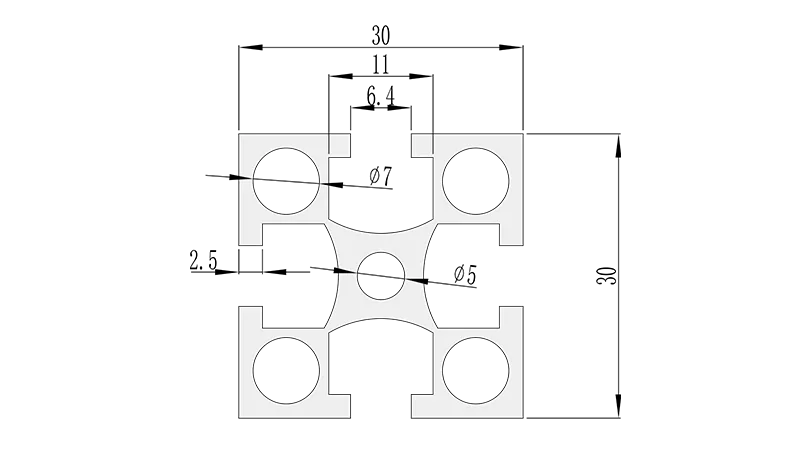
Let's get technical, but keep it simple. The 3030 National Standard Profile A is, at its core, a 30mm x 30mm square aluminum extrusion. But that's like calling a sports car "just a metal box with wheels"—the magic is in the details. First, the material: it's typically made from 6063-T5 aluminum alloy, a grade known for its excellent strength-to-weight ratio and weldability. T5 tempering (artificial aging after extrusion) gives it a hardness that resists deformation, even under constant stress. Then there's the cross-section: unlike generic 30x30 profiles, the National Standard A version follows strict dimensional guidelines, ensuring uniformity across batches. That means if you order 100 meters from one supplier and 100 from another, they'll fit together perfectly—no surprises during installation.
But the real star here is its structural design. The profile features a T-slot configuration along all four sides, with standardized slot widths that make attaching aluminum profile accessories a breeze. Whether you need brackets for a conveyor roller, corner codes to reinforce a joint, or end caps to protect workers from sharp edges, the T-slots eliminate the need for welding or drilling. That modularity is a game-changer for packaging lines, where layouts often need tweaks to accommodate new products or seasonal demand. But what truly sets it apart in high-speed applications is its rigidity. The 30x30mm cross-section, combined with internal ribbing (in some designs), distributes weight evenly and minimizes flexing. In tests, it's shown to reduce vibration by up to 30% compared to thinner 2020 profiles, and its lightweight nature means less inertia—so when the machine starts and stops quickly, there's less "wobble" in the frame.
Aluminum Profile Accessories: The Team Players That Boost Performance
A profile is only as good as the accessories that bring it to life. You could have the strongest 3030 Profile A in the world, but if you skimp on connectors or brackets, you're undermining its stability. That's why aluminum profile accessories are the unsung heroes of these systems. Let's break down a few key players:
Corner Codes & Gussets: These small, L-shaped brackets fit into the T-slots of intersecting profiles, locking them at 90-degree angles. Think of them as the "glue" that keeps joints tight, even under vibration. High-quality corner codes, often made from die-cast aluminum, distribute stress across the profile's walls instead of concentrating it on a single point—critical for long-term durability.
Connectors: From simple bolts to heavy-duty joining plates, connectors ensure profiles stay aligned. For high-speed lines, "floating" connectors with rubber gaskets are popular—they absorb minor vibrations without loosening. This is especially useful in areas like labelers or fillers, where precision is key.
End Caps & Covers: While they might seem cosmetic, end caps protect the profile's ends from moisture and debris, preventing corrosion that weakens the structure over time. They also make the workspace safer by eliminating sharp edges—important in facilities where operators work close to moving machinery.
When paired with the 3030 Profile A, these accessories create a system that's not just strong, but adaptable. Need to add a new guide rail to your conveyor? Slide a bracket into the T-slot, tighten a bolt, and you're done. Want to raise a workbench by 10cm? Swap out the feet for taller ones. This flexibility means packaging lines can evolve with your needs, without the hassle of reengineering entire frames.
How Does 3030 Profile A Stack Up Against Other Profiles?
You might be wondering: Why not just use a bigger profile, like the 4040 series, for maximum stability? It's a fair question. Let's compare the 3030 National Standard Profile A to two common alternatives—the smaller 2020 series and the larger 4040 series—to see where it shines.
| Profile Type | Cross-Section (mm) | Typical Load Capacity (kg/m) | Vibration Damping | Best For |
|---|---|---|---|---|
| 2020 National Standard | 20x20 | 50-80 | Low (prone to flexing at high speeds) | Light-duty tasks: small conveyors, manual workbenches |
| 3030 National Standard Profile A | 30x30 | 120-180 | High (balanced rigidity and weight) | High-speed packaging lines, automated fillers/cappers, precision guides |
| 4040 National Standard | 40x40 | 250-300 | Very High (but heavier) | Heavy machinery bases, large conveyor systems, static storage racks |
The 4040 series is undeniably strong, but it's also heavier. In high-speed applications, that extra weight can increase inertia—meaning the machine takes longer to start and stop, and vibrations from sudden movements are harder to dampen. It's overkill for most packaging tasks, where the load is moderate (think bottles, boxes, or small components), and the priority is agility. The 2020 series, on the other hand, is lightweight but lacks the rigidity needed for sustained high speeds. It's great for small, slow-moving setups but struggles with the constant motion of a 300+ packages-per-minute line.
The 3030 Profile A hits that sweet spot: enough strength to handle typical packaging loads (120-180kg/m), lightweight enough to keep inertia low, and rigid enough to minimize vibration. It's like choosing a sports sedan over a compact car or a truck—versatile, efficient, and built for the demands of daily use.
Real-World Impact: A Snack Food Plant's Success Story
Let's ground this in a real scenario. A mid-sized snack food manufacturer in the Midwest was struggling with their potato chip packaging line. The line ran at 250 bags per minute, but it was plagued by two issues: frequent jams at the bagger (caused by misaligned conveyor rails) and weekly breakdowns in the metal frame supporting the filler, which vibrated so badly that bolts came loose. Their maintenance team was spending 15+ hours a week just tightening parts and fixing jams, and product waste was running at 8%—well above the industry average of 3-5%.
The plant manager, fed up with the chaos, brought in an engineering consultant who recommended replacing the line's steel frame with a modular system built around 3030 National Standard Profile A and aluminum profile accessories. Skeptical at first (steel had been the "tough" choice for decades), the team agreed to a trial on one line. Within a month, the results were staggering: jams dropped by 70%, because the rigid aluminum rails kept bags aligned. Vibration was so reduced that bolts stayed tight, cutting maintenance time to 3 hours a week. Product waste? Down to 4%, saving the plant $120,000 annually on that single line alone. Today, they've upgraded all 10 lines to 3030 Profile A systems—and their operators now joke that the "line down" alerts have become a rarity.
Installation & Maintenance: Keeping Your 3030 System Running Smoothly
One of the biggest perks of 3030 Profile A systems is how easy they are to install and maintain—no welding, no specialized tools, just basic hand tools and a little know-how. Here's a quick guide to getting the most out of your setup:
Installation Tips: Start with a level base—even a small slope can throw off alignment at high speeds. Use a laser level to ensure profiles are straight before tightening accessories. When attaching brackets or connectors, torque bolts to the manufacturer's specs (usually 4-6 Nm for aluminum accessories) to avoid stripping T-slots or warping the profile.
Maintenance Routine: Inspect joints monthly for looseness—vibration can slowly wiggle bolts over time. Clean T-slots with a soft brush to remove dust and debris, which can jam accessories. For profiles in humid or wet areas, wipe down with a mild detergent quarterly to prevent corrosion. And don't overlook accessories: replace worn corner codes or cracked gaskets promptly—they're cheap to fix now, but ignoring them can lead to bigger issues later.
Compared to steel frames, which require welding repairs or repainting every few years, 3030 Profile A systems are almost maintenance-free. Their aluminum construction resists rust, and modular design means you can replace a single damaged profile instead of an entire section—saving time and money.
Future-Proofing Your Line: Why 3030 Profile A Grows With Your Business
The packaging industry isn't standing still. Consumer trends shift—think smaller batch sizes for artisanal products, or sustainable packaging that requires new machinery. E-commerce demands faster turnaround times, and automation is becoming the norm, with robots and AI-driven systems entering even mid-sized plants. In this environment, flexibility is key. You need a structural system that can adapt, not one that locks you into a single layout or speed.
The 3030 National Standard Profile A excels here. Need to add a robotic picker to your line? Attach a mounting bracket to the T-slots and you're ready. Want to reconfigure a conveyor to handle taller boxes? Swap out the vertical profiles for longer ones and adjust the guides. Because it's part of a national standard, you'll never struggle to find replacement parts or accessories—suppliers worldwide stock 3030-compatible components, so scaling up or modifying is a breeze.
Wrapping It Up: Stability That Drives Success
In the world of high-speed packaging, every detail matters. From the precision of a filler to the reliability of a conveyor, the difference between a good line and a great one often comes down to the foundation it's built on. The 3030 National Standard Profile A isn't just a piece of aluminum—it's a solution to the silent challenges of stability, vibration, and adaptability. It's why engineers trust it, maintenance teams appreciate it, and plant managers swear by it. So, the next time you walk through a packaging facility and marvel at the speed of the lines, take a closer look at the frames holding it all together. Chances are, you'll spot the clean, T-slotted lines of a 3030 Profile A system—quietly ensuring that every package, every product, and every minute of uptime counts.
At the end of the day, stability isn't just about machinery. It's about peace of mind for your team, reliability for your customers, and the freedom to focus on growing your business instead of fixing problems. And in a world that's always moving faster, that's the kind of foundation no packaging line should be without.