- Company Articles
- Industry articles
- Industry standards
- 3030 National Standard Profile A for Robot Workstations: Precision Alignment Features

3030 National Standard Profile A for Robot Workstations: Precision Alignment Features
Related Product
3030 National Standard Profile A
Workbench, production line, logistic rack, warehouse rack Industry: Manufacturer workshop, Automobile, Electronic, Assembling, logistic
Walk into any modern manufacturing facility today, and you'll likely hear the hum of robotic arms moving with near-surgical precision—placing circuit boards, assembling car parts, or packaging goods with unwavering consistency. These robot workstations are the backbone of smart factories, but their performance hinges on an often-overlooked hero: the structural framework that holds everything together. In a world where a misalignment of just 0.1mm can throw off an entire production line, the choice of structural components isn't just about strength—it's about precision. Enter the 3030 National Standard Profile A, a workhorse of aluminum extrusion profiles that's quietly revolutionizing how robot workstations achieve and maintain the alignment critical to their success.
What Is the 3030 National Standard Profile A, Anyway?
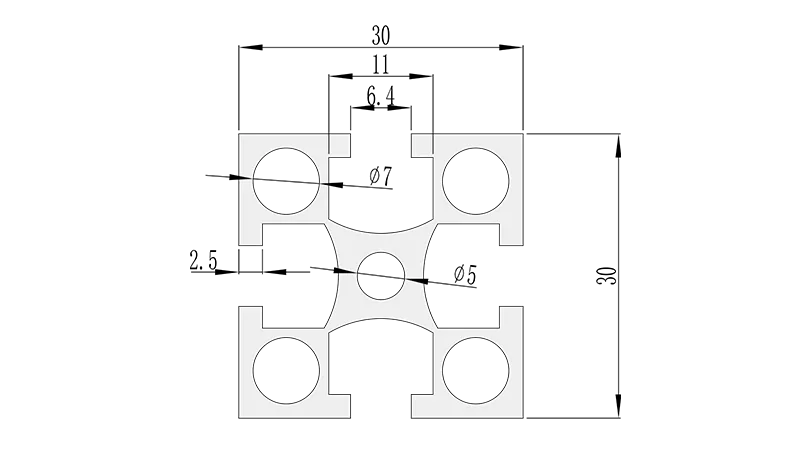
Let's start with the basics. The 3030 National Standard Profile A is a type of aluminum extrusion profile, meaning it's created by pushing heated aluminum through a custom die to form a uniform, cross-sectional shape. Picture squeezing Play-Doh through a star-shaped cutter—except instead of soft clay, it's high-grade aluminum, and the result is a rigid, lightweight beam with consistent dimensions. The "3030" refers to its cross-section: 30mm by 30mm, a sweet spot that balances strength, versatility, and space efficiency for mid-sized applications like robot workstations.
But why aluminum? Unlike steel, aluminum offers a winning combo of low weight (easy to maneuver during setup), corrosion resistance (no rust in humid factory environments), and impressive strength-to-weight ratio (it can handle the vibrations and loads of robotic operation without bending). And because it's extruded, each 3030 Profile A beam is identical—no more "close enough" measurements when building workstations. This uniformity is the first step toward precision alignment.
The Secret Sauce: Precision Alignment Features
So, what makes the 3030 National Standard Profile A stand out when it comes to keeping robot workstations aligned? Let's break down its key features, starting with the star of the show: the T-slot design.
T-Slots: The Backbone of Adjustable Alignment
Run your hand along the length of a 3030 Profile A, and you'll notice evenly spaced grooves—these are T-slots. Imagine them as built-in "tracks" that let you attach accessories (think brackets, sensors, or tool holders) anywhere along the profile, not just at fixed holes. But their real magic lies in alignment. When you slide a nut into a T-slot and tighten a bolt, the slot's precision-machined edges ensure the accessory sits exactly where you want it—no guesswork, no wobbly connections. For robot workstations, this means you can mount a robot arm's base plate with millimeter-level accuracy, then reposition it later if production needs change—all without drilling new holes or weakening the frame.
Dimensional Accuracy: Consistency You Can Count On
National standard profiles like the 3030 A aren't just "sort of" 30mm by 30mm. Thanks to tight manufacturing tolerances, each beam is within ±0.1mm of its stated dimensions. That might sound trivial, but when you're assembling a workstation with multiple connected profiles, those tiny inconsistencies add up. A 2020 profile (20mm x 20mm) might save space, but its smaller cross-section and looser tolerances (common in non-standard versions) can lead to "stacked errors" in alignment. The 3030 Profile A's strict dimensional control ensures that when you bolt two beams together at a 90° angle, they're truly perpendicular—no "lean" that could throw off a robot's path over time.
Surface Flatness: A Smooth Foundation for Stability
Ever tried building a shelf with a warped board? The whole thing wobbles. The same goes for robot workstations. The 3030 Profile A's extrusion process leaves its surfaces remarkably flat—typically within 0.2mm per meter. This flatness means when you mount a workbench top (like an aluminum honeycomb panel, a popular choice for its rigidity and light weight) onto a 3030 frame, the surface stays level. For robots tasked with delicate operations—say, placing a 0.5mm-thick circuit board onto a conveyor—even a slight dip in the workbench can cause misplacement. The profile's flatness acts as a silent quality control agent, keeping the workspace stable shift after shift.
Building Better Workstations: 3030 Profile A in Action
Let's move from theory to practice. How does the 3030 National Standard Profile A transform a basic frame into a high-performance robot workstation? Take a typical scenario: a small electronics manufacturer adding a collaborative robot (cobot) to its assembly line. The goal? A workstation where the cobot picks components from a flow rack, assembles them, and places the finished product onto a roller conveyor—all with 0.3mm positional accuracy.
The team starts with a 3030 Profile A frame: four vertical beams, connected by horizontal cross-members using 90° aluminum profile connectors (a type of aluminum profile accessory). The T-slots make it easy to mount the cobot's base plate at the exact height needed, while the profile's surface flatness ensures the base doesn't rock. They add a workbench top (1200mm x 800mm) supported by the frame, using brackets that slide into the T-slots for quick height adjustment. Along one side, they attach a material rack using 3030 uprights and horizontal rails, with plastic roller track guide rails (grey, to match the factory's color scheme) to feed components to the cobot. Even the cable management is simplified: zip ties thread through the T-slots, keeping wires off the floor and out of the robot's path.
Six months later, the manufacturer decides to add a second cobot to double output. Instead of building a new workstation from scratch, they reconfigure the existing 3030 frame: adding two more vertical beams, extending the workbench, and repositioning the flow rack using spare aluminum profile accessories. The whole process takes a day instead of a week—minimizing downtime, a key principle of lean systems. That's the beauty of modularity: the 3030 Profile A isn't just a structural part; it's a flexible platform that grows with your needs.
Why 3030? Comparing Profiles for Robot Workstations
With so many aluminum extrusion profiles on the market—2020, 3030, 4040, even 6060—why choose the 3030 National Standard Profile A for robot workstations? Let's stack it up against two common alternatives to see how it shines.
| Feature | 2020 National Standard Profile | 3030 National Standard Profile A | 4040 National Standard Profile |
|---|---|---|---|
| Cross-Section (mm) | 20 x 20 | 30 x 30 | 40 x 40 |
| Max Load Capacity (kg/m) | 150-200 | 300-400 | 500-600 |
| Alignment Tolerance (±mm) | 0.2-0.3 | 0.1 | 0.1 |
| Accessory Compatibility | Limited (small T-slots) | Extensive (standard T-slots) | Extensive (larger T-slots) |
| Best For | Light-duty, space-constrained setups (e.g., benchtop robots) | Mid-sized cobots/robots, flexible workstations | Heavy industrial robots, fixed installations |
The 4040 profile offers more strength, but it's overkill for most cobot workstations—adding unnecessary weight and cost. The 2020 profile saves space but struggles with heavier loads and tighter alignment needs. The 3030 Profile A hits the sweet spot: enough strength for a 50kg cobot, precise enough for micron-level tasks, and compatible with a vast range of aluminum profile accessories (from brackets to casters) to customize the workstation without overcomplicating things.
Supporting Lean Systems: More Than Just a Frame
Lean manufacturing is all about eliminating waste—whether it's time, materials, or inefficiency. The 3030 National Standard Profile A fits this philosophy like a glove. Its modular design means you only buy what you need, and reconfigure as production changes (no more scrapping entire workstations). Quick assembly with aluminum profile accessories (like quick-connect joints) cuts setup time from days to hours. Even maintenance is lean: standardized components mean a single set of tools and spare parts can service all workstations, reducing inventory bloat.
Take a case study from a automotive parts plant in Ohio. Before switching to 3030 Profile A workstations, they used welded steel frames for their robot cells. When a new car model required repositioning the robots by 12 inches, the team had to cut and reweld the frames—taking 48 hours of downtime. Now, with 3030 profiles, they loosen the T-slot bolts, slide the robot base to the new position, and retighten. Total downtime? 2 hours. That's a 96% reduction in waste—all because the profile's design prioritizes adaptability.
Conclusion: The Quiet Partner in Robotic Precision
Robot workstations are often celebrated for their high-tech robots, but the truth is, even the most advanced arm can't perform without a stable, aligned foundation. The 3030 National Standard Profile A may not have flashy sensors or moving parts, but its precision alignment features—T-slot design, tight dimensional tolerances, surface flatness—make it the unsung hero of modern manufacturing. Whether you're building a small cobot workbench or a large-scale automated line, this aluminum extrusion profile delivers the consistency, flexibility, and efficiency that today's factories demand.
In a world where every millimeter matters, the 3030 Profile A doesn't just hold things up—it holds them together, precisely. And in the race to build smarter, faster, and more reliably, that's more than just a structural choice—it's a competitive advantage.