- Company Articles
- Industry articles
- Industry standards
- 3030 National Standard Profile A for Testing Equipment Frames: Stability & Precision

3030 National Standard Profile A for Testing Equipment Frames: Stability & Precision
Related Product
3030 National Standard Profile A
Workbench, production line, logistic rack, warehouse rack Industry: Manufacturer workshop, Automobile, Electronic, Assembling, logistic
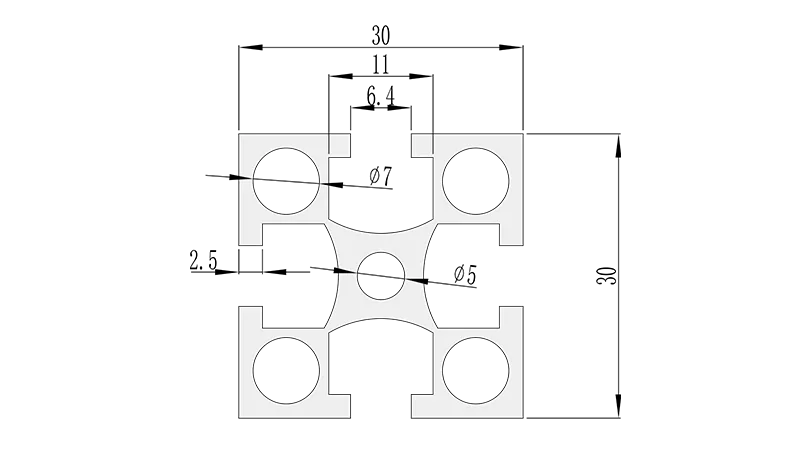
In the world of precision testing—whether it's in pharmaceutical labs analyzing drug compounds, electronics factories calibrating microchips, or aerospace facilities testing component durability—one thing remains non-negotiable: the equipment doing the testing must stand on a foundation you can trust. A wobbly frame, a misaligned surface, or a material that warps under stress isn't just an inconvenience; it's a threat to the integrity of every test result. That's where the 3030 National Standard Profile A comes in. More than just a piece of aluminum, it's the quiet hero ensuring that when your instruments measure, analyze, or validate, they do so on a stage built for accuracy.
Why Testing Equipment Frames Can't Afford to Cut Corners
Let's start with the obvious: testing equipment isn't cheap. From HPLC machines in biotech labs to coordinate measuring machines (CMMs) in automotive plants, these tools represent significant investments—often hundreds of thousands of dollars. But what good is a $200,000 instrument if the frame holding it vibrates with every footstep in the lab? Or if the workbench surface tilts by half a degree, throwing off calibration? These might sound like minor issues, but in precision testing, minor is a relative term.
Consider a medical device manufacturer testing the accuracy of a new glucose monitor. The device must measure blood sugar levels within ±5 mg/dL to meet regulatory standards. If the frame under the testing station flexes even slightly during use, the sensor alignment shifts, leading to readings that bounce between 95 and 105 mg/dL for the same sample. Suddenly, a product that should pass FDA approval is deemed unreliable—all because the frame couldn't stay steady.
Or take an electronics lab testing semiconductor chips for thermal resistance. These chips, smaller than a fingernail, generate heat that must be measured with pinpoint precision. A frame made from low-grade steel might conduct ambient heat unevenly, skewing temperature data by 2°C. In an industry where a 1°C difference can mean the difference between a chip that lasts 10 years and one that fails in 6 months, that's a disaster waiting to happen.
3030 National Standard Profile A: The Gold Standard in Frame Engineering
So, what makes the 3030 National Standard Profile A different? Let's break it down. First, it's an aluminum extrusion profile —meaning it's formed by pushing molten aluminum through a die to create a consistent, uniform shape. Unlike welded steel or plastic extrusions, aluminum extrusion offers two critical advantages: exceptional structural integrity and near-perfect dimensional accuracy. The 3030 designation refers to its cross-section: 30mm by 30mm, a sweet spot for balancing strength, weight, and versatility.
But it's not just the size that matters. The national standard designation ensures strict compliance with material and manufacturing benchmarks. This isn't some generic "aluminum bar" from a hardware store; it's engineered to meet tolerances that leave no room for error. The extrusion process, when done right, produces profiles with wall thicknesses consistent to within ±0.1mm and straightness deviations of less than 0.5mm per meter. For testing frames, that consistency is everything—it means every section of the frame behaves the same way under load, no weak spots, no unexpected bends.
Stability: The Backbone of Reliable Testing
Aluminum's Rigidity-to-Weight Advantage
Aluminum is often praised for being lightweight, but in testing frames, its real superpower is rigidity. The 3030 National Standard Profile A is made from 6061-T6 aluminum alloy, a material known for its high strength-to-weight ratio. At just 0.8 kg per meter, it's easy to handle during assembly, but don't let the lightness fool you: it boasts a yield strength of 276 MPa—strong enough to support heavy equipment without flexing. Compare that to a typical steel profile of the same dimensions, which might weigh 2-3 times as much but offer only marginally higher strength. The result? A frame that's stable enough for sensitive instruments but light enough to reconfigure when your testing needs change.
T-Slot Design: Where Flexibility Meets Security
If the material is the "what," the t-slot design is the "how" of the 3030 profile's stability. Run your finger along its length, and you'll notice a series of parallel slots (the "t-slots") cut into its sides. These slots aren't just for show—they're the key to building frames that stay tight, even under stress. Unlike traditional bolted or welded frames, where connections can loosen over time, t-slot profiles use specialized aluminum profile accessories like bolts, nuts, and brackets that slide into the slots and lock in place. Once tightened, these connections create a friction fit so secure that vibrations from nearby machinery or foot traffic are dampened, not amplified.
Think of it like building with Lego blocks, but for engineers. Need to add a shelf to hold test samples? Slide a bracket into the t-slot, tighten the bolt, and it's there—no drilling, no welding, no weakening the profile. And because the slots run the entire length, you can position accessories exactly where you need them, ensuring weight is distributed evenly across the frame. Uneven weight distribution is a common cause of frame instability, but with t-slots, you're in control.
Adjustable Leveling Feet: Conquering the Imperfect Floor
Even the best-designed frame can't perform on a lopsided floor. Labs, factories, and testing facilities are rarely perfectly level—concrete floors settle, tiles crack, and years of foot traffic create uneven surfaces. That's why adjustable leveling feet are a non-negotiable accessory for 3030 profile frames. These small but mighty components screw into the base of the profile, allowing you to tweak each corner's height by fractions of a millimeter. A few turns of the leveling foot, and suddenly a frame that wobbled on three legs is sitting rock-solid, even on a floor that slopes slightly.
I once worked with a battery testing lab where the concrete floor had a 0.3° slope across the room. Their old steel frame, bolted directly to the floor, tilted enough to make their charge-discharge testers report inconsistent capacity readings. Switching to a 3030 profile frame with adjustable leveling feet let them level the surface to within 0.05°, and overnight, their test data became 90% more consistent. It's the kind of fix that seems simple in hindsight, but it's only possible when the frame and its accessories are engineered to work in harmony.
Precision: When Tolerances Mean Everything
Stability keeps the frame from moving; precision ensures it was built exactly as intended. In testing, precision isn't just about straight lines—it's about repeatability. If you build two identical frames using 3030 National Standard Profile A, they should measure, fit, and perform identically. That's where the national standard comes into play.
Every batch of 3030 profile is tested for dimensional accuracy. The width? 30mm ±0.1mm. The depth? Same. The position of the t-slots? Within 0.05mm of the design specs. Why does this matter? Imagine assembling a frame where one section is 30.2mm wide and another is 29.8mm—when you try to connect them with a bracket, the fit will be loose, creating play that leads to micro-movements during testing. With the 3030 profile, those variations are eliminated. Every piece fits like it was made for the one next to it, because it was.
This precision extends to the extrusion's surface finish, too. The 3030 National Standard Profile A typically has a smooth, anodized coating—thinner than a human hair but tough enough to resist scratches and corrosion. A rough surface might seem harmless, but in applications like optical testing, even minor imperfections can scatter light, interfering with measurements. The anodized finish ensures a uniform, low-friction surface that plays nice with everything from sensor mounts to workbench tops.
Beyond the Profile: Accessories That Complete the System
A great profile is only as good as the accessories that bring it to life. The 3030 National Standard Profile A works seamlessly with a range of aluminum profile accessories designed to enhance stability, precision, and customization. Let's call out a few must-haves:
- Internal Straight Aluminum Joints: These connectors slide into the ends of two profiles, creating a flush, rigid connection. Unlike external brackets, they don't add bulk, keeping the frame streamlined and reducing vibration points.
- Corner Brackets: For 90° angles (common in frame corners), these brackets lock into t-slots on adjacent profiles, distributing stress evenly to prevent twisting.
- Adjustable Leveling Feet (Again, Because They're That Important): Available in various heights and load capacities, these feet often come with rubberized bases to dampen vibrations and prevent slipping.
- Workbench Tops: From solid aluminum plates to composite materials, these tops mount directly to the 3030 frame via t-slot brackets, creating a flat, stable surface for equipment. Many are even ESD-safe, making them ideal for electronics testing.
The beauty of this ecosystem is that it's modular. Need to add a shelf for test tubes? Grab a few brackets and a piece of profile. Want to raise your instrument by 10cm? Swap out the leveling feet for taller ones. This flexibility means your frame can grow and adapt as your testing needs evolve—no need to start from scratch.
How 3030 National Standard Profile A Stacks Up Against the Competition
| Feature | 3030 National Standard Profile A | 2020 National Standard Profile | Steel Square Tubing (30x30mm) |
|---|---|---|---|
| Material | 6061-T6 Aluminum Extrusion | 6063 Aluminum Extrusion | Mild Steel |
| Weight (kg/m) | 0.8 | 0.5 | 2.2 |
| Yield Strength (MPa) | 276 | 110 | 250 |
| Dimensional Tolerance | ±0.1mm | ±0.2mm | ±0.5mm |
| Corrosion Resistance | High (Anodized) | Medium (Natural Finish) | Low (Requires Painting) |
| Accessory Compatibility | Wide Range of T-Slot Accessories | Limited (Smaller T-Slots) | Minimal (Requires Drilling/Welding) |
As the table shows, the 3030 National Standard Profile A strikes a balance that's hard to beat. It's lighter than steel but stronger than smaller aluminum profiles, with tolerances tight enough for precision work. And unlike steel, it won't rust in humid labs or require repainting every few years. For testing equipment frames, that's a winning combination.
Real-World Impact: Stories from the Lab Floor
Let's ground this in real examples. A leading aerospace component manufacturer was struggling with their fatigue testing setup. They were using a steel frame to hold a hydraulic actuator that applied cyclic loads to turbine blades. Over time, the steel frame began to resonate with the actuator's vibrations, creating "noise" in the load data. Engineers spent weeks trying to isolate the issue, even adding rubber pads under the frame—with little success.
After switching to a frame built with 3030 National Standard Profile A and internal straight aluminum joints, the difference was immediate. The aluminum's natural damping properties reduced vibration by 40%, and the rigid t-slot connections eliminated resonance. The result? Test data that was cleaner, more consistent, and required 30% fewer retests. What was once a frustrating bottleneck became a model of efficiency.
Another example: a university research lab studying nanomaterials needed a frame for their atomic force microscope (AFM). AFMs measure surface features at the nanoscale—think mapping atoms on a material's surface. Even the tiniest vibration can blur images. The lab's original frame, a repurposed steel workbench, was so unstable that scans took twice as long (to average out noise) and still had artifacts. A custom 3030 profile frame with adjustable leveling feet and a vibration-dampening top plate changed everything. Scanning time dropped by 50%, and image resolution improved enough to reveal surface details previously missed.
Building Your Frame: Tips for Success
Ready to build your own testing frame with 3030 National Standard Profile A? Here are a few pro tips:
- Start with a Sketch: Map out your frame dimensions and equipment placement first. Consider weight distribution—heavier instruments should sit over support legs, not cantilevered.
- Don't Skimp on Joints: Invest in high-quality internal or corner brackets. Cheap accessories can loosen over time, undoing all the profile's good work.
- Level Twice, Tighten Once: Use a precision level when setting up leveling feet. Even a 0.1° tilt can affect sensitive instruments.
- Test for Vibration: Once assembled, place a small accelerometer on the frame (or even a bowl of water) and observe for ripples when nearby equipment is running. If you see movement, add cross-braces or damping pads.
Conclusion: When Precision Matters, Choose the Profile Built for It
Testing equipment frames are the unsung heroes of reliable data. They don't get the glory of the instruments they support, but without them, even the most advanced technology falls flat. The 3030 National Standard Profile A isn't just a material choice—it's a commitment to accuracy, stability, and adaptability. Its aluminum extrusion profile, tight tolerances, and compatibility with aluminum profile accessories make it the go-to for engineers who can't afford to compromise.
So, the next time you're setting up a testing station, ask yourself: Is my frame built to the same standard as my instruments? If the answer is no, it might be time to meet the 3030 National Standard Profile A. Your test results—and your peace of mind—will thank you.