- Company Articles
- Industry articles
- Industry standards
- 3030 National Standard Profile A for Workbench E: Ergonomic Design in Manufacturing

3030 National Standard Profile A for Workbench E: Ergonomic Design in Manufacturing
Related Product
3030 National Standard Profile A
Workbench, production line, logistic rack, warehouse rack Industry: Manufacturer workshop, Automobile, Electronic, Assembling, logistic
How a single profile is reshaping comfort, productivity, and worker well-being on the factory floor
The Silent Struggle: Why Ergonomics Matters More Than You Think
Walk into any manufacturing plant, and you'll see the heartbeat of production: assembly lines humming, tools clinking, and workers focused on crafting everything from electronics to machinery. But behind that rhythm lies a quiet challenge—one that often goes unnoticed until it's too late. I'm talking about ergonomics: the science of designing workspaces to fit the people who use them. For too long, many factories have treated workbenches, material racks, and assembly stations as afterthoughts—sturdy, yes, but rarely built with the human body in mind.
Consider Maria, a line worker at a mid-sized electronics plant. For eight hours a day, she stands at a fixed-height workbench, bending slightly forward to solder components onto circuit boards. By lunch, her lower back aches. By the end of the week, her shoulders feel tight, and she's developed a persistent headache from straining to see small parts. Sound familiar? It's a story repeated in factories worldwide. Poor ergonomics doesn't just hurt workers—it hurts businesses, too. Studies show that musculoskeletal disorders (MSDs) cost manufacturers billions annually in lost productivity, medical bills, and worker compensation claims. The solution? It starts with rethinking the very building blocks of the workspace. And that's where the 3030 National Standard Profile A comes in—especially when paired with Workbench E.
What Is 3030 National Standard Profile A, Anyway?
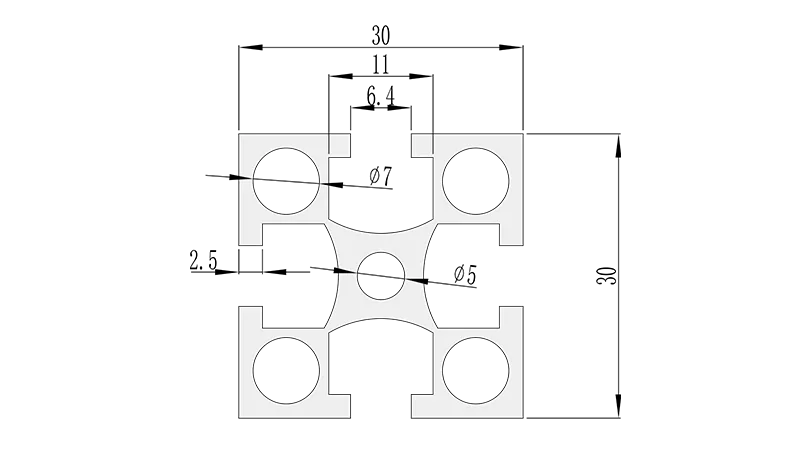
Let's break it down simply: 3030 National Standard Profile A is a type of aluminum extrusion profile—think of it as a specialized "building block" for industrial furniture and equipment. The "3030" refers to its dimensions: 30mm by 30mm, a sweet spot that balances strength and versatility. Unlike clunky steel pipes or one-size-fits-all plastic frames, this aluminum profile is designed with precision. Its T-slot design—longitudinal grooves running along its length—lets you attach accessories like brackets, shelves, and tool holders with ease, no welding or drilling required. That means you can customize your setup in minutes, not days.
But what makes it "national standard"? That designation ensures consistency in quality, dimensions, and compatibility. When a manufacturer uses 3030 National Standard Profile A, they know it will work seamlessly with other standard aluminum profile accessories—from end caps to hinges to Adjustable Leveling Feet. This standardization is a game-changer for factories, where downtime for repairs or reconfigurations can cost thousands. And because it's aluminum, it's lightweight enough to move (when needed) but strong enough to support heavy tools, components, and daily wear and tear. It's rust-resistant, too, making it ideal for environments where moisture or chemicals are present.
Now, pair that with Workbench E—a single-deck workbench (without casters) designed specifically for assembly tasks. At first glance, it might look like any other workbench, but under the surface, it's a masterclass in ergonomic engineering. And the secret ingredient? 3030 National Standard Profile A. Let's dive into how this combination transforms the daily grind into a more comfortable, efficient experience.
Workbench E: Built for Humans, Not Just Machines
Imagine a workbench that adapts to you, not the other way around. That's Workbench E. Designed with assembly line workers in mind—people who spend hours standing, reaching, and manipulating small parts—it prioritizes three key ergonomic principles: adjustability, accessibility, and comfort. And 3030 National Standard Profile A is the backbone that makes this possible.
Let's start with height. Traditional workbenches are often one-size-fits-all, forcing tall workers to hunch and shorter workers to stretch. Workbench E solves this with a height-adjustable frame, made possible by the modularity of 3030 Profile A. Using simple Aluminum Profile Accessories like height-adjustment brackets, supervisors can tweak the bench's height in 5cm increments, ensuring it aligns with the average shoulder or elbow height of the team using it. No more "making do"—just a workspace that fits.
Then there's the surface. Workbench E's single deck is wide enough to spread out tools and components (about 120cm by 60cm, depending on the model) but not so large that workers have to lean or walk to reach materials. The edge is rounded, too—no sharp corners to catch sleeves or cause bumps during long shifts. And because the frame is built with 3030 Profile A, adding accessories like tool hangers, LED task lights, or component bins is a breeze. Need a holder for your soldering iron? Screw a bracket into the T-slot. Want a small shelf for instruction manuals? Snap on a shelf bracket. Everything stays within arm's reach, reducing unnecessary movement that strains the neck, shoulders, and back.
Stability is another unsung hero of ergonomics. A wobbly workbench isn't just annoying—it's dangerous. A tool might slip, a component might fall, or a worker might overcompensate with tense muscles to steady themselves. Workbench E uses Adjustable Leveling Feet (another key accessory) to anchor itself firmly to the floor, even on uneven concrete. These feet screw into the 3030 Profile A legs, letting you tweak each corner independently until the bench is rock-solid. It's a small detail, but anyone who's spent a day on a wobbly bench knows how much difference it makes.
To put this in perspective, let's compare Workbench E (with 3030 Profile A) to a traditional steel workbench. The table below breaks down the ergonomic benefits:
| Feature | Traditional Steel Workbench | Workbench E (3030 Profile A) |
|---|---|---|
| Height Adjustability | Fixed height; requires custom fabrication to change | Adjustable in 5cm increments via Aluminum Profile Accessories |
| Surface Accessibility | Static; tools/materials often pile up in hard-to-reach areas | Modular T-slot system for adding tool holders/bins; everything within arm's reach |
| Stability | Heavy but prone to wobbling on uneven floors; no built-in leveling | Adjustable Leveling Feet for a rock-solid base on any surface |
| Comfort | Sharp edges; cold steel surface; no customization for posture | Rounded edges; optional anti-fatigue mat compatibility; posture-aligned height |
| Durability | Prone to rust; dents from heavy impacts; hard to repair | Aluminum frame resists rust; T-slot accessories easy to replace; scratch-resistant surface |
The difference is clear: Workbench E isn't just a place to work—it's a partner in productivity. And it's all thanks to the flexibility of 3030 National Standard Profile A.
Accessories That Make the Difference: Aluminum Profile Accessories and More
A workbench is only as good as its accessories. And because Workbench E is built with 3030 National Standard Profile A, it's compatible with a wide range of Aluminum Profile Accessories that turn a basic bench into a personalized workstation. Let's highlight a few that workers love:
- Adjustable Leveling Feet: As mentioned earlier, these small but mighty accessories screw into the 3030 Profile A legs, letting you stabilize the bench on uneven floors. They're rubber-tipped, too, so they won't scratch the floor or slide during use.
- Tool Rail A & B: These aluminum guide rails attach to the back of the bench, providing a place to hang tools like screwdrivers, pliers, and wrenches. They're slotted, so you can move tool hooks around as needed—no more searching for that one missing wrench.
- Component Bins: Small, stackable bins that clip into the T-slots of the 3030 Profile A frame. Perfect for organizing screws, nuts, washers, and other tiny parts. Workers can label them, color-code them, or arrange them by task—whatever makes their workflow smoother.
- LED Task Lights: Clip-on lights that mount to the profile, illuminating the work surface without casting shadows. This is a game-changer for detail work, like soldering or inspecting circuit boards, reducing eye strain during long shifts.
- Anti-Fatigue Mat Holders: While Workbench E doesn't come with casters, it can be paired with anti-fatigue mats to ease pressure on feet and legs. Special brackets (another Aluminum Profile Accessory) keep the mat in place, so it doesn't slide around during use.
What's impressive is how these accessories work together. A worker assembling a smartphone might have their soldering iron on a tool rail, component bins sorted by part type, and an LED light focused on the motherboard. A colleague assembling a larger machine could add a shelf for instruction manuals and a holder for power tools. The 3030 Profile A's T-slot design makes swapping out accessories quick—so if a bench needs to switch from electronics assembly to mechanical repair, it takes 15 minutes, not a full day.
One factory in Guangdong reported a 20% reduction in "search time" (the time workers spend looking for tools or components) after switching to Workbench E with these accessories. That adds up to hours of saved productivity each week—and happier workers who aren't frustrated by disorganized workspaces.
Real-World Impact: From Aches to Efficiency
Numbers tell part of the story, but let's hear from the people on the ground. Chen Wei has worked as an assembly line technician at a electronics factory in Jiangsu for 12 years. He used to spend his shifts at a traditional steel workbench, often complaining of lower back pain by Friday. "I'd come home and just want to lie down," he says. "Even weekends felt like recovery time." Then, last year, his factory replaced all old workbenches with Workbench E, built with 3030 National Standard Profile A.
"At first, I didn't think a new bench would make much difference. But after a week, I noticed I wasn't hunching over anymore—the height was perfect for me. The tool rail keeps my pliers and screwdrivers right where I need them, so I don't twist my shoulders to reach. Now, Friday evenings don't feel like a battle. I actually have energy to play with my kids."
Chen's experience isn't unique. A six-month study by the factory found that worker-reported MSDs (like back and shoulder pain) dropped by 35% after the switch. Absenteeism due to these issues fell by 28%, and production speed increased by 12%—not because workers were pushing harder, but because they were moving more efficiently, with less wasted motion.
Another example: a automotive parts plant in Zhejiang that manufactures brake components. Their old workbenches were made of wood, which warped over time, leading to uneven surfaces. Workers often had to prop up components with books or blocks to keep them level. After switching to Workbench E with 3030 Profile A and Adjustable Leveling Feet, quality control checks showed a 15% reduction in errors—because components stayed flat and stable during assembly. "We used to have parts that didn't align because the bench was wobbly," says Li Jia, a quality inspector. "Now, everything sits straight. It's like night and day."
These stories highlight a key point: ergonomics isn't just about comfort—it's about results. When workers are comfortable, they're more focused, less prone to mistakes, and more likely to stay with the company long-term. In an industry where turnover can be high, that's priceless.
Why 3030 National Standard Profile A Is Here to Stay
So, what makes 3030 National Standard Profile A and Workbench E more than just a passing trend? It's simple: they solve real, everyday problems for manufacturers and workers. The aluminum profile's durability means it lasts for years (even decades) with minimal maintenance. Its standardization ensures that factories can source replacement parts or accessories from any reputable supplier, avoiding vendor lock-in. And its adaptability means it can grow with a factory—whether they're scaling up production, adding new product lines, or reconfiguring their assembly floor.
As more factories prioritize worker well-being (and as regulations around workplace safety tighten), the demand for ergonomic solutions will only grow. 3030 National Standard Profile A isn't just a building material—it's a tool for creating workspaces that respect the people who power manufacturing. And Workbench E is proof that when you design with humans in mind, everyone wins: workers feel better, productivity rises, and businesses thrive.
So, the next time you walk through a factory, take a closer look at the workbenches. Are they rigid, one-size-fits-all relics of the past? Or are they flexible, human-centered workspaces built with 3030 National Standard Profile A? The difference isn't just in the metal—it's in the people who use them. And in manufacturing, people are the most important component of all.