
- Company Articles
- Industry articles
- Industry standards
- 3030 National Standard Profile A in Aerospace Manufacturing: Lightweight Structures
Introduction: The Weight of Innovation in Aerospace
In the aerospace industry, where every milligram counts, the quest for lightweight yet robust structures is more than a goal—it's a daily challenge. Engineers and production teams grapple with balancing strength, durability, and maneuverability, all while adhering to strict safety standards that leave no room for compromise. Whether it's assembling components for a commercial airliner, a satellite, or a next-gen drone, the tools and systems used in manufacturing play a pivotal role in determining efficiency, cost-effectiveness, and ultimately, the success of the final product. This is where the 3030 National Standard Profile A enters the spotlight—a humble yet transformative aluminum extrusion profile that's redefining how aerospace manufacturing floors operate.
Imagine a production line where workstations can be reconfigured in hours, not days, to adapt to a new aircraft model. Picture material racks that support heavy avionics components without adding unnecessary bulk to the factory floor. Envision assembly jigs that are lightweight enough to be moved by a small team but sturdy enough to hold precision parts during testing. These scenarios aren't just wishful thinking—they're the reality made possible by the 3030 National Standard Profile A. As a cornerstone of modern aluminum extrusion profile technology, this material isn't just changing how parts are made; it's reshaping the entire philosophy of aerospace manufacturing, one modular component at a time.
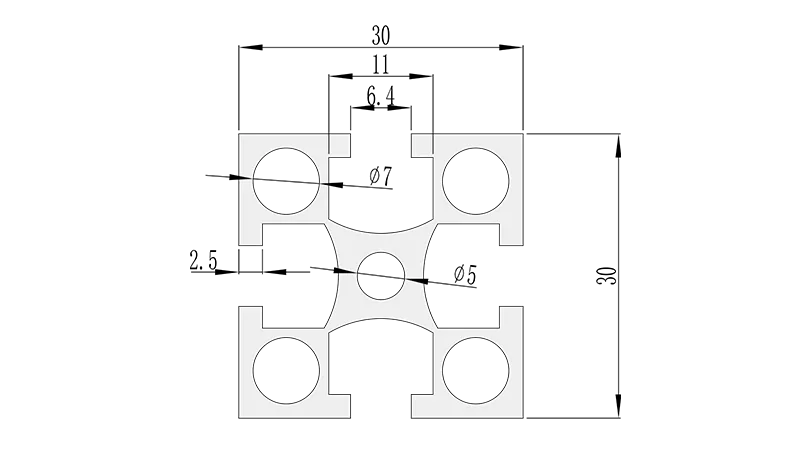
What is 3030 National Standard Profile A?
At its core, the 3030 National Standard Profile A is a type of aluminum extrusion profile—meaning it's created by forcing heated aluminum alloy through a die to form a specific cross-sectional shape. The "3030" designation refers to its dimensions: 30mm in width and 30mm in height, making it a compact yet versatile option for structural applications. What sets it apart, however, is its adherence to national standards, ensuring consistent quality, dimensional accuracy, and compatibility across manufacturers and suppliers.
Crafted typically from 6061 or 6063 aluminum alloys—known for their excellent strength-to-weight ratio and corrosion resistance—the 3030 profile is engineered to withstand the rigors of industrial environments while remaining surprisingly lightweight. Its cross-section often features T-slots along its length, which serve as built-in channels for attaching accessories like brackets, connectors, and panels. This design isn't just a matter of convenience; it's a deliberate choice to promote modularity, allowing users to customize structures without welding or complex machining.
For aerospace manufacturers, this modularity is a game-changer. Unlike traditional steel frames or custom-machined components, the 3030 profile can be easily adjusted, extended, or repurposed as production needs evolve. A workstation built for assembling engine parts today can be reconfigured next month to support wing panel assembly, all with minimal downtime and without the need for specialized tools. This flexibility aligns perfectly with the fast-paced, ever-changing demands of aerospace production, where adaptability can mean the difference between meeting tight deadlines and falling behind.
Key Properties That Make 3030 Profile Ideal for Aerospace
To understand why the 3030 National Standard Profile A has become a staple in aerospace manufacturing, let's break down its critical properties and how they address industry-specific challenges:
1. Exceptional Strength-to-Weight Ratio: Aluminum alloys like 6061 have a density roughly one-third that of steel, yet they offer impressive tensile strength (up to 310 MPa for 6061-T6). For aerospace manufacturing tools—such as assembly jigs, workbenches, and material racks—this means structures can support heavy loads (think engine components or avionics systems weighing hundreds of pounds) without adding unnecessary weight to the factory floor. Lighter equipment is easier to move, reduces strain on floor supports, and even lowers energy costs associated with transportation within the facility.
2. Corrosion Resistance: Aerospace manufacturing environments often involve exposure to coolants, lubricants, and cleaning agents, not to mention humidity variations in large production halls. The 3030 profile's aluminum base, combined with optional anodized or powder-coated finishes, provides excellent resistance to corrosion and chemical damage. This longevity ensures that structures remain reliable over years of use, reducing the need for frequent replacements and lowering long-term maintenance costs.
3. Precision and Consistency: Thanks to strict national standards, every 3030 profile produced meets tight tolerances for straightness, dimensional accuracy, and surface finish. This consistency is critical when building precision tools like alignment fixtures, where even a 0.1mm deviation can compromise part quality. Aerospace manufacturers can trust that two 3030 profiles from different batches will fit together seamlessly, eliminating the guesswork and delays caused by mismatched components.
4. Thermal Stability: Aluminum has excellent thermal conductivity, which helps dissipate heat evenly across structures. In aerospace facilities, where temperature-sensitive components (like composite materials or electronic systems) are handled, this property prevents localized hotspots that could warp parts or damage sensitive equipment. Whether near welding stations or in climate-controlled assembly zones, the 3030 profile maintains its structural integrity across a wide temperature range.
5. T-Slot Versatility: The T-slots running along the 3030 profile's length are more than just a design feature—they're a gateway to endless customization. By sliding aluminum profile accessories like bolts, brackets, and end caps into these slots, engineers can build everything from simple shelving units to complex, multi-level workstations. This eliminates the need for drilling or welding, reducing the risk of structural weakening and making on-the-fly adjustments possible.
A Closer Look: How 3030 Profile Compares to Other Aluminum Extrusions
While the 3030 National Standard Profile A is a standout option, it's helpful to compare it with other common aluminum profiles to understand its unique advantages for aerospace applications. Below is a comparison table highlighting key differences between 3030, 2020, and 4040 profiles—three of the most widely used extrusion sizes in industrial settings:
| Profile Type | Dimensions (WxH) | Typical Weight (kg/m) | Max Load Capacity (Static, kg/m) | Aerospace Suitability | Common Applications |
|---|---|---|---|---|---|
| 2020 National Standard | 20mm x 20mm | 0.45–0.6 | 150–200 | Limited (best for lightweight, low-load tools) | Small shelving, electronic component racks |
| 3030 National Standard Profile A | 30mm x 30mm | 0.8–1.1 | 300–400 | Excellent (balances strength, weight, and flexibility) | Assembly workstations, material handling racks, jigs |
| 4040 National Standard | 40mm x 40mm | 1.5–1.8 | 500–600 | Good (higher load capacity but bulkier) | Heavy-duty machinery frames, large storage systems |
As the table shows, the 3030 profile strikes a perfect balance between the smaller 2020 (too lightweight for most aerospace tools) and the larger 4040 (sturdier but heavier and less maneuverable). For aerospace manufacturers, this middle ground is invaluable. It's strong enough to support heavy components like landing gear assemblies or turbine blades, yet lightweight enough to be integrated into mobile workstations or temporary assembly cells. Unlike the 4040 profile, which can add unnecessary weight to structures that don't require maximum load capacity, the 3030 profile optimizes both material usage and performance—a critical consideration in an industry where every kilogram saved translates to cost savings and improved efficiency.
Real-World Applications in Aerospace Manufacturing
The versatility of the 3030 National Standard Profile A shines through in its diverse applications across aerospace production lines. Let's explore some of the most impactful use cases:
1. Assembly Workstations and Jigs: Precision is non-negotiable when assembling aerospace components, and the 3030 profile excels here. Workstations built with 3030 frames can be customized with tool holders, part bins, and adjustable shelves, all secured via T-slots. For example, a workstation for mounting avionics systems might include a tilting platform (supported by 3030 brackets) that allows technicians to position circuit boards at eye level, reducing strain and improving accuracy. Jigs—fixtures used to hold parts in place during welding or fastening—benefit from the profile's rigidity; a wing rib assembly jig, for instance, can maintain exact tolerances even under the stress of clamping large aluminum panels, ensuring each rib aligns perfectly with the wing structure.
2. Material Handling Racks and Trolleys: Moving heavy parts like engine casings or landing gear components around the factory floor is a logistical challenge. 3030 profile-based material racks and turnover trolleys offer a solution that's both durable and lightweight. A three-tiered material rack (built with 3030 uprights and crossbars) can safely hold hundreds of kilograms of parts while remaining easy to maneuver with casters (another aluminum profile accessory). Trolleys equipped with swivel wheels and adjustable shelves allow teams to transport components directly to the assembly line, reducing wait times and minimizing the risk of damage from multiple transfers.
3. Test Fixtures and Quality Control Stations: Before components are integrated into aircraft, they undergo rigorous testing—vibration tests, load tests, thermal cycling, and more. Test fixtures built with 3030 profiles provide a stable, configurable platform for these evaluations. For example, a fixture designed to test turbine blade durability can be adjusted to accommodate different blade sizes by simply repositioning 3030 cross-members and clamping brackets. Quality control stations, where parts are inspected for defects, often feature 3030-based tables with integrated lighting and magnifying glass mounts, creating an ergonomic workspace that enhances technician focus and accuracy.
4. Lean Manufacturing Cells: Many aerospace manufacturers have adopted lean principles to eliminate waste and streamline production. The 3030 profile aligns seamlessly with this philosophy. Lean cells—self-contained production units focused on a specific task—rely on flexibility and minimal waste, and 3030 structures support both. A lean cell for riveting fuselage panels might include a 3030-framed workbench, a nearby material rack, and a mobile tool cart, all designed to reduce movement and keep necessary tools within arm's reach. If production needs shift, the entire cell can be reconfigured in hours, not days, by adjusting the 3030 components—no need to replace expensive custom machinery.
Enhancing Performance with Aluminum Profile Accessories
The true power of the 3030 National Standard Profile A lies not just in the profile itself, but in its compatibility with a wide range of aluminum profile accessories. These accessories transform basic extrusions into fully functional, customized systems, and their integration is where aerospace manufacturers unlock even greater value.
Connectors and Joints: Without reliable connectors, the modularity of the 3030 profile would be impossible. Accessories like 90° aluminum profile connectors, 135° angle codes, and internal rotary joints allow for secure, rigid connections between profiles. For aerospace applications, where vibration and stress are constant, heavy-duty connectors (often made from die-cast aluminum or stainless steel) ensure joints don't loosen over time. A 90° straight connector, for example, can join two 3030 profiles at a right angle with minimal play, maintaining the structural integrity of a workstation even during high-precision assembly tasks.
End Caps and Surface Treatments: While end caps might seem like minor details, they play a crucial role in aerospace settings. Plastic or aluminum end caps seal the open ends of 3030 profiles, preventing dust, debris, or coolant from entering the T-slots—critical for maintaining cleanliness when working with sensitive components like avionics. Additionally, anodized or powder-coated finishes on both profiles and accessories add an extra layer of corrosion resistance, ensuring structures remain in top condition even in humid or chemical-exposed environments.
Gussets and Reinforcements: In high-load applications, like supporting engine assemblies, gussets (triangular brackets) provide extra stability. A 3030-based workbench holding a 500kg engine block, for instance, would use gussets at the corners to distribute weight evenly and prevent frame twisting. Reinforcement brackets, which attach to T-slots along the profile length, can further strengthen long spans, ensuring the structure doesn't sag under heavy loads—a common concern in aerospace where component weights vary widely.
Casters and Mobility Solutions: For mobile applications like tool trolleys or temporary assembly stations, casters are indispensable. Aluminum profile-compatible casters (often with locking brakes) attach directly to 3030 profile bases, allowing structures to be moved smoothly across factory floors. Swivel casters with precision bearings ensure trolleys can navigate tight corners, while heavy-duty options (rated for 200kg+ per caster) handle the weight of loaded material racks. This mobility reduces the need for fixed infrastructure, letting manufacturers adapt floor layouts on the fly.
Aligning with Lean Systems: Reducing Waste, Boosting Efficiency
Lean manufacturing isn't just a buzzword in aerospace—it's a strategic imperative. By minimizing waste (time, materials, movement) and maximizing value, lean systems help manufacturers stay competitive in a global market. The 3030 National Standard Profile A and its accessories are inherently aligned with lean principles, offering tangible benefits:
1. Waste Reduction Through Reusability: Traditional steel frames or custom-welded structures are often single-use; if a production line changes, they're scrapped or stored indefinitely, wasting materials and space. The 3030 profile, by contrast, is fully reusable. A material rack no longer needed for engine parts can be disassembled, and its components repurposed to build a new workstation for satellite assembly. This reduces scrap metal waste and lowers procurement costs for new equipment.
2. Improved Flow with Modular Design: Lean systems emphasize continuous flow—ensuring parts and materials move smoothly from one production stage to the next. 3030 profile-based conveyors (using roller tracks and aluminum guide rails) and gravity-fed racks facilitate this flow by allowing parts to glide directly to assembly stations. For example, a roller track built with 3030 side rails and plastic guide rails can transport wing panels from the fabrication area to the assembly line with minimal manual intervention, reducing bottlenecks and wait times.
3. Employee Empowerment Through Flexibility: Lean manufacturing encourages employees to identify and solve inefficiencies, and the 3030 profile puts this power in their hands. Technicians can adjust workstations to better suit their needs—raising a shelf, adding a tool holder, or repositioning a light—without waiting for maintenance teams. This autonomy boosts morale and productivity, as workers feel ownership over their environment and can make changes that directly improve their daily tasks.
4. Just-In-Time Production Support: Just-in-time (JIT) manufacturing, where parts are produced or delivered exactly when needed, reduces inventory costs and storage space. 3030 profile-based material racks with adjustable shelves make JIT easier to implement; racks can be sized to hold only the parts needed for the current shift, preventing overstocking. Mobile trolleys, built with 3030 frames, deliver these parts directly to the line as scheduled, ensuring production never stalls due to missing components.
Future Trends: Innovations in 3030 Profile and Aerospace Manufacturing
As aerospace manufacturing continues to evolve—with a focus on sustainability, automation, and advanced materials—the 3030 National Standard Profile A is poised to evolve with it. Here are a few trends shaping its future:
1. Integration with Smart Manufacturing: The rise of Industry 4.0 is bringing sensors, IoT connectivity, and data analytics to factory floors. Future 3030 profiles could feature embedded sensors that monitor load capacity, vibration, or temperature, alerting teams to potential issues before they cause downtime. Imagine a material rack that automatically notifies supervisors when it's overloaded, or a workstation that tracks usage patterns to optimize layout—all made possible by integrating smart technology into the profile's T-slots.
2. Sustainable Materials and Processes: Aerospace manufacturers are under increasing pressure to reduce their carbon footprint, and aluminum profiles are already more eco-friendly than steel (aluminum is 100% recyclable with no loss of quality). Future 3030 profiles may use higher percentages of recycled aluminum, further lowering environmental impact. Additionally, advances in extrusion die design could reduce material waste during production, making the manufacturing process itself more sustainable.
3. Advanced Coatings for Extreme Environments: While aluminum is naturally corrosion-resistant, aerospace components often face extreme conditions—high humidity, salt spray (for marine-based aircraft), or chemical exposure. New coatings, such as ceramic-infused anodizing or graphene-reinforced paints, could enhance the 3030 profile's durability in these environments, extending its lifespan and reducing maintenance needs.
4. Custom Extrusion Profiles for Niche Applications: As aerospace designs become more specialized (e.g., electric vertical takeoff and landing vehicles, or eVTOLs), there may be demand for 3030 variants with unique cross-sections—extra T-slots for cable management, integrated channels for wiring, or curved profiles for aerodynamic tooling. Manufacturers are already exploring custom die designs that retain the 3030's core benefits while adding application-specific features.
Conclusion: Building the Future of Aerospace, One Profile at a Time
The 3030 National Standard Profile A may not be the most glamorous component in aerospace manufacturing, but its impact is undeniable. By combining lightweight strength, modular flexibility, and seamless integration with aluminum profile accessories, it addresses the industry's most pressing challenges—from reducing production waste to improving precision and adaptability. For engineers, technicians, and production managers, it's more than just a building material; it's a tool that empowers innovation, enabling them to design and reimagine manufacturing systems that keep pace with the demands of modern aerospace.
As aerospace continues to push boundaries—developing faster, more efficient aircraft, exploring space travel, and embracing sustainable practices—the 3030 profile will undoubtedly play a central role. Its ability to evolve with new technologies, materials, and manufacturing philosophies ensures it will remain a cornerstone of aerospace production for years to come. In the end, the true measure of its value isn't in its dimensions or specs, but in the way it empowers teams to build better, safer, and more efficient aircraft—one lightweight, perfectly aligned structure at a time.