- Company Articles
- Industry articles
- Industry standards
- 3030 National Standard Profile A in Automotive Manufacturing: Flexible Line Construction

3030 National Standard Profile A in Automotive Manufacturing: Flexible Line Construction
Related Product
3030 National Standard Profile A
Workbench, production line, logistic rack, warehouse rack Industry: Manufacturer workshop, Automobile, Electronic, Assembling, logistic
The automotive industry is a relentless innovator, driven by evolving consumer demands, stricter regulations, and the race to integrate cutting-edge technologies like electric powertrains and autonomous systems. Behind every sleek new model rolling off the production line lies a critical challenge: how to build manufacturing facilities that can keep up. Traditional production lines, often built with rigid steel structures and welded frameworks, were once the norm—but they're increasingly becoming a bottleneck. Reconfiguring them for new models or process upgrades can take weeks, if not months, and cost millions. This is where flexible manufacturing solutions step in, and at the heart of this revolution is a seemingly unassuming component: the 3030 National Standard Profile A.
In this article, we'll dive into how this aluminum extrusion profile is transforming automotive manufacturing lines, making them adaptable, cost-effective, and ready for the future. We'll explore its design, benefits, real-world applications, and why it's quickly becoming the go-to choice for manufacturers aiming to stay agile in a fast-changing industry.
What Is 3030 National Standard Profile A?
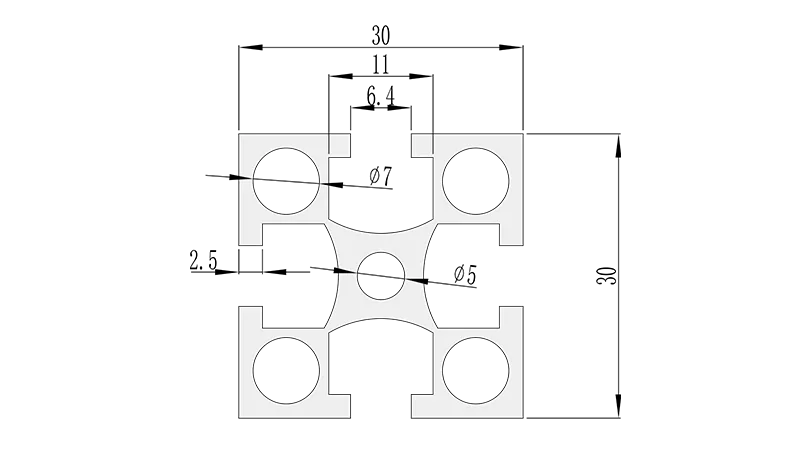
Let's start with the basics. The 3030 National Standard Profile A is a type of aluminum extrusion—a long, slender structure created by forcing heated aluminum through a die to achieve a specific cross-sectional shape. As the name suggests, it measures 30mm by 30mm, making it compact yet surprisingly robust. What sets it apart, however, is its T-slot design : a continuous groove running along its length that allows for easy attachment of accessories like brackets, connectors, and panels. This might sound simple, but it's the foundation of its flexibility.
Unlike traditional steel profiles, which require welding or drilling to modify, the 3030 profile is designed to be modular. It's lightweight (aluminum is about one-third the weight of steel) yet strong enough to support heavy loads—think car parts, assembly tools, or even entire workstations. It's also corrosion-resistant, thanks to aluminum's natural oxide layer, which protects it from the oils, coolants, and humidity common in factory environments. And because it's made from aluminum, it's fully recyclable, aligning with the automotive industry's growing focus on sustainability.
But the profile itself is just part of the equation. Its true power lies in its compatibility with a vast ecosystem of aluminum profile accessories : corner brackets, sliding nuts, end caps, and hinges, to name a few. These accessories snap or bolt into the T-slot, allowing manufacturers to build, modify, and expand structures without specialized tools or lengthy downtime. It's like building with industrial-grade Legos—only sturdier and tailored for the demands of automotive production.
Why Flexibility Matters in Automotive Manufacturing
Before we dive deeper into the 3030 profile, let's pause to understand why flexibility has become a buzzword in automotive manufacturing. In the past, car models had longer lifespans—think 5–7 years per generation. Today, that cycle has shrunk to 3–4 years, with mid-cycle updates becoming more frequent. Add to that the rise of electric vehicles (EVs), which have different assembly requirements than internal combustion engine (ICE) cars, and the pressure to adapt becomes clear.
Consider a scenario: A manufacturer decides to add a new EV model to its lineup. The traditional steel assembly line, built for ICE cars, would need major overhauls. Welded frames would have to be cut, new conveyors installed, and workstations repositioned—each step taking time and disrupting production. With a flexible line built using 3030 profiles, the process is. Workstations can be reconfigured in hours, conveyors extended with a few extra profiles and connectors, and tool mounts adjusted to fit new equipment. Downtime? Minimal. Cost? A fraction of traditional methods.
Flexibility also matters for lean system implementation. Lean manufacturing, which focuses on minimizing waste and maximizing efficiency, relies on continuous improvement. A rigid line makes it hard to test new workflows or adjust for bottlenecks. A 3030-based line, by contrast, lets teams experiment: move a workstation closer to a conveyor, add a material rack for faster part access, or reangle a tool holder to reduce operator fatigue. If a change doesn't work, it's just as easy to revert—no permanent modifications, no wasted resources.
Key Features of 3030 National Standard Profile A
To understand why this profile is ideal for flexible lines, let's break down its core features:
1. T-Slot Versatility
The T-slot is the profile's secret weapon. It accepts a range of fasteners, from sliding T-nuts to drop-in bolts, allowing accessories to be attached anywhere along the length. Need to mount a monitor arm on a workstation? Slide a nut into the slot, position the arm, and tighten the bolt. Want to add a side panel to a material rack? Use bracket clips that lock into the T-slot. This adaptability means the same profile can be used for everything from simple frames to complex assembly systems.
2. Lightweight Strength
Aluminum's strength-to-weight ratio is a game-changer. A 3030 profile can support up to 500kg per linear meter (depending on the wall thickness and support spacing), yet it's light enough for two workers to carry and assemble without heavy machinery. This reduces installation time and makes reconfiguration a manual task—no cranes or welders needed.
3. Compatibility Across Systems
The 3030 profile isn't a one-trick pony. It plays well with other components critical to automotive lines, such as conveyors , workbenches, and material racks. For example, a roller conveyor can be mounted directly to 3030 profiles using specialized brackets, and the entire system can be adjusted in height or length by swapping out profile sections. This interoperability means manufacturers don't have to replace their entire line—they can upgrade incrementally, saving costs.
4. Low Maintenance
Steel rusts; aluminum doesn't. In a factory where spills and humidity are common, this is a huge advantage. The 3030 profile requires minimal upkeep—just occasional cleaning to remove dust or debris from the T-slot. And if a section gets damaged (say, from a dropped tool), it can be replaced individually without tearing down the entire structure.
Real-World Applications in Automotive Manufacturing
Now, let's look at how the 3030 National Standard Profile A is used on the factory floor. From assembly stations to material handling, its applications are wide-ranging and impactful.
1. Assembly Workstations
Automotive assembly is a process, requiring workers to have tools, parts, and documentation within arm's reach. 3030 profiles excel here, enabling the creation of ergonomic, customizable workbenches . For example:
- Adjustable Height : Using telescoping 3030 legs with locking pins, workbenches can be raised or lowered to suit operators of different heights, reducing strain and improving productivity.
- Tool Integration : Drill presses, torque wrenches, and even small robots can be mounted to the bench using T-slot brackets, keeping tools organized and accessible.
- ESD Protection : For electronics assembly (e.g., EV batteries or infotainment systems), 3030 profiles can be paired with conductive accessories to create ESD-safe workstations, preventing static damage to sensitive components.
One major automotive supplier, for instance, replaced its fixed steel workbenches with 3030-based ones and reported a 25% reduction in operator fatigue and a 15% increase in assembly speed—simply by allowing workers to customize their stations.
2. Material Handling and Flow Racks
In automotive plants, parts need to move quickly from storage to the assembly line. Material racks built with 3030 profiles are lightweight yet strong enough to hold heavy components like engine blocks or suspension parts. Their modular design allows for adjustable shelving: add a shelf for smaller parts, or remove one to accommodate larger items. Some manufacturers even use 3030 profiles to build mobile carts, equipped with casters (another compatible accessory), to transport parts directly to the line—eliminating the need for forklifts in tight spaces.
Flow racks, which use gravity to feed parts to workers, are another area where 3030 profiles shine. The T-slot allows for easy installation of roller tracks, and the racks can be angled slightly to ensure smooth part flow. If a new part size is introduced, the rollers can be repositioned or the rack height adjusted in minutes—no need for a custom-built replacement.
3. Conveyor Systems
Conveyors are the arteries of automotive lines, moving car bodies, subassemblies, and parts between stations. Traditional steel conveyors are heavy and hard to modify, but 3030 profiles are changing that. Manufacturers are using them to build lightweight, modular conveyor frames that can be extended, shortened, or reconfigured with minimal effort.
For example, a tier-one supplier of EV battery packs needed to adjust its conveyor line to accommodate a new battery size. Using 3030 profiles and compatible roller track accessories, the team extended the conveyor by 2 meters and added side guides to prevent jamming—all in a single 8-hour shift. With a steel conveyor, this would have taken days and required specialized contractors.
4. Quality Control Stations
Quality control is non-negotiable in automotive manufacturing. Inspection stations need to be flexible to handle different vehicle models and components. 3030 profiles allow for the easy integration of cameras, lighting, and measurement tools. For instance, a station checking weld quality can be fitted with adjustable camera mounts that slide along the T-slot, ensuring inspectors can view every angle of a part. If a new model with different weld locations is introduced, the mounts are simply repositioned—no drilling or welding required.
Traditional Steel vs. 3030 Profile: A Comparison
To truly appreciate the impact of 3030 National Standard Profile A, let's compare it to traditional steel lines. The table below breaks down key factors:
| Factor | Traditional Steel Lines | 3030 Profile-Based Lines |
|---|---|---|
| Reconfiguration Time | Weeks to months (requires welding, cutting, and specialized labor) | Hours to days (modular assembly with hand tools) |
| Weight | Heavy (requires cranes/ forklifts for installation) | Lightweight (manual handling possible) |
| Cost | High initial and modification costs (welding, material waste) | Lower upfront costs; significantly lower modification costs |
| Customization | Limited (fixed designs; hard to adapt to new parts) | Highly customizable (T-slot accessories enable endless configurations) |
| Durability | Prone to rust (requires painting/coating) | Corrosion-resistant (no coating needed) |
| Sustainability | Steel recycling is energy-intensive; high carbon footprint | Aluminum is 100% recyclable; lower production energy use |
Challenges and Considerations
While the 3030 profile offers numerous benefits, it's not a one-size-fits-all solution. Manufacturers should keep a few things in mind:
Load Capacity : While strong, aluminum isn't steel. For extremely heavy loads (e.g., fully assembled car bodies), manufacturers may need to reinforce 3030 profiles with thicker walls or additional supports. However, for most subassembly and material handling tasks, it's more than sufficient.
Supplier Quality : Not all aluminum profiles are created equal. Tolerances (how closely the profile matches the 30x30mm specification) and material purity can vary between suppliers. Choosing a reputable supplier ensures that accessories fit properly and the profile performs as expected.
Training : While 3030 profiles are easy to use, factory teams may need basic training on how to select and install accessories. Investing in a short workshop can prevent mistakes and ensure teams take full advantage of the profile's flexibility.
The Future: 3030 Profiles and Industry 4.0
As the automotive industry moves toward Industry 4.0—smart factories with connected systems and data-driven decision-making—the 3030 profile is poised to play an even bigger role. Its T-slot design makes it easy to integrate sensors, cameras, and IoT devices. Imagine a workstation with a built-in sensor that monitors tool usage and sends alerts when maintenance is needed, or a conveyor line with RFID readers mounted on 3030 brackets that track parts in real time.
Some manufacturers are already experimenting with "digital twins"—virtual replicas of production lines. The modularity of 3030 profiles makes it easier to update the digital twin when the physical line is modified, ensuring the virtual model always reflects reality. This allows for faster testing of new workflows and more accurate predictive maintenance.
Sustainability will also drive adoption. As automakers commit to carbon neutrality, the recyclability and energy efficiency of aluminum profiles (aluminum production uses 95% less energy than producing new aluminum from ore) will make them even more attractive compared to steel.
Conclusion: Building for the Future
The 3030 National Standard Profile A might not be the most glamorous component in automotive manufacturing, but it's undoubtedly one of the most transformative. By prioritizing modularity, lightweight strength, and compatibility, it's enabling manufacturers to build lines that can adapt to new models, technologies, and market demands—all while reducing costs and downtime.
In an industry where change is the only constant, flexibility isn't just a nice-to-have; it's a competitive advantage. Whether it's assembling EV batteries, inspecting welds, or moving parts across the factory floor, the 3030 profile is proving that the future of automotive manufacturing is modular, sustainable, and ready to evolve. As more manufacturers embrace this technology, we can expect to see faster innovation, lower costs, and a more resilient industry—one T-slot at a time.