- Company Articles
- Industry articles
- Industry standards
- 3030 National Standard Profile A in Battery Production Lines: Safety & Conductivity

3030 National Standard Profile A in Battery Production Lines: Safety & Conductivity
Related Product
3030 National Standard Profile A
Workbench, production line, logistic rack, warehouse rack Industry: Manufacturer workshop, Automobile, Electronic, Assembling, logistic
3030 National Standard Profile A in Battery Production Lines: Safety & Conductivity
Walk into any modern battery production facility, and you'll notice a symphony of precision: machines whirring, robots gliding, and workers focused on assembling components that power everything from smartphones to electric vehicles. But behind this seamless operation lies an often-overlooked hero: the infrastructure that holds it all together. From workbenches where delicate cells are tested to conveyors that move materials across the floor, the right structural components can make or break efficiency, safety, and scalability. Today, we're diving into one such component that's quietly revolutionizing battery manufacturing: the 3030 National Standard Profile A . Let's explore why this aluminum profile has become a go-to choice for production managers, and how it balances two critical needs in battery lines: uncompromising safety and reliable conductivity.
The High-Stakes World of Battery Production: Why Infrastructure Matters
Battery manufacturing isn't just about putting parts together—it's about precision under pressure. A single misstep in handling lithium-ion cells can lead to short circuits, thermal runaway, or even fires. Add to that the need for ESD (Electrostatic Discharge) protection—static electricity can damage sensitive electronics—and you've got a production environment where every surface, every workbench, and every conveyor needs to be designed with safety in mind. Then there's efficiency: as demand for batteries skyrockets, factories need systems that can adapt to new cell sizes, production volumes, and workflows without constant overhauls.
This is where structural profiles come in. Traditionally, many facilities relied on rigid, custom-built metal frames or generic steel pipes. But these often fall short: steel is heavy, making reconfiguration a nightmare; custom builds take weeks to design and install; and non-conductive materials can trap static, putting products at risk. Enter aluminum profiles—lightweight, modular, and inherently conductive. And among these, the 3030 National Standard Profile A stands out for its balance of strength, versatility, and compliance with industry standards.
What Is 3030 National Standard Profile A? Breaking Down the Basics
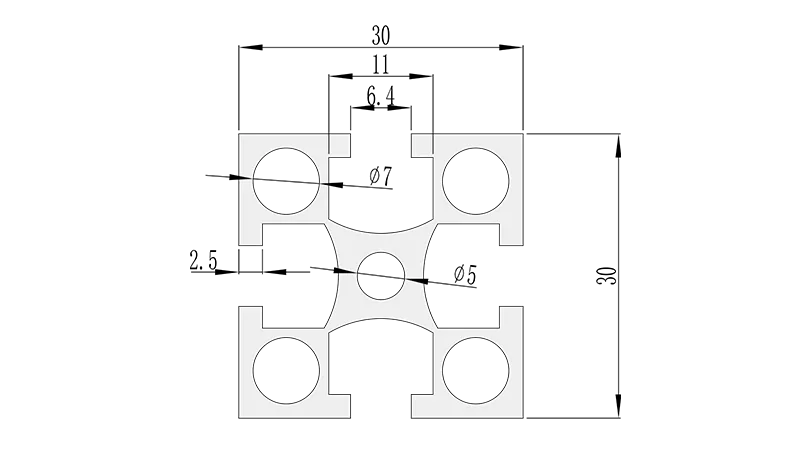
Let's start with the basics: the "3030" in the name refers to its dimensions—30mm in width and 30mm in height. It's a square aluminum extrusion, meaning it's formed by pushing heated aluminum through a die to create a consistent cross-section. What makes it a "national standard" profile? It adheres to strict manufacturing guidelines for dimensions, material thickness, and tolerances, ensuring compatibility with a wide range of aluminum profile accessories (think connectors, brackets, and end caps) from different suppliers. No more guessing if a joint from one brand will fit a profile from another—standardization means interchangeability, which saves time and reduces costs.
But what really sets the 3030 apart is its t-slot design. Run your finger along its length, and you'll feel evenly spaced grooves (slots) along each side. These slots are the profile's superpower: they let you attach accessories without drilling holes or welding. Need to add a shelf to a workbench? Slide a bracket into the slot and tighten a screw. Want to reposition a conveyor guide rail? Loosen the fastener, adjust, and retighten. This modularity is a game-changer for battery lines, where change is constant.
| Feature | 3030 National Standard Profile A | Typical 2020 Profile | Traditional Steel Pipe (30mm) |
|---|---|---|---|
| Dimensions (WxH) | 30mm x 30mm | 20mm x 20mm | 30mm diameter |
| Material | 6063 Aluminum Alloy | 6063 Aluminum Alloy | Mild Steel |
| Weight (per meter) | 0.8-1.2kg | 0.4-0.6kg | 7.0kg |
| Load Capacity (vertical) | Up to 200kg/m | Up to 80kg/m | Up to 300kg/m |
| ESD Conductivity | Yes (via grounding) | Yes (via grounding) | Yes, but heavier |
| Modularity | High (t-slot, standard accessories) | High, but lower load capacity | Low (welding/drilling required) |
As the table shows, the 3030 strikes a sweet spot: it's lighter than steel but stronger than smaller aluminum profiles like the 2020, making it ideal for medium-to-heavy-duty applications in battery lines. Now, let's dig into its two star qualities: safety and conductivity.
Safety First: How 3030 Profile Protects Against ESD and Structural Failures
In battery production, ESD protection isn't optional—it's a lifeline. Static electricity can build up on workers, tools, or equipment, and when discharged near a lithium-ion cell, it can puncture the cell's separator, causing a short circuit. That's why every surface that comes into contact with batteries needs to either dissipate static (conductive) or prevent it from building up (anti-static). Aluminum, being a metal, is naturally conductive, but how does the 3030 profile ensure that static is safely grounded rather than zapping sensitive components?
It all starts with the material. The 3030 National Standard Profile A is made from 6063 aluminum alloy, which has good electrical conductivity. When integrated into an ESD workstation —say, a bench where operators assemble battery modules—the profile can be connected to a grounding system via conductive brackets or cables. This creates a path for static charge to flow from the workstation to the ground, never reaching the batteries. Unlike plastic or painted steel, which can insulate and trap static, aluminum provides a consistent, reliable conductive path.
But safety isn't just about ESD. Structural integrity matters too. A workbench that wobbles under the weight of testing equipment, or a material rack that bends when loaded with cell trays, puts workers and products at risk. The 3030 profile's design addresses this with its thick walls (typically 1.5-2mm) and square cross-section, which distributes weight evenly. When paired with the right aluminum profile accessories —like 90° connectors or reinforced brackets—it can support heavy loads without flexing. For example, a material rack built with 3030 profiles can easily hold multiple layers of battery cell trays, even in high-traffic areas of the production floor.
Take the example of a mid-sized battery manufacturer in Guangdong that recently upgraded its assembly line. Previously, they used wooden workbenches with plastic tops, which were prone to static buildup and would warp over time. After switching to ESD workstations framed with 3030 profiles and conductive table tops, they saw a 60% drop in ESD-related component failures. "We used to have at least one incident a week where a cell was damaged by static," says the plant manager. "Now, it's maybe one a quarter. And the workbenches are so sturdy—we can clamp tools, mount testing gear, and even reconfigure the layout in an hour when we switch to a new battery model."
Conductivity Beyond ESD: Thermal Management and Workflow Efficiency
While ESD conductivity gets most of the attention, the 3030 profile's conductive properties offer another hidden benefit: thermal management. Battery production involves processes like cell formation, where cells are charged and discharged, generating heat. Equipment like testing stations or charging racks can get warm, and if heat isn't dissipated, it can affect both equipment performance and battery quality. Aluminum's thermal conductivity—about three times that of steel—helps here. A 3030 profile frame can act as a passive heat sink, drawing heat away from sensitive components and into the surrounding air. It's not a replacement for active cooling systems, but it adds an extra layer of thermal stability, especially in tight production spaces where airflow is limited.
Then there's the role of the 3030 profile in streamlining workflows, particularly when paired with conveyor systems. Battery lines often use roller conveyors to move cells, modules, or finished packs between stations. These conveyors need to be rigid enough to handle the load but lightweight enough to adjust when production needs change. 3030 profiles are ideal for building conveyor frames: their t-slot design lets you mount roller tracks, side guides, and motor brackets with precision. And because the profiles are modular, you can extend a conveyor by adding more sections, or reangle it to fit a new layout—no welding or custom fabrication required.
Consider a scenario where a factory needs to add a new inspection station to its conveyor line. With traditional steel conveyors, this might involve cutting and welding new sections, which takes days and disrupts production. With 3030 profiles, the maintenance team can unbolt a section, add a new 3030 frame with a roller track, and bolt it back in place—all in an afternoon. The result? Minimal downtime and a production line that adapts as quickly as market demands change.
Aluminum Profile Accessories: The Unsung Heroes of Modularity
A profile is only as good as the accessories that bring it to life, and the 3030 National Standard Profile A shines here thanks to its compatibility with a vast ecosystem of aluminum profile accessories . Let's break down some of the most useful ones in battery production:
- 90° Connectors: These L-shaped brackets join two 3030 profiles at a right angle, perfect for building workbench frames or conveyor supports. They slide into the t-slots and tighten with a hex key—no drilling required.
- End Caps: Simple but essential, these plastic or aluminum caps cover the ends of profiles, preventing dust buildup and protecting workers from sharp edges.
- Linear Guides: For moving parts like sliding tool trays on workbenches, linear guides attach to 3030 profiles, allowing smooth, precise motion.
- Conductive Brackets: When grounding an ESD workstation, these brackets connect the 3030 profile to the facility's grounding system, ensuring static charge is safely dissipated.
The beauty of these accessories is that they're standardized. A 90° connector made for the 3030 National Standard Profile A will work with any other 3030 profile that meets the same standard, regardless of the supplier. This interoperability is a huge win for factories that source components from multiple vendors, reducing the risk of mismatched parts and costly delays.
Real-World Impact: How 3030 Profile Transformed a Battery Plant's Workflow
To put this all in perspective, let's look at a case study. A lithium-ion battery manufacturer in Jiangsu was struggling with two main issues: their existing workstations were made of wood and plastic, leading to frequent ESD incidents, and their conveyors were rigid steel structures that couldn't keep up with new battery sizes for electric vehicles. The plant manager, Mr. Li, decided to overhaul the production line's infrastructure, starting with the workstations and conveyors, and chose the 3030 National Standard Profile A as the core component.
First, they replaced all wooden workbenches with ESD workstations framed in 3030 profiles. Each bench was equipped with conductive table tops, grounding cables connected to the profiles, and modular tool holders attached via t-slot brackets. "The difference was immediate," Mr. Li recalls. "Our ESD meters showed static levels dropping from 30,000 volts (danger zone) to under 100 volts (safe) within a week. Operators also loved the flexibility—they could adjust the height of the tool holders or add shelves as needed, which cut down on time spent searching for tools."
Next, they replaced the steel conveyors with 3030 profile-based roller conveyors. Using aluminum roller tracks, plastic guide rails, and 3030 frames, the team built a system that could handle both small consumer battery packs and larger EV modules. When a new EV battery model with a longer length came in, they simply added two more 3030 sections to the conveyor, extending it by 1.5 meters in under two hours. "Before, changing conveyor length would take a full day of welding and painting," Mr. Li says. "Now, it's a morning project. We've cut changeover time by 75%, which means we can take on more orders without expanding the factory."
Six months after the upgrade, the plant saw a 40% reduction in production downtime, a 50% drop in ESD-related defects, and a 25% increase in daily output. "The 3030 profile wasn't the only change, but it was the foundation," Mr. Li notes. "Everything else—from the ESD workstations to the conveyors—built on its strength and modularity. It's not just a profile; it's a system that grows with us."
Why Choose 3030 National Standard Profile A Over Other Options?
With so many aluminum profiles on the market, why has the 3030 National Standard Profile A become a favorite? Here's a quick breakdown of its key advantages:
1. Balanced Strength and Weight: It's strong enough for workbenches, conveyors, and material racks (up to 200kg/m vertical load) but light enough to reconfigure without heavy machinery.
2. ESD and Conductivity: Aluminum's natural conductivity, paired with grounding accessories, makes it ideal for ESD-sensitive environments like battery lines.
3. Standardization: As a national standard profile, it works with accessories from multiple suppliers, reducing supply chain risks.
4. Cost-Effective: While aluminum is pricier than steel upfront, the modularity and reusability of 3030 profiles lower long-term costs—no need to replace entire systems when workflows change.
5. Safety: Rounded edges, lightweight design, and structural stability reduce workplace accidents, from static shocks to strain injuries during reconfiguration.
Final Thoughts: Building the Future of Battery Production, One Profile at a Time
In the fast-paced world of battery manufacturing, success hinges on the details—the small, often unseen components that keep production lines running safely and efficiently. The 3030 National Standard Profile A may not grab headlines, but for production managers like Mr. Li, it's a game-changer. By balancing ESD safety, structural strength, and modularity, it addresses the core challenges of battery production: protecting sensitive components, adapting to change, and scaling without constant overhauls.
As battery technology evolves—with larger cells, higher energy densities, and new chemistries—the need for flexible, safe infrastructure will only grow. The 3030 profile, with its standardization and compatibility with aluminum profile accessories, is poised to meet that need. It's not just a piece of metal; it's a building block for the future of energy storage. And in an industry where every innovation counts, that's something worth celebrating.
So, the next time you walk through a battery factory, take a closer look at the workbenches, conveyors, and racks. Chances are, you'll spot the 3030 National Standard Profile A hard at work—quietly, reliably, and safely powering the production of the batteries that power our world.