3030 National Standard Profile A in Consumer Electronics: Assembly Line Efficiency
Related Product
3030 National Standard Profile A
Workbench, production line, logistic rack, warehouse rack Industry: Manufacturer workshop, Automobile, Electronic, Assembling, logistic
3030 National Standard Profile A

How a Single Aluminum Extrusion Profile is Transforming Manufacturing Workflows

The Race to Build Better: Challenges in Consumer Electronics Assembly

Walk into any consumer electronics factory, and you'll feel the pulse of speed and precision. Phones, tablets, smartwatches—each device is a puzzle of tiny components, assembled with millimeter accuracy. But here's the catch: the industry waits for no one. New models launch every few months, design tweaks happen overnight, and consumer demand swings like a pendulum. For manufacturers, this means assembly lines can't just be efficient—they need to be adaptable . Rigid workbenches, clunky material racks, and one-size-fits-all conveyor systems? They're relics of a slower era.

Today's factories need infrastructure that bends without breaking. Something that can reconfigure when a new product hits the line, that grows with production demands, and that reduces waste in every form—time, motion, and materials. Enter the unsung hero of modern manufacturing: the 3030 National Standard Profile A. This unassuming aluminum extrusion profile isn't just a piece of metal. It's the backbone of lean, flexible, and future-ready assembly lines. Let's dive into how this single component is reshaping how consumer electronics are built.

What is 3030 National Standard Profile A?

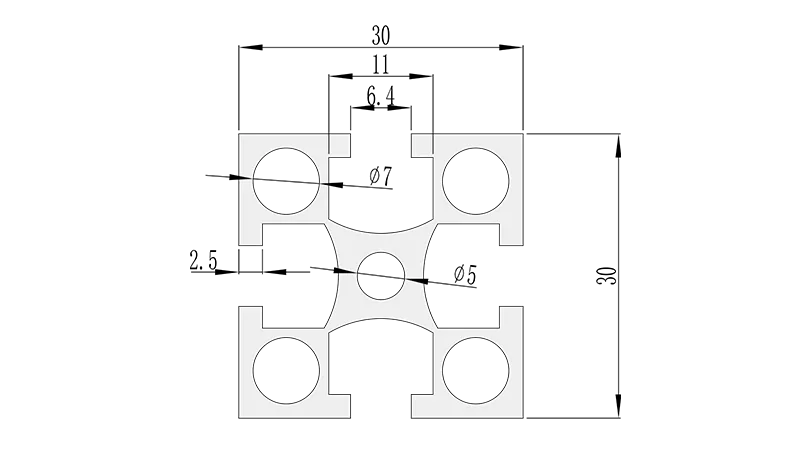
At first glance, the 3030 National Standard Profile A looks simple: a 30mm x 30mm square tube with a hollow core and a T-shaped slot running along each edge. But that simplicity is its superpower. Made from 6063-T5 aluminum alloy—known for its strength, corrosion resistance, and lightweight properties—this aluminum extrusion profile is engineered to be both robust and versatile. The "national standard" label ensures consistency: every 3030 Profile A, whether from Supplier X or Supplier Y, has the same dimensions, slot size, and load capacity. That interchangeability is gold for manufacturers who can't afford downtime due to mismatched parts.

The magic lies in the T-slot design. Those grooves along each side aren't just for show—they're the gateway to infinite customization. Slide in a bolt, clip on an accessory, or lock in a bracket, and suddenly this basic tube becomes part of a workbench, a flow rack, or even a mobile trolley. No welding, no drilling, no messy modifications. Just quick, tool-free adjustments that keep assembly lines moving.

But the profile itself is just the start. Pair it with compatible accessories—end caps to smooth edges, 90° aluminum profile connectors to join tubes at right angles, or casters for mobility—and you've got a modular system that can build almost anything. It's like industrial Lego for grown-ups, but with the strength to support heavy circuit boards and the precision to align delicate components.

Building the Perfect Workbench: Where Ergonomics Meets Efficiency

Ask any assembly line worker what slows them down, and they'll likely mention their workbench. Too low, too cluttered, or too rigid to hold the tools they need. Traditional workbenches—often made of fixed steel or wood—are like concrete shoes in a race: they get the job done, but never fast enough. The 3030 National Standard Profile A changes that by turning workbenches into customizable command centers.

Imagine a workbench built with 3030 Profile A frames. The height? Adjustable, thanks to telescoping legs and locking brackets, so a 5'2" operator and a 6' tall colleague can both work comfortably. The surface? Swap out a basic plywood top for an aluminum honeycomb panel that's lightweight but strong enough to support a 50kg test fixture. Need a tool rail above? Slide brackets into the T-slots and mount it in minutes. ESD protection for sensitive circuit boards? Add a conductive mat and ground it through the profile's metal frame. Every detail is designed to reduce motion waste—no more reaching across the bench for a screwdriver or bending awkwardly to plug in a device.

But the real beauty is how these workbenches evolve. When a new phone model with a larger screen arrives, simply adjust the shelf height to fit the new test jigs. When a worker needs a second monitor for assembly instructions, clip a monitor arm to the side rail. No need to order a whole new bench—just reconfigure the one you have. It's lean manufacturing in action: using what you have to meet changing needs.

Feature Traditional Steel Workbench 3030 National Standard Profile A Workbench
Customization Fixed design; modifications require welding/drilling Tool-free adjustments via T-slots; add/remove accessories in minutes
Ergonomics One-size-fits-all height; limited adjustability Height-adjustable legs; customizable shelf positions
Weight Heavy (often 100kg+); hard to move Lightweight aluminum frame (30-50kg); add casters for mobility
Cost Over Time Low upfront cost, but replacement needed for design changes Higher initial investment, but reusable and reconfigurable for years
ESD Compatibility Requires additional conductive coatings Metal frame grounds static; compatible with ESD mats and wrist straps

Take a leading smartphone manufacturer in Shenzhen, for example. They swapped 200 traditional workbenches for 3030 Profile A models last year. Within three months, operator complaints about fatigue dropped by 40%, and assembly time per unit decreased by 12%. Why? Workers could finally position tools and components exactly where they needed them, reducing unnecessary movement. And when the factory shifted to a new phone model, reconfiguring the benches took hours instead of days—keeping production on track.

Flow Racks: Keeping Materials Moving, No Bottlenecks Allowed

Efficiency in electronics assembly isn't just about building fast—it's about keeping materials flowing like water. Parts stuck in a corner, bins stacked too high, or workers waiting for components to arrive: these are the silent productivity killers. Flow racks, designed to gravity-feed materials to the line, are the solution. And when built with 3030 National Standard Profile A, they become unstoppable.

A typical flow rack using 3030 Profile A starts with a sturdy frame—vertical posts and horizontal beams locked together with 90° aluminum profile connectors. Then, along the beams, you mount roller tracks: plastic or steel rollers that let bins glide forward as the front one is removed. The angle is adjustable, so heavy components (like battery packs) slide smoothly without jamming. And because the 3030 Profile A is lightweight, even a large 3-row, 3-floor material rack can be moved with casters if needed—no forklift required.

What makes these racks so effective? They turn "search and retrieve" into "grab and go." Instead of walking to a storage room, workers find capacitors, resistors, and screens waiting at their fingertips. The T-slots in the 3030 Profile A make it easy to add dividers, labeling holders, or even LED lights to highlight low-stock bins. And if production ramps up, just add another section to the rack—no need to tear down and rebuild.

Case Study: A Tablet Manufacturer's 50% Reduction in Material Retrieval Time

A mid-sized tablet factory in Dongguan was struggling with bottlenecks at their assembly stations. Workers spent 20 minutes per hour walking to fetch parts from a central storage area—a classic case of "motion waste" in lean terms. The solution? A bank of flow racks built with 3030 Profile A, positioned just steps from the line. Each rack was customized to hold the exact bins and components needed for each station: screen assemblies on the top shelf, motherboards on the middle, and screws/connectors on the bottom. Within a week, material retrieval time dropped by 50%. Workers stayed at their stations, focus improved, and production throughput jumped by 15%.

But flow racks are just the start. Pair the 3030 Profile A with swivel roller balls (1 inch or 0.5 inch) for a flexible picking surface, or plastic roller track guide rails (yellow for high-visibility, grey for low-profile) to keep bins aligned. The possibilities are endless—and all built on the same, simple profile.

Lean System Integration: Building Efficiency from the Ground Up

Lean manufacturing isn't just a buzzword—it's a philosophy built on eliminating waste. From overproduction to excess inventory, every inefficiency eats into profits. The 3030 National Standard Profile A isn't just a tool for building things; it's a tool for living lean. Here's how:

Just-In-Time (JIT) Production: Flow racks built with 3030 Profile A ensure components arrive exactly when they're needed. No more stockpiling parts in warehouses—bins empty as assembly progresses, triggering replenishment only when necessary. This slashes inventory costs and frees up floor space.

Continuous Improvement: Lean thrives on small, constant tweaks. With 3030 Profile A, testing a new workflow layout takes hours, not weeks. Move a workbench, adjust a flow rack angle, or add a new shelf—then measure the results. If it works, keep it; if not, change it back. No risk, no downtime, just progress.

Waste Reduction: Traditional steel racks rust, wooden workbenches warp, and plastic components crack. The 3030 Profile A's aluminum construction resists corrosion and wear, lasting 10+ years with minimal maintenance. When a line is retired, the profiles can be disassembled and reused elsewhere—no waste, just value.

Consider a lean cell built entirely with 3030 Profile A: workbenches for assembly, flow racks for materials, and a conveyor (yes, even conveyors!) for moving semi-finished products between stations. Every element is modular, so if the cell needs to shrink, grow, or reorient, it happens in a day. No more waiting for custom fabrication—just bolts, brackets, and a team ready to adapt.

Why Aluminum? The Material Advantage in Electronics Manufacturing

You might wonder: why use aluminum extrusion profile for these applications? Why not steel, which is stronger? Or plastic, which is cheaper? The answer lies in balance. Steel is strong, but it's heavy—try moving a steel workbench across the factory floor. Plastic is light, but it bends under heavy loads. Aluminum? It's the sweet spot: strong enough to support 100kg+ on a workbench, light enough for one person to carry a 2-meter profile, and corrosion-resistant—critical in factories where cleaning agents and humidity are common.

Then there's sustainability. Consumer electronics brands are under pressure to reduce their carbon footprint, and aluminum delivers. It's 100% recyclable, and recycling it uses 95% less energy than producing new aluminum. When a 3030 Profile A finally reaches the end of its life (which takes decades), it can be melted down and turned into a new profile—no waste, no guilt.

Cost is another factor. While 3030 Profile A has a higher upfront price than basic steel or plastic, it pays for itself in the long run. A traditional steel workbench might cost $200, but if you need to replace it every 3 years, the total cost over a decade is $667. A 3030 Profile A workbench costs $350 upfront, but lasts 10+ years and can be reconfigured 10 times over. It's an investment that keeps giving.

Future-Proofing with 3030 Profile A: Smart Factories, Smarter Profiles

The consumer electronics industry isn't slowing down—and neither is the 3030 National Standard Profile A. As factories shift to smart manufacturing and Industry 4.0, this humble aluminum profile is evolving right along with them. Imagine T-slots housing sensors that track workbench usage, or embedded RFID tags that monitor tool locations. The 3030 Profile A's modular design makes it easy to integrate new tech without overhauling the entire line.

Take automation, for example. Collaborative robots ("cobots") are becoming common on assembly lines, and they need stable mounting points. 3030 Profile A frames provide a rigid, adjustable base for cobots, allowing them to be positioned exactly where they're needed. When a new task arises, reprogram the cobot and reposition its 3030 mount—done.

Sustainability will also drive innovation. As brands aim for carbon-neutral production, the 3030 Profile A's recyclability and durability will become even more valuable. Factories might start using profiles made from recycled aluminum, or designing modular systems that generate less waste from the start.

Conclusion: The 3030 Difference—Efficiency Redefined

In the fast-paced world of consumer electronics, every second counts. The 3030 National Standard Profile A isn't just a piece of aluminum—it's a catalyst for efficiency. It turns rigid workbenches into adaptable command centers, clunky storage into smooth-flowing racks, and static assembly lines into lean, agile systems. It's the reason a factory can shift from building a 5-inch phone to a 10-inch tablet in days, not months. It's the tool that lets workers focus on building, not searching, bending, or waiting.

So the next time you pick up a smartphone or tablet, take a moment to appreciate the unseen hero: the 3030 National Standard Profile A, quietly supporting the assembly line that brought it to life. In a world of constant change, it's the one constant manufacturers can rely on to build better, faster, and smarter.


Get In Touch with us

Hey there! Your message matters! It'll go straight into our CRM system. Expect a one-on-one reply from our CS within 7×24 hours. We value your feedback. Fill in the box and share your thoughts!