- Company Articles
- Industry articles
- Industry standards
- 3030 National Standard Profile A in Mechanical Manufacturing: Machine Frame Construction

3030 National Standard Profile A in Mechanical Manufacturing: Machine Frame Construction
Related Product
3030 National Standard Profile A
Workbench, production line, logistic rack, warehouse rack Industry: Manufacturer workshop, Automobile, Electronic, Assembling, logistic
In the bustling world of mechanical manufacturing, where precision meets productivity, the unsung hero often lies in the structure that holds everything together: the machine frame. Think of it as the backbone of any production line—quietly supporting the gears, motors, and components that bring products to life. A well-built frame doesn't just keep machines upright; it ensures stability during high-speed operations, maintains alignment for precise cuts or assemblies, and even influences how easily a facility can adapt to new production needs. But here's the thing: not all frames are created equal. The choice of material and profile can make or break a machine's performance, longevity, and cost-effectiveness. That's where the 3030 National Standard Profile A comes into play—a workhorse in the world of aluminum extrusion profiles that's redefining what machine frames can do.
1. The Basics of Machine Frame Construction: Why It Matters
Before diving into the specifics of the 3030 Profile A, let's take a step back. What exactly does a machine frame do, and why does its design matter so much? At its core, a machine frame is the structural foundation that anchors every moving and stationary part of a machine. Whether it's a CNC router, an assembly line conveyor, or a robotic welding cell, the frame must:
- Bear Loads: Support the weight of motors, tools, workpieces, and sometimes even operators (in the case of workbenches).
- Resist Vibration: Minimize shaking during operation to prevent errors in precision tasks, like laser cutting or micro-assembly.
- Maintain Alignment: Keep components positioned correctly over time, even as temperatures fluctuate or parts wear.
- Allow Adaptability: Let manufacturers reconfigure or upgrade machines without rebuilding the entire frame.
Traditionally, machine frames were built with steel—thick, heavy, and strong. But steel has drawbacks: it's prone to rust, hard to modify once welded, and its weight can make installation and repositioning a nightmare. Enter aluminum extrusion profiles. Lightweight, corrosion-resistant, and infinitely modular, aluminum profiles have become a go-to for modern manufacturers. And among these, the 3030 National Standard Profile A stands out as a versatile solution that balances strength, flexibility, and cost.
2. What Is 3030 National Standard Profile A?
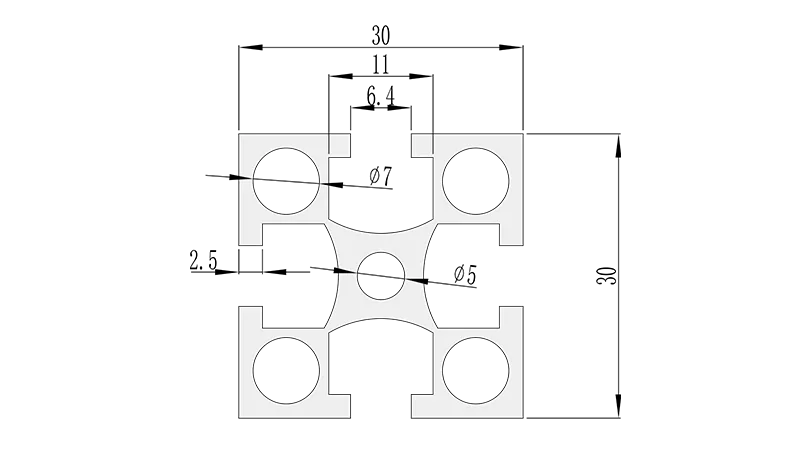
Let's start with the basics: the name. "3030" refers to its cross-sectional dimensions—30 millimeters in width and 30 millimeters in height. "National Standard" means it adheres to strict Chinese manufacturing specifications, ensuring consistency in dimensions, material quality, and performance across suppliers. And "Profile A" typically denotes a specific design within the 3030 category, often with standard T-slot configurations (more on that later) and wall thickness optimized for general-purpose use.
But numbers only tell part of the story. The 3030 Profile A is made from aluminum alloy, most commonly 6063-T5. This alloy is prized for its excellent strength-to-weight ratio, corrosion resistance, and machinability. After extrusion (the process of forcing molten aluminum through a die to create the profile's shape), it undergoes heat treatment (T5) to harden the material, then surface treatments like anodizing or powder coating. Anodizing, in particular, creates a hard, protective oxide layer that resists scratches and further corrosion—ideal for factory environments where oils, coolants, or humidity might otherwise damage the frame.
What really sets aluminum extrusion profiles apart, though, is the T-slot system. Running along the length of the 3030 Profile A are longitudinal slots (T-shaped grooves) that allow for easy attachment of accessories—brackets, panels, connectors, even other profiles. No welding, no drilling (in most cases), just bolts, nuts, and connectors that slide into the slots and tighten securely. This modularity is a game-changer for manufacturers who need to iterate quickly or adapt to changing production demands.
3. Key Features of 3030 National Standard Profile A
So, what makes the 3030 Profile A a standout choice for machine frames? Let's break down its most compelling features:
3.1 Lightweight Yet Strong
Aluminum is about one-third the weight of steel, which makes frames built with 3030 Profile A significantly easier to transport, install, and reposition. But don't let the lightness fool you—this profile is surprisingly strong. Thanks to its alloy composition and structural design (the T-slots add rigidity), it can handle substantial loads. For example, a single 3030 Profile A (with standard wall thickness of 2mm) can support up to 150-200 kg when used as a vertical support, depending on the span. That's more than enough for most small to medium machine frames, workbenches, or material racks.
3.2 Modular Design with Aluminum Profile Accessories
Remember those T-slots? They're the secret to the profile's versatility. Pair the 3030 Profile A with aluminum profile accessories like 90° aluminum profile connectors, end caps, corner brackets, or panel mounts, and you can build almost anything. Need to add a shelf to a machine frame? Slide a bracket into the T-slot and tighten. Want to extend the frame's length? Connect two profiles with a straight connector. This modularity reduces assembly time from days (with steel welding) to hours, and it makes future modifications a breeze. If your production line needs to expand next year, just add more profiles and accessories—no need to start from scratch.
3.3 Corrosion Resistance
Factories are tough environments. Oils, coolants, humidity, even chemicals can take a toll on metal frames. Steel rusts; aluminum doesn't—especially when anodized. The anodized surface of the 3030 Profile A acts as a barrier, preventing oxidation and ensuring the frame stays looking and performing like new for years. This is particularly important in industries like food processing, pharmaceuticals, or electronics manufacturing, where cleanliness and hygiene are critical.
3.4 Precision and Consistency
As a national standard profile, the 3030 Profile A is manufactured to tight tolerances. That means every piece you buy will have the exact same dimensions, slot positions, and surface finish. This consistency is vital for machine frames, where even a 1mm misalignment can throw off precision operations. Whether you're building a single prototype or a fleet of identical machines, you can trust that the 3030 Profile A will deliver uniform performance.
3.5 Cost-Effective in the Long Run
At first glance, aluminum profiles might seem pricier than steel. But factor in the savings from reduced labor (no welding), easier installation, lower shipping costs (due to lighter weight), and longer lifespan (no rust), and the 3030 Profile A often works out cheaper over time. Plus, since it's a national standard, it's widely available from suppliers, which keeps costs competitive and reduces lead times.
4. How Does 3030 Profile A Compare to Other Profiles?
To truly appreciate the 3030 Profile A, it helps to see how it stacks up against other common aluminum profiles. Let's compare it to two popular alternatives: the smaller 2020 National Standard Profile and the larger 4040 National Standard Profile.
| Feature | 3030 National Standard Profile A | 2020 National Standard Profile | 4040 National Standard Profile |
|---|---|---|---|
| Dimensions (WxH) | 30mm x 30mm | 20mm x 20mm | 40mm x 40mm |
| Typical Wall Thickness | 2mm | 1.5mm | 2-3mm |
| Max Load Capacity (Vertical, 1m span) | 150-200 kg | 50-80 kg | 300-400 kg |
| Weight per Meter | ~0.8-1.0 kg | ~0.4-0.5 kg | ~1.5-2.0 kg |
| Best For | Medium machine frames, workbenches, conveyor supports, material racks | Light-duty frames, small enclosures, electronics racks | Heavy-duty machinery, large workstations, industrial robots |
As the table shows, the 3030 Profile A hits a sweet spot. It's stronger than the smaller 2020 Profile (which is better for lightweight tasks like mounting circuit boards) but lighter and more cost-effective than the 4040 Profile (which is overkill for most mid-range applications). This balance makes it the go-to choice for manufacturers who need a profile that can handle a wide range of tasks without unnecessary bulk or expense.
5. Applications in Machine Frame Construction
The versatility of the 3030 National Standard Profile A means it's used in countless machine frame applications. Here are just a few examples where it shines:
5.1 Workbench Frames
Assembly lines, inspection stations, and lab workbenches all need sturdy, adaptable surfaces. A workbench built with 3030 Profile A offers the perfect combination of strength (to support tools and parts) and flexibility (to add shelves, drawers, or lighting via aluminum profile accessories). For example, a typical assembly workbench might use 3030 profiles for the legs and frame, with a plywood or aluminum honeycomb panel top. Add casters (via caster accessories) and it becomes mobile—ideal for moving between production stations.
5.2 Conveyor System Supports
Conveyors are the arteries of manufacturing, moving parts from one station to the next. The frames that support these conveyors need to be stable (to prevent jamming) and lightweight (to keep installation costs low). 3030 Profile A is often used to build the side frames and supports for belt or roller conveyors. Its T-slots make it easy to mount conveyor rails, motors, or guides, and its corrosion resistance ensures it holds up in environments where conveyors might be exposed to oils or debris.
5.3 Automated Machinery Enclosures
Robotic arms, CNC machines, and automated assembly cells often need enclosures to protect operators, contain debris, or maintain cleanroom conditions. 3030 Profile A frames provide a lightweight, modular solution for these enclosures. Panels (acrylic, metal, or composite) can be attached directly to the profiles via T-slot connectors, and the modular design allows for easy access panels or future upgrades (like adding windows or sensor mounts).
5.4 Material Racks and Storage Systems
Factories need places to store raw materials, work-in-progress, and finished goods. Material racks built with 3030 Profile A are strong enough to hold boxes, bins, or even small pallets, yet lightweight enough to reconfigure as storage needs change. For example, a 3-row, 3-floor material rack (similar to "Material Rack B" in the keyword list) can be assembled in hours using 3030 profiles, cross-braces, and shelf supports—no welding required.
6. Case Study: Upgrading a Production Line with 3030 Profile A
To see the 3030 Profile A in action, let's look at a real-world example. A mid-sized automotive parts manufacturer was struggling with their existing assembly line workbenches. The original benches were built with steel angle iron—heavy, rusting in spots, and impossible to modify. When they wanted to add tool holders and overhead lighting, they had to drill new holes (risking structural damage) or weld on brackets (adding downtime). The solution? They replaced the steel frames with 3030 National Standard Profile A.
The results were striking: Installation took just two days (compared to a week for the original steel benches). The new benches were 40% lighter, making them easier to move when reconfiguring the line. Using aluminum profile accessories, they added tool hooks, shelves, and LED light bars in minutes—no drilling or welding. And because the profiles were anodized, they resisted the oil and coolant splatters that had rusted the steel frames. Six months later, when the manufacturer introduced a new part that required a wider work surface, they simply added two more 3030 profiles to each bench—done in an afternoon. The total cost? About 20% less than rebuilding with steel, thanks to reduced labor and material costs.
7. Installation Tips for Optimal Performance
To get the most out of your 3030 National Standard Profile A frame, follow these installation best practices:
- Choose the Right Connectors: Use high-quality aluminum profile connectors (like 90° or 45° aluminum profile connectors) rated for your load. Avoid cheap plastic connectors for heavy applications—invest in metal ones for durability.
- Ensure Square Alignment: Use a square tool to check that corners are 90° during assembly. Misaligned frames can cause stress on connectors and reduce load capacity.
- Don't Over-Tighten Fasteners: Tighten bolts until snug, but don't overdo it—aluminum can strip if bolts are over-tightened. Most manufacturers recommend a torque of 4-6 Nm for M5 bolts in 3030 profiles.
- Add Cross-Braces for Stability: For tall frames or those carrying heavy loads, add diagonal cross-braces (using 3030 profiles and angle connectors) to prevent swaying or twisting.
- Protect the Surface: Use end caps to cover exposed profile ends (prevents cuts and debris buildup) and consider rubber feet or leveling pads (like anti-slip adjustable leveling feet) to stabilize the frame on uneven floors.
8. Future Trends: Why 3030 Profile A Will Remain a Staple
As manufacturing evolves—toward Industry 4.0, automation, and flexible production—demand for modular, adaptable machine frames will only grow. The 3030 National Standard Profile A is perfectly positioned to meet these trends. Its modular design aligns with the need for "plug-and-play" manufacturing systems that can be reconfigured in hours, not weeks. Its compatibility with smart factory technologies (sensors, IoT devices, and automation components can be easily mounted via T-slots) makes it a future-proof choice. And as sustainability becomes a priority, aluminum's recyclability (95% of the energy used to produce new aluminum is saved by recycling) adds another layer of appeal.
9. Conclusion: The Backbone of Modern Manufacturing
Machine frames might not be the most glamorous part of manufacturing, but they're undeniably critical. The 3030 National Standard Profile A has earned its reputation as a reliable, versatile solution for these frames, thanks to its winning combination of strength, modularity, and cost-effectiveness. Whether you're building a simple workbench or a complex automated production cell, this profile—paired with the right aluminum profile accessories—offers the flexibility to adapt, the durability to perform, and the efficiency to keep your operations running smoothly.
In a world where manufacturing is all about speed, precision, and adaptability, the 3030 National Standard Profile A isn't just a material choice—it's a strategic one. It's the backbone that lets manufacturers build better, faster, and smarter. And in the end, that's what keeps production lines moving, products improving, and businesses thriving.