- Company Articles
- Industry articles
- Industry standards
- 3030 National Standard Profile A in Renewable Energy Equipment: Solar Panel Frames

3030 National Standard Profile A in Renewable Energy Equipment: Solar Panel Frames
Related Product
3030 National Standard Profile A
Workbench, production line, logistic rack, warehouse rack Industry: Manufacturer workshop, Automobile, Electronic, Assembling, logistic
In recent years, the world has woken up to the urgent need for sustainable energy solutions. As fossil fuels continue to deplete and climate change concerns grow, renewable energy sources like solar power have moved from being "alternative" to mainstream. Walk through any neighborhood, and you'll likely spot solar panels glinting on rooftops; drive past rural areas, and vast solar farms stretch across fields like shimmering blue carpets. But while the panels themselves—with their sleek, high-tech appearance—often steal the spotlight, there's a quiet workhorse holding it all together: the solar panel frame. Without a strong, reliable frame, even the most advanced solar cells would be vulnerable to the elements, misaligned, or simply unable to perform at their best. Today, we're diving into one component that's revolutionizing how these frames are built: the 3030 National Standard Profile A. This unassuming aluminum extrusion profile might not have the same "wow" factor as a cutting-edge solar cell, but its role in making solar energy more efficient, durable, and accessible is impossible to overstate.
The Unsung Hero: Why Solar Panel Frames Matter
Let's start with the basics: why does a solar panel even need a frame? At first glance, you might think the panel itself—the glass-covered sheet of photovoltaic cells—is the only important part. But the frame serves three critical purposes. First, it provides structural support. Solar panels are designed to last 25-30 years, and in that time, they'll face everything from heavy rain and snow to high winds and extreme temperatures. A flimsy frame could warp, bend, or even crack, leaving the delicate cells inside exposed to damage. Second, the frame ensures proper alignment. Solar panels work best when they're angled to capture maximum sunlight, and the frame holds that angle steady over decades. Even a small shift could reduce energy output significantly. Third, the frame simplifies installation. Whether on a rooftop, a ground-mounted array, or a solar farm, frames make panels easy to transport, handle, and secure to their mounting systems.
For years, solar frames were often made from materials like steel, wood, or generic plastic. Steel is strong, but it's heavy—making installation harder and increasing shipping costs. It also rusts over time, especially in coastal or humid areas, which shortens the panel's lifespan. Wood is lightweight and cheap, but it rots, warps, and attracts pests. Plastic frames might resist corrosion, but they lack the rigidity needed to withstand high winds or heavy snow loads. Clearly, there was a gap: the ideal frame material needed to be strong, lightweight, corrosion-resistant, and cost-effective. Enter aluminum extrusion profiles—and specifically, the 3030 National Standard Profile A.
Meet 3030 National Standard Profile A: What Is It?
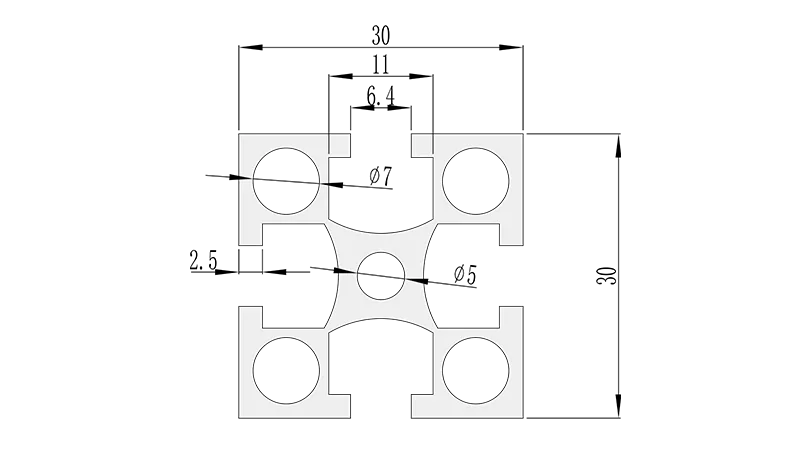
If you're not familiar with aluminum extrusion profiles, think of them as the building blocks of modern manufacturing. Extrusion is a process where aluminum is heated and pushed through a die (a mold) to create long, uniform shapes with specific cross-sections. This allows manufacturers to design profiles with precise dimensions, strength, and functionality—all while keeping costs low and production efficient. The 3030 National Standard Profile A is one such shape, defined by its dimensions: 30mm in width and 30mm in height, with a standardized cross-section that meets national industry guidelines.
What makes this profile stand out? For starters, its design is optimized for versatility. The "3030" refers to its square-like shape (30x30mm), which provides balanced strength in all directions. Unlike irregularly shaped materials, this symmetry makes it easy to connect, stack, or mount—perfect for building frames that need to be both sturdy and adaptable. The "National Standard" part is key too: it means every 3030 Profile A is manufactured to the same specifications, regardless of the supplier. This consistency is a game-changer for solar installers and manufacturers. Imagine ordering parts from different suppliers and having them fit together perfectly every time—that's the reliability national standards bring.
But the real magic is in the details of the extrusion itself. The 3030 Profile A isn't just a solid block of aluminum; its cross-section is engineered with precision. It typically features T-slots—long, narrow grooves running along its length—that allow for easy attachment of brackets, connectors, and other aluminum profile accessories. These slots eliminate the need for welding or drilling, which saves time during assembly and reduces the risk of weakening the material. For solar frames, this means faster production, easier customization, and lower labor costs—all of which translate to more affordable solar energy for homeowners and businesses.
Why 3030 Profile A Stands Out for Solar Frames
Now that we know what the 3030 National Standard Profile A is, let's explore why it's become the go-to choice for solar panel frames. It all comes down to four key advantages: strength, lightweight design, corrosion resistance, and compatibility with lean system principles in manufacturing.
First, strength. Aluminum might not seem as tough as steel, but when it's extruded into a profile like the 3030, its strength-to-weight ratio is exceptional. The profile's shape—with internal ribs and thickened walls in critical areas—distributes weight evenly, allowing it to support heavy solar panels (which can weigh 30-50 pounds each) without bending. In lab tests, 3030 Profile A frames have withstood wind speeds of up to 140 mph and snow loads of 50 pounds per square foot—well above the requirements for most residential and commercial installations. For solar farms in hurricane-prone regions or snowy climates, this durability is non-negotiable.
Second, lightweight design. Aluminum is about one-third the weight of steel, which makes a huge difference during installation. A crew installing rooftop solar panels can handle aluminum frames more easily, reducing the risk of injury and cutting down on installation time. For large-scale solar farms, where hundreds or thousands of panels are installed, the weight savings add up fast—lower shipping costs, fewer workers needed, and less strain on mounting systems (like roof rafters or ground anchors). This not only makes solar more affordable but also opens up new possibilities, like installing panels on older roofs that might not support the weight of steel frames.
Third, corrosion resistance. Aluminum naturally forms a thin layer of oxide on its surface, which protects it from rust and corrosion. Unlike steel, which needs to be painted or coated to survive outdoors, aluminum profiles like the 3030 can withstand rain, salt spray (in coastal areas), and humidity without degradation. This is a huge advantage for solar panels, which spend their entire lives exposed to the elements. A 3030 Profile A frame won't rust through after a decade; it'll still be strong and secure when the solar panel reaches the end of its lifespan. In fact, many aluminum frames are recyclable, aligning perfectly with solar energy's sustainability goals.
Fourth, compatibility with lean system manufacturing. Lean system principles focus on minimizing waste, streamlining processes, and maximizing efficiency—and the 3030 Profile A is a lean manufacturer's dream. Because it's a standardized extrusion, it can be produced in bulk with minimal waste. The T-slots mean frames can be assembled with simple aluminum profile accessories (like brackets and screws) instead of custom-made parts, reducing inventory costs. And since the profile is lightweight and easy to cut to length, manufacturers can quickly adjust production to meet demand—whether they're building frames for small residential panels or large commercial ones. This lean approach lowers costs across the supply chain, making solar energy more accessible to everyone.
Aluminum Profile Accessories: The Perfect Partners to 3030 Profile A
A great frame is only as good as the parts that hold it together, and that's where aluminum profile accessories come in. The 3030 National Standard Profile A is designed to work seamlessly with a range of connectors, brackets, end caps, and fasteners—all engineered to make assembly faster, stronger, and more flexible. Let's take a closer look at some of the most essential accessories and how they enhance the 3030 Profile A's performance in solar frames.
First, T-slot nuts and bolts. These small but mighty accessories are the backbone of the T-slot system. The nuts slide into the grooves of the 3030 Profile A, and when a bolt is tightened, they lock into place—no drilling or welding required. This makes it easy to attach crossbars, mounting brackets, or even additional profiles to create a custom frame shape. For solar panels, which come in various sizes (from 60-cell residential panels to 72-cell commercial ones), this flexibility is key. Installers can adjust the frame's width or height on-site using just a few tools, ensuring a perfect fit every time.
Next, corner brackets. Solar frames are typically rectangular, so connecting the 3030 Profile A at 90-degree angles is a common task. Corner brackets—small L-shaped pieces of aluminum or steel—fit into the T-slots and reinforce the joint between two profiles. They distribute stress evenly, preventing the corners from weakening over time. Some brackets even have built-in swivel joints, allowing for slight angle adjustments (useful for panels mounted on sloped roofs).
End caps are another unsung accessory. These plastic or aluminum caps snap onto the ends of the 3030 Profile A, covering the T-slots and creating a clean, finished look. But their purpose isn't just aesthetic: they also prevent water, dirt, and insects from getting inside the profile, which could cause corrosion or block the T-slots. In coastal areas, where saltwater spray is a concern, end caps add an extra layer of protection for the frame's interior.
Finally, mounting rails. While the 3030 Profile A forms the outer frame of the solar panel, mounting rails attach the frame to the roof or ground. These rails are often made from the same 3030 Profile A (or a similar extrusion), ensuring compatibility with the frame's accessories. Brackets connect the frame to the rails, and adjustable clamps allow installers to fine-tune the panel's angle for maximum sunlight.
The beauty of these accessories is that they're standardized, just like the 3030 Profile A itself. A manufacturer in California can order brackets from a supplier in Texas and know they'll fit perfectly with the profiles they're using. This standardization reduces lead times, lowers costs, and makes it easier for small businesses or even DIY enthusiasts to build their own solar frames—a game-changer for making solar energy more accessible.
From Raw Aluminum to Finished Frame: How 3030 Profile A Is Made
To truly appreciate the 3030 National Standard Profile A, it helps to understand how it's manufactured. The process, called aluminum extrusion, is both an art and a science, combining heat, pressure, and precision engineering to turn raw aluminum into a highly functional building block.
It all starts with aluminum billets—large cylindrical blocks of aluminum alloy. These billets are heated to around 800-900°F (427-482°C), a temperature where the aluminum becomes soft enough to shape but not molten. The choice of alloy is crucial: most 3030 Profile A frames use 6063 aluminum, a blend known for its excellent extrudability, strength, and corrosion resistance. This alloy is often called "architectural aluminum" because it balances form and function so well.
Once heated, the billet is loaded into an extrusion press, where a hydraulic ram pushes it through a die. The die is a steel mold with a cross-section that matches the desired shape of the profile—in this case, the 3030 National Standard Profile A. As the aluminum is forced through the die, it takes on the die's shape, emerging as a long, continuous length of profile. Imagine squeezing toothpaste through a tube with a star-shaped opening—the toothpaste comes out as a star; similarly, the aluminum comes out as the 3030 Profile A.
After extrusion, the profile is cooled rapidly with water or air to lock in its shape. Then, it's stretched to straighten it—extrusion can sometimes cause slight bends, and stretching ensures the profile meets the strict straightness tolerances of the national standard. Finally, the profile undergoes a surface treatment. Most 3030 Profile A frames are anodized, a process where the aluminum is submerged in an electrolyte bath and an electric current is applied. This creates a thicker, harder oxide layer on the surface, enhancing corrosion resistance and giving the profile a smooth, uniform finish (often silver or black, though custom colors are possible).
The result? A profile that's consistent in size, strength, and quality. Every foot of 3030 Profile A has the same wall thickness, the same T-slot dimensions, and the same structural properties. This consistency is why manufacturers and installers trust it—they know exactly what they're getting, every time. And because extrusion is a high-volume process, the 3030 Profile A can be produced at scale, keeping costs low even as demand for solar frames grows.
3030 Profile A vs. the Competition: Why Aluminum Extrusion Wins
To really understand the value of the 3030 National Standard Profile A, let's compare it to other materials still used in solar frames. We've touched on steel, wood, and plastic, but let's dig deeper into how they stack up.
Steel frames are strong, there's no denying that. But as mentioned earlier, they're heavy—about three times heavier than aluminum for the same strength. This makes them harder to transport and install, especially on rooftops where weight is a concern. Steel also rusts, which means it needs regular maintenance (like painting) to last. In a 30-year solar panel lifespan, that's a lot of repainting—and a lot of added cost.
Wood frames are lightweight and cheap upfront, but they're a nightmare for long-term durability. Wood warps when it gets wet, rots when exposed to moisture, and can be eaten by termites or other pests. Even pressure-treated wood, which resists rot, will eventually degrade in harsh weather. A wood frame might last 10-15 years, but that's half the lifespan of the solar panel itself—meaning homeowners would need to replace the frame mid-panel life, adding unexpected costs.
Plastic frames, often made from PVC, are lightweight and corrosion-resistant, but they lack strength. PVC softens in high heat (which is a problem for solar panels, which absorb sunlight and can get hot) and becomes brittle in cold temperatures. A plastic frame might crack in a harsh winter or warp in a summer heatwave, leaving the panel vulnerable.
Aluminum extrusion profiles like the 3030 Profile A solve all these problems. They're as strong as steel but a third the weight. They resist corrosion without maintenance, like plastic, but don't warp or crack in extreme temperatures. And while aluminum is more expensive than wood or plastic upfront, its 30+ year lifespan means lower long-term costs. When you factor in reduced installation labor, lower shipping costs, and minimal maintenance, aluminum frames often end up being the most cost-effective choice over the panel's lifetime.
Another advantage? Aluminum is 100% recyclable. When a solar panel reaches the end of its life, the 3030 Profile A frame can be melted down and reused to make new profiles, with no loss in quality. This aligns perfectly with the sustainability goals of solar energy—after all, what's the point of clean energy if the equipment used to harness it ends up in a landfill? Steel is recyclable too, but the energy required to recycle it is higher than for aluminum, making aluminum the greener choice.
Real-World Impact: 3030 Profile A in Action
Enough theory—let's look at how the 3030 National Standard Profile A is making a difference in real solar projects. From small residential installations to large commercial farms, this profile is proving its worth every day.
Take the case of GreenWave Solar, a small installer based in Colorado. A few years ago, they were struggling with high installation costs, partly due to using steel frames. Their crews were spending extra time lifting heavy frames onto roofs, and they were fielding complaints from homeowners about rust spots appearing on frames after just a few winters. Then, they switched to 3030 Profile A frames. "The difference was night and day," says Sarah Lopez, GreenWave's operations manager. "Our install times dropped by 20% because the frames are lighter. We haven't had a single rust complaint in three years, and homeowners love that the frames are slimmer and less noticeable on their roofs." GreenWave was even able to lower their prices by 10%, making solar accessible to more families in the area.
On a larger scale, consider the SolarHorizon Farm in Arizona, a 50-megawatt solar farm with over 150,000 panels. When the farm was built in 2020, the developers chose 3030 Profile A frames for their durability in the desert heat. "Temperatures here can hit 120°F in the summer, and the sun is brutal," explains project engineer Mark Chen. "We needed frames that wouldn't warp or degrade, and that could handle the occasional dust storm. The 3030 Profile A has held up perfectly. We did an inspection last year, and the frames look as good as the day they were installed." The farm's energy output has stayed consistent, exceeding projections by 3%—a small margin that adds up to millions of extra kilowatt-hours over the farm's lifetime.
Even DIY enthusiasts are getting in on the action. John Miller, a homeowner in Oregon, built his own solar array using 3030 Profile A frames he ordered online. "I'm handy, but I'm not a professional installer," he says. "The standardized profiles and accessories made it easy. I could watch YouTube tutorials, order the brackets and bolts from the same supplier as the profiles, and everything fit together like a puzzle. My system has been up for two years, and it's withstood snow, rain, and even a windstorm. I saved thousands by doing it myself, and a big part of that was thanks to how user-friendly the 3030 Profile A is."
Looking Ahead: The Future of 3030 Profile A in Solar Energy
As solar energy continues to grow—globally, solar capacity is expected to triple by 2030—the demand for efficient, durable frames will only increase. And the 3030 National Standard Profile A is poised to play a central role in meeting that demand. Here are a few trends that will shape its future:
First, larger solar panels. To increase efficiency, manufacturers are making bigger panels—some now measure over 6 feet tall and 3 feet wide. These larger panels need stronger frames, and the 3030 Profile A is up to the task. Its standardized design makes it easy to scale up frame sizes by adding crossbars or using thicker-walled versions of the profile.
Second, smarter mounting systems. Solar panels are increasingly being integrated with smart home technology, allowing homeowners to adjust angles remotely or monitor performance in real time. The T-slots in the 3030 Profile A make it easy to attach sensors, motors, or other smart devices directly to the frame, turning a simple panel into a connected part of the home's energy system.
Third, sustainability. As the world focuses more on circular economies, the recyclability of aluminum will become even more important. Manufacturers are already exploring ways to use recycled aluminum in 3030 Profile A production, reducing the carbon footprint of frame manufacturing. Some are even developing profiles with built-in recycled content labels, letting consumers know exactly how "green" their solar setup is.
Finally, customization. While standardization is key to the 3030 Profile A's success, there's also growing demand for custom frame designs. For example, some homeowners want low-profile frames that blend into their rooflines, while others need frames that can withstand extreme conditions (like the high winds of a coastal hurricane). Extrusion dies can be modified to create variations of the 3030 Profile A—with thicker walls, unique slot configurations, or custom colors—without losing the benefits of standardization. This flexibility will keep the profile relevant as solar technology evolves.
Conclusion: The Backbone of a Sustainable Future
Solar energy is more than just a trend—it's a critical step toward a sustainable future. And while we often focus on the latest breakthroughs in solar cell technology, it's important to remember the components that make these breakthroughs possible. The 3030 National Standard Profile A might not be the most glamorous part of a solar panel, but it's the backbone that holds everything together. Its strength, lightweight design, corrosion resistance, and compatibility with aluminum profile accessories make solar energy more efficient, durable, and accessible. Whether you're a homeowner installing panels on your roof, a farmer powering a barn with solar, or a utility company building a massive solar farm, this aluminum extrusion profile is working behind the scenes to make clean energy a reality. As we look to a future powered by the sun, the 3030 Profile A will undoubtedly continue to play a starring role—quietly, reliably, and (indispensably).