- Company Articles
- Industry articles
- Industry standards
- 3030 National Standard Profile A in Semiconductor Manufacturing: Cleanroom Compatibility

3030 National Standard Profile A in Semiconductor Manufacturing: Cleanroom Compatibility
Related Product
3030 National Standard Profile A
Workbench, production line, logistic rack, warehouse rack Industry: Manufacturer workshop, Automobile, Electronic, Assembling, logistic
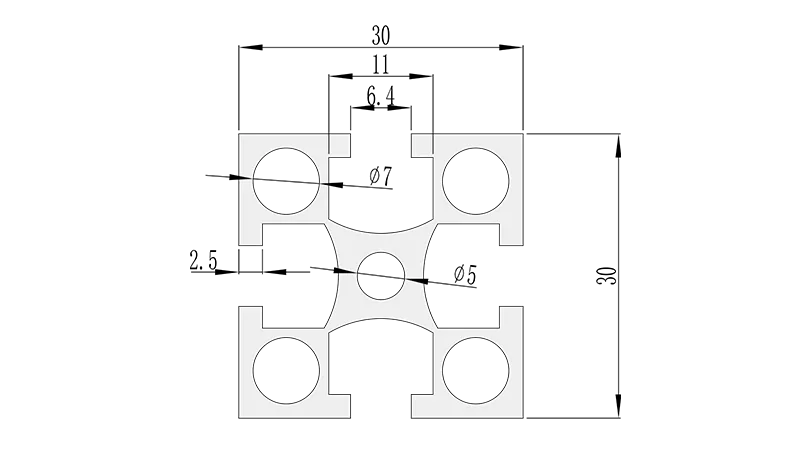
Step into a semiconductor fabrication plant, and you'll immediately sense the intensity of precision. Every surface gleams, every airflow is controlled, and every tool seems to hum with the weight of million-dollar expectations. In this world, where a particle smaller than a virus can derail production, even the structures holding equipment matter. That's where the 3030 National Standard Profile A comes in—a quiet champion of cleanroom design. Let's explore why this unassuming aluminum extrusion profile has become indispensable in semiconductor manufacturing, and how its unique traits make it a perfect fit for the most demanding cleanroom environments.
The Semiconductor Cleanroom: Where Perfection Is Non-Negotiable
To appreciate the 3030 Profile A's role, we first need to understand the environment it operates in. Semiconductor cleanrooms aren't just "clean"—they're meticulously controlled ecosystems. These facilities produce microchips with features as tiny as 2-3 nanometers, a scale where human hair (about 50,000 nanometers thick) looks like a mountain range. To work at this level, even the air quality is obsessively managed.
ISO 14644-1, the global cleanroom classification standard, ranges from ISO 1 (ultraclean) to ISO 9 (ambient air). Most semiconductor fabs operate at ISO 5 or better, meaning fewer than 3,520 particles (0.5 microns or larger) per cubic meter. For context, a typical bedroom has around 10 million particles per cubic meter. Add electrostatic discharge (ESD) risks—even a small spark can destroy delicate circuits—and you've got an environment that tolerates no shortcuts in material selection.
Traditional materials fall short here. Steel rusts and sheds particles; plastic warps under temperature shifts; wood introduces contaminants. What's needed is a material that's strong, stable, easy to sanitize, and ESD-friendly. Enter aluminum extrusion profile—a material that checks all these boxes. And among aluminum profiles, the 3030 National Standard Profile A stands out as a versatile solution.
Unpacking the 3030 National Standard Profile A: What Makes It Tick?
At its core, the 3030 National Standard Profile A is a square aluminum extrusion, measuring 30mm by 30mm. The "National Standard" label ensures consistent dimensions and quality across manufacturers, while "Profile A" denotes its specific T-slot design—those distinctive grooves running along its length that allow accessories to attach without welding. But its real magic lies in how these features align with cleanroom needs.
Aluminum extrusion itself is a manufacturing marvel. Heated aluminum is forced through a die to create uniform cross-sections, resulting in a material with exceptional strength-to-weight ratio, smooth surfaces, and minimal internal stress. Unlike steel, aluminum resists corrosion, won't rust, and is naturally non-magnetic—critical for avoiding interference with sensitive testing equipment. When anodized (a process that grows a protective oxide layer), it becomes even more durable and resistant to scratches.
1. Size and Strength: The Goldilocks Advantage
At 30mm x 30mm, the 3030 Profile A hits a sweet spot. It's compact enough to fit in tight cleanroom layouts—where space is often at a premium—yet robust enough to support heavy loads. A typical 3030 profile with 1.5mm wall thickness can handle static loads of 100-150 kg per linear meter, more than enough for workbenches, material racks, or equipment stands. This balance makes it more versatile than smaller profiles (like 20x20) that lack strength, or larger ones (like 40x40) that waste space.
2. Surface Quality: A Contamination-Fighting Design
Cleanrooms dread crevices, pores, or rough surfaces—they trap dust and bacteria. The 3030 Profile A's extruded construction eliminates these risks. Its smooth, seamless surface has no cracks or edges to harbor particles, and anodization adds a hard, non-porous layer that's easy to wipe down with disinfectants. Unlike painted steel, anodized aluminum won't chip or flake, ensuring long-term contamination control.
3. ESD Compatibility: Protecting the Unseen
Static electricity is a silent killer in semiconductors. A single ESD event can damage microscopic circuits, rendering chips useless. Aluminum's conductive properties help here: when properly grounded, 3030 profiles safely dissipate static charges. Anodized versions can be treated with conductive coatings to achieve surface resistance in the ESD-safe range (10^6-10^9 ohms), preventing charge buildup. This makes the profile ideal for workstations handling sensitive wafers or components.
How Does 3030 Compare to Other Profiles? A Practical Breakdown
Aluminum profiles come in all sizes, from tiny 20x20 to heavy-duty 40x40. Why does the 3030 Profile A stand out for cleanrooms? Let's compare:
| Profile Type | Dimensions (mm) | Load Capacity (kg/m) | Cleanroom Space Efficiency | Typical Applications |
|---|---|---|---|---|
| 2020 National Standard | 20x20 | 50-80 | High (very compact) | Light shelving, small tool holders |
| 3030 National Standard Profile A | 30x30 | 100-150 | Excellent (ideal balance) | Workbenches, material racks, mid-weight structures |
| 4040 EU Standard | 40x40 | 200-300 | Moderate (bulkier) | Heavy equipment stands, large storage |
The 3030 Profile A's advantage is clear: it offers enough strength for most cleanroom tasks without wasting space. For example, a 3030-based workbench can support a 50kg testing machine while fitting in a 1.2m x 0.8m footprint—critical in fabs where every square meter is optimized for workflow.
Aluminum Profile Accessories: Completing the Cleanroom Puzzle
A profile is only as good as the accessories that bring it to life, and the 3030 Profile A benefits from a robust ecosystem of aluminum profile accessories designed for cleanrooms. These add-ons enhance functionality while maintaining contamination control.
Modular connectors are a standout feature. Instead of welding (which creates fumes and uneven surfaces), 3030 profiles use T-slot connectors that slide into grooves and tighten with bolts. This allows tool-free assembly and reconfiguration—perfect for adapting to changing production needs. These connectors, made from anodized aluminum or ESD-safe plastic, avoid introducing contamination or static risks.
End caps are another essential accessory. They seal the profile's open ends, preventing dust buildup inside. For workbenches, ESD-safe mats, adjustable shelves, and tool hooks transform a basic frame into a customized workstation. Even casters—for mobile trolleys—are cleanroom-specific: non-marking, ESD-compliant wheels that don't shed particles and lock securely during use.
Lean System Integration: Making Cleanrooms Work Smarter
Semiconductor fabs thrive on lean system principles—eliminating waste, streamlining workflows, and maximizing value. The 3030 Profile A aligns perfectly with this mindset, thanks to its modularity and adaptability.
Lean systems demand flexibility. Production lines evolve, new tools are added, and workflows get optimized. Rigid infrastructure slows this down, but 3030 profiles are inherently modular. Need to reconfigure a workbench for a new chip design? Loosen a few bolts, adjust the frame, and you're ready. Want to relocate a material rack? Disassemble it and rebuild elsewhere—no cutting or welding required.
This flexibility reduces waste in multiple ways: shorter lead times for reconfigurations, less scrap from discarded fixed structures, and easier adaptation to 5S principles (Sort, Set in Order, Shine, Standardize, Sustain). For example, a 3030-based material rack can be adjusted to hold different wafer pod sizes, ensuring tools and materials stay organized and accessible—key to minimizing motion waste.
Real-World Applications: 3030 Profile A in Action
Let's look at how the 3030 Profile A is used daily in semiconductor fabs:
Workbenches: The Technician's Command Center
Cleanroom workbenches built with 3030 profiles are where magic happens. These aren't just tables—they're customized hubs with ESD mats, integrated lighting, and tool storage. The 3030 frame supports heavy microscopes or metrology tools, while adjustable legs ensure precise height alignment for technicians. Modular accessories like sliding drawers or wafer pod holders keep essentials within arm's reach, reducing unnecessary movement.
Material Racks: Organizing the Supply Chain
Semiconductor production relies on a steady flow of wafers, masks, and tools. 3030-based material racks (like the "material rack b (3 row and 3 floor)" from industry catalogs) keep these supplies organized. Adjustable shelves accommodate different container sizes, from 300mm wafer FOUPs to small toolboxes. Smooth surfaces and sealed ends prevent particle buildup, while ESD-safe components protect sensitive materials.
Mobile Trolleys: Moving Materials Safely
Transporting materials between stations without contamination is a challenge. 3030-framed trolleys with ESD casters solve this. They're lightweight enough to maneuver in tight spaces but strong enough to carry heavy loads. Some feature roller tracks (another cleanroom staple) to let wafer pods slide smoothly onto shelves, reducing handling risk.
Compliance: Meeting the Strictest Standards
In semiconductors, compliance isn't optional. The 3030 Profile A meets key standards to ensure it's cleanroom-ready:
ESD Protection: Anodized surfaces can be treated to meet ANSI/ESD S20.20, ensuring static charges dissipate safely.
Contamination Control: Smooth, anodized surfaces resist particle shedding and are easy to decontaminate, meeting ISO 14644-1 for cleanroom materials.
Material Safety: Aluminum extrusion profile is non-toxic, doesn't outgas VOCs, and meets USP Class VI standards for medical-grade materials—overkill for semiconductors, but reassuring.
The Road Ahead: 3030 Profile A in Next-Gen Fabs
As semiconductors shrink further (1nm nodes are on the horizon), cleanroom demands will only grow. The 3030 Profile A is poised to evolve alongside these needs. Future iterations may integrate smart features like embedded sensors for real-time monitoring of temperature, humidity, or vibration. Lighter aluminum alloys could reduce weight while maintaining strength, boosting sustainability. And as automation (AGVs, robots) becomes more prevalent, 3030's precision mounting points will simplify integration with robotic systems.
Why the 3030 National Standard Profile A Is Indispensable
In the high-stakes world of semiconductor manufacturing, the 3030 National Standard Profile A is more than a building material—it's a partner in precision. Its unique blend of size, strength, cleanroom compatibility, and modularity makes it ideal for the industry's toughest challenges. Whether supporting a workbench where the next microchip is born or organizing materials in a lean workflow, it quietly ensures that semiconductor fabs can focus on what they do best: pushing the boundaries of technology.
So the next time you marvel at a smartphone or laptop, remember: behind that cutting-edge tech is a network of unsung heroes—like the 3030 Profile A—working tirelessly to make it all possible.