- Company Articles
- Industry articles
- Industry standards
- 3030 National Standard Profile A in Telecommunications Equipment: Structural Support

3030 National Standard Profile A in Telecommunications Equipment: Structural Support
Related Product
3030 National Standard Profile A
Workbench, production line, logistic rack, warehouse rack Industry: Manufacturer workshop, Automobile, Electronic, Assembling, logistic
In the world of telecommunications, where network reliability can mean the difference between seamless connectivity and costly downtime, there's a silent workhorse that keeps everything upright, organized, and operating at peak efficiency. It's not the latest 5G chip or cutting-edge router—though those are important. It's the structural framework that holds these technologies together. Today, we're shining a light on a component that's quietly become indispensable in this space: the 3030 National Standard Profile A . This unassuming aluminum extrusion profile might not make it into tech headlines, but its role in providing robust, flexible support for telecommunications equipment is nothing short of transformative. Let's dive into why this profile has become a go-to choice for engineers, technicians, and facility managers alike.
The Hidden Challenges of Telecommunications Equipment Support
Before we get into the specifics of the 3030 Profile A, let's take a step back and understand the unique demands placed on structural support systems in telecommunications. It's easy to focus on the flashy equipment—the servers, antennas, and transmitters—but the structures holding them face a laundry list of challenges:
Weight vs. Mobility: Telecommunications gear isn't light. A single server can weigh 30-50 kg, and a full rack might hold a dozen or more. Yet, data centers and network hubs constantly need to reconfigure layouts as they scale, add new equipment, or upgrade old systems. Heavy steel racks or fixed wooden frames make this process a logistical nightmare, often requiring cranes or multiple technicians to move even small sections.
Environmental Resilience: Telecom equipment lives in diverse environments. Indoor data centers are climate-controlled but dense with heat-generating gear, while outdoor setups—think cell towers or remote network nodes—brave rain, wind, UV radiation, and temperature swings. The support structures here need to resist corrosion, withstand vibrations, and maintain stability without warping or weakening over time.
Adaptability: The telecom industry moves fast. 5G rollouts, edge computing, and IoT expansion mean equipment needs change quarterly, not annually. A rigid support system that works today might be obsolete in six months. Technicians need structures that can evolve—adding shelves, adjusting heights, or reconfiguring layouts—without requiring a complete overhaul.
Safety: Last but never least, safety is paramount. Whether it's a technician climbing a tower to service an antenna or a data center worker accessing a server, the structures must be stable, slip-resistant, and free of sharp edges. Even small failures here can lead to injuries or equipment damage.
For years, the industry relied on a patchwork of solutions: steel for strength, wood for cost, and plastic for lightweight needs. But none checked all the boxes. Steel was strong but heavy and prone to rust. Wood was cheap but rotted and couldn't handle heavy loads. Plastic was light but flexed under pressure. Then came aluminum extrusion profiles—and among them, the 3030 National Standard Profile A emerged as a game-changer.
What Exactly Is the 3030 National Standard Profile A?
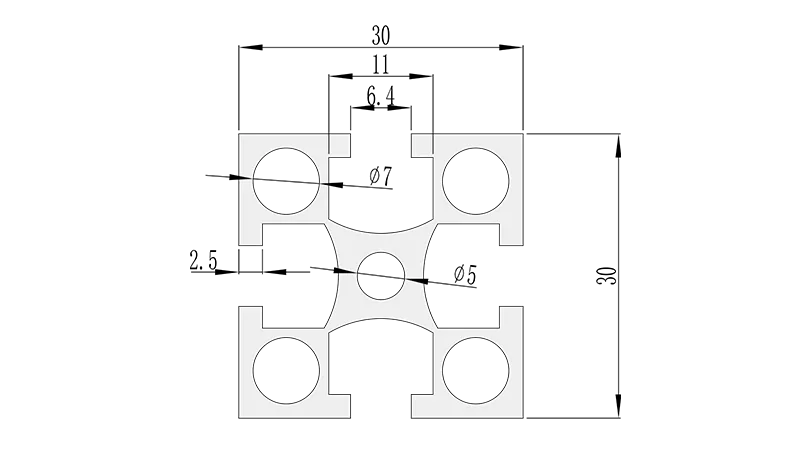
Let's start with the basics. The 3030 National Standard Profile A is a type of aluminum extrusion profile —a long, uniform shape created by forcing heated aluminum alloy through a precision die. The "3030" refers to its cross-sectional dimensions: 30mm in width and 30mm in height, making it compact enough for tight spaces but sturdy enough for heavy-duty tasks. The "National Standard" label is key here—it ensures consistency in manufacturing, so no matter which supplier you source it from, the dimensions, material quality, and performance will meet strict industry benchmarks. This standardization eliminates the guesswork for engineers and ensures compatibility across different projects.
But what really sets this profile apart is its design. Unlike a solid aluminum bar, the 3030 Profile A features a hollow core with reinforcing ribs, reducing weight without sacrificing strength. Even more importantly, it includes longitudinal T-slots—grooves running the length of the profile—that act as built-in attachment points. These slots are the secret to its versatility. With the right aluminum profile accessories —think brackets, nuts, bolts, and panels—you can attach, adjust, or reposition components in minutes, no welding or drilling required. It's like building with a high-tech erector set, but for grown-ups solving real-world engineering problems.
To put it simply: the 3030 Profile A isn't just a piece of metal. It's a modular building block. And in an industry where adaptability is king, that makes all the difference.
Why Aluminum? The Material Science Behind the Magic
You might be wondering: why aluminum? Why not stick with steel, which has been the gold standard for structural support for decades? The answer lies in aluminum's unique properties, which align perfectly with the needs of telecommunications:
Strength-to-Weight Ratio: Aluminum is about one-third the density of steel, meaning a 3030 Profile A frame weighs significantly less than a steel frame of the same size. Yet, thanks to its alloy composition and extrusion design, it still boasts impressive load-bearing capacity—often up to 200 kg per linear meter for vertical supports. This combination makes it easy to transport, install, and reconfigure, while still safely holding heavy equipment.
Corrosion Resistance: Aluminum naturally forms a thin oxide layer when exposed to air, acting as a built-in shield against rust and corrosion. For indoor data centers, this means less maintenance and longer lifespans. For outdoor setups, it's a lifesaver—no need for frequent painting or coating to protect against rain or humidity. In coastal areas, where salt spray accelerates corrosion, aluminum profiles outlast steel by years.
Thermal Conductivity: Telecommunications equipment generates heat—lots of it. Servers, routers, and transmitters can push ambient temperatures in data centers to 35°C or higher. Aluminum's high thermal conductivity helps dissipate this heat, acting as a passive cooling aid. When used in racks or enclosures, the 3030 Profile A can help channel heat away from sensitive components, reducing reliance on energy-intensive cooling systems.
Design Flexibility: Extrusion allows for intricate cross-sectional designs, like the T-slots and reinforcing ribs in the 3030 Profile A. Steel, by contrast, is often limited to simple shapes (I-beams, square tubes) unless you invest in expensive custom fabrication. Aluminum extrusion is cost-effective even for complex profiles, making it easy to tailor the 3030 Profile A to specific needs—whether that's extra T-slots for cable management or thicker walls for high-load areas.
3030 Profile A in Action: Real-World Applications in Telecom
Enough theory—let's look at how the 3030 National Standard Profile A is actually used in telecommunications. From data centers to field installations, its versatility shines in countless scenarios. Here are a few standout examples:
1. Server Racks and Data Center Frames
Walk into any modern data center, and you're likely looking at rows of racks built with aluminum extrusion profiles. The 3030 Profile A is a favorite here for several reasons. First, its lightweight nature makes it easy to assemble and reposition. A team of two technicians can build a full rack in under an hour, compared to half a day for a steel equivalent. The T-slots allow for quick attachment of shelves, cable management arms, and even cooling fans—no drilling or welding required. Need to adjust the height of a shelf to fit a taller server? Just loosen a few bolts, slide the bracket to the new position, and retighten. It's that simple.
One data center manager I spoke with put it this way: "We used to dread reconfiguring our steel racks. Moving a single rack required a forklift and three people, and we'd lose hours of uptime. With 3030 Profile A racks, two of us can reposition a full rack in 20 minutes. The T-slots let us add cable organizers on the fly, which cut down on wire tangles by 40%. And because they're corrosion-resistant, we don't have to worry about rust eating through the frames in our humid environment. It's been a game-changer for efficiency."
2. Outdoor Equipment Enclosures and Antenna Mounts
Outdoor telecommunications setups—like cell towers, remote network nodes, or satellite dishes—face some of the harshest conditions. The 3030 Profile A excels here thanks to its weather resistance. Unlike steel, which rusts when exposed to rain or salt air, aluminum's oxide layer keeps it protected for decades. This makes it ideal for building enclosures that house transmitters, batteries, or backup generators. The T-slots even allow for easy installation of solar panels or weather shields, turning a basic frame into a self-sustaining outdoor station.
Take antenna mounts, for example. These need to be strong enough to hold heavy antennas steady in high winds but lightweight enough to avoid overburdening the tower. The 3030 Profile A's strength-to-weight ratio makes it perfect for this. Engineers can design mounts that pivot or tilt (using aluminum profile accessories like hinges and adjustable brackets) to optimize signal strength, all while keeping the overall weight low. And because aluminum doesn't conduct electricity as well as steel, it reduces the risk of interference with sensitive radio equipment—a critical detail in telecommunications.
3. Workbenches and Repair Stations
It's not just about holding equipment—it's about supporting the people who maintain it. Telecom repair shops and testing facilities rely on workbenches that are sturdy, adaptable, and built to last. Enter the 3030 Profile A. By combining lengths of the profile with tabletops (often made of plywood or metal), technicians can build workbenches that are both strong and customizable. Need a shelf for tools? Add a crossbeam with brackets. Want to mount a power strip or testing equipment? Slide a T-slot nut into the profile and secure it in place. Even better, these workbenches are lightweight enough to move around the shop but stable enough to prevent accidental tipping when working on heavy gear.
A technician at a regional telecom provider summed it up: "Our old wooden workbenches were always wobbly, and the legs would rot after a few years near the shop's humidity. The 3030 Profile A bench we built is rock-solid. I can clamp a 40kg router to it and not worry about it moving. And when we need to add a new shelf for 5G testing gear? Five minutes with a hex key, and it's done. It's like having a workbench that grows with our needs."
The Role of Aluminum Profile Accessories: Making the 3030 Profile A Even More Versatile
The 3030 National Standard Profile A is impressive on its own, but its true power lies in the ecosystem of aluminum profile accessories that complement it. Think of the profile as the backbone; the accessories are the muscles, joints, and connective tissue that turn it into a fully functional system. Let's take a closer look at some of the most useful accessories in telecom applications:
- T-Slot Nuts and Bolts: These small but critical components slide into the T-slots of the 3030 Profile A, allowing you to attach almost anything—shelves, brackets, panels—without drilling holes. They're reusable, so you can reposition components as needed.
- Angle Brackets: Perfect for connecting two profiles at 90-degree angles (think the corners of a rack or workbench). They come in various sizes to match different profile widths, ensuring a snug, secure fit.
- Cable Management Channels: These U-shaped accessories clip into T-slots, keeping wires and cables organized and out of the way. In data centers, this reduces the risk of accidental disconnections and makes troubleshooting faster.
- Adjustable Feet: For uneven floors in data centers or outdoor installations, adjustable feet screw into the bottom of 3030 Profile A frames, ensuring stability and leveling.
- Hinges and Latches: Essential for enclosures or fold-down shelves. Aluminum hinges attached to 3030 profiles allow doors or panels to swing open smoothly, while latches keep them securely closed in harsh weather.
The beauty of these accessories is their compatibility. Because the 3030 Profile A follows national standards, accessories from different suppliers work together seamlessly. This means you're not locked into a single brand—you can mix and match to find the best solution for your needs.
| Support System Type | Weight (kg/m) | Load Capacity (kg/linear meter) | Corrosion Resistance | Reconfigurability | Best For |
|---|---|---|---|---|---|
| 3030 National Standard Profile A | 1.2-1.5 | 150-200 | Excellent (oxide layer protection) | High (T-slots + accessories) | Data centers, outdoor enclosures, workbenches |
| Steel Square Tubing (2mm wall) | 4.5-5.0 | 250-300 | Poor (requires painting/coating) | Low (welded joints) | Heavy static loads (rarely used in telecom today) |
| Wooden Frames (Pine) | 2.0-2.5 | 50-80 | Poor (prone to rot, warping) | Low (nails/screws damage wood) | Budget temporary setups (not recommended for telecom) |
| Plastic Extrusions | 0.8-1.0 | 30-50 | Good (resistant to moisture) | Medium (limited accessory options) | Light-duty shelving (not for heavy equipment) |
The Sustainability Edge: Why 3030 Profile A Is Greener Than You Think
In an era where sustainability is no longer optional, the 3030 National Standard Profile A offers another compelling advantage: it's eco-friendly. Aluminum is 100% recyclable, and recycling it requires just 5% of the energy needed to produce new aluminum. This means that when a telecom facility upgrades its racks or enclosures, the old 3030 profiles can be melted down and reused, reducing waste and carbon footprint.
But it's not just about end-of-life recycling. The modular nature of aluminum extrusion profiles also reduces waste during construction. With steel or wood, cutting a piece to the wrong length often means throwing it away. With 3030 Profile A, excess lengths can be repurposed into smaller components—like brackets or shelf supports—or stored for future projects. One lean system supplier I spoke with estimated that their clients reduce construction waste by 35% when using aluminum profiles instead of traditional materials.
There's also the energy savings from reduced transportation and installation. Because 3030 Profile A is lightweight, shipping costs are lower, and fewer trucks are needed to transport the same amount of material. On-site, less labor and equipment are required for assembly, further cutting down on carbon emissions. It's a win-win: better for the planet, and better for the bottom line.
Choosing the Right Supplier: What to Look For
Now that you're convinced of the 3030 Profile A's benefits, how do you ensure you're getting a quality product? Not all aluminum extrusion profiles are created equal, so it's important to partner with a reputable supplier. Here are a few key factors to consider:
National Standard Compliance: Make sure the supplier explicitly states that their 3030 Profile A meets national standards. This ensures consistent dimensions, material quality, and performance. Ask for certification or test reports if needed.
Accessory Availability: A good supplier should offer a wide range of aluminum profile accessories—T-slot nuts, brackets, hinges, etc.—to complement the 3030 Profile A. This saves you time and money by sourcing everything from one place.
Custom Cutting and Finishing: While standard lengths are available, many projects require custom-cut profiles. Look for suppliers that offer precision cutting, deburring (to remove sharp edges), and finishing options (like anodizing for extra corrosion resistance).
Technical Support: Even seasoned engineers can use a little help. The best suppliers offer technical support, including CAD drawings, load capacity charts, and design advice. This is especially valuable for complex projects like outdoor antenna mounts or custom data center racks.
The Future of Telecom Support: Where 3030 Profile A Is Headed
As telecommunications continues to evolve—with 5G expansion, edge computing, and the Internet of Things (IoT) driving demand for more distributed, flexible networks—the role of the 3030 National Standard Profile A will only grow. Here are a few trends to watch:
Smart Integration: Imagine a server rack built with 3030 Profile A that includes embedded sensors in its T-slots, monitoring temperature, vibration, or load in real time. Suppliers are already experimenting with "smart" aluminum profile accessories that can connect to network management systems, alerting technicians to potential issues before they cause downtime.
Advanced Alloys: Material science is constantly improving. New aluminum alloys are being developed that offer even higher strength-to-weight ratios or better thermal conductivity, making the 3030 Profile A suitable for even more demanding applications—like high-altitude antenna mounts or deep-sea network nodes.
Modular Outdoor Solutions: With edge computing pushing network equipment closer to end-users, we'll see more compact, prefab enclosures built with 3030 Profile A. These could include integrated solar panels, batteries, and 5G microcells—all supported by lightweight, weather-resistant aluminum frames.
Final Thoughts: Why 3030 Profile A Deserves Its Place in Telecom History
At the end of the day, the 3030 National Standard Profile A is more than just a piece of aluminum. It's a symbol of how thoughtful engineering can solve complex problems with simplicity. In telecommunications, where reliability, adaptability, and efficiency are non-negotiable, this profile delivers on all fronts. It's lightweight yet strong, rigid yet flexible, durable yet sustainable.
The next time you make a call, stream a video, or connect to Wi-Fi, take a moment to appreciate the structures that make it all possible. Chances are, somewhere in that network—whether in a data center, on a cell tower, or in a repair shop—the 3030 National Standard Profile A is hard at work, keeping the world connected. And that, in our book, makes it a true unsung hero of the telecom industry.