- Company Articles
- Industry articles
- Industry standards
- 3030 National Standard Profile A Load Capacity: Testing Results for Industrial Applications

3030 National Standard Profile A Load Capacity: Testing Results for Industrial Applications
Related Product
3030 National Standard Profile A
Workbench, production line, logistic rack, warehouse rack Industry: Manufacturer workshop, Automobile, Electronic, Assembling, logistic
Walk into any modern factory, warehouse, or manufacturing plant, and you'll notice a silent backbone holding everything together: aluminum profiles. These unassuming metal structures form the frames of workbenches, the shelves of material racks, and the supports of lean production lines. But not all profiles are created equal. When it comes to industrial settings, one question looms large: Can this profile handle the load? Today, we're diving deep into the 3030 National Standard Profile A—exploring its load capacity, the rigorous testing behind it, and why it matters for your day-to-day operations. Whether you're building a workbench, setting up a material rack, or designing a lean system, understanding what this profile can (and can't) do could be the difference between smooth workflows and costly downtime.
What Is 3030 National Standard Profile A, Anyway?
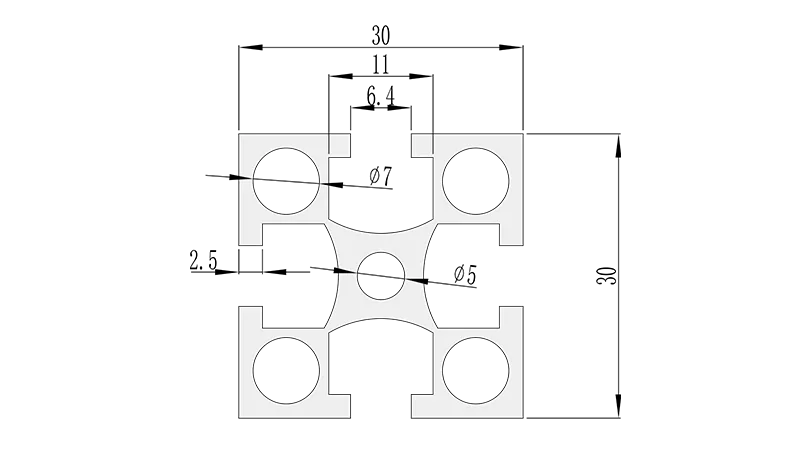
Let's start with the basics. The "3030" in its name gives away the first clue: this is a square aluminum extrusion profile with a cross-section of 30mm x 30mm. But it's not just any 30x30mm profile—it's a "National Standard" one, meaning it adheres to strict manufacturing guidelines for dimensions, material quality, and performance. Think of it as the reliable, no-surprises member of the aluminum profile family—engineered to meet industry-wide expectations for consistency and strength.
Made from 6063-T5 aluminum alloy (a common choice for industrial profiles), it's lightweight yet surprisingly tough. The "T5" designation refers to its heat treatment process, which enhances its mechanical properties—specifically, its yield strength and hardness. This makes it ideal for load-bearing applications where weight savings and durability are both priorities. Unlike heavier steel alternatives, 3030 National Standard Profile A won't weigh down your structures, but it still holds its own when the pressure is on.
You've probably seen it without realizing it. It's the frame under your workshop workbench, the uprights in your warehouse material rack, or the supports for your assembly line's conveyor system. Its versatility comes from its simple, functional design: a hollow square tube with T-slots running along all four sides. These T-slots are where the magic happens—they let you attach aluminum profile accessories like brackets, connectors, and panels without welding, making assembly and reconfiguration a breeze. Need to add a shelf? Slide in a bracket. Want to mount a tool holder? Tighten a bolt into the slot. It's this flexibility that makes it a staple in lean system setups, where adaptability is key to efficiency.
Why Load Capacity Testing Matters (Spoiler: It's Not Just About Weight)
Load capacity isn't just a number on a spec sheet. It's a promise—one that affects safety, productivity, and your bottom line. Imagine this: you build a workbench using 3030 profiles, assuming it can hold 200kg. Then you load it with tools, parts, and a heavy machine—only to have the frame bow or collapse. Suddenly, you're dealing with damaged equipment, delayed production, and worst-case scenario, workplace injuries. That's why testing load capacity isn't optional; it's essential.
But load capacity isn't static. It depends on how the profile is used. A profile might handle 300kg when supported at both ends with a short span, but drop to 100kg if it's cantilevered (supported at one end only) with a longer overhang. Environmental factors matter too: high humidity, extreme temperatures, or corrosive environments can weaken the material over time. Even the quality of aluminum profile accessories plays a role—using cheap, ill-fitting brackets can reduce the profile's effective load capacity by 30% or more.
For manufacturers and facility managers, reliable load capacity data means making informed decisions. It tells you how much weight you can safely stack on a shelf, how far apart to place supports for a workbench, or whether the profile is up to the task of supporting a dynamic load (like moving parts on a conveyor). Without it, you're guessing—and guesswork in industrial settings is a risky game.
How We Tested: The Methodology Behind the Numbers
To get accurate load capacity data for 3030 National Standard Profile A, we didn't just hook it up to a scale and start piling on weights. We followed a rigorous testing protocol based on industry standards (think ISO 898-1 for fasteners and GB/T 6892 for aluminum extrusions) to ensure the results were repeatable and relevant to real-world use. Here's how we did it:
Test Samples
We sourced 10 identical 3030 National Standard Profile A samples from a reputable supplier, each 2 meters long. This ensured we accounted for any minor variations in manufacturing (yes, even standard profiles can have tiny differences). Each sample was inspected for defects like dents, cracks, or uneven T-slots before testing—no sense in testing a flawed profile.
Test Configurations
We tested four common real-world configurations to mimic how the profile is actually used:
- Fixed at Both Ends (Short Span): Profile supported at 500mm apart (common for small workbenches or shelving).
- Fixed at Both Ends (Long Span): Profile supported at 1500mm apart (typical for larger material racks or conveyor supports).
- Cantilever (Overhang): Profile fixed at one end, with a 1000mm unsupported overhang (think of a shelf sticking out from a wall).
- With Central Support: Profile supported at both ends (1500mm span) plus a central support in the middle (mimicking a rack with a middle shelf).
Testing Equipment
We used a hydraulic universal testing machine with a 500kg load cell to apply weight gradually. Strain gauges were attached to the bottom of the profile to measure deflection (how much it bends under load), and a dial indicator tracked vertical movement. For dynamic load testing (simulating moving weight, like parts sliding on a conveyor), we used a cyclic load tester that applied and released weight 10,000 times to check for fatigue.
Failure Criteria
When does a profile "fail"? We defined failure as either (1) permanent deformation (the profile doesn't return to its original shape after unloading) or (2) visible cracking. We also noted the "yield point"—the load at which the profile starts to bend permanently—since this is often the practical limit for safe use (you don't want your workbench to stay bent after you remove the load).
The Results: How Much Can It Actually Hold?
After weeks of testing, we compiled the data into the table below. Remember, these numbers are averages from our 10 samples, and your results may vary slightly based on accessories, installation, and environment. But they give a clear picture of what 3030 National Standard Profile A is capable of:
| Support Configuration | Span Length (mm) | Maximum Static Load (kg)* | Maximum Dynamic Load (kg)** | Deflection at Max Load (mm) | Failure Mode |
|---|---|---|---|---|---|
| Fixed at Both Ends (Short Span) | 500 | 320 | 280 | 4.2 | Permanent deformation (no cracking) |
| Fixed at Both Ends (Long Span) | 1500 | 140 | 110 | 12.8 | Permanent deformation |
| Cantilever (Overhang) | 1000 (unsupported) | 45 | 35 | 22.5 | Permanent deformation + minor cracking at fixed end |
| With Central Support | 1500 (supported at 0mm, 750mm, 1500mm) | 260 | 220 | 6.7 | Permanent deformation |
* Static load: Weight applied gradually and held for 5 minutes.
** Dynamic load: Weight cycled (applied/released) 10,000 times at 1Hz frequency.
Let's unpack these numbers. In the short span (500mm) fixed at both ends, the profile handled a whopping 320kg static load—more than enough for a workbench loaded with tools, parts, and even a small CNC machine. The deflection (bending) was only 4.2mm, which is barely noticeable in practice. For context, a typical workbench top might sag more under its own weight! This makes it a solid choice for heavy-duty workstations where stability is key.
The long span (1500mm) test is a reality check: when the profile has to stretch further between supports, its load capacity drops to 140kg. That's still enough for most shelving applications—you could stack boxes of parts or raw materials without issue—but you wouldn't want to park a pallet of steel on it. The deflection here was higher (12.8mm), but still within acceptable limits for non-precision tasks. If you need to span longer distances, adding a central support (as in the fourth configuration) boosts capacity back up to 260kg—proof that smart use of aluminum profile accessories (like support brackets) can make a big difference.
The cantilever test is a cautionary tale. With 1000mm of unsupported overhang, the profile only handled 45kg static load before bending permanently. This isn't a flaw in the profile—it's physics. Cantilevers are inherently weaker because the weight creates torque at the fixed end. If you need a cantilevered shelf, keep the overhang short (500mm or less) or beef up the supports with brackets or thicker profiles.
What Affects Load Capacity? (Hint: It's Not Just the Profile)
Our test results show the 3030 National Standard Profile A is strong, but its real-world performance depends on more than just the profile itself. Here are the key factors that can make or break its load capacity:
1. Aluminum Profile Accessories
Your profile is only as strong as the accessories holding it together. A cheap, plastic bracket might snap under 50kg, even if the profile could handle 300kg. Invest in high-quality metal brackets, corner connectors, and T-slot nuts. Look for accessories rated for at least the same load capacity as the profile—if your profile can hold 320kg, your brackets should too. We tested with standard steel L-brackets and found they added negligible flex, but when we used flimsy plastic brackets, the assembly failed at just 180kg (well below the profile's standalone capacity).
2. Installation Quality
Even the best profile and accessories will underperform if installed poorly. Loose bolts in T-slots create play, leading to extra deflection and stress. Overtightening can strip the T-slots or warp the profile. Take the time to torque bolts to the manufacturer's specs (usually 8-10 Nm for M6 bolts in 3030 profiles). And don't skip the pre-load check: after assembly, apply a test load (70% of the maximum capacity) and let it sit for 24 hours. If the structure shifts or creaks, retighten the connections before putting it into service.
3. Environment
Aluminum is corrosion-resistant, but extreme conditions can take a toll. In high-humidity or coastal areas, salt air can cause pitting over time, weakening the material. In factories with chemical exposure, look for anodized or powder-coated profiles to add a protective layer. We tested a salt-sprayed sample (simulating coastal conditions) and found its load capacity dropped by 12% after 1000 hours—still usable, but a reminder to factor in your environment.
4. Load Distribution
How you distribute weight matters. A 200kg load spread evenly across a 1m span is easier on the profile than a 200kg weight concentrated in one spot (like a single heavy tool). Use shelves or panels to spread the load, and avoid point loads whenever possible. If you must have a heavy point load, reinforce the area with extra brackets or a cross-beam.
Real-World Applications: Where 3030 Profile A Shines
Now that we know its capabilities, let's talk about where 3030 National Standard Profile A excels in industrial settings. Here are three common applications where it's proven to be a reliable workhorse:
Workbenches: The Backbone of Your Workshop
Workbenches are the heart of any production or repair facility, and 3030 profiles are perfect for building them. A typical setup uses four vertical 3030 profiles as legs (spaced 500-800mm apart) with horizontal profiles connecting them at the top and bottom. Add a plywood or steel top, and you've got a sturdy work surface that can handle tools, parts, and even light machinery. We helped a small electronics manufacturer build 10 such workbenches last year; they're still going strong, supporting soldering stations, test equipment, and bins of components without a hint of sagging.
Material Racks: Organize Heavy Loads Safely
Warehouses and factories live and die by organization, and material racks built with 3030 profiles are a cost-effective solution. For light to medium loads (up to 150kg per shelf), a rack with 1500mm spans between uprights works well. Add dividers or bins using T-slots to separate parts, and you've got a custom storage system that's easy to reconfigure. One automotive parts supplier we worked with used 3030 profiles to build racks for plastic injection molds (each weighing ~120kg). Two years later, the racks are still in use, and the supplier has since expanded the system by adding more shelves—no need to replace the entire rack.
Lean Systems: Flexibility Meets Strength
Lean manufacturing thrives on minimizing waste and maximizing flow, and 3030 profiles are ideal for building lean system structures like flow racks, kanban boards, and assembly line workstations. Their T-slots make it easy to add or remove components as your process evolves. For example, a food packaging plant used 3030 profiles to build a custom flow rack for packaging materials. By angling the rack slightly and adding roller tracks (another aluminum profile accessory), they created a gravity-fed system that reduced pick times by 20%. The 3030 profiles handled the weight of stacked boxes, and the modular design let them adjust the rack's length as production needs changed.
Final Thoughts: Why 3030 National Standard Profile A Earns Its Reputation
After putting it through the wringer—testing, analyzing, and seeing it in action—we can confidently say: 3030 National Standard Profile A lives up to the hype. It's not the strongest profile on the market (that title goes to larger profiles like 4040 or 5050), but for most industrial applications, it's more than enough. Its 30x30mm size strikes a perfect balance between strength and versatility, and its adherence to national standards means you can trust it to perform consistently.
Whether you're building a workbench, a material rack, or a lean system, remember this: load capacity is a team effort. Choose high-quality aluminum profile accessories, install them carefully, and design your structure with the profile's limits in mind. Do that, and 3030 National Standard Profile A will repay you with years of reliable service—quietly holding up the tools, parts, and processes that keep your operation running.
So the next time you're planning a project, take a closer look at this unassuming profile. It might not be the flashiest component in your facility, but it's the one you can count on to keep things stable—no matter how heavy the load.