- Company Articles
- Industry articles
- Industry standards
- 3030 National Standard Profile A Load Distribution: Ensuring Even Weight Support

3030 National Standard Profile A Load Distribution: Ensuring Even Weight Support
Related Product
3030 National Standard Profile A
Workbench, production line, logistic rack, warehouse rack Industry: Manufacturer workshop, Automobile, Electronic, Assembling, logistic
Walk into any modern factory, workshop, or lab, and you'll notice a common thread tying everything together: structures that work with the weight they bear, not against it. A workbench holding heavy machinery without so much as a creak. A material rack stacked with parts that stays steady, even when employees rush to grab items. A conveyor system gliding smoothly under the weight of products. These aren't accidents—they're the result of intentional design, and at the heart of it all often lies one unsung hero: the 3030 National Standard Profile A . This unassuming aluminum extrusion, with its 30mm x 30mm frame, is a masterclass in balancing strength, flexibility, and smart load distribution. But why does even weight support matter so much? Let's start with a scenario we've all seen (or experienced): a rickety workbench where tools slide to one side, or a shelf that sags in the middle, threatening to spill its contents. These aren't just nuisances—they slow down work, increase the risk of accidents, and shorten the lifespan of equipment. In industrial settings, where every minute and every dollar counts, uneven load support isn't just inefficient; it's costly. That's where the 3030 National Standard Profile A shines. In this article, we'll unpack how this profile distributes weight evenly, the role of its aluminum profile accessories , and why it's become a staple for anyone who values stability in their workspace.
What Is 3030 National Standard Profile A, Anyway?
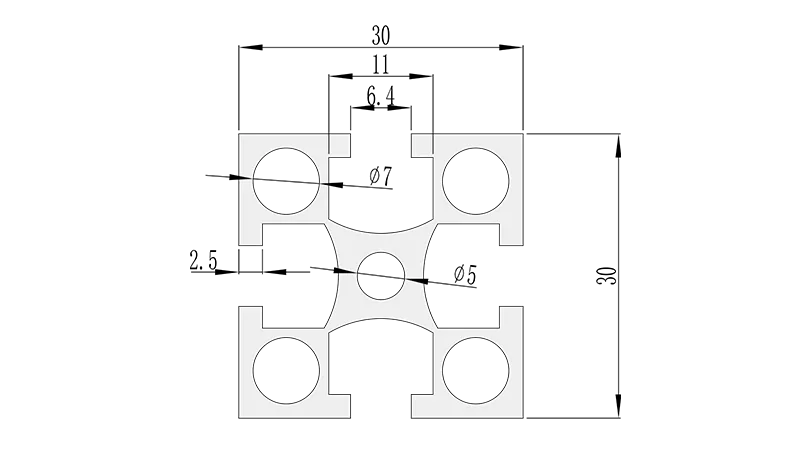
Before we dive into load distribution, let's get to know the star of the show: the 3030 National Standard Profile A. At first glance, it looks like a simple square tube—but that simplicity is deceptive. This profile is a product of precision engineering, born from aluminum alloy (typically 6063-T5, a material prized for its strength, corrosion resistance, and lightweight properties). The "3030" refers to its cross-section: 30 millimeters wide, 30 millimeters tall. But what really sets it apart is how it's made. Through a process called extrusion, molten aluminum is forced through a die, creating a consistent, hollow structure with T-slots running along each of its four sides. These T-slots are the profile's Swiss Army knife—they let you attach brackets, panels, shelves, and other accessories without welding, drilling, or messy adhesives. But beyond versatility, the extrusion process ensures the profile has uniform wall thickness (usually 1.5mm to 2mm, depending on the variant), which is critical for even weight distribution. Unlike a flimsy plastic or a heavy steel beam, the 3030 profile strikes a sweet spot: strong enough to bear significant weight, yet light enough that it doesn't add unnecessary bulk to the structures it supports.
To visualize this, think of a bridge. A well-designed bridge doesn't just "hold" weight—it spreads it out, so no single beam or joint bears the brunt. The 3030 profile works the same way. Its square cross-section, combined with internal reinforcing ribs (in some variants), creates a structure where weight applied to the top surface is distributed evenly down the walls and into the base. This design minimizes stress concentration—those weak points where too much weight can cause bending or breaking. For example, if you place a 50kg tool on a workbench made with 3030 profiles, the weight doesn't just press down on the spot directly under the tool; it spreads along the length of the profile, so every inch contributes to supporting the load. That's the magic of good load distribution: it turns "point stress" into "shared responsibility."
The Science Behind Even Weight Support
Load distribution in aluminum profiles isn't just about "being strong enough"—it's about how the material responds to weight. Aluminum, by nature, is both strong and flexible. When you apply weight to the 3030 profile, it bends slightly (engineers call this "deflection"), but within its "yield strength" (the maximum stress it can handle without permanent damage), it bounces back. This flexibility is key. Unlike rigid materials that crack under sudden stress, aluminum absorbs and distributes force, reducing the risk of failure. But the profile's design amplifies this property. Let's break down its cross-section: the 30x30mm square, with walls of uniform thickness, creates a "closed" structure. In engineering terms, closed cross-sections are far stiffer than open ones (like a C-channel or L-bracket) because they resist twisting and bending in multiple directions. So, when you mount a shelf on top of two parallel 3030 profiles, the weight is spread across both profiles, and their closed structure ensures they don't twist or bow under pressure.
Then there are the T-slots. Those grooves along each side aren't just for attaching accessories—they play a role in load distribution, too. When you secure a bracket or panel to a T-slot using a bolt and nut, the slot itself acts as a reinforcement. The bolt pulls the bracket tight against the profile, creating a "clamping force" that transfers some of the load from the accessory into the profile's walls. For example, if you're building a workbench with a wooden top, attaching the top to the 3030 frame via T-slots ensures the weight of the bench (and whatever's on it) is spread across the entire frame, not just the screws holding the top in place. It's like having extra hands holding the load, distributed along the length of the profile.
Accessories: The Unsung Partners in Load Distribution
A profile is only as good as the accessories that connect and support it. You could have the strongest 3030 profile in the world, but if you skimp on aluminum profile accessories , your structure will still fail. Think of it like building a house: the walls (profiles) are important, but the nails, screws, and brackets (accessories) hold everything together. Let's look at three key accessories that make even weight support possible:
1. 90° Aluminum Profile Connectors : These are the "cornerstones" of any structure built with 3030 profiles. A 90° connector joins two profiles at a right angle (like the corner of a workbench or the leg of a shelf). But not all connectors are created equal. High-quality 90° connectors (often made of die-cast aluminum or steel) have a snug fit, ensuring that the load from a horizontal profile (like a workbench top frame) is transferred vertically into the leg profile without "shearing" (sliding apart). Cheap plastic connectors might work for light loads, but under heavy weight, they flex, creating weak points. A good rule of thumb: if your structure will hold more than 20kg, invest in metal connectors with set screws that bite into the profile's T-slots for extra grip.
2. 3030 Aluminum Profile End Caps : These small, often-overlooked pieces cap the open ends of the 3030 profile. At first glance, they seem cosmetic—they prevent debris from getting into the T-slots and give the structure a clean look. But they also add structural value. The ends of an extruded profile are slightly weaker than the rest (think of a straw: the open end bends easier than the middle). An end cap reinforces that open end, turning it into a solid, load-bearing surface. For example, if you're using a 3030 profile as a vertical leg, an end cap at the bottom ensures the weight of the structure is spread evenly across the entire base of the leg, not just the edges. It's a small detail, but it prevents the profile from cracking or deforming at the base over time.
3. Gusset Plates (Gusset Alp 3030) : For longer spans (like a workbench top that's 1.5 meters long), even the strongest profiles can flex. That's where gusset plates come in. These triangular metal plates attach to the inside corner of a 90° joint, adding rigidity. Imagine a bookcase with a long top shelf—without gussets, the shelf might sag in the middle. With gussets at the corners, the joint becomes stiffer, distributing the weight more evenly along the length of the shelf. Gusset Alp 3030 is designed specifically for 3030 profiles, with pre-drilled holes that align with the T-slots, making installation a breeze. They're not always necessary, but for spans over 1 meter or loads over 50kg, they're a game-changer.
Real-World Applications: Where Load Distribution Shines
Enough theory—let's talk about how the 3030 National Standard Profile A and its accessories work in real life. Take the humble workbench , a staple in every workshop. A typical workbench built with 3030 profiles has a frame made of horizontal and vertical profiles, connected by 90° connectors, with a wooden or metal top secured via T-slot brackets. The key here is even weight distribution: the top's weight is spread across the horizontal frame profiles, which then transfer the load down through the vertical leg profiles to the floor. If the bench is well-built, placing a 100kg machine in the center won't cause the frame to sag, and placing tools on one side won't make the bench tip. Why? Because the 3030 profiles' cross-section and the connectors work together to spread that weight evenly.
Another common application is material storage, like the aptly named Material Rack B (3 row and 3 floor) (a popular design in warehouses). Each shelf in this rack is supported by 3030 profiles, with vertical posts holding up the structure. Without even load distribution, stacking heavy boxes on the top shelf could cause the rack to lean forward, or the middle shelf might bow under the weight of tools. But with 3030 profiles, the shelves distribute the weight across their entire length, and the vertical posts channel that load safely to the ground. Add in gusset plates at the shelf-post joints, and you've got a rack that can hold hundreds of kilograms without so much as a wobble.
| Span Length (Between Supports) | Max Uniform Load (Without Gussets) | Max Uniform Load (With Gussets) | Deflection at Max Load |
|---|---|---|---|
| 500mm (20 inches) | 80kg | 120kg | 1.2mm (negligible, unnoticeable) |
| 1000mm (39 inches) | 45kg | 75kg | 3.5mm (slight, but within safe limits) |
| 1500mm (59 inches) | 25kg | 50kg | 7.8mm (visible, but still safe for most loads) |
| 2000mm (79 inches) | 15kg | 30kg | 12.3mm (requires caution; avoid placing heavy items in the center) |
*Table: Load capacity of 3030 National Standard Profile A (1.5mm wall thickness) under uniform weight distribution. Values based on industry testing and assume use of high-quality aluminum profile accessories.
Common Load Distribution Mistakes (and How to Avoid Them)
Even with the best materials, mistakes happen. Let's walk through three common errors that throw off load distribution—and how to fix them:
Mistake #1: Overloading the Middle of a Long Span : Picture this: a 2-meter-long shelf built with 3030 profiles, supported only at the ends. You place a 50kg box right in the center. What happens? The shelf sags—maybe not immediately, but over time, the profile's deflection increases, weakening the material. The fix? Either shorten the span (add a middle support), use gusset plates, or distribute the load. Instead of one 50kg box, use two 25kg boxes on either side of the center. The 3030 profile can handle 50kg over 2 meters if the weight is spread out—just not concentrated in one spot.
Mistake #2: Using Mismatched Accessories : Mixing and matching accessories from different brands might seem cost-effective, but it's a recipe for disaster. For example, using a 2020 profile connector on a 3030 profile (because it was cheaper) will result in a loose fit. The connector won't grip the T-slots properly, so when weight is applied, the joint flexes, creating uneven stress. Always use accessories designed for 3030 profiles—look for "3030 compatible" labels, and stick to reputable brands.
Mistake #3: Ignoring Torque Settings : Tightening connector screws "as much as possible" might seem like a good idea, but over-tightening can strip the T-slots or crack the profile. Under-tightening, and the connector slips. Most aluminum profile accessories come with recommended torque settings (usually 2-3 Nm for M5 screws). Invest in a small torque wrench—it's a cheap tool that prevents costly mistakes. A good rule: if the screw head starts to deform, you've gone too far.
Best Practices for Building with 3030 Profiles
Now that you know what to avoid, let's cover the "dos" of building with 3030 National Standard Profile A for optimal load distribution:
1. Plan Before You Build : Sketch your structure and calculate the load. How much weight will each shelf or beam hold? What's the longest span between supports? There are free online calculators that can estimate deflection for aluminum profiles—use them! Knowing your load requirements upfront helps you choose the right profile thickness (1.5mm vs. 2mm walls) and accessories.
2. Use the Right Number of Supports : For spans over 1 meter, add a middle support. For example, a 1.5-meter workbench top should have three vertical legs (one at each end, one in the middle) instead of two. This cuts the span in half, reducing deflection and doubling the load capacity.
3. Inspect Regularly : Even the best-built structures loosen over time. Every few months, check connectors for tightness, end caps for cracks, and profiles for bending. Tighten loose screws, replace damaged accessories, and straighten bent profiles (if possible) to maintain even load distribution.
Why It All Matters: The Bottom Line
At the end of the day, even weight support in industrial structures isn't just about "not breaking." It's about efficiency, safety, and longevity. A workbench that doesn't sag means tools stay in place, reducing time wasted searching for misplaced items. A material rack that stays steady means fewer accidents and less product damage. And a structure built with 3030 National Standard Profile A and quality aluminum profile accessories lasts longer, so you don't have to replace it every few years.
So the next time you walk into a workshop and admire how "solid" everything feels, take a closer look—chances are, 3030 profiles are hard at work, distributing weight evenly and quietly keeping the operation running smoothly. And now that you know the science behind it, you can build structures that do the same.