- Company Articles
- Industry articles
- Industry standards
- 3030 National Standard Profile A Load Testing: Ensuring Safety in Industrial Use

3030 National Standard Profile A Load Testing: Ensuring Safety in Industrial Use
Related Product
3030 National Standard Profile A
Workbench, production line, logistic rack, warehouse rack Industry: Manufacturer workshop, Automobile, Electronic, Assembling, logistic
In the fast-paced world of manufacturing and industrial operations, every component in your workspace plays a silent but critical role in keeping things running smoothly. From the workbench where assembly line workers piece together electronics to the material racks storing raw materials, structural integrity isn't just a buzzword—it's the backbone of safety, efficiency, and reliability. Today, we're diving deep into one such unsung hero: the 3030 National Standard Profile A. This aluminum profile is a staple in factories, warehouses, and workshops worldwide, but how do we know it can handle the daily grind? The answer lies in rigorous load testing. Let's unpack why load testing matters, how it's done, and what it means for your operations.
What Is 3030 National Standard Profile A, Anyway?
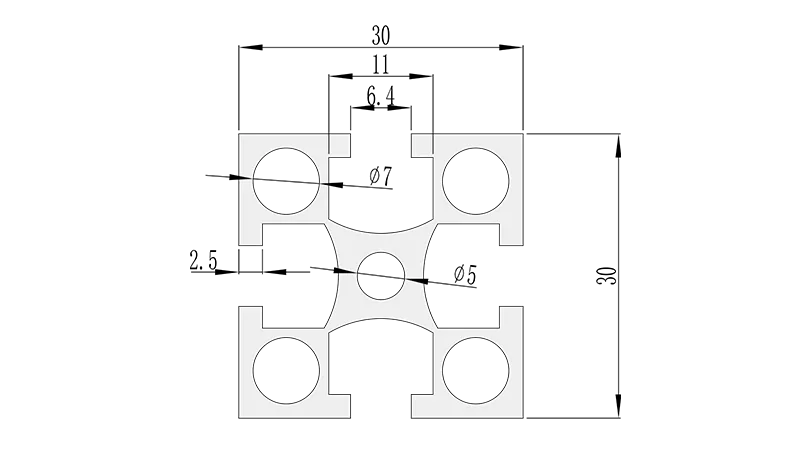
Before we jump into load testing, let's get familiar with the star of the show. The 3030 National Standard Profile A is a type of aluminum extrusion profile, a lightweight yet durable building block used to construct everything from workbenches to machine guards, and from conveyor frames to material storage racks. As the name suggests, it measures 30mm by 30mm in cross-section—a versatile size that strikes a balance between strength and flexibility. Made primarily from aluminum alloy 6063-T5 (a common choice for industrial profiles), it's known for its excellent corrosion resistance, high strength-to-weight ratio, and ease of assembly with aluminum profile accessories like corner codes, gussets, and end caps.
What makes this profile "national standard"? In short, it adheres to strict manufacturing and dimensional specifications set by national regulatory bodies, ensuring consistency across suppliers. This standardization is key for industrial users: whether you're replacing a worn part or expanding a system, you can trust that a 3030 National Standard Profile A from one reputable supplier will fit seamlessly with components from another. But here's the catch: standardization doesn't guarantee that every application is safe. That's where load testing comes in.
Why Load Testing Matters: Safety Isn't Optional
Imagine walking into a factory where workbenches groan under the weight of tools, material racks sag under boxes of components, and conveyor frames vibrate precariously during operation. Would you feel confident working there? Probably not. Load testing is the process of determining how much weight a structure—like a 3030 profile-based workbench or rack—can safely support before deforming, bending, or failing. It's not just about avoiding catastrophic collapses (though that's a big part of it); it's about ensuring long-term reliability, preventing costly downtime, and protecting workers from injury.
In industrial settings, the consequences of inadequate load capacity are all too real. A workbench that can't support the weight of heavy machinery might tip over, damaging equipment and injuring operators. A material rack that buckles under stored goods could lead to product loss, production delays, or even a chain reaction of falling items. And in regulated industries like automotive or aerospace, non-compliance with load safety standards can result in fines, legal liabilities, or revoked certifications. Simply put, load testing isn't an extra step—it's the foundation of a responsible, efficient workspace.
How 3030 National Standard Profile A Load Testing Works
Load testing a 3030 National Standard Profile A isn't a one-size-fits-all process. It depends on the application: a profile used in a static workbench will face different stresses than one in a dynamic conveyor system. Let's break down the most common testing methods and what they reveal.
Static Load Testing: The "Stand Still and Hold" Test
Static load testing is the most basic—and most critical—type of load test. It involves applying a constant, stationary weight to the profile (or a structure built with the profile) and measuring how much it deflects (bends) over time. For example, if you're building a workbench using 3030 profiles, static load testing would simulate the weight of tools, equipment, and materials resting on it for hours or even days.
During a static test, engineers incrementally add weight to the structure, pausing at each stage to measure deflection with tools like dial indicators or laser levels. The goal is to find the "yield point"—the load at which the profile starts to bend permanently—and the "failure point"—the load at which it breaks or collapses. Most industrial applications require the structure to support 1.5 times its intended maximum load (a safety factor of 1.5) without permanent deformation. For instance, if a workbench is designed to hold 200kg, it should pass a static test of 300kg with minimal, temporary deflection.
Dynamic Load Testing: When Things Start Moving
Not all loads are static. Conveyor systems, turnover trolleys, and mobile workbenches face dynamic loads—weights that shift, vibrate, or move as the structure itself moves. A 3030 profile used in a roller track conveyor, for example, must handle not just the weight of products sliding along it but also the impact of items being loaded onto it and the vibrations from the conveyor motor.
Dynamic load testing uses specialized equipment to simulate these conditions. Hydraulic or pneumatic machines apply repeated, varying forces to the profile, mimicking the stress of moving loads. Engineers measure how the profile responds over thousands of cycles, checking for fatigue (weakening due to repeated stress) and ensuring it doesn't loosen connections with aluminum profile accessories like 3030 aluminum angle yards or gusset plates. For dynamic applications, the safety factor is often higher—sometimes 2.0 or more—to account for the unpredictable nature of moving loads.
Impact Load Testing: Preparing for the Unexpected
Even the most carefully planned workspaces can face unexpected impacts: a dropped tool hitting a workbench, a forklift accidentally bumping a material rack, or a heavy component being placed roughly on a conveyor. Impact load testing evaluates how well the 3030 profile absorbs sudden, short-duration forces without failing.
In these tests, a weighted object is dropped onto the profile from a controlled height, or a swinging pendulum strikes it. Sensors measure the force of impact and the profile's deformation. The goal isn't to see if the profile survives a massive collision (no material is indestructible), but to ensure it can withstand common workplace impacts without catastrophic failure. For example, a 3030 profile-based machine guard should absorb the impact of a falling tool without shattering, protecting the machine and nearby workers.
Load Testing Results: What Do the Numbers Mean?
To make sense of load testing, let's look at real-world data. Below is a hypothetical but representative load test results table for a 3030 National Standard Profile A (1.5mm wall thickness) used in a typical workbench setup, with and without aluminum profile accessories like gusset plates and reinforced corner codes. These numbers reflect industry standards and common safety margins.
| Test Type | Setup | Maximum Load Before Deflection (kg) | Maximum Load Before Failure (kg) | Safe Working Load (kg)* |
|---|---|---|---|---|
| Static Load | Profile alone (unsupported, 1m length) | 80 | 150 | 40 (50% of deflection load) |
| Static Load | Profile with aluminum profile accessories (gussets + 3030 angle yards), 1m length | 150 | 280 | 75 (50% of deflection load) |
| Dynamic Load (Repeated 10,000 cycles) | Profile with accessories, 1m length (simulating conveyor use) | 120 (after 10,000 cycles) | 220 (after 10,000 cycles) | 60 (50% of post-cycle deflection load) |
| Impact Load (5kg weight dropped from 1m) | Profile with accessories, mounted horizontally | No permanent deflection | Load exceeds 300kg (profile bends but doesn't snap) | N/A (impact resistance meets safety standards) |
*Safe Working Load (SWL) is typically 50% of the maximum load before deflection for static applications, and lower for dynamic use, to account for fatigue and unexpected stresses.
The table tells a clear story: aluminum profile accessories make a huge difference. Without gussets or corner codes, the 3030 profile alone can only safely support 40kg over a 1m length. Add those accessories, and the safe working load jumps to 75kg—nearly double. This is because accessories distribute weight more evenly, reinforce weak points (like joints), and prevent twisting or bending under stress. It's a reminder that even the strongest profile is only as good as the components holding it together.
Real-World Applications: From Workbenches to Material Racks
Now that we understand the "why" and "how" of load testing, let's explore how this applies to everyday industrial setups. The 3030 National Standard Profile A is a workhorse, and its load capacity varies by application. Let's take two common uses: workbenches and material racks.
Workbenches: The Heart of the Workshop
Workbenches are where the magic happens—assembly, repairs, testing, and more. A typical workbench built with 3030 profiles might span 1.5m to 2m in length, with a wooden or aluminum honeycomb panel top. Using the load test data above, a 2m bench with reinforced accessories could safely support around 110kg (since longer spans reduce load capacity slightly). That's enough for power tools, a laptop, bins of components, and even a worker leaning on the edge—without any sagging or risk of collapse.
But here's a pro tip: don't just rely on the profile's load capacity. The way the bench is assembled matters too. Using high-quality casters (if it's mobile) with locking brakes, ensuring level installation, and distributing weight evenly across the surface all play a role in safety. A workbench that's unevenly loaded—say, with all tools piled on one corner—will fail long before its rated capacity. Load testing accounts for these variables by simulating real-world use, not just ideal conditions.
Material Racks: Storing Smart, Storing Safe
Material racks are another common application for 3030 profiles. Whether storing boxes of electronics components, automotive parts, or raw materials, these racks need to handle vertical and horizontal loads. A typical 3-tier material rack might use 3030 profiles for uprights and cross-braces, with roller tracks (another keyword!) for easy loading/unloading. Load testing here isn't just about the weight per shelf; it's about the rack's stability. A rack that can support 50kg per shelf but tips over when fully loaded is just as dangerous as one that collapses.
In load tests for material racks, engineers check both shelf load capacity and overall stability. For example, a 3030 profile rack with 3 shelves (each 1.2m long) might have a safe working load of 40kg per shelf, with a stability test ensuring it won't tip when a fully loaded shelf is extended (common when accessing items). Again, aluminum profile accessories like diagonal braces and heavy-duty foot bases are critical here—they prevent the rack from swaying or toppling under load.
Choosing the Right Lean System Supplier: Quality Starts at the Source
You've done your homework: you understand load testing, you know the importance of aluminum profile accessories, and you're ready to build a safe workspace. Now, where do you get your 3030 National Standard Profile A? The answer: a reliable lean system supplier. Not all suppliers are created equal, and choosing the wrong one can undermine even the best load testing efforts.
A reputable lean system supplier doesn't just sell profiles—they prioritize quality control. Look for suppliers who conduct their own load testing on profiles and accessories, provide test certificates, and adhere to national standards (like the "national standard" in 3030 National Standard Profile A). They should be transparent about material grades (e.g., 6063-T5 aluminum), wall thickness, and load capacity data for different applications. Avoid suppliers who cut corners, like using thinner wall thicknesses or low-grade aluminum alloys—these might save money upfront but cost you dearly in repairs, replacements, or accidents later.
Bonus points if your supplier offers technical support. A good lean system supplier will help you calculate load capacities for your specific setup (e.g., "How much weight can a 2m workbench with X accessories support?") and recommend the right accessories for your needs. They'll also stand behind their products, offering warranties or replacements if a profile fails under normal use. After all, safety is a partnership—not just a product.
Final Thoughts: Safety Is a Journey, Not a Destination
Load testing the 3030 National Standard Profile A isn't a box to check; it's a commitment to creating a workspace where workers feel safe, equipment runs smoothly, and productivity thrives. From static workbenches to dynamic conveyor systems, understanding how much weight your profiles can handle—and ensuring you use the right aluminum profile accessories—makes all the difference.
As you build or upgrade your industrial setup, remember: every component matters. The profile, the accessories, the assembly, and the supplier—they all play a role in safety. And when in doubt, ask questions. Request load test reports, consult with your lean system supplier, and never assume a structure is safe without proof. After all, a workspace built on trust in load testing is one where everyone can focus on what they do best: making great products.
So, the next time you walk past a 3030 profile-based workbench or rack, take a moment to appreciate the load testing that went into it. It's not glamorous, but it's the quiet guardian of industrial safety. And that's something worth celebrating.