- Company Articles
- Industry articles
- Industry standards
- 3030 National Standard Profile A Material Rack B: Optimizing Warehouse Logistics Efficiency

3030 National Standard Profile A Material Rack B: Optimizing Warehouse Logistics Efficiency
Related Product
3030 National Standard Profile A
Workbench, production line, logistic rack, warehouse rack Industry: Manufacturer workshop, Automobile, Electronic, Assembling, logistic
Walk into any busy warehouse, and you'll quickly spot the heartbeat of its operations: the flow of materials. From raw components arriving at the loading dock to finished products being prepped for shipment, every step relies on how well your storage and handling systems are designed. But for many operations, inefficiencies lurk in disorganized racks, wasted floor space, and rigid structures that can't keep up with changing needs. This is where purpose-built solutions like the 3030 National Standard Profile A and Material Rack B come into play—tools that don't just store materials, but transform how your team moves, accesses, and manages inventory. Let's dive into how these two components work together to turn logistical headaches into streamlined success.
Why Warehouse Logistics Efficiency Isn't Just a "Nice-to-Have"
Before we explore the specifics of the 3030 National Standard Profile A and Material Rack B, let's ground ourselves in why logistics efficiency matters. In today's fast-paced supply chains, delays of even a few minutes per order can snowball into missed deadlines, unhappy customers, and increased labor costs. Consider this: a warehouse with disorganized storage might require workers to spend 20 extra minutes per hour searching for items. Over a shift, that's hours of lost productivity. Multiply that across a team, and the impact on your bottom line becomes impossible to ignore.
Space is another critical factor. As real estate costs rise, warehouses can't afford to waste square footage on bulky, inefficient storage. Vertical space is often underutilized, while cluttered aisles slow down material handling equipment like forklifts and pallet jacks. And then there's scalability—seasonal fluctuations, new product lines, or sudden growth can leave rigid, one-size-fits-all storage systems obsolete almost overnight.
The solution? Systems that are designed for efficiency—modular, durable, and tailored to how your team actually works. That's where the 3030 National Standard Profile A and Material Rack B shine.
Meet the 3030 National Standard Profile A: The Building Block of Modern Storage
At the core of many high-performance warehouse solutions is the 3030 National Standard Profile A. If you're not familiar with aluminum extrusion profiles, think of them as the "Lego blocks" of industrial storage—versatile, strong, and infinitely customizable. The 3030 profile, in particular, is a workhorse in this category. Let's break down what makes it stand out.
What Is 3030 National Standard Profile A?
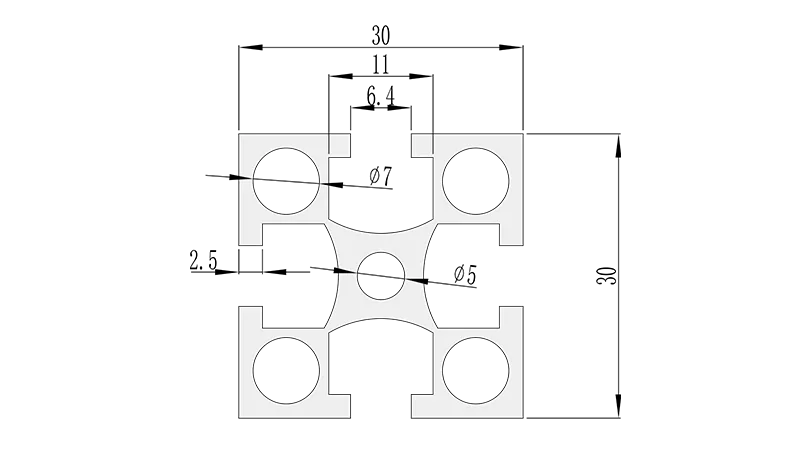
The 3030 National Standard Profile A is an aluminum extrusion profile with a square cross-section, measuring 30mm x 30mm. Its design is deceptively simple: a hollow aluminum frame with T-slots running along all four sides. These T-slots are key—they allow for easy attachment of accessories like brackets, shelves, and connectors without the need for welding or drilling. This means you can assemble, disassemble, and reconfigure structures quickly, adapting to new needs in hours rather than days.
But what truly sets aluminum extrusion profile apart from traditional materials like steel or wood? For starters, aluminum offers an unbeatable strength-to-weight ratio. It's lightweight enough for manual assembly (no heavy machinery required) but strong enough to support heavy loads—critical for storage racks holding everything from small components to bulky equipment. Aluminum is also naturally corrosion-resistant, making it ideal for warehouses with humidity or temperature fluctuations, where steel might rust or wood might warp over time.
Aluminum Profile Accessories: The Secret to Customization
A profile is only as good as the accessories that bring it to life. The 3030 National Standard Profile A works seamlessly with a range of aluminum profile accessories—think corner brackets, shelf supports, end caps, and even casters for mobility. These accessories snap into the T-slots, creating sturdy connections that hold up under daily use but can be adjusted when needed. For example, adding a new shelf to a rack doesn't require cutting or welding; just slide in a few brackets, secure them with bolts, and you're done. This level of flexibility is a game-changer for warehouses that need to pivot quickly.
Material Rack B: A Storage Solution Built for Workflow
Now that we understand the foundation (the 3030 National Standard Profile A), let's look at how it's put to work in Material Rack B. Described as a "3 row and 3 floor" rack, Material Rack B is a prime example of how modular design translates to real-world efficiency. Let's break down its structure and purpose.
The Anatomy of Material Rack B
Material Rack B is constructed using the 3030 National Standard Profile A as its frame, with three horizontal rows and three vertical floors—essentially a 3x3 grid of storage space. Each shelf is designed to hold bins, cartons, or even small equipment, with clear pathways between rows for easy access. The rack's height is optimized for both manual picking (no more stretching or bending to reach items on high shelves) and compatibility with material handling tools like order pickers or conveyor systems.
What makes Material Rack B more than just a stack of shelves? Its attention to workflow . The three-row design ensures that similar items can be grouped logically—for example, all electronic components in the top row, mechanical parts in the middle, and packaging materials in the bottom. This "zone picking" reduces the time workers spend moving between areas. The three-floor structure, meanwhile, maximizes vertical space without sacrificing accessibility. Unlike tall, narrow racks that require ladders, Material Rack B keeps every shelf within arm's reach for most operators.
Durability Meets Practicality
Built with the 3030 aluminum extrusion profile, Material Rack B is tough enough to handle daily wear and tear. The aluminum frame resists dents and scratches, even when items are loaded or unloaded quickly. Unlike wooden shelves that can splinter or particleboard that warps under heavy loads, the aluminum shelves (often reinforced with cross-bracing) maintain their shape over time. This durability means fewer replacements and repairs, lowering long-term costs.
How They Work Together: A Synergy of Design
The magic of the 3030 National Standard Profile A and Material Rack B isn't just in their individual features—it's in how they complement each other. The 3030 profile provides the modular backbone, while Material Rack B is the practical application of that modularity. Let's walk through a typical scenario of how they might be implemented in a warehouse.
Imagine a small electronics manufacturer that's outgrown its initial storage setup. Their old steel racks are heavy, hard to reconfigure, and starting to rust in the humid warehouse environment. They need a system that can handle small components (resistors, capacitors) and larger items (circuit boards, power supplies) while keeping everything organized by production line.
They opt for Material Rack B units built with 3030 National Standard Profile A. Using aluminum profile accessories like shelf dividers and bin holders, they customize each shelf to fit specific component sizes. The top floor of one rack holds bulk packaging materials, the middle floor has labeled bins for small parts, and the bottom floor is reserved for heavier items. Because the 3030 profile is lightweight, the team assembles the racks in a single afternoon without hiring outside help. Six months later, when they add a new product line, they simply reconfigure the shelves using extra brackets and accessories—no need to buy entirely new racks.
This scenario illustrates the core advantage of their partnership: adaptability. The 3030 profile ensures the rack can evolve, while Material Rack B's 3x3 design ensures space is used efficiently from day one.
The Benefits: More Than Just Storage
So, what tangible benefits do the 3030 National Standard Profile A and Material Rack B bring to warehouse logistics? Let's break them down into four key areas:
1. Space Utilization: Making the Most of Every Inch
Material Rack B's vertical, multi-tiered design is a masterclass in space efficiency. By stacking storage across three floors, it reduces the need for sprawling horizontal storage, freeing up floor space for other operations like assembly stations or material handling equipment. The 3030 National Standard Profile A's slim profile (30mm x 30mm) also means less wasted space on bulky frame materials, compared to traditional steel racks with thick beams.
For example, a warehouse previously using single-level wooden shelves might fit 10 units in a 20-foot section. With Material Rack B, they could fit the same number of units in half the space, or double their storage capacity in the same footprint—all without sacrificing accessibility.
2. Workflow Efficiency: From Searching to Retrieving
Disorganized storage forces workers to spend valuable time searching for items. Material Rack B's structured 3-row, 3-floor layout eliminates this guesswork. When paired with clear labeling (made easier by the rack's uniform shelf sizes), workers can locate items in seconds rather than minutes. The aluminum extrusion profile's smooth, clean finish also makes shelves easy to clean and maintain, reducing dust buildup that can obscure labels or damage sensitive materials.
In one case study, a distribution center reported a 28% reduction in picking time after switching to Material Rack B—simply because workers no longer wandered aisles searching for misplaced items.
3. Durability: Built to Last, Even in Tough Environments
Aluminum's natural resistance to corrosion and rust means the 3030 National Standard Profile A and Material Rack B stand up to harsh warehouse conditions. Unlike steel, they won't degrade in humid environments or when exposed to occasional spills. The aluminum extrusion profile's strength also ensures the rack can handle consistent loading and unloading without bending or warping. This durability translates to lower replacement costs over time—while a wooden shelf might need replacing every 2-3 years, an aluminum rack can last a decade or more with minimal maintenance.
4. Scalability: Growing Without Growing Pains
Businesses rarely stay the same size for long. Seasonal spikes, new product lines, or sudden growth can strain rigid storage systems. The 3030 National Standard Profile A and aluminum profile accessories eliminate this problem. Need to add a fourth shelf? Just buy extra brackets. Want to extend a rack by a few feet? Add more profile sections. This scalability means your storage system grows with your business, avoiding the costly cycle of buying new racks every time your needs change.
Traditional Racks vs. Material Rack B: A Side-by-Side Comparison
To truly appreciate the advantages of Material Rack B (built with 3030 National Standard Profile A), let's compare it to two common alternatives: traditional steel racks and wooden shelves. The table below highlights key differences in performance and value:
| Feature | Traditional Steel Racks | Wooden Shelves | Material Rack B (3030 Profile A) |
|---|---|---|---|
| Weight | Heavy (requires machinery for assembly) | Moderate (but prone to warping over time) | Lightweight (assembled manually) |
| Assembly Time | 8-10 hours for 5 units (requires skilled labor) | 4-6 hours for 5 units (basic tools needed) | 2-3 hours for 5 units (no special skills required) |
| Customization | Limited (requires welding to modify) | Low (cutting wood weakens structure) | High (easily reconfigured with accessories) |
| Durability | High (but prone to rust in humid environments) | Low (splinters, warps, rots) | High (corrosion-resistant aluminum, no warping) |
| Cost Over 5 Years* | High (initial cost + rust repairs + replacement parts) | Very High (frequent replacements needed) | Low (initial cost + minimal maintenance + reconfigurable) |
*Estimated costs based on a warehouse with 20 storage units, including initial purchase, maintenance, and replacement.
Real-World Impact: A Small Business Success Story
To bring these benefits to life, let's look at a real example (with identifying details changed for privacy). "TechPro Components," a small electronics parts distributor in the Midwest, was struggling with inefficiency. Their 5,000-square-foot warehouse was cluttered with mismatched wooden shelves and second-hand steel racks. Workers spent up to 40% of their shifts searching for parts, and inventory errors were common due to disorganized storage.
In 2023, TechPro invested in 15 Material Rack B units built with 3030 National Standard Profile A. They paired the racks with aluminum profile accessories like dividers and label holders to organize components by product line. Within the first month, picking time dropped by 35%, and inventory accuracy improved from 85% to 98%. By freeing up floor space, they also added two new assembly stations, increasing their order fulfillment capacity by 20%.
The owner, Maria Gonzalez, summarized the impact: "We didn't just buy racks—we bought a system that works with our team. The fact that we could reconfigure the shelves when we added new parts was a game-changer. We're now handling 30% more orders with the same staff, and overtime has dropped significantly."
Conclusion: Investing in Efficiency for the Long Haul
In the world of warehouse logistics, every detail matters. The 3030 National Standard Profile A and Material Rack B are more than just storage solutions—they're investments in your team's productivity, your space's potential, and your business's ability to adapt. By combining the 3030 profile's modular, durable aluminum extrusion design with Material Rack B's space-efficient 3-row, 3-floor layout, you're not just organizing materials—you're building a logistics system that can grow, evolve, and thrive in an ever-changing market.
So, if you're tired of watching your team waste time searching for items, or struggling to fit new inventory into an already cramped space, it might be time to rethink your storage. The 3030 National Standard Profile A and Material Rack B aren't just about storing materials—they're about unlocking the full potential of your warehouse. And in today's competitive landscape, that's not just an advantage—it's a necessity.