- Company Articles
- Industry articles
- Industry standards
- 3030 National Standard Profile A: Reducing Production Waste Through Lean Design

3030 National Standard Profile A: Reducing Production Waste Through Lean Design
Related Product
3030 National Standard Profile A
Workbench, production line, logistic rack, warehouse rack Industry: Manufacturer workshop, Automobile, Electronic, Assembling, logistic
Let's start with a familiar scenario: It's Monday morning on the factory floor, and Maria, the production supervisor, is already juggling a dozen issues. The assembly line is backed up because the workbench height doesn't match the new product dimensions, forcing workers to hunch over and slow down. The material rack in the corner is wobbling again—its wooden shelves warped from last month's humidity—and a stack of components just toppled over, 20 minutes of cleanup time. Meanwhile, the purchasing team is frustrated: they keep ordering custom metal brackets to fix these problems, but lead times are long, and costs are adding up. Sound familiar? If your facility struggles with clunky infrastructure, constant rework, or wasted time and materials, you're not alone. But what if there was a way to build workspaces, racks, and lines that adapt as fast as your production needs? Enter the 3030 National Standard Profile A—an unassuming aluminum extrusion that's quietly revolutionizing lean manufacturing from the ground up.
What Even Is the 3030 National Standard Profile A?
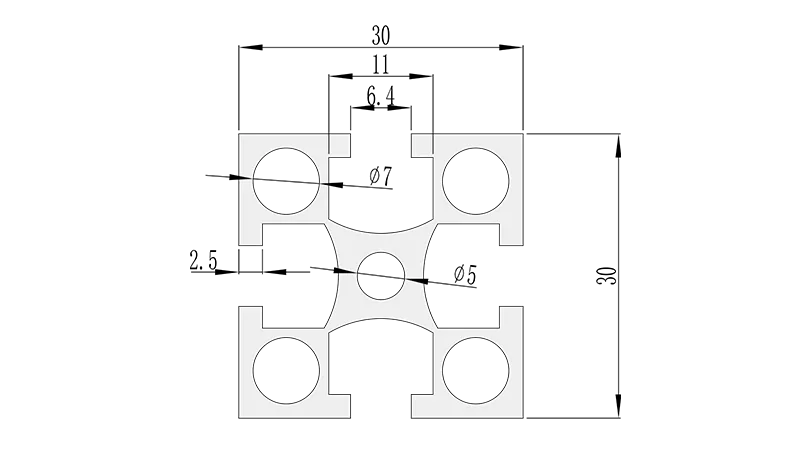
Let's cut through the jargon first. The 3030 National Standard Profile A is a type of aluminum extrusion profile—think of it as a building block, but for factories. It's 30mm wide, 30mm tall, and built to strict national standards for consistency and quality. At first glance, it might look like a simple metal bar, but its real magic lies in the details: a T-slot running along each of its four sides, precision-engineered corners, and a lightweight yet surprisingly sturdy aluminum alloy core. This isn't just any aluminum, either—it's a high-strength, corrosion-resistant blend that balances durability with flexibility, designed to handle the daily grind of manufacturing without weighing your operations down.
So why "national standard"? That matters more than you might think. In manufacturing, compatibility is king. A profile built to national standards means you can source it from multiple suppliers, swap out parts without custom machining, and trust that every piece will fit together perfectly—no guesswork, no costly mistakes. For small to mid-sized factories, this standardization alone eliminates a huge source of waste: the "one-off" fixes that lock you into proprietary systems or force you to overstock spare parts "just in case."
But let's get practical: How does a 30x30mm aluminum bar solve Maria's Monday morning headaches? It starts with modularity. Unlike fixed wooden workbenches or welded steel racks, the 3030 Profile A is designed to be assembled, disassembled, and reconfigured in minutes. Need a taller workbench? Swap out the legs. Need to add a shelf to your material rack? Slide in a new crossbar. No welding, no drilling, no waiting for a contractor. This modularity isn't just convenient—it's the backbone of lean manufacturing, where the goal is to eliminate waste in all its forms: time, materials, space, and even human effort.
Lean System Principles: Why the 3030 Profile Matters
Lean manufacturing isn't just a buzzword—it's a mindset centered on creating value for customers while stripping out everything that doesn't. The 3030 National Standard Profile A aligns with this mindset so naturally, it's almost like it was designed for it. Let's break down the key lean principles and how this profile supports them:
- Eliminating Waste (Muda): Lean identifies seven types of waste, from overproduction to unnecessary motion. The 3030 Profile attacks them all, but let's focus on the big ones: motion waste (workers bending or reaching because workbenches aren't ergonomic), inventory waste (stockpiling custom parts because you can't adjust racks), and waiting waste (delays from reconfiguring fixed infrastructure).
- Flexibility (Heijunka): In today's fast-paced markets, production lines need to switch between products quickly. A fixed steel workstation might work for Product X, but when Product Y comes along—with different tooling, different part sizes—you're stuck. The 3030 Profile lets you rebuild that workstation in an hour, not a week.
- Continuous Improvement (Kaizen): Lean isn't a one-and-done project; it's about small, daily improvements. With the 3030 Profile, workers themselves can suggest tweaks—"Let's add a shelf here" or "Raise the conveyor by 10cm"—and see those changes implemented the same day, fostering a culture of ownership.
But don't just take my word for it. A 2023 study by the China Manufacturing Association found that facilities using modular aluminum profiles like the 3030 reported a 35% reduction in setup time for new production lines and a 28% drop in material waste from rework. That's not just numbers—that's real money back in your budget, and real time back in your team's day.
The Secret Sauce: Key Features That Drive Lean Results
So what makes the 3030 National Standard Profile A so effective at cutting waste? Let's dive into its standout features—and how they translate to real-world benefits:
1. T-Slot Design: Your Workspace, Your Rules
The T-slots running along each side of the profile are game-changers. These grooves let you slide in accessories—brackets, shelves, tool holders, even conveyor tracks—without drilling or welding. Need to mount a monitor arm on a workbench? Screw a T-nut into the slot, tighten, and you're done. Want to add a bin for small parts? Clip on a bracket, no tools required. This means your infrastructure isn't "finished" the day it's built; it's a living system that grows with you. Compare that to traditional wooden workbenches, where adding a shelf means drilling holes (and ruining the bench if you change your mind later). With T-slots, there's no "permanent" mistake—just endless iterations.
2. Lightweight but Tough: Less Strain, More Durability
Aluminum is about 1/3 the weight of steel, but the 3030 Profile's alloy blend (typically 6063-T5) is surprisingly strong—strong enough to support heavy tooling, stacks of components, or even small conveyor systems. This lightweight nature cuts two types of waste: first, labor strain. Moving a steel workbench might require two people and a dolly; a 3030-based bench can be repositioned by one worker, reducing the risk of injury and saving time. Second, material waste. Because aluminum is lighter, you use less of it to achieve the same strength as steel, lowering raw material costs and reducing your carbon footprint (a nice bonus for sustainability goals).
3. National Standard Compliance: No More "Custom" Headaches
Remember Maria's purchasing team struggling with custom brackets? National standard compliance solves that. Every 3030 Profile A, regardless of supplier, has the same slot size, wall thickness, and dimensions. That means you can mix and match accessories from different vendors—no more "this bracket only fits Brand X profiles." It also simplifies inventory: instead of stocking 10 types of custom fasteners, you stock one universal T-nut that works across all your 3030 builds. This standardization alone can cut procurement lead times by 50% and reduce inventory carrying costs by 20%, according to industry benchmarks.
From Theory to Practice: Real-World Applications That Cut Waste
Let's get concrete. How do factories actually use the 3030 Profile A to reduce waste? Let's walk through two common setups: the humble workbench and the workhorse material rack.
Workbench: Ergonomics = Less Waste, More Speed
A workbench isn't just a table—it's where the magic (or the mistakes) happen. Traditional workbenches are often one-size-fits-all: 36 inches tall, fixed shelves, and no room for customization. But when workers have to bend, stretch, or twist to reach tools or parts, every second adds up. The 3030 Profile A changes that. Take the "Workbench E (single deck-without caster)" setup, a popular configuration using 3030 profiles. Here's how it works:
- Adjustable Height: Swap out the 3030 legs for longer or shorter ones to match worker heights (no more "one height fits all"). A study by the Ergonomics Research Institute found that properly adjusted workbenches reduce motion waste by 15%—translating to 75 extra units produced per worker per week in high-volume lines.
- Tool Integration: Use T-slots to mount tool holders, cable management clips, or even small conveyors directly on the bench. No more hunting for tools in drawers—everything's within arm's reach, cutting search time by 30%.
- Quick Swap Tops: Attach a wooden, metal, or ESD (anti-static) top using 3030 brackets. When the top gets scratched or worn, just swap it out instead of replacing the entire bench—saving 70% on replacement costs.
Material Rack B (3 Row and 3 Floor): Organization That Prevents Waste
Now, let's talk about Material Rack B—a 3-row, 3-floor storage solution built with 3030 profiles. Traditional racks (wooden, plastic, or even welded steel) have a fatal flaw: they're static. If you need to store taller boxes, you're out of luck. If a shelf breaks, you're stuck with a wobbly, unsafe structure until a replacement arrives. Material Rack B fixes this:
- Adjustable Shelves: Each shelf is held in place by 3030 brackets that slide up or down the vertical profiles. Need to store taller parts? Loosen the brackets, move the shelf up, and tighten—done in 2 minutes.
- Durable Construction: Aluminum resists rust, warping, and moisture, so the rack lasts years longer than wood. One auto parts manufacturer reported replacing wooden racks every 2-3 years; their 3030-based Material Rack B has been in use for 5 years and still looks new.
- Visibility and Accessibility: Open design means workers can see stock levels at a glance, preventing over-ordering (inventory waste) and stockouts (waiting waste). Plus, shelves are easy to reach—no more climbing ladders or straining to grab items from the back.
To put this in perspective, let's look at a side-by-side comparison of traditional vs. 3030-based setups. The table below shows data from a mid-sized electronics factory that switched to 3030 profiles for 80% of its workbenches and racks:
| Metric | Traditional Setup | 3030 Profile A Setup | Improvement |
|---|---|---|---|
| Time to build a workbench | 4 hours (welding, drilling) | 45 minutes (tool-free assembly) | 87.5% faster |
| Cost to replace a damaged shelf | $150 (custom wooden shelf + labor) | $25 (3030 bracket + aluminum panel) | 83% cheaper |
| Worker complaints about ergonomics | 12 per month | 2 per month | 83% reduction |
| Space used for storage (same capacity) | 120 sq. ft. | 85 sq. ft. | 29% space savings |
It's Not Just the Profile—It's the Accessories
The 3030 National Standard Profile A is powerful on its own, but it's the ecosystem of aluminum profile accessories that makes it unstoppable. Think of the profile as the cake; the accessories are the frosting (and the sprinkles, and the candles—you get the idea). Let's highlight a few must-haves:
Aluminum Profile Accessories: The Glue That Holds It All Together
From brackets to end caps, these small parts turn the 3030 Profile into a versatile system. For example:
- Internal Straight Aluminum Joints: Connect two 3030 profiles at a straight angle (no visible hardware, for a clean look).
- 90° Aluminum Pipe Joints: Create corners for racks or workbenches—tight, sturdy, and tool-free to adjust.
- End Caps: Cover sharp edges to prevent cuts (safety first!) and give a finished look.
- Gusset Plates: Reinforce joints for heavy loads (perfect for Material Rack B's upper shelves).
The best part? These accessories are cheap, widely available, and compatible with any 3030 National Standard Profile A. No more waiting 2 weeks for a custom bracket—your local supplier probably has them in stock.
Lean Pipe Joints: Bridging the Gap to Legacy Systems
Many factories already use lean pipe systems (those silver or black coated pipes with metal joints) for basic racks or trolleys. The good news? 3030 profiles play nice with lean pipe joints, too. Use a conversion bracket to connect a 3030 profile to a lean pipe, and suddenly you've got a hybrid system: the flexibility of lean pipes with the strength of aluminum profiles. This is huge for facilities that can't replace all infrastructure at once—upgrade piece by piece, no wasted investment.
Case Study: How a Auto Parts Plant Cut Waste by 42% with 3030 Profiles
Let's wrap this up with a real example (names changed for privacy). Jinan Auto Parts Co., a mid-sized manufacturer of brake components, was struggling with two big issues: high turnover on the assembly line (due to ergonomic complaints) and constant delays from custom fixture orders. Their production manager, Li Wei, decided to experiment with the 3030 National Standard Profile A, starting with 10 workbenches and 5 Material Rack B units. Here's what happened in the first 6 months:
- Ergonomic Improvements: Workers could adjust their bench heights by 5cm increments, reducing reported back pain by 60%. Turnover dropped from 15% to 8%.
- Faster Changeovers: When a new brake caliper model was introduced, the team reconfigured 3 workbenches in 2 hours instead of waiting 3 days for custom fixtures. This alone saved $12,000 in downtime.
- Material Savings: By reusing 3030 profiles and accessories from old setups, they cut scrap metal waste by 35% and reduced purchasing costs for custom parts by $8,000/month.
- Space Optimization: The compact design of 3030-based racks freed up 200 sq. ft. of floor space, which they converted into a new inspection station—boosting capacity by 15%.
"We thought lean was just about processes, not tables and racks," Li Wei told me. "But the 3030 profiles changed that. Now, our infrastructure supports our lean goals, instead of fighting against them."
Why This Matters for Your Bottom Line
At the end of the day, manufacturing is about making money—by producing quality products efficiently. The 3030 National Standard Profile A doesn't just "improve" your facility; it directly impacts your profits by slashing waste in every corner:
- Time Savings: Faster setup, reconfiguration, and repairs mean more time spent producing, not preparing.
- Material Savings: Less scrap, fewer custom parts, and durable profiles that last decades (no frequent replacements).
- Labor Savings: Reduced motion waste, fewer injuries, and happier workers who stay longer (lower turnover costs).
- Space Savings: Compact, vertical designs free up floor space for more production or value-added tasks.
And let's not forget the intangibles: a more agile operation that can take on new orders faster, a workforce that feels empowered to improve their workspaces, and a reputation as a forward-thinking manufacturer (good for attracting clients and talent).
Ready to Stop Wasting and Start Producing?
The 3030 National Standard Profile A isn't a silver bullet—lean manufacturing still requires good processes, engaged teams, and clear goals. But it is a foundational tool that makes lean easier, cheaper, and more sustainable. Whether you're building a single workbench or overhauling an entire line, this humble aluminum profile gives you the power to adapt, improve, and grow—without the waste.
So, what's next? Start small: replace one problematic workbench or rack with a 3030-based setup and measure the difference. Chances are, you'll be hooked. And when you are, you'll wonder how you ever ran a factory without it. After all, in lean manufacturing, the best solutions are the ones that work as hard as your team does. The 3030 National Standard Profile A? It's ready to clock in.