- Company Articles
- Industry articles
- Industry standards
- 3030 National Standard Profile A Slot Design: Enhancing Connector Versatility

3030 National Standard Profile A Slot Design: Enhancing Connector Versatility
Related Product
3030 National Standard Profile A
Workbench, production line, logistic rack, warehouse rack Industry: Manufacturer workshop, Automobile, Electronic, Assembling, logistic
Walk into any busy workshop, manufacturing floor, or even a small garage-turned-into-a-hobby-space, and you'll notice something quiet but crucial: the structures that hold everything together. From workbenches where intricate assemblies happen to material racks that keep parts organized, these setups rely on one unsung hero: aluminum profiles. They're the backbone of flexibility, the reason a space can reconfigure in a day instead of a week, and the silent partner in turning chaos into efficiency. But not all profiles are created equal. Today, let's talk about one that's been making waves in workshops and factories alike: the
3030 National Standard Profile A
. What makes it stand out? Its slot design—a small feature with a big impact, especially when it comes to how connectors and accessories work together.
First, Let's Get to Know the 3030 National Standard Profile A
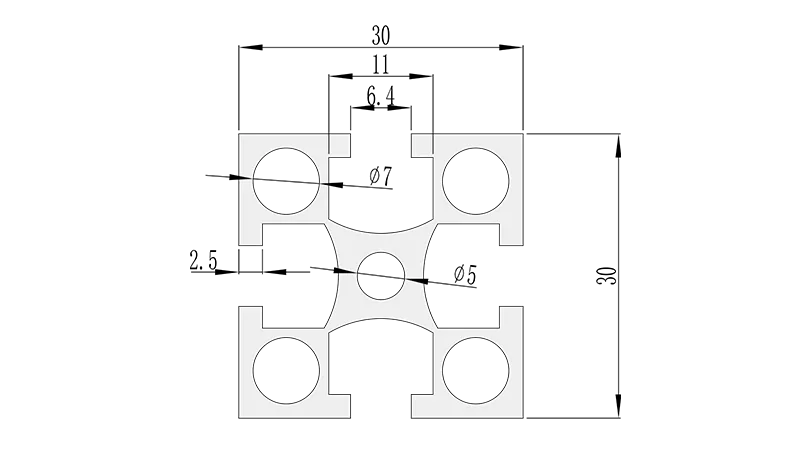
Before diving into the star of the show (that slot design), let's get the basics down. The 3030 National Standard Profile A is, at its core, a length of aluminum extrusion—lightweight, strong, and built to last. "3030" refers to its cross-section: 30mm by 30mm, a sweet spot that balances stability with versatility. Too narrow, and it might wobble under heavy tools; too wide, and it becomes bulky for smaller setups. This profile hits that middle ground perfectly.
But what really sets it apart isn't just the size—it's the material. Made from high-grade aluminum alloy, it's resistant to rust, easy to clean, and surprisingly tough. I've seen these profiles hold up in auto repair shops where oil and grease are part of the daily grind, and in electronics assembly lines where precision is non-negotiable. They don't warp, they don't corrode, and they take a beating without complaining. That durability matters because when you're building something meant to adapt—like a workbench that might need to hold a new machine next month—you need parts that won't let you down.
The Slot Design: Small Grooves, Big Flexibility
Now, let's talk about the feature that turns this "good" profile into a "great" one: the slot design. If you look at the cross-section of the 3030 Profile A, you'll notice a T-shaped groove running along its length—often called a T-slot. It's not just a random indentation; it's engineered to do one thing really well: let you connect, adjust, and reconfigure with minimal hassle.
Here's why that matters. Traditional aluminum profiles sometimes have slots that are too narrow, too shallow, or irregularly shaped. That means you're limited to specific connectors—ones that fit *exactly* or not at all. If you need a 45-degree angle but your profile's slot only works with 90-degree brackets, you're stuck. You either buy a whole new profile (costly) or rig something up with zip ties (risky). The 3030 Profile A's slot, though, is designed to be (compatible) with a wide range of connectors, thanks to its standardized dimensions. The groove is deep enough to hold bolts securely but not so deep that you need special tools to reach them. It's wide enough to accommodate different connector heads but tight enough to prevent wobbling once tightened. It's like a well-designed puzzle piece—one that fits more than just one other piece.
Enhancing Connector Versatility: 90° and 45° Connectors in Action
Let's put this into context with two of the most common connectors you'll find in any setup: the
90° aluminum profile connector
and the
45° aluminum profile connector
. These are the workhorses of assembly—used to join profiles at right angles (90°) for shelves or workbench legs, or at acute angles (45°) for diagonal braces or sloped material racks.
With older profiles, using these connectors could be a headache. A 90° connector might slide around in a loose slot, requiring extra washers or constant retightening. A 45° connector might not seat properly, leaving a wobbly joint that compromises the whole structure. But with the 3030 Profile A's slot design, both connectors lock in place smoothly. The T-slot holds the connector's bolt or pin securely, so once you tighten it, it stays tight—no more mid-project adjustments or fears of collapse.
To see how this plays out, let's compare their uses in a typical workshop scenario:
| Connector Type | Common Uses | How the 3030 Profile A Slot Helps |
|---|---|---|
| 90° Aluminum Profile Connector | Workbench frames, vertical shelving, table legs | Slot's width ensures the connector's base sits flush; deep groove prevents the bolt from pulling out under weight. |
| 45° Aluminum Profile Connector | Diagonal braces for stability, sloped material chutes, angled tool holders | Slot's consistent shape allows the connector to pivot slightly during installation, making alignment easier before tightening. |
I remember visiting a small electronics workshop last year where they'd just switched to the 3030 Profile A. The foreman, Mike, showed me their old setup: a jumble of mismatched profiles and connectors that took two people an entire afternoon to reconfigure. "Now?" he said, grinning, as he grabbed a 45° connector and a length of 3030 Profile A. He slid the connector into the slot, tightened a hex key, and had a diagonal brace built in under a minute. "No more fighting with loose slots or broken connectors," he said. "It just… works." That's the versatility we're talking about—tools that adapt to *your* needs, not the other way around.
Aluminum Profile Accessories: The Slot Design's Perfect Partners
A great profile is only as good as the accessories that go with it, and the 3030 Profile A's slot design plays well with a whole range of
aluminum profile accessories
. Take
aluminum profile rubber strip
, for example. These thin, flexible strips slide right into the T-slot, and they do two important things: deaden noise and protect the slot itself. If you've ever heard metal-on-metal clanging when parts slide on a bare profile, you know how grating that can be. The rubber strip muffles that noise, making the workspace quieter. It also keeps dust, debris, and small screws from falling into the slot—something that used to jam connectors or require tedious cleaning.
Then there are end caps—those small plastic or aluminum caps that snap onto the ends of the profile. With the 3030 Profile A, they're designed to fit snugly, thanks to the slot's standardized edges. No more trimming caps to size or dealing with ones that pop off. Even simple things like cable ties or label holders can be attached directly to the slot, turning the profile into a multi-functional tool: not just a structural support, but a way to organize wires or mark shelves. It's these little details that add up to a setup that feels intentional, not thrown together.
Real-World Impact: Why This Matters for Your Workspace
Let's step back and ask: Why does any of this matter? At the end of the day, it's about making work easier. Whether you're running a large factory or a home workshop, time and frustration are your biggest enemies. A profile that lets you swap out a connector in 5 minutes instead of 30? That's time you can spend on actually building or repairing something. A slot that works with both 90° and 45° connectors? That's fewer parts to stock, less money spent on specialized tools, and more flexibility to adapt when a project's needs change.
I think of a furniture manufacturer I worked with a while back. They used to build custom workbenches for clients, and each one required different configurations. With their old profiles, they'd have to order specific connectors for each angle, leading to delays and excess inventory. After switching to the 3030 Profile A, they standardized on a handful of connectors (including those 90° and 45° ones) and could build any bench design in half the time. "We used to dread custom orders," one of their lead builders told me. "Now? We look forward to them. The profile and its slot design make it fun to problem-solve again."
It's not just about efficiency, though. It's about confidence. When you know your connectors will lock in place, your shelves won't sag, and your workbench won't wobble, you can focus on the task at hand—not worrying if the structure will hold. That peace of mind is priceless.
Wrapping Up: The Future of Aluminum Profiles
The 3030 National Standard Profile A might seem like just another aluminum extrusion, but its slot design tells a bigger story: that the best tools are the ones that listen to the people using them. By focusing on versatility—making sure connectors fit, accessories work, and setups adapt—it turns a simple piece of metal into a partner in productivity.
As workshops and factories continue to evolve, with shorter production runs and more custom projects, adaptability will only grow more important. Profiles like the 3030 National Standard Profile A are leading the way, proving that sometimes, the smallest features (like a well-designed slot) can make the biggest difference. So the next time you walk into a workspace that feels "just right"—organized, efficient, and ready for anything—take a closer look at the structures holding it all together. Chances are, you'll find a 3030 Profile A, quietly doing its job: making hard work a little easier.