- Company Articles
- Industry articles
- Industry standards
- 3030 National Standard Profile A Specifications: Dimensions, Tolerance & Material Grade

3030 National Standard Profile A Specifications: Dimensions, Tolerance & Material Grade
Related Product
3030 National Standard Profile A
Workbench, production line, logistic rack, warehouse rack Industry: Manufacturer workshop, Automobile, Electronic, Assembling, logistic
Introduction: The Backbone of Modern Manufacturing
If you've ever stepped into a factory, a workshop, or even a well-organized garage, you've likely encountered structures that seem to effortlessly combine strength, flexibility, and precision. From workbenches that hold heavy machinery to material racks that keep production lines flowing, these structures often share a common building block: the aluminum profile. Among the countless profiles available, one stands out for its versatility and reliability—the 3030 National Standard Profile A. In this article, we'll dive deep into what makes this profile a favorite among manufacturers, DIY enthusiasts, and engineers alike, focusing on its critical specifications: dimensions, tolerance, and material grade. Whether you're building a custom workbench for your garage or sourcing components for a large-scale production line, understanding these specs will help you make informed decisions that save time, money, and frustration.
Aluminum extrusion profile has revolutionized how we design and build structures. Unlike traditional materials like wood or steel, aluminum profiles offer a unique blend of lightweight durability, corrosion resistance, and modularity. The 3030 National Standard Profile A, in particular, has become a staple in industries ranging from automotive to electronics. Its name gives a hint: "3030" refers to its cross-sectional dimensions, while "National Standard" ensures consistency across manufacturers. But what do these numbers really mean, and why do they matter? Let's start by breaking down the basics.
Dimensions: The Blueprint of Precision
At first glance, the "3030" in 3030 National Standard Profile A might seem like just another set of numbers. But to engineers, fabricators, and anyone who works with aluminum profiles, these digits are the foundation of every project. Let's unpack what they represent and why each dimension is carefully calibrated.
Understanding the 3030 Cross-Section
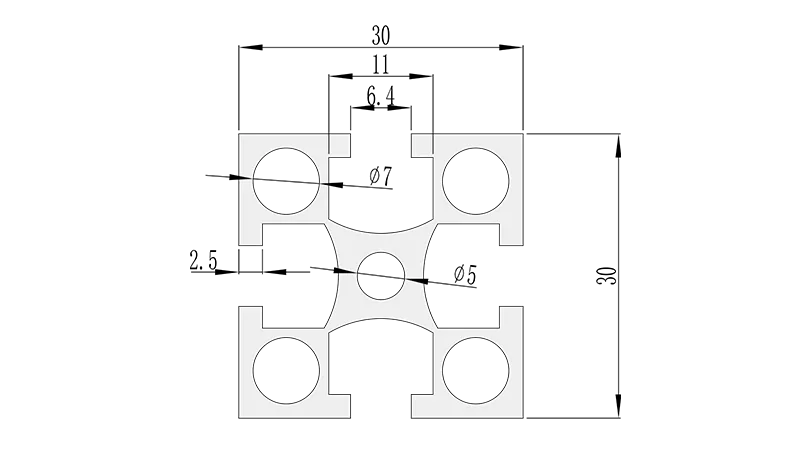
The "3030" indicates that the profile has a square cross-section, with both width and height measuring 30 millimeters (mm). But that's just the starting point. A closer look reveals more details that impact how the profile performs in real-world applications. Let's break down the key dimensions:
| Dimension | Specification (mm) | Typical Variations | Significance |
|---|---|---|---|
| Width | 30 ± 0.1 | — | Ensures compatibility with standard accessories and connectors. |
| Height | 30 ± 0.1 | — | Matches width for symmetrical strength and uniform load distribution. |
| Wall Thickness | 1.2, 1.5, 2.0 | Custom options available | Affects load capacity; thicker walls handle heavier weights. |
| Slot Width | 6.0 ± 0.05 | — | Determines which bolts, nuts, and accessories can be inserted. |
| Slot Depth | 8.0 ± 0.1 | — | Impacts how securely accessories attach to the profile. |
| Weight per Meter | 0.7–1.2 kg/m (varies by wall thickness) | — | Important for transportation and structural weight limits. |
| Cross-Sectional Area | 10.8–18.0 cm² (varies by wall thickness) | — | Relates to structural rigidity and material usage. |
Why Wall Thickness Matters
One of the most critical dimensions is wall thickness. The 3030 National Standard Profile A is commonly available in 1.2mm, 1.5mm, and 2.0mm options, each serving different needs. For example, a 1.2mm wall is ideal for lightweight structures like display racks or small workbenches where weight is a priority. On the other hand, a 2.0mm wall is better suited for heavy-duty applications, such as industrial workbenches that need to support power tools or material racks holding bulky components. Choosing the right thickness isn't just about strength—it also affects cost and weight. A thicker wall uses more aluminum, increasing both the price and the profile's weight, so it's a balance between functionality and practicality.
The Role of Slots in Modularity
If you've ever assembled furniture with pre-drilled holes, you know how frustrating misalignment can be. Aluminum profiles solve this problem with T-slots—longitudinal grooves running the length of the profile. In the 3030 National Standard Profile A, these slots are typically 6.0mm wide and 8.0mm deep. Why these numbers? The 6.0mm width is standardized to fit common fasteners like M5 bolts, while the 8.0mm depth ensures enough space for nuts and washers to sit securely without protruding. This design makes the profile incredibly modular: you can attach brackets, panels, or accessories anywhere along the slot, not just at fixed points. It's like having a blank canvas for your structure, where you can add or remove components as your needs change.
Tolerance: The Invisible Detail That Makes or Breaks Fitment
Imagine building a shelf where the brackets don't quite fit into the slots, or a frame that wobbles because the profiles aren't perfectly straight. These issues often boil down to one factor: tolerance. In manufacturing, tolerance refers to the acceptable range of variation from a specified dimension. For the 3030 National Standard Profile A, tight tolerances are non-negotiable—and for good reason.
What Tolerance Numbers Mean
The National Standard sets strict tolerance limits for the 3030 profile. For example, the width and height are specified as 30 ± 0.1mm, meaning they can be as small as 29.9mm or as large as 30.1mm and still be considered within spec. Length tolerance is typically ±0.2mm per meter, ensuring that even longer profiles (up to 6 meters or more) remain straight and consistent. Slot position tolerance is even tighter, often ±0.05mm, so that accessories like 90° aluminum profile connectors align perfectly every time.
Why Tight Tolerances Matter
You might be thinking, "What's the big deal with 0.1mm? That's barely visible!" But in the world of modular structures, those tiny fractions of a millimeter add up. If two profiles in a frame have width variations at opposite ends of the tolerance range—one at 29.9mm and another at 30.1mm—the difference could cause brackets to fit loosely or not at all. Over time, this looseness can lead to instability, noise, or even structural failure. In precision applications like electronics assembly, where components must align with sub-millimeter accuracy, poor tolerance can grind production to a halt.
Tight tolerances also ensure compatibility across brands. Since the 3030 National Standard Profile A is used by countless suppliers, you can mix and match profiles and accessories from different manufacturers without worrying about fitment issues. This interoperability is a cornerstone of the aluminum profile's popularity—it allows businesses to source components from multiple suppliers, keeping costs competitive, and gives DIYers the freedom to experiment with different brands.
How Tolerances Are Achieved
Achieving tight tolerances isn't easy. It starts with high-quality extrusion dies, which are precision-machined to the exact dimensions of the profile. During extrusion, the aluminum alloy is heated to a specific temperature (around 500°C for 6063 alloy) to ensure it flows smoothly through the die, minimizing distortion. After extrusion, the profiles are cooled rapidly and then subjected to quality control checks using laser measuring tools. Any profile that falls outside the tolerance range is rejected. This rigorous process ensures that when you buy a 3030 National Standard Profile A, you're getting a product that lives up to its specifications.
Material Grade: The Alloy That Defines Performance
Dimensions and tolerances tell part of the story, but the real heart of the 3030 National Standard Profile A is its material. Aluminum alloys are carefully formulated to balance strength, ductility, corrosion resistance, and machinability—and for most profiles, two alloys stand out: 6061 and 6063. Let's explore why these alloys are chosen and how they impact the profile's performance.
6063 vs. 6061: Choosing the Right Alloy
6063 aluminum is the most common alloy for extrusion profiles, and for good reason. It has excellent extrudability, meaning it flows smoothly through complex dies, resulting in profiles with sharp corners and consistent dimensions. It also offers good corrosion resistance and can be easily anodized to enhance durability and appearance. After heat treatment (typically T5 or T6), 6063 has a tensile strength of around 180–240 MPa, which is more than enough for most structural applications like workbenches, shelving, and material racks.
6061 aluminum, on the other hand, is stronger (tensile strength of 200–310 MPa) but less malleable, making it harder to extrude into complex shapes. It's often used for profiles that need to withstand higher loads, such as in automotive or aerospace components. However, for the 3030 National Standard Profile A, 6063 is the go-to choice because its balance of properties aligns perfectly with the profile's intended uses: lightweight, easy to work with, and strong enough for most industrial and commercial applications.
Heat Treatment: T5 vs. T6
After extrusion, aluminum profiles undergo heat treatment to enhance their mechanical properties. The two most common treatments for 6063 alloy are T5 and T6. T5 involves cooling the profile rapidly after extrusion and then aging it at room temperature, resulting in good strength and dimensional stability. T6 takes it a step further: after extrusion, the profile is solution-heated, quenched, and then artificially aged at elevated temperatures, which increases its strength even more. For most 3030 profiles, T5 is sufficient, but T6 may be specified for applications requiring higher load capacity, such as heavy-duty workbenches or industrial material racks.
Corrosion Resistance: A Key Advantage of Aluminum
Unlike steel, aluminum naturally forms a thin oxide layer that protects it from corrosion. This makes the 3030 National Standard Profile A ideal for use in humid environments, such as food processing plants or outdoor workshops. For even greater protection, profiles can be anodized—a process that thickens the oxide layer, giving them a hard, scratch-resistant finish in a range of colors. Anodized profiles are not only more durable but also more aesthetically pleasing, making them popular for applications where appearance matters, like retail displays or office furniture.
Applications: Where the 3030 Profile Shines
Now that we've covered the specs, let's look at how the 3030 National Standard Profile A is used in the real world. Its versatility makes it a favorite across industries, but here are some of the most common applications:
Workbenches: The Workshop Essential
Walk into any modern workshop, and you're likely to find workbenches built with aluminum profiles. The 3030 National Standard Profile A is perfect for this role. Its 30x30mm cross-section provides a stable frame, while the T-slots allow for easy attachment of vises, tool holders, and shelves. For example, a typical workbench might use 2.0mm wall thickness profiles for the legs (to support heavy tools) and 1.5mm profiles for the frame. Aluminum profile accessories like end caps (to cover sharp edges) and rubber strips (to dampen noise) add the finishing touches, creating a workspace that's both functional and safe.
Lean Systems: Streamlining Production
In manufacturing, efficiency is everything—and lean systems rely on modular, flexible structures to keep production lines moving. The 3030 profile is a cornerstone of lean manufacturing, used to build material racks, conveyor supports, and pick-to-light systems. Its lightweight design makes it easy to reconfigure lines as production needs change, while its strength ensures that even under constant use, the structures remain stable. For example, a material rack B (3 row and 3 floor) might use 3030 profiles to create a sturdy, adjustable shelving unit that can be expanded or modified without welding or drilling.
DIY Projects: From Garage to Home Office
It's not just industries that benefit from the 3030 profile—DIY enthusiasts love it too. Its modularity makes it perfect for custom projects like 3D printer frames, home gym equipment, or standing desks. With a few profiles, some aluminum profile accessories, and basic tools, you can build almost anything. The T-slots mean you don't need to drill holes, and the lightweight nature makes assembly a one-person job. Plus, since the profiles are available in standard lengths, you can cut them to size with a miter saw or even a hacksaw, making it accessible to anyone with basic DIY skills.
Aluminum Profile Accessories: The Perfect Partners
A profile is only as good as the accessories that complement it. Aluminum profile accessories are designed to work seamlessly with the 3030 National Standard Profile A, enhancing its functionality and making assembly a breeze. Let's take a look at some of the most essential ones:
Connectors: Holding It All Together
Connectors are the glue that holds aluminum structures together. For the 3030 profile, common options include 90° aluminum profile connectors (for right-angle joints), 45° connectors (for slopes or angled frames), and 135° connectors (for offset joints). These connectors slide into the T-slots and are secured with bolts, creating strong, rigid joints without welding. Some connectors even allow for rotation, adding flexibility to your design.
End Caps and Covers: Finishing Touches
Sharp edges on aluminum profiles can be dangerous, especially in high-traffic areas. End caps solve this problem by covering the ends of the profile, creating a smooth, safe finish. 3030 aluminum profile end caps are designed to snap or press into place, requiring no tools. T-slot rubber seal covers are another useful accessory—they fill the T-slots to prevent dust and debris from accumulating, while also reducing noise when components are moved along the profile.
Panels and Shelves: Adding Functionality
To turn a frame into a functional structure, you'll need panels or shelves. These can be made of plywood, MDF, or aluminum sheet, and they attach to the profiles using bracket accessories. For example, a workbench top might be a plywood sheet secured to 3030 profiles with angle brackets, creating a sturdy surface for tools and projects. Some panels even have pre-cut slots that align with the profile's T-slots, making installation quick and easy.
Conclusion: Why Specifications Matter
The 3030 National Standard Profile A is more than just a piece of aluminum—it's a testament to the power of precision engineering. Its dimensions ensure compatibility, its tight tolerances guarantee fitment, and its material grade delivers the perfect balance of strength and versatility. Whether you're building a workbench for your garage, a production line for a factory, or a custom shelf for your home, understanding these specifications will help you choose the right profile for the job.
In a world where time and efficiency are critical, the 3030 profile stands out as a reliable, cost-effective solution. Its modular design means you can adapt and expand your structures as your needs change, while its durability ensures they'll stand the test of time. And with a wide range of aluminum profile accessories available, the possibilities are endless. So the next time you're planning a project, remember: the right profile makes all the difference—and the 3030 National Standard Profile A is a choice you won't regret.